In this guide
If you run finance for an international school or an EdTech company in Gurugram, three questions decide most of your accounting: when a fee becomes income, whether GST applies, and what keeps a school trust's tax exemption alive. The short answer is that 12A and 80G compliance for Gurugram international schools rests on live Section 12AB registration plus timely Form 10B or 10BB, while EdTech firms sit outside the education exemption and charge 18 percent GST on subscriptions. This explainer walks through the numbers behind each, without the sales pitch. For the commercial engagement itself, see our Accounting Services for Schools & Colleges page.
Why Gurugram's education sector needs its own accounting lens
Gurugram concentrates two very different kinds of education business in the same few kilometres. Along Golf Course Road and the sectors off Sohna Road sit fee-charging international schools, many run as trusts or Section 8 companies. In the office parks around Cyber Hub and Udyog Vihar sit EdTech firms selling online courses and app subscriptions, structured as private limited companies. They look adjacent, but their books diverge sharply: one lives on the education exemption and grant-style receipts, the other on taxable recurring revenue. Getting the classification right at the start saves a painful reclassification at audit. Haryana adds one welcome simplification: the state levies no professional tax, so payroll here is lighter than in Maharashtra or Karnataka, a point covered in our note on Haryana employer compliance.
How school fee income is recognised across the academic year
The single most common error in school books is treating a banked cheque as income. It is not. Fees collected for an academic session are earned as teaching is delivered, so an annual fee is spread across the months of instruction and the unearned portion is parked as a liability. This is ordinary accrual accounting, and it matters because it keeps a term's surplus honest rather than front-loaded into the month of collection.
A Rs 1,20,000 annual tuition fee billed in April is recognised at Rs 10,000 a month. The balance yet to be earned sits as fees received in advance under other current liabilities on the deferred revenue line, and drops by Rs 10,000 each month. Non-refundable admission fees are different: they are recognised in full on admission, because the service that earns them, granting the seat, is complete. Schools structured as trusts also run fund-based accounting, keeping restricted building or scholarship funds separate from the general fund.
Is GST charged on school fees, and where does EdTech differ?
Tuition charged by an educational institution up to higher secondary level is exempt under Entry 66 of Notification 12/2017 Central Tax (Rate), and the exemption extends to transport, catering, security and housekeeping supplied to that school. You can read the entry on the CBIC GST portal. The moment the activity is coaching, a skill course or private tutoring, the exemption falls away and GST applies at 18 percent.
EdTech is squarely on the taxable side. An online course or app subscription sold by an EdTech company carries 18 percent GST, because the company is not an institution awarding a recognised qualification. A Rs 10,000 annual subscription therefore adds Rs 1,800 of GST. Where the same content is sold to a learner outside India, it can qualify as an export of services and be zero-rated under a Letter of Undertaking filed on the GST portal. The revenue-recognition mechanics of these subscriptions mirror SaaS billing, which is why our SaaS Accounting Services and IT company accounting pages are useful companions for an EdTech finance team.
| Item | International school (K-12) | EdTech subscription firm |
|---|---|---|
| Typical structure | Trust or Section 8 company | Private limited company |
| GST on core fee | Exempt (Entry 66) | 18 percent |
| Income tax basis | Section 11 or 10(23C) exemption | Normal corporate tax |
| Revenue timing | Over months of instruction | Over subscription period |
| Key annual filing | Form 10B or 10BB | GSTR-9, ITR-6, tax audit |
12A and 80G compliance for a Gurugram school trust
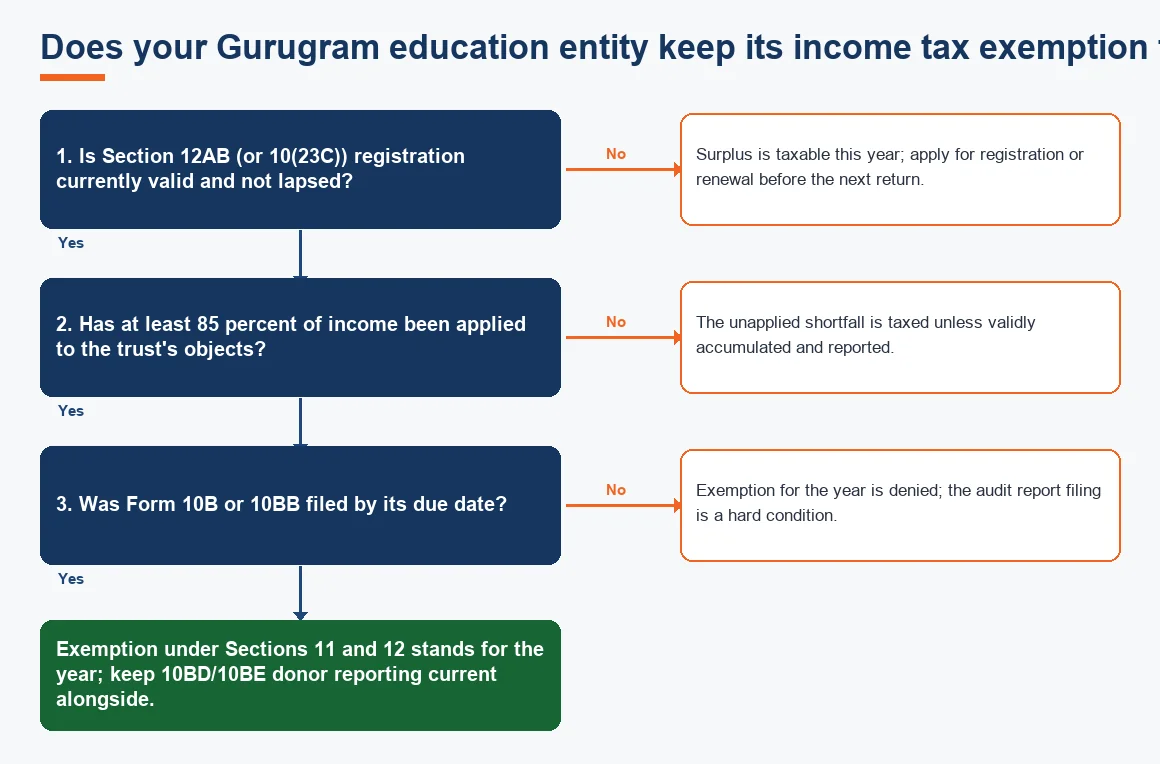
This is where most exemptions quietly lapse. A school trust must hold registration under Section 12AB of the Income Tax Act to claim exemption under Sections 11 and 12. The registration is no longer perpetual: it is granted for five years and must be renewed before it expires. Guidance and the filing forms sit on the Income Tax Department portal. Alongside it, the trust must apply at least 85 percent of its income to its objects each year under the 85 percent income application rule; the shortfall, if any, is taxed unless validly accumulated.
Two filings do the heavy lifting each year:
- Audit report: Form 10B where total income exceeds Rs 5 crore, or Form 10BB below that. Miss it and the exemption for that year is lost, not merely delayed.
- 80G donation reporting: Form 10BD lists the donors, and certificate 10BE is issued to each donor so they can claim their deduction. This is separate from 12AB and is easy to forget in a school's first year of taking donations.
Larger institutions may instead sit under Section 10(23C) rather than the 11 and 12 route; the choice affects which approval and forms apply, so fix it before the first return. For the day-to-day upkeep calendar behind these registrations, our glossary note on 12A and 80G annual upkeep lists the recurring tasks.
TDS on payments to freelance tutors and content creators
EdTech firms and schools both pay individual specialists: subject tutors, exam-question writers, video presenters. Fees to a freelance tutor or content creator are professional services, so TDS is deducted under Section 194J at 10 percent, or 2 percent where the contract is genuinely for technical services rather than professional judgement. No deduction applies until the aggregate paid to that person crosses Rs 50,000 in a financial year. Tax deducted in, say, July is deposited by 7 August and reported quarterly in Form 26Q. Keeping a running tally per vendor is what stops a firm from breaching the Rs 50,000 threshold unnoticed and missing the first deduction.
EdTech deferred revenue and the Ind AS 115 question
An EdTech annual subscription is collected upfront but earned over twelve months, so the accounting mirrors school fees. Revenue is released month by month and the unearned part is a liability. Whether you apply Ind AS 115 or the older AS 9 depends on the company's size and listing status; most privately held Gurugram EdTech firms stay on AS 9 until the Ind AS thresholds bite. If you are unsure which framework applies, the Ind AS Applicability Checker settles it in a minute. Either way, the discipline is the same: recognise across the service period, never on collection.
Worked example: recognising a term's fees and the deferred balance
Take a single student billed Rs 1,20,000 for the academic year in April, taught across twelve months. The fee is recognised at Rs 10,000 a month, and the fees-received-in-advance liability winds down in step. The first quarter looks like this.
| Month | Fee recognised in P&L (Rs) | Cumulative income (Rs) | Fees received in advance, closing (Rs) |
|---|---|---|---|
| April (collect 1,20,000) | 10,000 | 10,000 | 1,10,000 |
| May | 10,000 | 20,000 | 1,00,000 |
| June | 10,000 | 30,000 | 90,000 |
| End of Q1 | 30,000 | 30,000 | 90,000 |
At 30 June the school has banked Rs 1,20,000 but earned only Rs 30,000. The Rs 90,000 sitting in advance is a genuine liability: if the student leaves, most of it is refundable. Reporting the full Rs 1,20,000 as Q1 income would overstate the surplus by Rs 90,000 and distort the 85 percent application test. The same schedule, with GST added on the invoice, works for an EdTech subscription: the GST is paid to the government on the invoice date, while the revenue is still released monthly.
A month-by-month compliance rhythm
Education finance runs on a predictable calendar. Mapping it once and automating the reminders is what keeps a small Gurugram finance team out of penalty territory.
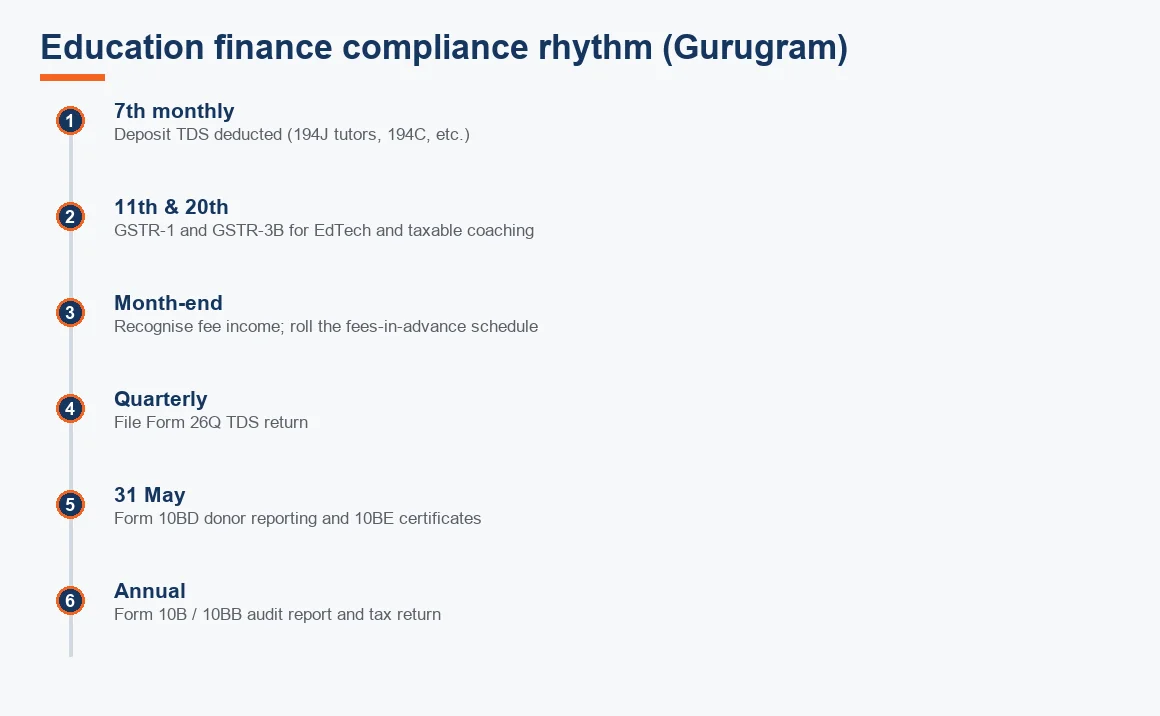
Beyond the monthly cadence, the annual anchors are the tax audit and Form 10B or 10BB by their due dates, the 80G Form 10BD by 31 May for the previous year's donations, and the 12AB renewal in the year it falls due. If you are still deciding who should own this calendar internally versus externally, our guides on choosing an accountant in Gurugram and the virtual CFO checklist for Gurugram startups are a sensible next read, and the 2026 cost guide sets expectations on budget.
Key terms
- Deferred Revenue: fees collected but not yet earned, carried as a liability until the service is delivered.
- Ind AS 115 Revenue Recognition: the standard that ties revenue to performance obligations over the service period.
- Section 12A / 80G Annual Upkeep: the recurring registrations and forms that keep a trust's exemption and donor deductions alive.
- Section 10(23C) Exemption Rules: the alternative income tax exemption route for certain educational institutions.
- 85% Income Application Rule: the requirement to apply at least 85 percent of income to the trust's objects each year.
Key takeaways
- Recognise academic fees and EdTech subscriptions over the service period; the unearned part is a liability, not income.
- School tuition to higher secondary is GST-exempt; coaching and EdTech subscriptions carry 18 percent GST.
- Keep 12AB registration current (five-year renewal) and file Form 10B or 10BB on time, or the year's exemption is lost.
- 80G reporting runs on Form 10BD and certificate 10BE, separate from the 12AB exemption.
- Deduct Section 194J TDS at 10 percent on freelance tutors once annual payments cross Rs 50,000.
The mechanics above are the informational backbone. For a Gurugram-specific engagement covering an international school or EdTech firm end to end, the commercial detail lives on the Accounting Services for Schools & Colleges Gurugram page, with adjacent city options for general accounting in Gurugram and SaaS accounting in Gurugram if your model sits closer to software. Fast-scaling EdTech founders may also want our startup accounting view on burn and runway.
Decision guide