In this guide
For a Delhi school or coaching centre run as a charitable trust or society, 12A and 80G compliance is the annual discipline that keeps two things alive: the exemption on fee surplus under section 12A, and the donor's deduction under section 80G. Neither is granted once and forgotten. Since the 2021 overhaul, both registrations sit on a renewal clock, carry an income application test and require an audit report in a specific form. This explainer sets out how each piece works for an education institution in Delhi, with the numbers worked through. It stays on the how-and-why; if you want the service itself, that sits with Accounting Services for Schools & Colleges and, locally, Accounting Services for Schools & Colleges Delhi.
What 12A and 80G actually mean for a Delhi education institution
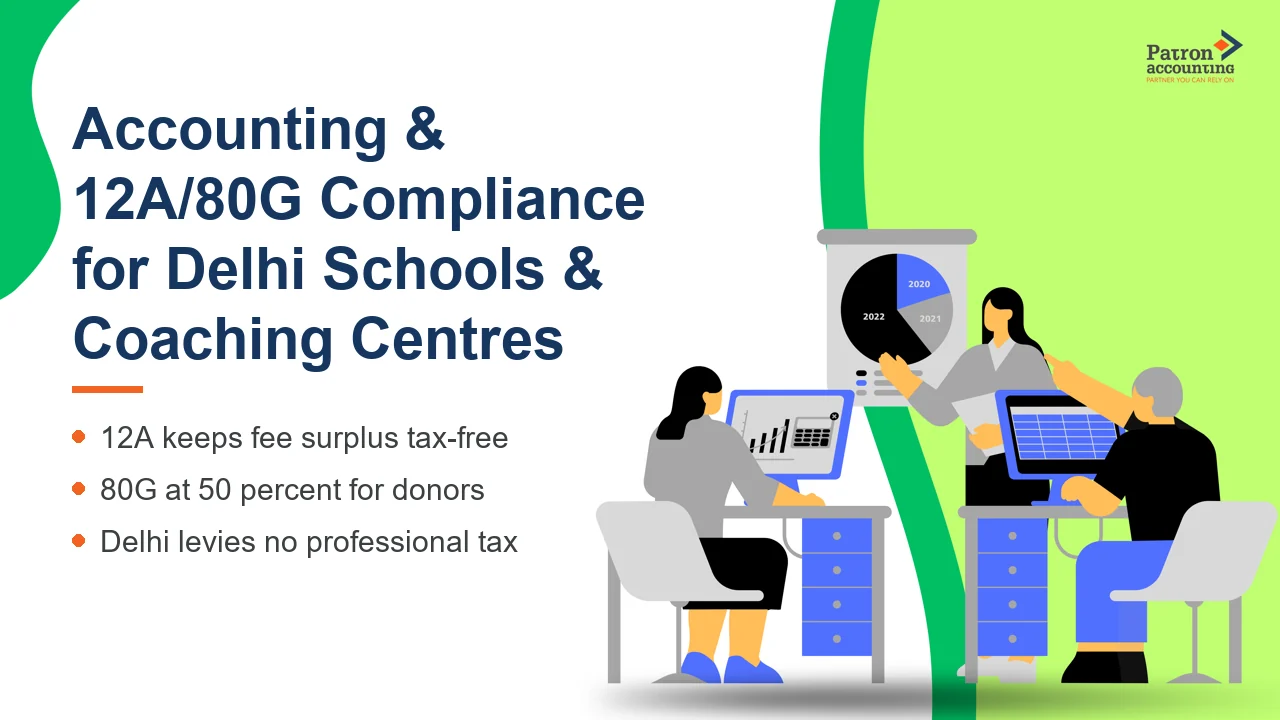
Section 12A (operated through section 12AB registration) exempts a trust, society or section 8 company from income tax on the surplus it applies to its charitable objects, which for a school means education. Without it, the fee surplus is taxed at maximum marginal rate. Section 80G is a separate benefit that sits with the donor: an approved institution can issue receipts that let the giver claim a deduction, usually 50 percent of the sum donated. The two are applied for together but stand on their own feet, and a lapse in one does not automatically drag down the other.
Education institutions have a second route as well. A school wholly or substantially financed by government, or one whose annual receipts stay under the prescribed limit, can claim exemption under section 10(23C) instead of the section 11 route. The choice matters because the compliance forms differ. The Section 10(23C) Exemption Rules are worth reading before you lock in a path, and the underlying books should follow Fund-Based Accounting so that corpus, restricted grants and general funds never get mixed.
Schools versus coaching centres: who actually qualifies
This is the local point that trips people up. A school or college run by a registered non-profit trust or society can hold 12A and 80G. A commercial coaching centre run as a proprietorship, partnership or private company cannot: it is a business, its profit is taxable in the ordinary way, and it charges GST at 18 percent because the exemption for education services does not reach commercial coaching. Many Delhi coaching brands are structured exactly that way, so before assuming a 12A benefit exists, confirm the legal wrapper.
| Feature | Charitable school or college (trust/society) | Commercial coaching centre (business) |
|---|---|---|
| 12A / 80G eligibility | Yes, if registered | No |
| Tax on surplus | Exempt if 85 percent applied | Taxed as business income |
| GST on fees | Exempt (formal education) | 18 percent |
| Governing accounts form | Form 10B or 10BB | Tax audit under 44AB if applicable |
| Donor benefit | 80G receipt possible | None |
Keeping the registration alive: the renewal clock
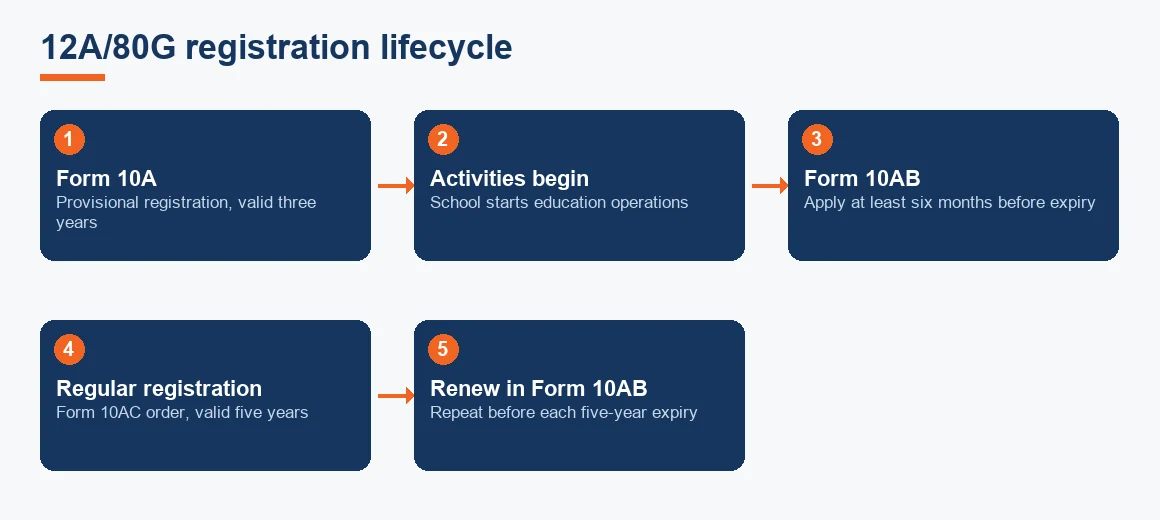
The single biggest change since 2021 is that registration expires. A new institution gets provisional registration for three years by filing Form 10A on the income tax e-filing portal, signed with a trustee's digital signature. Before that runs out, it must convert to regular registration through Form 10AB, filed at least six months before expiry or within six months of the commencement of activities, whichever is earlier. Regular registration then runs for five years and is itself renewed in Form 10AB. The approval each time is issued as an order in Form 10AC with a unique registration number. Miss the window and you apply afresh, and donations received in the gap do not qualify for 80G in the donor's hands. Filing details are published on the Income Tax Department portal.
The 85 percent application rule in plain terms
Exemption under section 11 is conditional. In each financial year the trust must apply at least 85 percent of its income towards its objects in India. Application covers revenue spending (salaries, utilities, academic costs) and capital spending (building a block, buying lab equipment). The remaining 15 percent can be retained without any further paperwork. If the institution cannot spend 85 percent in the year, it has two safety valves: Form 9A, where income was not received or could not be applied for a genuine reason and is treated as applied, and Form 10, where income is accumulated for a specific purpose for up to five years. The 85% Income Application Rule is where most exemption is won or lost, and money parked as a corpus or a tied grant sits outside the ordinary calculation as Restricted Corpus Donations.
Worked example: testing the 85 percent rule for a Delhi school
Take a Delhi school trust with fee income of Rs 6,00,00,000 and voluntary donations (non-corpus) of Rs 20,00,000 in the year. Corpus donations of Rs 15,00,000 are excluded from income. The test is whether it applied at least 85 percent of its Rs 6,20,00,000 income. All figures are indicative.
| Particulars | Amount (Rs) |
|---|---|
| Fee income | 6,00,00,000 |
| Add: voluntary donations (non-corpus) | 20,00,000 |
| Income for section 11 (corpus excluded) | 6,20,00,000 |
| Required application at 85 percent | 5,27,00,000 |
| Permitted accumulation at 15 percent | 93,00,000 |
| Actual application: salaries, academics, admin | 4,10,00,000 |
| Actual application: capital (new classroom block) | 1,30,00,000 |
| Total actual application | 5,40,00,000 |
| Shortfall against 85 percent requirement | Nil (surplus of 13,00,000 over target) |
| Taxable income after exemption | Nil |
Because actual application of Rs 5,40,00,000 exceeds the Rs 5,27,00,000 target, the whole surplus is protected and no tax arises. Note that capital spending counts: the classroom block did most of the work here. Depreciation on that block is not double-counted as application in later years, and a quick way to schedule it is the Depreciation Calculator.
Form 10B or Form 10BB: which audit report
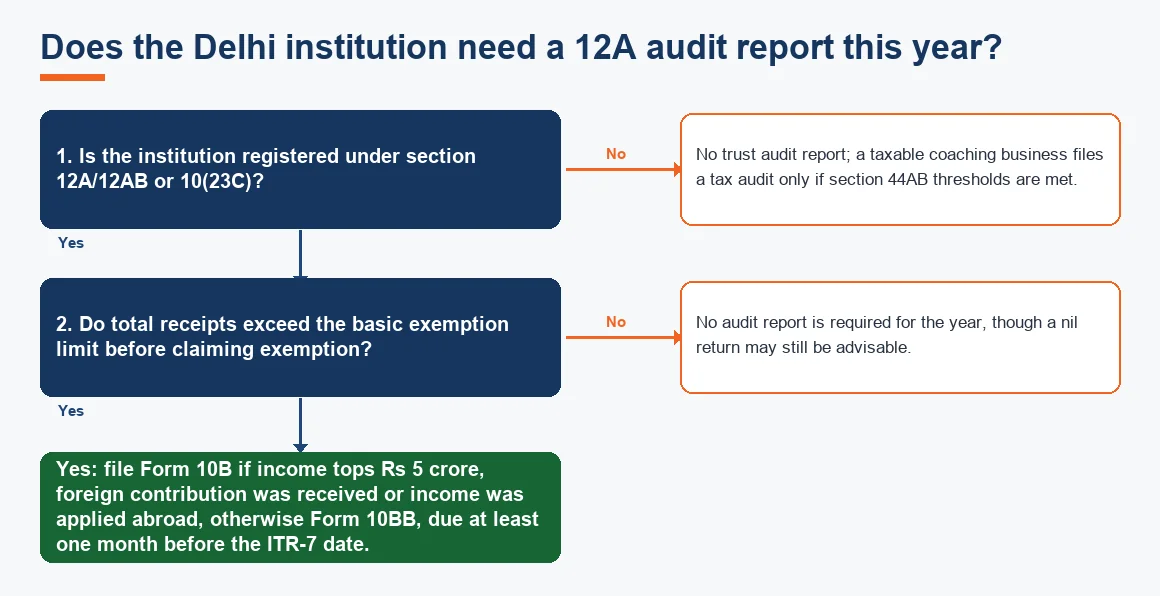
A registered institution must get its accounts audited and file the report before the return. Which form applies is set by Rule 17B. Form 10B is required where total income before exemption exceeds Rs 5 crore, or the institution received any foreign contribution, or it applied any income outside India. Every other case uses Form 10BB. Our example school, with Rs 6 crore of income, files Form 10B. The report is due at least one month before the due date of the return, so for an audit case it lands by 30 September, with the return (ITR-7) following by 31 October. The exact form set is on the e-filing portal.
Foreign donations and the FCRA overlay
A Delhi institution that receives money from abroad needs FCRA registration or prior permission, and all foreign contribution must land in the designated FCRA Designated Bank Account at the specified SBI branch before being moved to a utilisation account. This is separate from 12A and 80G, but it interacts with the audit form: any foreign contribution forces Form 10B. Keep foreign and domestic receipts in visibly separate ledgers so the audit and the annual FCRA return reconcile without a scramble. For the section 8 company route, incorporation and annual filings sit with the Ministry of Corporate Affairs.
The Delhi payroll and local overlay
Delhi is simpler than Maharashtra or Gujarat on one count: it levies no professional tax, so there is no PTEC or PTRC to run. That is the Delhi Nil Professional Tax Regime, and it means the payroll overlay for a school here is TDS on salary under section 192, provident fund at 12 percent of basic wages, ESI where monthly wages are up to Rs 21,000, and the half-yearly labour welfare fund contribution. The employer registration and Shops and Establishment side of this is covered in Delhi Shops & Establishment + GST/TDS Compliance for Employers (No PT), and a broader review of your deductions sits in the GST & TDS Health-Check for Delhi MSMEs.
If the institution also runs taxable activity, say a commercial coaching arm or a hostel let to outsiders, that income is ring-fenced and can be taxed even while the education surplus stays exempt. A coaching start-up structured as a company is really a business from day one and belongs closer to Startup Accounting Services India than to a trust framework. When you compare fee quotes for this local work, the Cost of Accounting Services in Delhi: 2026 Price Guide and the practical guide to choosing an accountant in Delhi are the two to read; general bookkeeping for a Delhi entity is handled through Accounting & Bookkeeping Services in Delhi.
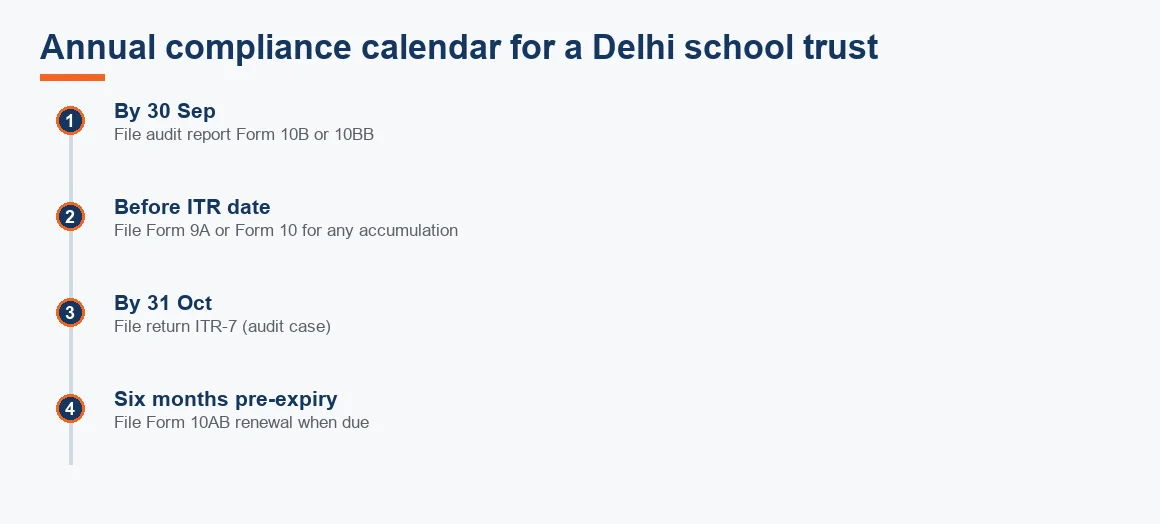
The compliance calendar for the year
Nothing here is hard once it is on a calendar. The audit report goes in first, then the return, with any accumulation election made before the return date. The renewal in Form 10AB is the outlier: it is date-driven off your registration order, not off the financial year, so it needs its own reminder.
Key terms
- Section 12A / 80G Annual Upkeep: the recurring filings and renewals that keep a trust's exemption and donor deduction valid.
- 85% Income Application Rule: the requirement to apply at least 85 percent of income to charitable objects each year.
- Section 10(23C) Exemption Rules: the alternative exemption route for certain educational institutions.
- Restricted Corpus Donations: tied gifts held as corpus that sit outside the ordinary application test.
- Fund-Based Accounting: keeping corpus, restricted and general funds in separate ledgers.
Key takeaways
- 12A protects the fee surplus and 80G benefits the donor; both must be renewed on their own clock.
- Only a genuine non-profit trust, society or section 8 company qualifies; a commercial coaching business does not.
- Apply at least 85 percent of income each year, and use Form 9A or Form 10 to cover a genuine shortfall.
- Cross Rs 5 crore, take foreign money or spend abroad and the audit form is 10B, not 10BB, due one month before the return.
- Delhi has no professional tax, so the local payroll overlay is TDS, PF, ESI and labour welfare fund only.
Decision guide