


Talk to an Expert
Talk to an Expert ✆ +91 945 945 6700
Trusted by 10,000+ Businesses
Delhi, Delhi

Accounting Services for Schools and Colleges in Delhi

Reviewed by CA and CS Team, Patron Accounting LLP ICAI & ICSI Registered| 15+ Years Experience| Last Updated: July 2026 Verify Credentials →

Fees matched to committee approval: Delhi requires a private school fee approved by its fee regulation committee. Your register is mapped to that schedule head by head.

Exemption status that holds: You know each month how much income has been applied to your objects and how much sits set apart in permitted modes.

Donation records donors accept: Your donation register issues the annual statement and donor certificates straight from it. Corpus gifts stay recorded apart from general donations.

Grant money proved used: Each restricted grant carries its own ledger and closing balance. You can answer a funder's question about what its money paid for.

15+ YearsIndustry Experience
CA & CSCertified Experts
4.9
Based on real Google reviews

Get Free Consultation

Talk to a CA/CS expert today

🇮🇳 +91

Our team will get back to you shortly. No spam.

Real Stories from Real People

Verified Google reviews from founders and businesses Patron works with across India.

Sunny Ashpal
Sunny Ashpal
Director - Demandify Media
Google
Anjanay Srivastava
Anjanay Srivastava
Founder - Hunarsource Consulting
Google
Mayur Shewale
Mayur Shewale
Founder - Bijasani Traders
Google
Ascendancy International
Owner
Google

I've had an outstanding experience working with my CA - Patron Accounting. Their professionalism, attention to detail, and timely communication made the entire process seamless and stress-free.

I'm glad that I was able to connect with Patron. They took the minimum time to do the calculations based on the details provided by me and were really helpful throughout the process.

Really a fantastic experience with Patron Accounting especially Shubham, he was extremely great. Knowledgeable person who deserves the 5 star for smooth handling of all documentation.

Patron Accounting gives the best service related to all account handling of our firm. I am blessed and extremely happy that Patron Accounting assigned us a dedicated point of contact.

I have called Patron to file ITR for my 5 family members. I worked with Shubham Junjunwala and Amin Jain. It was a smooth process. They understand basics very well and respond promptly.

From the very beginning, their approach has been highly professional, prompt, and solution-oriented. Every interaction reflected their deep knowledge and commitment to helping clients.

Very proficient and professional staff. Do fantastic job and instant response. Strongly recommended engaging them for all accounting needs specially for startups and growing businesses.

I contacted them to file the ITR. Shubham was the POC for me and he was really very professional and giving prompt responses. Highly recommend them for tax and compliance work.

Join 3,000+ Founders and Businesses on Patron

Rated 4.9 on Google - trusted for startup accounting since 2019.

Talk to an Expert
10,000+Businesses ServedGST compliance and litigation support across India.
15+Years ExperienceDeep expertise in IP registration, GST & business compliance.
50,000+Documents FiledReturns, appeals, and filings handled accurately.
4.9★Client RatingTrusted by entrepreneurs, startups, and growing businesses.
ISO CertifiedProfessional standards and documented processes.
SSL SecureYour financial and business data is fully protected.

What Education Sector Accounting Costs and Covers for Delhi Businesses

📌 TL;DR - Education Accounting Services at a Glance

Accounting services for schools in Delhi hold tuition income, government aid and corpus in separate funds, each restriction tracked to its condition. Payroll compliance narrows to TDS and provident fund, since Delhi charges no professional tax. Patron runs the term-fee cut-off, utilisation statements and the 10B or 10BB audit report for DoE-recognised institutions across South Delhi. Common among education trusts and societies.

Registration under Section 12A is what keeps a Delhi institution's surplus exempt, and it survives only where the accounts show income applied to the objects it was granted for. Application of income is computed each year, corpus donations are posted to the corpus fund rather than to income, and restricted receipts are tracked against the conditions attached to them, so accounting work for schools in Delhi leaves the fund ledgers inspection-ready. The compliance behind 80G approval is separate.

Opening balances go wrong when a fund ledger is carried forward unquestioned, so the first cycle is the heavy one. Corpus is separated from general funds and earlier positions are checked back against what the GST portal shows. School and college accounting in Delhi then settles into a monthly rhythm, until a campus across the state line starts a second set of books.

What Do Education Sector Accounting Mean for Delhi Businesses?

Institutions often treat this as the same job as filing their returns, and it is not. A return takes the year's surplus as already settled. Accounting services for schools in Delhi decide what that surplus actually is, holding tuition, aid and corpus in separate funds and testing each against the condition attached to it. Filing reads the figure. This work produces it.

Because Delhi charges no professional tax, a school's payroll compliance is lighter than a neighbouring state's, and the accounting effort concentrates on the fund ledgers instead. A single trust running one campus inside the capital and another over the state boundary keeps two sets of books, since the two sites are separate persons for tax. Accounting services for schools in Delhi keep each fund, and where relevant each campus, on its own footing. An exempt surplus can then be shown to rest only on income properly applied to the institution's objects.

Key Terms for Education Accounting:

What Is Education Sector Accounting. Unlike ordinary business bookkeeping, which tracks profit for owners, accounting in Delhi

Who Needs Education Sector Accounting in Delhi: From Connaught Place to Growing SMEs

Accounting services for schools in Delhi suit education bodies whose money arrives tied to conditions, from term fees to grants to corpus gifts. A recognised school or a coaching institute near Laxmi Nagar cannot keep its books the way an ordinary company ledger would.

  • Schools billing tuition, transport and hostel fees that each need tracking term by term.
  • Coaching institutes around Laxmi Nagar taking fees in advance before a batch has even run.
  • Colleges funded by grants where the giver later demands a utilisation statement.
  • Trusts and societies holding 12AB registration that must meet the 85% application rule each year.
  • Institutions receiving corpus donations that must stay ring-fenced from general funds.
  • Bodies running FCRA accounts where foreign contributions need books kept wholly separate.
  • Trusts opening a second campus across the state line, needing each ledger reconciled apart.
  • Institutions weighing the true cost of concessions, part of school and college accounting in Delhi.

Education Sector Accounting Included for Delhi Businesses

ServiceWhat We Do
Term-fee deferral and fee ledgerFor institutions around Okhla and Nehru Place, we split tuition, transport and hostel fees by term, recognising fee income in the period actually earned Monthly
Grant utilisation and restricted fund trackingGrant money and earmarked donations are matched to spending, giving accounting services for schools in Delhi a clean statement that each grant was fully used Quarterly
Fund-based bookkeeping for school societiesSeparate fund ledgers keep general, corpus and restricted balances distinct, delivering bookkeeping for schools in Delhi that a Section 12AB body can rely on Monthly
Corpus and donation recordsDonor name, address and PAN are recorded, corpus is kept apart from general donations, and 80G receipts are issued for every eligible gift On event / as needed
Specified person transaction registerDealings with trustees and other specified persons are logged and tested against Section 13, with any excess benefit identified before the assessment stage Half-yearly
Management accounts and audit packMonthly MIS for the school committee and a year-end Form 10B pack, part of the Accounting Services for Schools menu we run nationally Monthly, annually
Our Process

How Education Sector Accounting Works in Delhi — Step by Step

How Patron delivers education accounting for Delhi businesses, step by step.

Step 1

Fee demand to collection reconciliation

The fee software export is reconciled per student and per head: tuition, admission, transport, hostel and examination. That is agreed to what actually reached the bank, leaving a defensible outstanding fee figure. Fee collected for a later academic term is carried forward rather than taken to income.

Illustration for Fee demand to collection reconciliation: The fee software export is reconciled per student and per head: in Delhi
Step 2

Concession and scholarship posting

Approved waivers, concessions and scholarships are posted against the fee demand rather than quietly netted out of collections. Gross fee income and the cost of concessions then both appear, which is what the governing body and the auditor need to see.

Illustration for Concession and scholarship posting: Approved waivers, concessions and scholarships are posted against the in Delhi
Step 3

Corpus and donation classification

Donations are split into corpus and general on the strength of the donor's written direction, not on how they were spent. Donor name, address and PAN are captured at receipt so the annual donation statement and donor certificates can be issued without chasing.

Illustration for Corpus and donation classification: Donations are split into corpus and general on the strength of the in Delhi
Step 4

Application and accumulation tracking

Spending is classified through the year as revenue or capital application towards the objects. The balance is tracked as accumulated or set apart, with the corresponding funds held in the permitted investment modes. This is monitored monthly, not discovered at year end.

Illustration for Application and accumulation tracking: Spending is classified through the year as revenue or capital in Delhi
Step 5

Specified person transaction testing

A standing list of specified persons is maintained from the trust deed and governing body records. Salary, rent, interest and purchases involving them are tested for reasonableness, with the comparable kept on file alongside the approval.

Illustration for Specified person transaction testing: A standing list of specified persons is maintained from the trust in Delhi
Step 6

Restricted fund segregation

Fee collection, general and any foreign contribution accounts are kept strictly apart in the ledger as well as at the bank, with no transfers that mix them. Foreign contribution is received and utilised only through the designated account.

Illustration for Restricted fund segregation: Fee collection, general and any foreign contribution accounts are kept in Delhi
Step 7

Year end audit pack assembly

Receipts and payments, income and expenditure and the balance sheet are prepared in the format the trust audit report expects. The application, accumulation and specified-person schedules are attached, so the auditor certifies from a complete file.

Illustration for Year end audit pack assembly: Receipts and payments, income and expenditure and the balance sheet are in Delhi

Documents Required for Education Sector Accounting

Delhi charges no profession tax at all, so its additions are the Shops and Establishments registration and the half-yearly welfare fund statement.

  • Fee collection register / fee software export by student, term and fee head (tuition, admission, transport, hostel, exam)
  • Fee concession, scholarship and waiver approvals
  • Trust deed or society memorandum and rules, with the current 12AB registration order and 80G approval order
  • Donation register with donor name, address and PAN, separating corpus from general donations
  • Record of application of income, amounts accumulated or set apart, and investments held in Section 11(5) modes
  • Bank statements for every account, including separate fee-collection and FCRA accounts if held
  • Payroll records for teaching and non-teaching staff, with PF and ESI challans
  • Registration certificate under the Delhi Shops and Establishments Act, 1954
  • Delhi Labour Welfare Fund Form A statement and half-yearly contribution challan (six months ending 30 June and 31 December)
Client Portal

How You Work With Patron

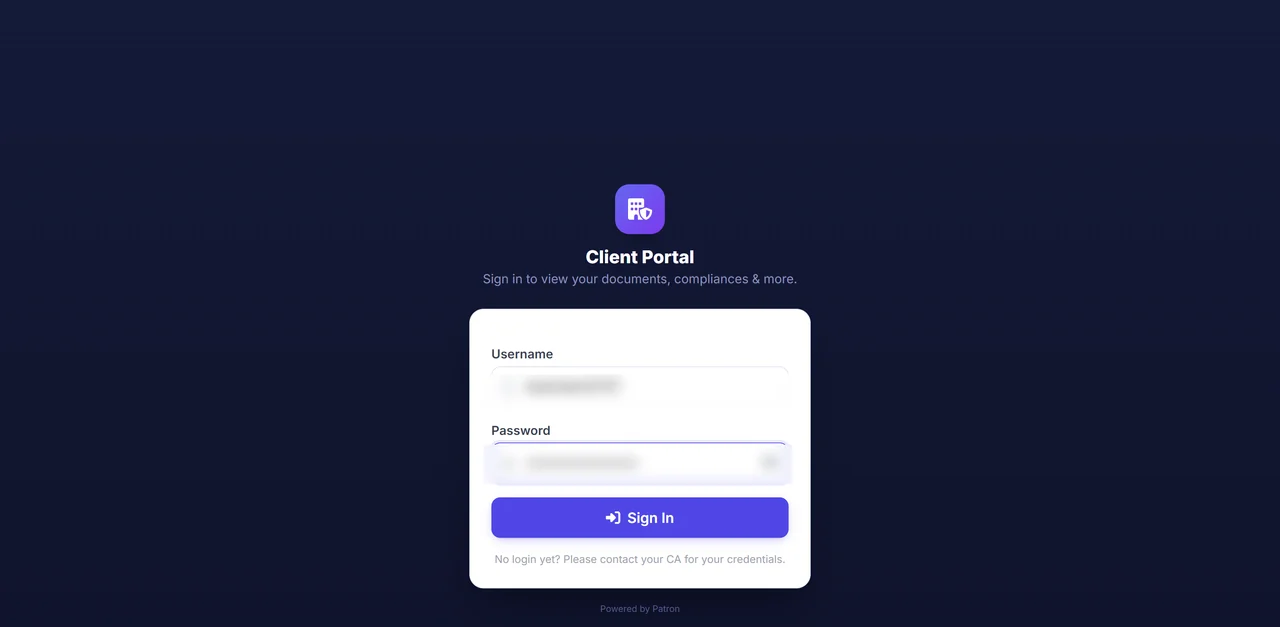
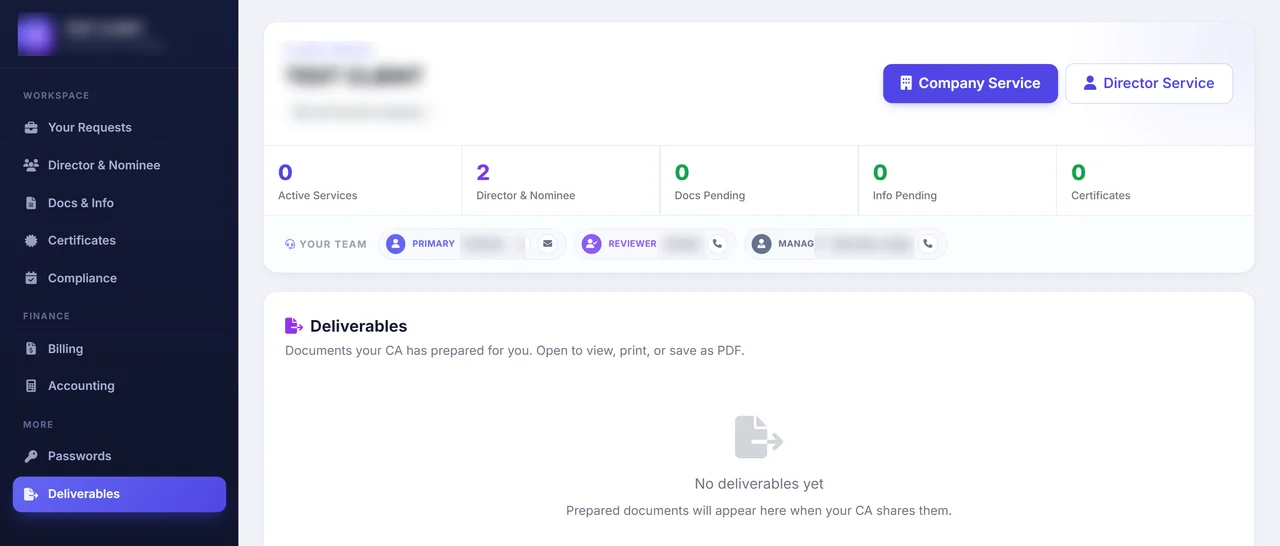
Everything happens in one secure login. You can see your active services, the Patron team on your account, and anything still pending. Once you raise a request, it moves through the same clear steps every time, so you always know exactly where your work stands.

Secure client portal login screen
1

Sign in securely

Your books, documents and requests all sit behind one private, password protected login. The team handling your account is shown on screen, so nothing sensitive ever needs to travel over email or WhatsApp.

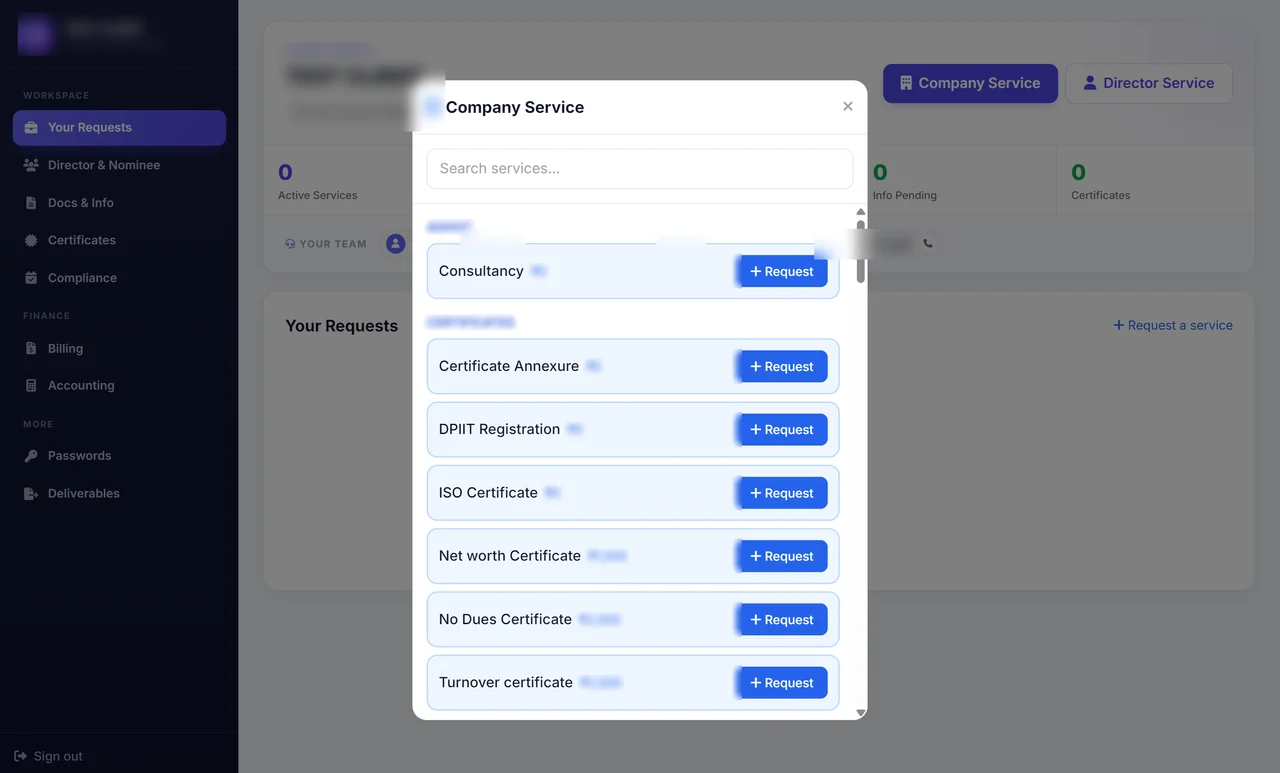
Service catalogue inside the client portal
2

Raise your request

Choose the service you need from the menu inside the portal, where the price is shown before you go ahead. Your request is logged the moment you send it, with no phone calls or reminder emails to wait on.

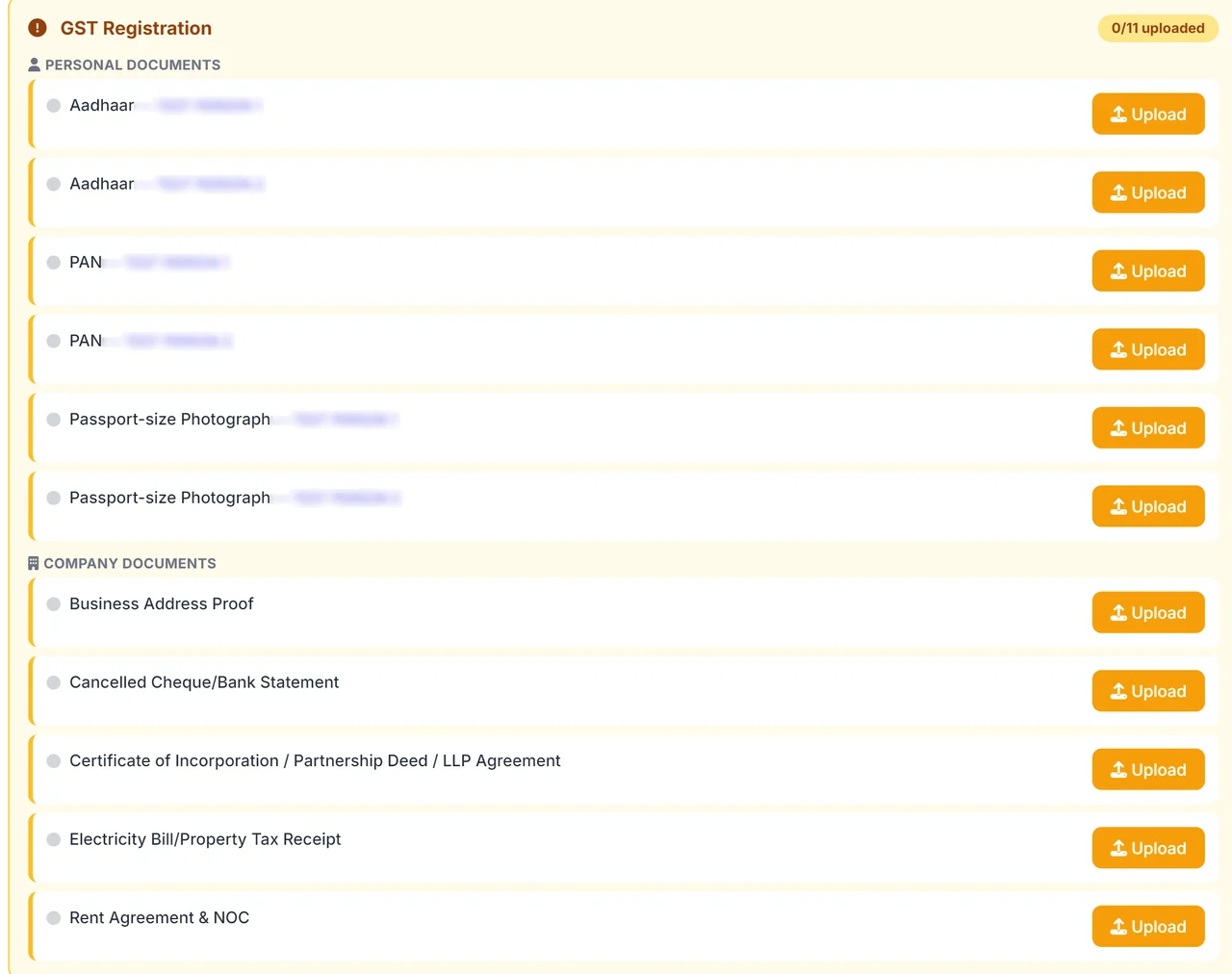
GST registration document checklist in the client portal, with an upload button beside each item
3

Share what the service asks for

For every service, the portal lists the exact documents it needs, each with its own upload button. The example shown here is the GST registration checklist. When a service needs nothing from you, it simply asks for nothing.

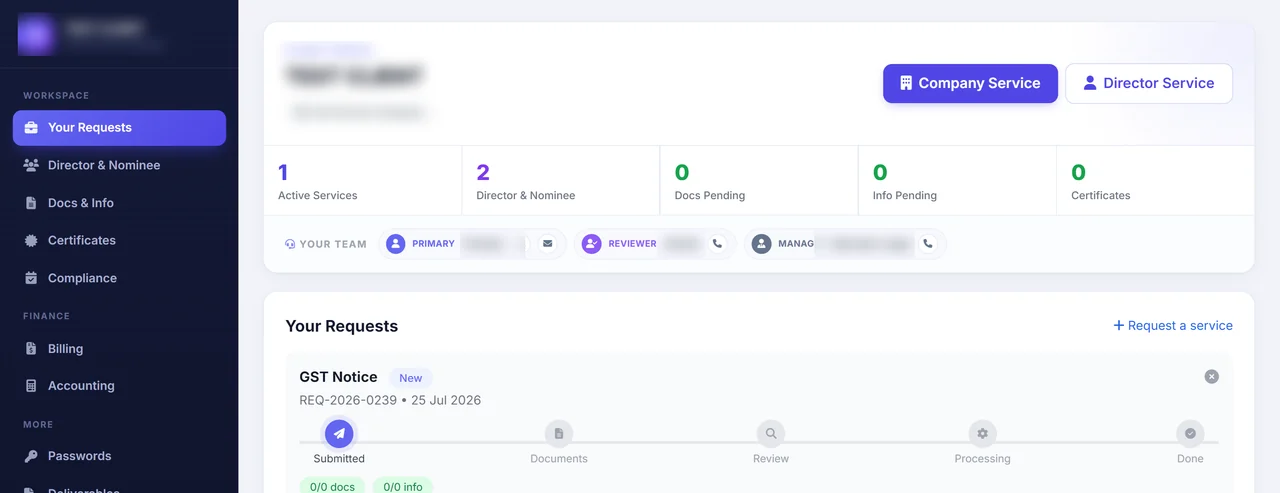
Live request tracker inside the client portal
4

We review, prepare and file

Once your documents are in, your team checks them, prepares the work and files it for you. A live tracker shows each stage as it happens, from review to processing to done, so you never have to ask where things stand.

Deliverables area of the client portal
5

Collect your finished work

Every completed return, computation and certificate is placed in your Deliverables area. You can open, print or download any of them as a PDF whenever you need a copy.

Education Sector Accounting Challenges Specific to Delhi: MCD Trade Licensing and NCR Inter-State GST Reconciliation

ChallengeImpactHow Patron Accounting Solves It
Scholarships and fee concessions netted straight off fee incomeGross fee revenue and the cost of concessions both vanish, hiding the true discount rateOur team records gross fees and books concessions as a separate contra, so the concession burden shows each term.
Hostel, mess and transport run as one blur with tuitionLoss-making auxiliary services hide inside fee surplus, and segment results stay unknownPatron accounts hostel, mess and transport as separate segments, so each auxiliary service shows its own result.
Assets bought from a specific grant not tagged to that fundGrant restrictions cannot be evidenced, risking the funding and the sanction conditionsOur team tags grant-funded assets to their fund, so capital reconciles to each sanction and its restriction; see 12A and 80G compliance for schools.
MCD trade licence and local charges paid but recorded against nothingLicence lapses go unnoticed and prepaid civic charges misstate the period's expensePatron maintains an MCD licence and local-charge register, apportioning renewals across the period they cover.
Inter-state vendor purchases across the NCR booked to wrong GST headsInput credit mismatches GSTR-2B, and the NCR reconciliation carries unresolved differencesWe reconcile inter-state purchase credits to GSTR-2B, so the NCR supply and credit position ties each month.

Education Sector Accounting Fees in Delhi

Fee ComponentAmount
Starter — a single institution with standard fee and grant headsINR 4,499
Excl. GST & Government Charges
Growth — more fee heads, fund accounting and added campusesOn quote
Managed — multi-campus books with custom fund and grant reportingOn quote

A standalone institution, tracking fee heads and basic fund accounting, sits at the entry price of INR 4,499. It moves up as you add campuses, more fee heads or restricted-grant tracking. In Delhi the rate matches the national one, set by scope; Delhi levies no profession tax, so only add-ons like Shops Act registration bill separately. Schedule a pricing consultation on +91 94594 56700.

Fees exclude GST and government charges. Final quote confirmed after a scoping review.

All fees and charges listed are indicative only and do not constitute a binding offer. Final amounts may vary depending on the volume of work and the complexity involved.

Professional accounting and compliance charges are scoped to your number of entities, funding stage and monthly transaction volume, and are separate from statutory and government charges. Contact us for a detailed, fixed quote.

Get a free Education Accounting consultation - Call +91 945 945 6700 or WhatsApp us. No-obligation assessment.

Education Sector Accounting Compliance Calendar 2026 for Delhi Businesses

ComplianceDue DateApplies To
TDS / TCS deposit (Challan ITNS-281)7th of every month (30 April for March)Every business that deducts tax at source on salaries, rent, contractor or professional fees
Provident Fund (ECR) and ESI contribution15th of every monthEmployers registered under EPF and ESI
GSTR-3B (summary return and tax payment)20th monthly for turnover above Rs 5 crore; 24th quarterly under QRMP for turnover up to Rs 5 crore (Category Y)GST-registered businesses in Delhi
80G / 12A renewal and Form 10BD statement of donations31 May 2026Trusts issuing 80G receipts to donors
Advance tax second instalment (45% cumulative)15 September 2026Companies, firms and individuals liable to advance tax
Trust audit report (Form 10B / 10BB)30 September 2026Charitable trusts and institutions registered under 12A/12AB
Trust income-tax return (ITR-7)31 October 2026Registered trusts, societies and Section 8 companies
Annual GST return GSTR-9 and reconciliation GSTR-9C31 December 2026GST-registered Delhi businesses above the annual-return and audit thresholds

For a Delhi institution the year turns on the Form 10B audit by 30 September, with GSTR-3B on the 24th. Each fee cycle needs a clean revenue cut-off at close. Delhi levies no professional tax, so the local rhythm stays GST and TDS led. For accounting services for schools in Delhi, Patron keeps every date on schedule; book a review on +91 94594 56700 or see our local notes.

Key Benefits

Why Professional Education Sector Accounting Matters

Fees matched to committee approval

Delhi requires a private school fee approved by its fee regulation committee. Your register is mapped to that schedule head by head.

  • Fee register mapped to the committee-approved schedule
  • Unapproved-head collection kept as refundable
  • Without it, the books count refundable amounts as income

Exemption status that holds

You know each month how much income has been applied to your objects and how much sits set apart in permitted modes.

  • Income applied to objects tracked month by month
  • Accumulation held in Section 11(5) permitted modes
  • Without it, a shortfall surfaces after year-end with no room to correct

Donation records donors accept

Your donation register issues the annual statement and donor certificates straight from it. Corpus gifts stay recorded apart from general donations.

  • Register carries donor name, address and PAN
  • Corpus gifts classified apart from general donations
  • Without PAN or written direction, donors chased months later

Grant money proved used

Each restricted grant carries its own ledger and closing balance. You can answer a funder's question about what its money paid for.

  • Each restricted grant on its own ledger and balance
  • Separate fee-collection and FCRA bank accounts supporting it
  • Without separation, purpose reconstructed from bank narrations

Specified person dealings tested

We test salary, rent, interest and purchases involving trustees and their relatives against a comparable, and keep the approval alongside.

  • Trustee dealings tested against a comparable, approval kept
  • Register of specified persons under Section 13(3)
  • Without the file, a routine trustee payment can be disputed as a benefit

True cost of concessions

You see waivers and scholarships as a cost in their own right, not as lower collections. Your governing body reads gross fee income separately.

  • Concessions, scholarships and waivers posted as a cost
  • Fee income shown gross, not netted off
  • Without it, rising concessions read as a fee shortfall

Why Accounting Services for Schools & Colleges Clients in Delhi Choose Patron Accounting

Five things a founder can check before handing over the books. Each is a claim with the proof behind it.

Fund-based books keep fees, grants and corpus apart

We run fund-based accounting so tuition fees, government grants and corpus donations sit in separate funds, never pooled. That discipline comes from 15+ years handling institutional books.

12A/80G status protected and Form 10B filed on time

Whether an institution runs on 10(23C) or 12A, we protect the exemption and file Form 10B by the due date, part of 25,000+ filings completed.

Fee-management software reconciled to the ledger, term by term

We set up the software your finance team already runs, whether Zoho Books, Xero, Tally Prime or Odoo, reconciling your fee-management software to the ledger each term.

Term-wise fee statements plus employer compliance

Each term we deliver fee deferral and utilisation statements reconciled to the ledger, and track Delhi Shops and Establishment dues for staff, part of 25,000+ filings completed.

A Delhi team close to your campus

From Nehru Place to Karol Bagh, our Delhi team handles MCD licensing and inter-state place-of-supply for schools and colleges, grounded in 15+ years across 3,000+ businesses served since 2019.

Figures reflect Patron Accounting LLP engagements since 2019. Scope and turnaround are confirmed in your engagement letter.

Trust Accounting vs Company Accounting for Institutions: for Delhi Businesses

CriterionTrust AccountingCompany Accounting for Institutions
Nature of the methodFund-based bookkeeping for a school registered as a society or public charitable trust.Corporate accrual accounting under Schedule III when the institution is a registered company.
Who it suitsSuits Okhla and Nehru Place societies claiming Section 10(23C) or 12A exemption.Suits campuses set up as companies; regular books become compulsory beyond the presumptive turnover limit.
Handling fees and donationsTuition, donations and grants split into corpus, restricted and unrestricted funds.Fees booked as accrued revenue; donations rare and grants deferred against matched costs.
Tax positionExemption hinges on applying 85% of income yearly; retained surplus risks tax.Net surplus taxed as company profit, with no charitable application requirement.
Cross-border GST viewInter-state NCR vendor GST still needs clean input records even under exemption.Company books capture inter-state NCR GST and vendor reconciliation more systematically.
Audit and reporting trailSociety files Form 10B or 10BB; specified-person payments draw close scrutiny.Companies Act statutory audit and MCA filing give lenders a familiar format.
VerdictMost Okhla and Nehru Place institutions in Delhi run as societies, so fund-based accounting is the lawful fit; companies keep corporate books. Sound accounting services for schools in delhi follow registered status. See Accounting Services for Schools & Colleges.

Delhi Rules for Schools and Colleges — Delhi's Nil Professional Tax, Section 12A/80G

A Delhi school runs its teaching payroll without any profession-tax deduction, since the capital does not levy the tax, which sets it apart from a Mumbai institution at once. Where the school is a registered trust, that lighter payroll sits over an income that is largely exempt.

On top of that lighter payroll sits the exemption framework. Income applied to the school's objects stays exempt, core education carries no GST, and Fund-Based Accounting pins each grant to its stated use. Accounting services for schools in Delhi answer to the provisions below.

  • No profession tax in DelhiTeaching and administrative salaries carry no profession-tax deduction, unlike in Maharashtra or Gujarat.
  • Sections 12A/12AB, Income-tax Act 1961Has an exempt surplus as long as income is applied to its purposes, re-registering under 12AB at intervals.
  • Notification 12/2017-Central Tax (Rate), entry 66Education up to higher secondary carries no GST, but ancillary services can still attract it.
  • Delhi Shops and Establishments Act 1954The establishment registers under the Delhi Shops Act, framing the employment records behind the payroll.
  • Rule 3(1), Companies (Accounts) Rules 2014The audit trail stays enabled, so a fee reversal is logged. Full 12A and 80G detail sits on the parent education page.

Official sources: Ministry of Corporate Affairs · Income Tax Department · GST Portal · Startup India (DPIIT)

Does a Delhi school deduct professional tax from teacher salaries?

No. Delhi levies no professional tax at all, so nothing is deducted on that head from teaching or administrative staff. Your salary statutory heads are TDS under Section 192, EPF and ESI only. If your society also runs a campus in Maharashtra or Gujarat, professional tax applies there, so we keep payroll registers state-wise instead of applying one rule to every branch.

When must a Delhi school or college running under Section 12A file Form 10B?

Form 10B must be filed at least one month before the income tax return due date, so for most Delhi institutions the audit report is uploaded by 30 September. Miss it and the exemption for that year is exposed, with fee income assessed as ordinary receipts. We close the fee ledger and grant utilisation statements by August so the auditor is not working blind.

Is a Delhi school liable to GST on fees, hostel and transport?

Tuition charged by an educational institution up to higher secondary is exempt from GST, and transport, catering and hostel supplied to its own students are exempt as well. Coaching and skill programmes are taxable at 18%. We split exempt and taxable streams in the ledger from day one, because a Delhi institute running both loses input credit when the split is not documented.

Do the accounts of a Nehru Place coaching institute differ from those of a CBSE school in Delhi?

Completely. A Nehru Place coaching institute is a taxable commercial supplier, so batch fees carry 18% GST, GSTR-3B falls due on the 24th for QRMP filers up to Rs 5 crore turnover, and no Section 12A shelter applies. A recognised school instead runs exempt fee income and a Form 10B audit. The two need separate charts of accounts, not one adapted template.

Does a Delhi institute need an MCD trade licence, and does it affect the accounts?

A coaching or tutorial establishment operating in Delhi generally requires an MCD trade licence, and the annual renewal fee sits in your compliance expense schedule with the licence copy in the statutory file. Assessors reviewing a Connaught Place or Okhla premises ask for it early. We date the renewal in your compliance calendar so a lapsed licence never becomes the reason a file is queried.

How do you recognise an annual fee that a Delhi school collects in one instalment?

Session fee collected in April is deferred and recognised month by month across the academic year, so April books do not carry twelve months of income. Development fund, admission fee and refundable security are posted to separate heads, because only the revenue portion is income at all. That deferral is what makes a Delhi school's monthly MIS usable for budgeting staff costs.

How do you track corpus donations and government grants for a Delhi institution?

Corpus donations are recorded against a designated corpus fund and never mixed with general fee income, because a corpus receipt carrying written donor direction is excluded under Section 11(1)(d). Grants are tracked head-wise against utilisation, with unspent balances carried forward. We issue a utilisation statement per grant, so a department inspection and the Form 10B audit read from identical numbers.

What happens if a Delhi education trust does not apply 85% of its income in the year?

Income applied below 85% becomes taxable unless you exercise the accumulation option, which means filing Form 9A or Form 10 before the return due date. We monitor the application percentage from the third quarter rather than in September, so a Delhi trust holding unspent fee income still has time to release capital expenditure or file the option deliberately instead of in a rush.

What does accounting for a school or college in Delhi cost?

Fees are quoted on student count, number of campuses and whether Form 10B audit support and grant reporting are in scope, not as one package rate. A single-campus Delhi coaching institute costs a fraction of a college with hostel, transport and three grant streams. We price after reading one term's fee register and last year's audited accounts. Quotes exclude GST and government charges.

Are visits to an Okhla or Connaught Place campus arranged, and how do records get shared?

Bookkeeping runs remotely, with visits to your Okhla, Naraina or Connaught Place campus arranged when fee counters, cash collection or an auditor walkthrough need someone on the premises. We hold no Delhi office. Fee registers, bank statements and grant files move through a secured shared folder, and we take over from your existing accountant with a written opening-balance handover.

Quick Answers

Registration under Section 12A is what keeps a Delhi institution's surplus exempt, and it survives only where the accounts show income applied to the objects it was granted for. Application of income is computed each year, corpus donations are posted to the corpus fund rather than to income, and restricted receipts.

Education Accounting Deadlines in Delhi You Cannot Afford to Miss

TDS / TCS deposit (Challan ITNS-281) is due 7th of every month (30 April for March). Provident Fund (ECR) and ESI contribution is due 15th of every month. GSTR-3B (summary return and tax payment) is due 20th monthly for turnover above Rs 5 crore; 24th quarterly under QRMP for turnover up to Rs 5 crore (Category Y). Patron tracks each against your books so nothing is reconstructed after the fact. Call +91 94594 56700 to set up a filing-reminder schedule.

Start Your Education Sector Accounting in Delhi with Patron Accounting

The monthly cycle gains a fixed date. Counter collections tie back to the bank by a set day, refunds and cheque returns are cleared in the same pass, and a short fund statement follows in the same week. Accounting services for schools in Delhi replace a term-driven scramble with twelve ordinary closes.

Audit queries stop landing on the school office. When the auditor asks which fund bore a repair bill, or what a transfer between two fund accounts represented, the answer comes from working papers rather than a clerk searching old vouchers. Bookkeeping for schools in Delhi closes the query in the same week.

Whether the institution is aided or unaided decides a great deal, as does how many bank accounts hold restricted money and who signs on each. Our work across educational institutions shows that three accounts and one register need a different starting point.

Book a Free Consultation - No Obligation.

Education Accounting Across Key Cities

Your city is highlighted below — we run the same on-ground service across these cities too.

Reviewed by the CA & CS Team, Patron Accounting LLP
ICAI & ICSI registered  ·  15+ years in Indian accounting & compliance  ·  Last reviewed 23 July 2026  ·  Next review 23 October 2026