In this guide
To reduce DSO (Days Sales Outstanding) you shorten the gap between raising an invoice and banking the money, and you do it with five repeatable levers: tighter credit screening at the order stage, invoicing on the day of dispatch, an early-payment discount, a fixed reminder cadence and weekly action on the ageing report. DSO is simply the average number of days your credit sales sit as unpaid receivables, so every day you knock off returns cash you have already earned. This article explains how to calculate the number properly, what a good figure looks like for an Indian SME, and the levers that actually move it. Commercial help with the collections function itself sits with our Accounts Receivable Outsourcing team; here we stay on the how-to.
How is DSO calculated?
The DSO formula is straightforward. Take your closing trade receivables, divide by credit sales for the period, and multiply by the number of days in that period.
DSO = (Closing trade receivables ÷ Credit sales for the period) × Days in the period
Two points decide whether the number is honest. First, use sales excluding GST on both sides, because your receivables ledger carries the tax-inclusive balance while your sales figure in the profit and loss statement is net; mixing the two inflates the result. Second, only count credit sales. Cash and advance-paid sales never become receivables, so including them understates how slowly your credit book actually turns. If your business is seasonal, calculate DSO on a rolling basis rather than picking a single quiet or peak month, which can swing the number by weeks.
What is a good DSO ratio?
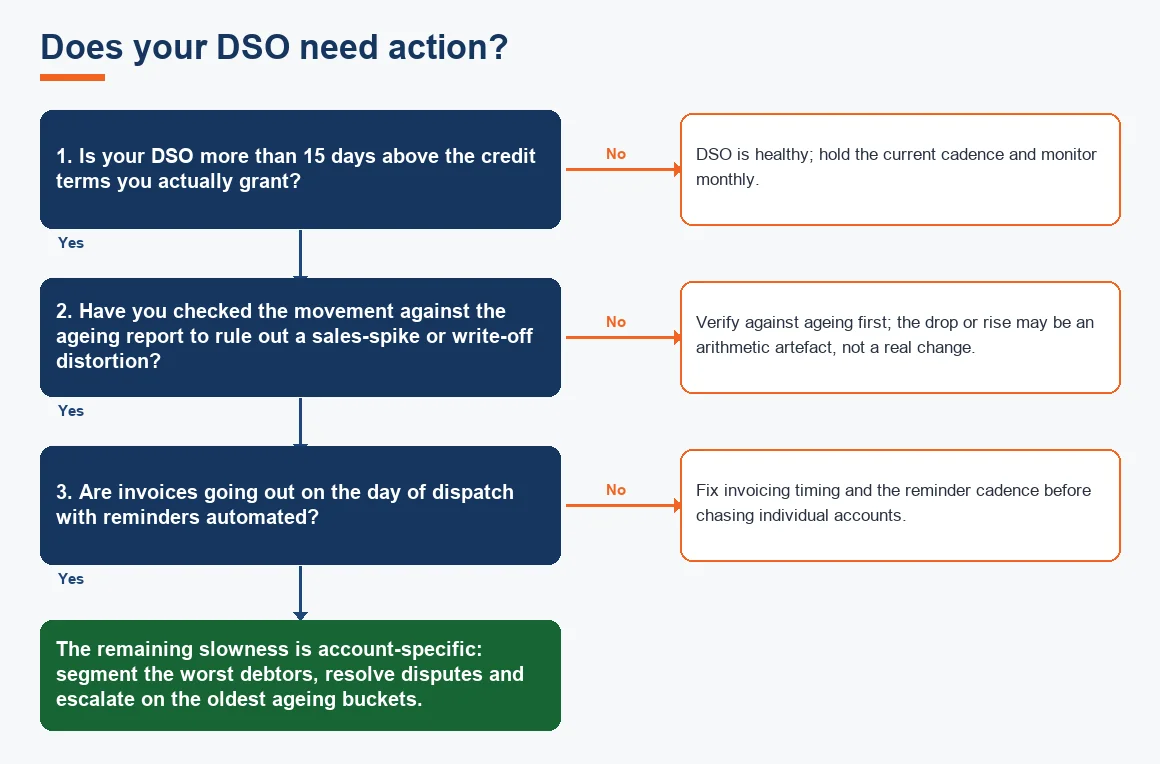
There is no universal target; the honest benchmark is your own credit terms. A DSO within about 15 days of the terms you actually grant is healthy. A business selling on 45-day terms should therefore expect a DSO of roughly 50 to 60 days once normal processing and postal float are allowed for. Once DSO drifts beyond twice your stated terms, the cause is rarely the customer alone; it is usually weak follow-up, invoices raised late, or disputes nobody has resolved. The table below gives a working read on where a figure sits.
| DSO relative to your credit terms | What it usually means | Action |
|---|---|---|
| At or below terms | Collections are disciplined; possibly terms are tighter than the market | Hold; check you are not losing sales to easier-credit rivals |
| Up to 15 days above terms | Normal processing and float; healthy for most SMEs | Maintain the reminder cadence |
| 15 to 30 days above terms | Follow-up is slipping or a few large accounts are slow | Work the ageing report; segment the worst accounts |
| More than twice the terms | Process failure: late invoicing, unresolved disputes, no dunning | Fix the process, not just the chasing |
One statutory floor overrides all of this. Under the MSMED Act, a buyer must pay a registered micro or small supplier within 45 days of acceptance (15 days where no term is agreed), and Section 43B(h) of the Income Tax Act now disallows the buyer's deduction until the sum is actually paid. If your customers are corporates buying from you as a registered small enterprise, that clock works in your favour.
What causes a high DSO?
A high DSO is almost always a stack of small process gaps rather than one bad debtor. The common causes are invoices raised days after dispatch, terms granted without any credit check, missing purchase order numbers that let the buyer's payables team park the bill, disputed quantities or rates that sit unresolved, and no structured reminders. Concentration adds risk: if three customers make up half your book, their slowness sets your whole DSO. A sudden increase in DSO usually points to one large account going quiet or a batch of invoices stuck in dispute, both of which the AR ageing report will expose in minutes.
How to reduce DSO: five levers that work
These are the levers, in the order they usually pay off. Applied together they compound, and none of them requires new software you do not already have.
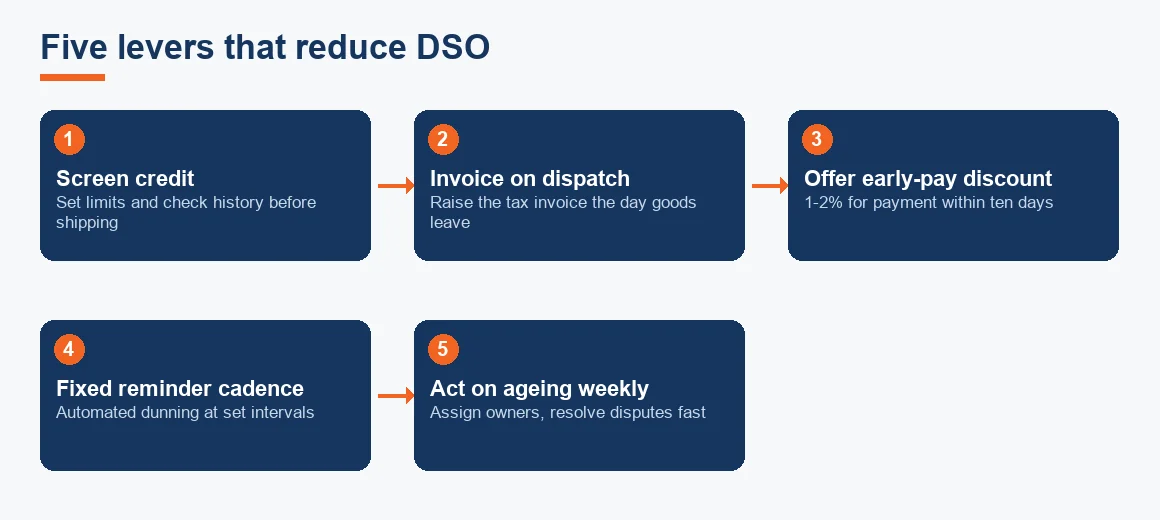
- Screen credit at the order stage. The cheapest day to fix a slow payer is before you ship. Set a simple limit per customer, check it against their payment history, and hold new orders where an account is already overdue. This is the receivables side of the 5 C's of credit.
- Invoice on the day of dispatch. Every day between delivery and invoice is a day added directly to DSO, and it is free to remove. Raise the tax invoice the moment goods leave or the service milestone is signed off, with the correct purchase order number quoted so the buyer's payables team cannot park it.
- Offer a modest early-payment discount. A 1 to 2 per cent discount for payment within ten days often pulls forward weeks of collection. Compare the cost against your working-capital funding rate before committing; if an overdraft costs you 11 to 12 per cent a year, a well-priced discount is usually cheaper than the interest saved.
- Run a fixed reminder cadence. Automated, polite reminders at set intervals collect more than sporadic phone calls. A structured collections cadence using dunning letters keeps the pressure consistent without souring the relationship.
- Act on the ageing report weekly. Sort by the oldest bucket, assign each overdue account an owner, and resolve disputes fast. Reconciled bank data makes this reliable, which is where bank and credit card reconciliation earns its keep by confirming exactly what has and has not landed.
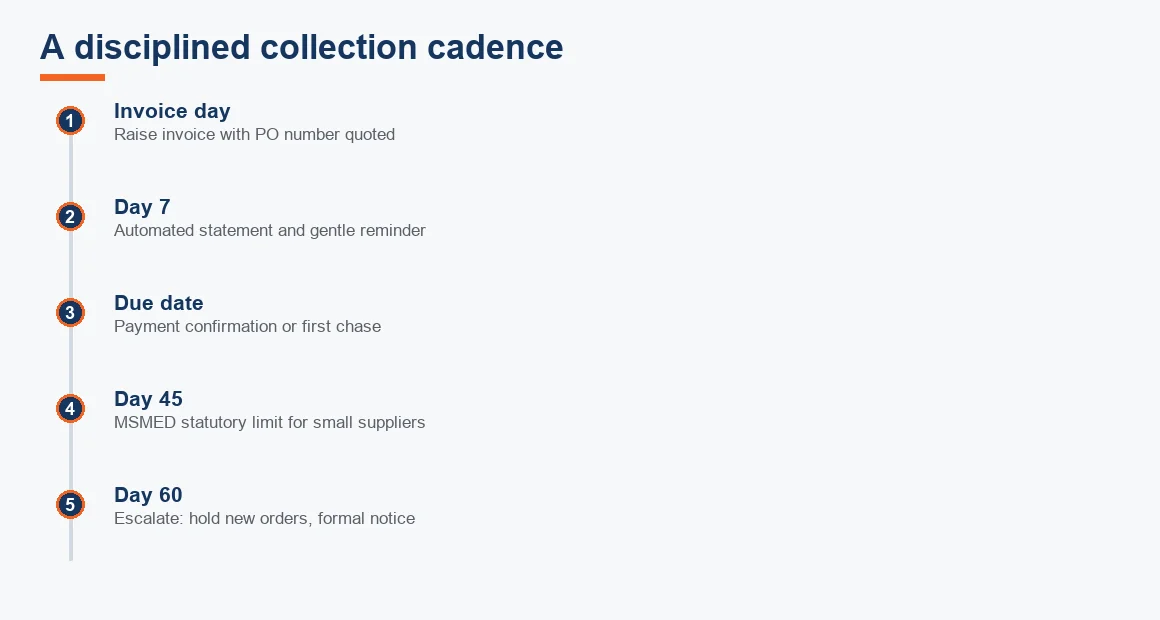
Two supporting moves help. A clean, current ledger is the foundation, so if your books are behind, a backlog bookkeeping catch-up comes first. And because collections and supplier payments are two ends of the same working-capital pipe, aligning them through accounts payable outsourcing and tracking both in your MIS reporting stops you from paying suppliers faster than customers pay you.
Worked example: the cash a lower DSO releases
Assume a distributor with annual credit sales of Rs 12 crore (net of GST) and a current DSO of 75 days, targeting 60 days. The receivables tied up at each level, and the cash released, work out as below.
| Line | Working | Amount |
|---|---|---|
| Annual credit sales (excl GST) | Given | Rs 12,00,00,000 |
| Sales per day | 12,00,00,000 ÷ 365 | Rs 3,28,767 |
| Receivables at 75 days DSO | 3,28,767 × 75 | Rs 2,46,57,534 |
| Receivables at 60 days DSO | 3,28,767 × 60 | Rs 1,97,26,027 |
| Working capital released | 2,46,57,534 − 1,97,26,027 | Rs 49,31,507 |
| Annual interest saved (indicative, at 11%) | 49,31,507 × 11% | Rs 5,42,466 |
Cutting DSO by 15 days frees roughly Rs 49 lakh of cash, close to a month of purchases funded without touching the overdraft, and saves around Rs 5.4 lakh a year in interest at an indicative 11 per cent (Exl GST on any financing charges). That is the whole case for the exercise: the money is already yours, DSO just measures how long you let others hold it.
Why GST makes a high DSO expensive
GST is payable by reference to the time of supply, which is driven by the invoice date, not the date the customer pays. Tax of Rs 1.8 lakh on a Rs 10 lakh invoice therefore leaves your bank in the next GSTR-3B even if nothing has been collected. A high DSO means you are funding the exchequer out of your own working capital while you wait, and where your buyer is a small enterprise, the Section 43B(h) MSME clock adds a matching pressure at the buyer's end to pay you within 45 days. The two rules together make slow collection a real cash cost, not just a ratio on a dashboard. For the underlying provisions, see the CBIC GST portal on time of supply and the Income Tax Department on Section 43B(h).
What does a low DSO mean?
A low DSO means cash returns quickly, so the same level of sales needs less working capital and less borrowing. It usually reflects disciplined credit screening and prompt collection. But read it in context: an unusually low DSO can mean your terms are tighter than the market and you may be losing sales to competitors offering easier credit, or it can be the arithmetic artefact of a sales spike or a write-off described earlier. A healthy low DSO shows the oldest ageing buckets close to empty; an unhealthy one hides slow accounts behind a flattering average. For the full mechanics of how a sale becomes cash, our explainer on accounts receivable and the order-to-cash cycle sets out each stage.
Key terms
- Days Sales Outstanding (DSO): the average number of days credit sales remain unpaid.
- Accounts Receivable Aging Schedule: receivables sorted by how overdue they are, the tool behind every collection decision.
- Working Capital: current assets less current liabilities, the pool a lower DSO frees up.
- Dunning Letters: the structured series of payment reminders sent as an invoice ages.
- Section 43B(h) MSME Clock: the income-tax rule tying a buyer's deduction to actual payment of a small supplier within 45 days.
Key takeaways
- DSO = closing trade receivables ÷ credit sales × days in the period, always net of GST and on credit sales only.
- Benchmark against your own terms: within 15 days is healthy, beyond twice the terms signals a process failure.
- The five levers are credit screening, same-day invoicing, early-payment discounts, a fixed reminder cadence and weekly ageing action.
- Cutting DSO by 15 days on Rs 12 crore of sales releases about Rs 49 lakh of cash you have already earned.
- GST falls due on the invoice date, so a high DSO funds the government before it funds the business; always check any DSO drop against the ageing report.
Want to check the expected credit loss buried in a slow book? Our ECL Estimator (Ind AS 109) gives a quick provisioning read on the older buckets before you decide what is worth chasing.
Decision guide