
In this guide
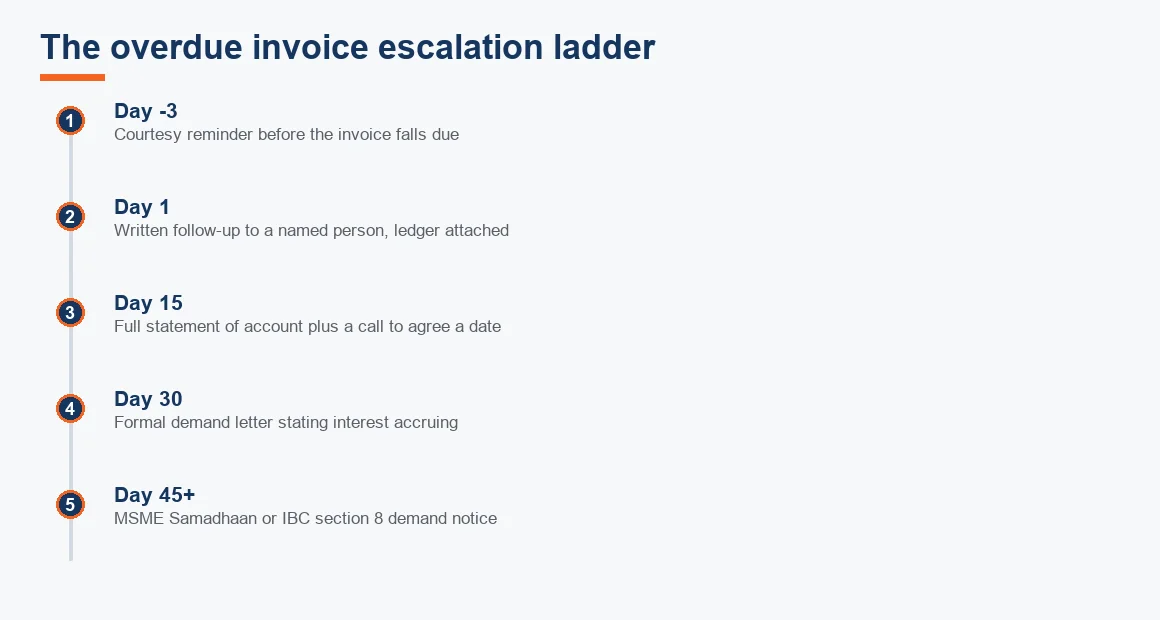
An invoice collections strategy is a written, dated sequence of actions that moves an overdue invoice from a polite reminder towards recovery, without souring the relationship. The strategy that works in India is an escalation ladder: a courtesy reminder before the due date, a firm follow-up on day one, a statement of account at day 15, a formal demand at day 30, and a statutory route beyond day 45. This article sets out that ladder, the interest and MSME rules that give it teeth, and a worked example you can copy.
What is a collection strategy, and what is its purpose?
A collection strategy is the documented order in which you chase money that is due but unpaid. Its purpose is narrow and commercial: to convert accounts receivable into bank balance faster, to reduce write-offs, and to do both while keeping the customer willing to buy again. It is the operating half of your credit policy. The credit policy decides who gets terms and how much; the collection strategy decides what happens, and on which day, when those terms are missed.
The reason a strategy beats reminders is predictability. When every overdue invoice follows the same ladder, your accounts team stops making case-by-case judgements under pressure, the customer learns your rhythm, and nothing slips through because a busy week meant no one chased. If your ledgers are behind and you cannot even see what is overdue, that is a data problem to fix first through backlog bookkeeping and catch-up, before any strategy can run.
The invoice collection process, step by step
These are the steps in the collection process for a standard 30-day invoice. The dates are anchors, not suggestions, and they run off the due date rather than the invoice date.
- Day minus 3 (before due): a short courtesy reminder that the invoice falls due shortly, quoting the number, amount and due date. This is not chasing; it flushes out disputes early.
- Day 1 (just overdue): a written follow-up to a named person in accounts payable, with the ledger statement attached. Confirm the invoice is booked and approved for payment.
- Day 15: a full statement of account listing every open item, and a phone call to agree a payment date in writing.
- Day 30: a formal demand letter that states the amount, the interest that is accruing, and the consequence of continued non-payment.
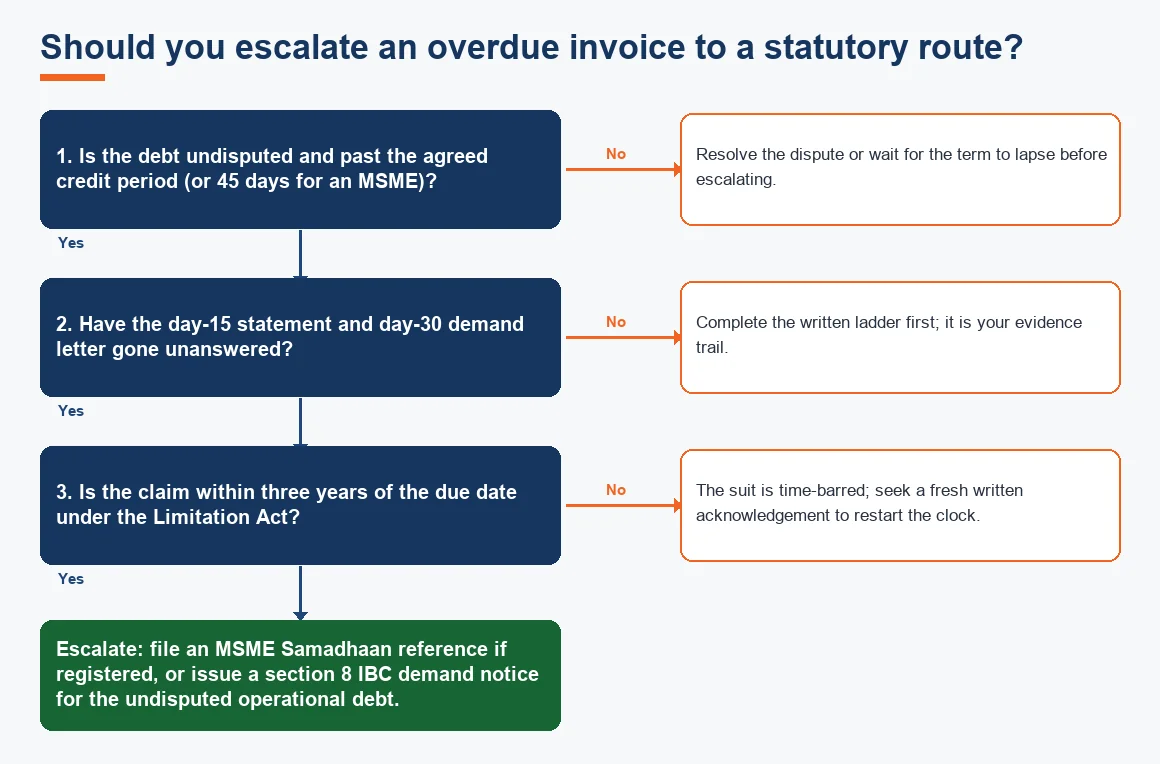
- Day 45 and beyond: escalate to a statutory route: an MSME Samadhaan reference if you are a registered micro or small enterprise, or a demand notice under section 8 of the Insolvency and Bankruptcy Code for an undisputed operational debt.
Overdue invoice follow up: what to say and when
Effective overdue invoice follow up is boring on purpose. Every message quotes the invoice number, date, amount and agreed credit period, and attaches a ledger statement so there is no argument about the balance. The tone hardens down the ladder but the facts stay identical, which matters if the file later goes to a lawyer.
Put the first contact in writing, then call. On the call, your first job is not to demand payment but to confirm the invoice is recorded and approved in the buyer's system. Most delays in India are not refusals to pay; they are an invoice that never reached accounts payable, a purchase order mismatch, or an approval sitting with someone on leave. Fix the mechanical problem and the money usually follows. These formal, dated reminders are what accountants call dunning letters, and keeping copies builds the paper trail you need for any later claim.
The three C's of a successful collection strategy
The three C's of a successful collection strategy are consistency, courtesy and clarity. Consistency means the same ladder runs on every invoice, every time, so customers cannot learn that the squeaky wheel gets chased and everyone else gets ignored. Courtesy means you assume an administrative slip before you assume bad faith, because that assumption is usually correct and it protects the relationship. Clarity means every message contains the exact number, amount and date, leaving no room for a convenient misunderstanding about which invoice or how much.
The most successful collection strategy is simply the one that is actually followed. A modest ladder run without fail recovers more cash than an aggressive policy that depends on someone remembering to act. Reading your AR ageing report weekly, and tracking your days sales outstanding, tells you whether the ladder is working or whether it has quietly stopped running.
Interest, the MSME 45-day rule and section 43B(h)
Your leverage depends on whether you are a registered micro or small enterprise. Under section 15 of the MSMED Act, a buyer must pay a registered micro or small supplier within the agreed period, capped at 45 days from acceptance of goods or services, and within 15 days where no period is agreed. Where the buyer is late, section 16 entitles the supplier to compound interest at three times the notified RBI bank rate, compounded monthly from the appointed day, and this right cannot be signed away in the contract.
Two further statutory points matter. First, since assessment year 2024-25, section 43B(h) of the Income Tax Act disallows the buyer's expense until a micro or small supplier is actually paid inside that limit; the buyer only gets the deduction in the year of payment. That is genuine leverage in February and March, and it is worth understanding the section 43B(h) MSME clock before you raise it. You can point a stalling buyer to the rule on the Income Tax Department portal. Second, for suppliers who are not registered as micro or small, only the interest rate written into the contract applies, commonly 18 to 24 per cent a year. Interest actually recovered carries GST at the rate of the underlying supply, a point the CBIC guidance confirms.
Worked example: MSME interest on a late payment
Assume you are a registered small enterprise. You raise an invoice of INR 5,00,000, the appointed day (45 days) passes, and the buyer pays a full three months after that appointed day. Take the RBI bank rate as 6.75 per cent (indicative, check the current notified rate). Three times that is 20.25 per cent a year, compounded monthly at 1.6875 per cent.
| Item | Basis | Amount (INR) |
|---|---|---|
| Principal overdue | Invoice value | 5,00,000 |
| Statutory rate | 3 x RBI bank rate (6.75%) | 20.25% p.a. |
| Monthly compounding rate | 20.25% / 12 | 1.6875% |
| Compounded value after 3 months | 5,00,000 x (1.016875)^3 | 5,25,742 |
| Interest recoverable | 5,25,742 minus 5,00,000 | 25,742 |
The buyer owes INR 5,25,742, of which INR 25,742 is statutory interest that cannot be waived. For a non-MSME supplier on a 24 per cent contractual rate, the same delay on simple interest would be roughly INR 30,000, but you would have to enforce the contract to get it. Note that under section 23 of the MSMED Act the buyer cannot claim this interest as a deduction, which is a further reason it concentrates minds.
The seven elements of a collection policy
A collection policy that a team can actually run has seven parts. Treat this as a checklist when you write yours:
- Credit terms: the standard credit period and any customer-specific exceptions, in writing.
- The escalation ladder: the dated sequence above, with who acts on each day.
- Roles: which named person sends reminders, who signs the demand letter, who approves a write-off.
- Interest and charges: the contractual rate, and the MSMED position where it applies.
- Dispute handling: how a queried invoice is logged, investigated and cleared, with the clock paused only for genuine disputes.
- Stop-supply and hold rules: the balance or age at which new orders are held pending payment.
- Write-off and provisioning: when a debt is provided for and when it is finally written off, tied to your accounts receivable aging schedule.
How to reduce bad debts and improve collection from debtors
To reduce bad debts you work at both ends. At the front end, vet credit before you grant it and set limits deliberately, an approach the five C's of credit frames well. At the back end, run the ladder without exception and act on ageing early, because a debt at 120 days is far harder to collect than the same debt at 30. Improving collection from debtors is mostly about speed and consistency, not aggression.
Clean upstream processes help more than most owners expect. Invoicing accurately on the day of delivery, matching purchase orders, and keeping bank and credit card reconciliation current so you know the moment a payment lands, all shorten the cycle. Your collections sit inside the wider order-to-cash cycle, and the same discipline on the buying side, handled through accounts payable outsourcing, keeps you off other suppliers' escalation ladders. For provisioning against debts that may not be recovered, the ECL estimator gives a defensible number for your accounts.
When a growing ledger outgrows one part-time person, the collections function itself can be run for you through accounts receivable outsourcing, so the ladder runs every day regardless of leave and workload.
Key terms
- Accounts Receivable: money owed to you by customers for goods or services already delivered.
- Days Sales Outstanding (DSO): the average number of days it takes to collect payment after a sale.
- Dunning Letters: the sequence of formal, dated reminders sent to a customer with an overdue balance.
- Section 43B(h) MSME Clock: the income-tax rule that disallows a buyer's expense until a micro or small supplier is paid inside the limit.
- Working Capital: current assets less current liabilities, the cash cushion that slow collections quietly erode.
Key takeaways
- Run a dated escalation ladder, not ad hoc reminders, and anchor every step to the due date.
- Your first contact should confirm the invoice is booked and approved, because that fixes most delays.
- If you are a registered micro or small enterprise, the MSMED interest and section 43B(h) disallowance give you real, non-waivable leverage.
- Watch the three-year limitation period, and use signed balance confirmations to reset it.
- Reduce bad debts at both ends: vet credit before granting it, and act on ageing early.
Decision guide