
In this guide
An accounts receivable ageing report is a list of every unpaid customer invoice, grouped by how long it has been outstanding at a fixed cut-off date. The balances are dropped into ageing buckets, normally 0-30, 31-60, 61-90 and above 90 days, so you can see in one glance how much of your money is current and how much has gone stale. It is the single most useful collections document a small business owns, because it turns a long debtor ledger into a short, ranked follow-up list.
What is an accounts receivable ageing report?
The report reads straight off the sales ledger. Each open invoice carries an amount and an invoice date; the ageing tool subtracts that date from the reporting date to work out days outstanding, then places the balance in the matching bucket. A firm with Rs 40 lakh of receivables and Rs 9 lakh sitting beyond 90 days can see immediately that 22 percent of its collections are at risk, without reading a single individual invoice. If you want the wider picture of how an invoice becomes a receivable in the first place, our explainer on the order-to-cash cycle covers the full journey from sale to cash.
The report is a management view, not a legal balance. It changes every day as invoices are raised and payments land, so it is always read against a stated cut-off date. Accounting systems such as Tally, Zoho Books and Xero generate it from the receivables ledger in a single step, which is why a manual spreadsheet is only worth building if you are reconstructing history or checking the software's own output.
What are the two types of ageing report?
There are two ways to age the same ledger, and they answer different questions.
- Ageing by invoice date: days are counted from the day the invoice was raised. This shows how long the money has existed as a debt in total, regardless of the credit terms you granted.
- Ageing by due date: days are counted from the payment due date, so an invoice inside its credit period shows as current and only starts ageing once it is genuinely late.
The due-date method is the stricter and more honest collections view, because it isolates customers who are actually overdue. The invoice-date method suits a quick liquidity read and matches how most default reports are set up. Pick one, label it clearly, and stay consistent, otherwise two colleagues will quote different overdue figures from the same ledger.
How to prepare an accounts receivable ageing report
Whether the software builds it or you do, the logic is the same five steps. This is also how you would rebuild a report during a structured collections push.
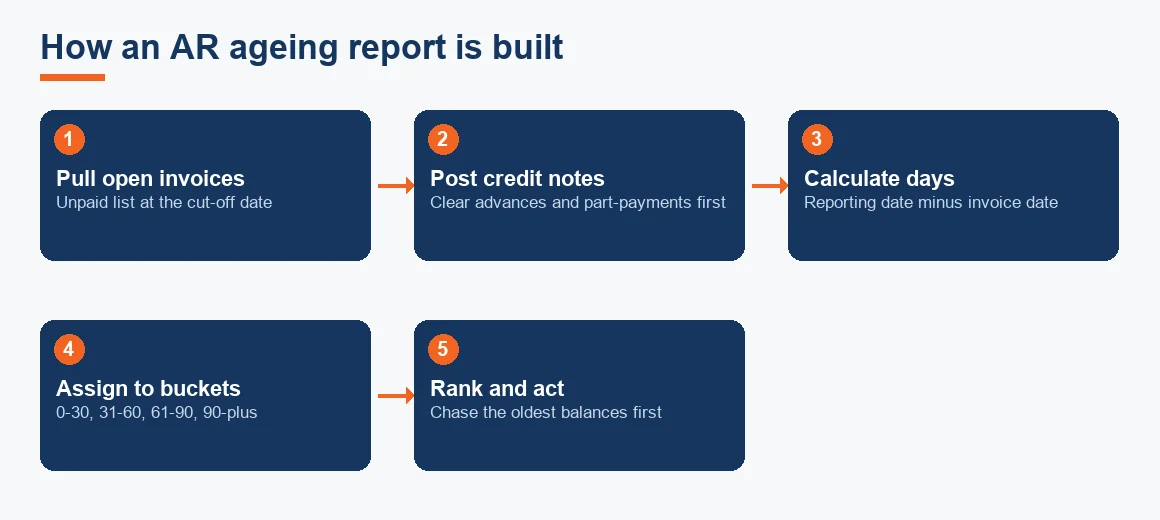
- Pull the open invoice list as at the reporting date from the sales ledger.
- Post all credit notes, customer advances and part-payments first, so no invoice is overstated.
- Calculate days outstanding for each invoice: reporting date minus invoice date (or due date).
- Assign each balance to its bucket: 0-30, 31-60, 61-90 or 90-plus.
- Total each bucket, work out its share of the whole, and rank the oldest balances for action.
How is AR age calculated and how do you read it?
The arithmetic is a simple date subtraction. An invoice dated 18 May read at a 24 July cut-off is 67 days old, which lands it in the 61-90 bucket. Reading the finished report is about proportions, not single numbers. Look first at the shape: a healthy ledger is heavily weighted to the left, with most value in 0-30. A ledger with a fat 90-plus column is telling you that either collections have stalled or a disputed invoice has been left unescalated. The report also feeds directly into Days Sales Outstanding, the single ratio that summarises how quickly you convert sales into cash.
What is a good AR ageing percentage?
Judge the percentages against the credit terms you actually granted, not an industry average pulled off the internet. As a working benchmark for an Indian services business:
- At least 80 percent of the total by value should sit in 0-30 days.
- Under 5 percent should sit beyond 90 days.
- Anything above 10 percent in the 90-plus bucket is a red flag pointing to a collection failure or a stuck dispute.
A related rule of thumb, sometimes called the 10 rule, treats any single overdue account worth more than 10 percent of total receivables as a concentration risk that needs a named owner and a weekly review, because one large default can sink a quarter's cash flow. None of these figures are statutory; they are simply the levels at which most owners should start asking questions.
Is AR ageing a KPI, and what is its purpose?
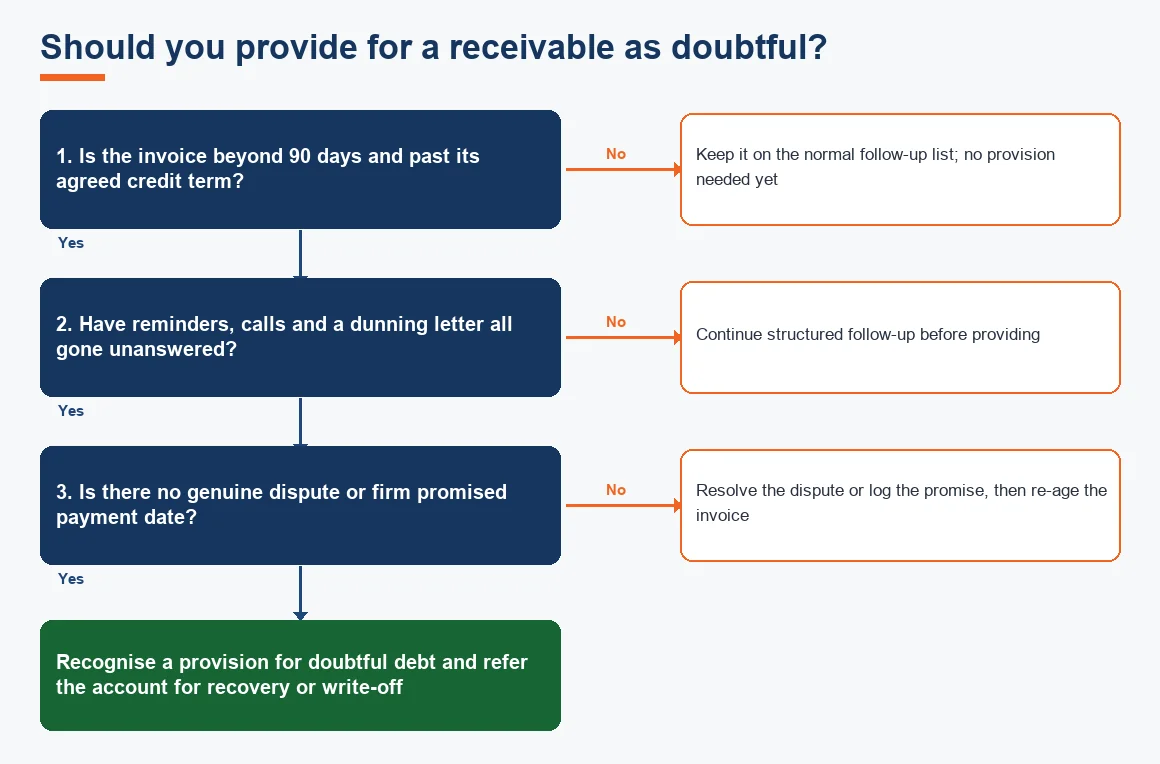
Yes. The ageing profile is a genuine key performance indicator because it is measurable, it trends over time, and it drives action. The percentage in the 90-plus bucket, tracked month on month, tells you whether your collections discipline is improving or slipping long before the bank balance does. Its purpose is threefold: to prioritise chasing, to size the provision you may need for doubtful debts, and to warn you about customers who should move to advance payment. Many owners fold the headline buckets into their monthly MIS reporting alongside DSO so the board sees receivable health at a glance. Deciding a customer's credit limit in the first place is a separate discipline covered in our note on the 5 C's of credit.
The internal report versus the Schedule III statutory schedule
Do not confuse the four-bucket working report with the statutory disclosure. Schedule III of the Companies Act requires the trade receivables ageing schedule in the notes to the accounts to run across five periods, from less than six months to more than three years, and to split every line between disputed and undisputed dues. That is a year-end compliance format, published once, and it is built from six-monthly and yearly bands rather than 30-day ones. The internal report is a live collections tool refreshed weekly. Keep them as two separate views: the reference format sits in the Ministry of Corporate Affairs Schedule III, and you can read a plain-language summary in our glossary on the Schedule III balance sheet. Companies that keep their books clean through the year, often with catch-up bookkeeping where they have fallen behind, find the statutory schedule almost writes itself.
A worked example: reading a Rs 40 lakh ledger
Consider a Pune-based IT services firm with Rs 40 lakh outstanding at a 24 July cut-off, aged by invoice date. The buckets below show how the same total looks once it is spread across the ageing profile, and what each share is telling the owner.
| Ageing bucket | Amount (Rs) | Share of total | What it signals |
|---|---|---|---|
| 0-30 days | 26,00,000 | 65% | Current, but below the 80% benchmark |
| 31-60 days | 3,20,000 | 8% | Normal drift, watch for slippage |
| 61-90 days | 1,80,000 | 4.5% | Chase now before it turns 90-plus |
| 90+ days | 9,00,000 | 22.5% | Serious risk, escalate and provide |
| Total | 40,00,000 | 100% |
The headline is the Rs 9 lakh in the 90-plus bucket at 22.5 percent, more than four times a safe level. If that balance is one customer, it is also a 10-rule concentration risk on its own. Say Rs 2 lakh of it is a genuinely unrecoverable debt from a customer who has ceased trading. Written off in the books, the debt disappears, but the GST already paid on that supply does not come back. GST law gives no bad-debt relief, so output tax stays paid unless the supply itself is reduced or cancelled by a credit note under Section 34, which the CBIC requires to be issued by 30 November following the financial year end. A write-off in the accounts and a GST credit note are two different acts; do not assume one triggers the other.
Turning the report into collection action
An ageing report is only worth building if it changes what you do next. The practical move is a fixed escalation ladder tied to the buckets, so nobody has to decide case by case how hard to chase.
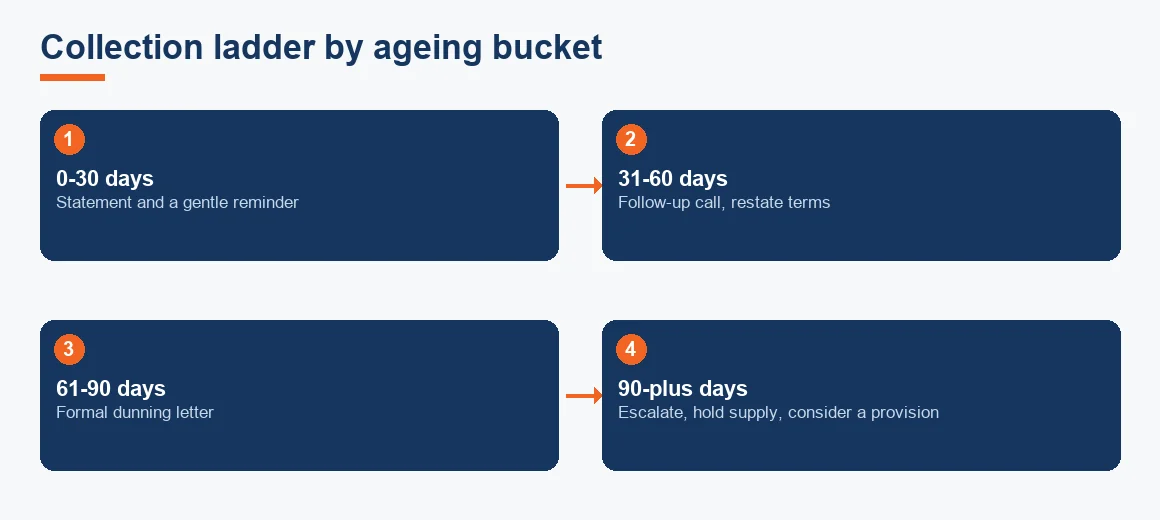
Run this every week off the same report, and the 90-plus column shrinks because problems are caught at 45 days rather than discovered at 120. Businesses that would rather not run the ladder in-house hand the whole cycle to accounts receivable outsourcing, which pairs the ageing report with structured follow-up; the mirror-image discipline on the money you owe is covered by accounts payable outsourcing. If you would like a technician to estimate a provision on your oldest balances, our ECL estimator applies the Ind AS 109 simplified approach to an ageing matrix.
Key terms
- Accounts Receivable Ageing Schedule: the grouped list of unpaid invoices by days outstanding.
- Days Sales Outstanding (DSO): the average number of days it takes to collect a sale.
- Dunning Letters: the escalating written reminders sent to overdue customers.
- Schedule III Balance Sheet: the statutory format that dictates the year-end receivables ageing disclosure.
Key takeaways
- An ageing report ranks every unpaid invoice by days outstanding so collections effort goes where the money is at risk.
- Age by due date for chasing and by invoice date for a liquidity view, and always post credit notes and advances before you run it.
- Aim for 80 percent-plus in 0-30 days and under 5 percent beyond 90, measured against the terms you actually granted.
- Keep the internal four-bucket report separate from the five-period Schedule III statutory schedule.
- Writing off a bad debt does not recover the GST paid; only a Section 34 credit note by 30 November can, and only if the supply is reduced.
Decision guide