In this guide
The 5 C's of credit are character, capacity, capital, collateral and conditions: the five factors a lender or supplier weighs before extending credit to a borrower or a customer. Banks use them to price a loan, and your finance team uses the same framework to decide whether a new B2B customer gets credit terms and how large an opening limit should be. This post sets out each C, explains which matters most, and shows how to apply the framework to trade receivables in an Indian business.
What are the 5 C's of credit?
The 5 C's are a structured checklist for creditworthiness assessment. Rather than relying on a gut feel about whether a party will pay, the framework forces you to examine five separate dimensions of credit risk and to record a view on each. There are five Cs, no more and no fewer, and the mnemonic has stayed stable for decades precisely because it covers both the willingness to pay (character) and the ability to pay (capacity, capital, collateral) against the backdrop of the wider environment (conditions). Whether a bank is assessing a term loan or you are assessing a customer's accounts receivable risk, the same five headings apply.
Character, capacity, capital, collateral and conditions explained
Each C answers a different question. Read together, they build a rounded picture of the credit risk you are about to take on.
Character
Character is the borrower's track record and willingness to honour obligations: past repayment history, the promoters' reputation, any litigation, and how the party has treated other creditors. For a trade customer, a GSTIN status check, the latest MCA filings and a promoter credit check stand in for a formal credit bureau score.
Capacity
Capacity measures whether cash flow can actually service the debt, and it is usually the heaviest weighted of the five. Lenders test it with the debt service coverage ratio, interest coverage and the trend in operating cash flow across three years of audited financials. For a supplier, capacity translates into a simpler question: does the customer's own collection cycle generate the cash to clear your invoice before it falls due?
Capital
Capital in the 5 C's of credit is the money the borrower has already put into the business: the promoter's own stake, retained earnings and net worth. It signals commitment, because a party that has invested its own funds has more to lose from default. A thin net worth relative to the credit sought is a warning that the borrower is trading largely on other people's money.
Collateral
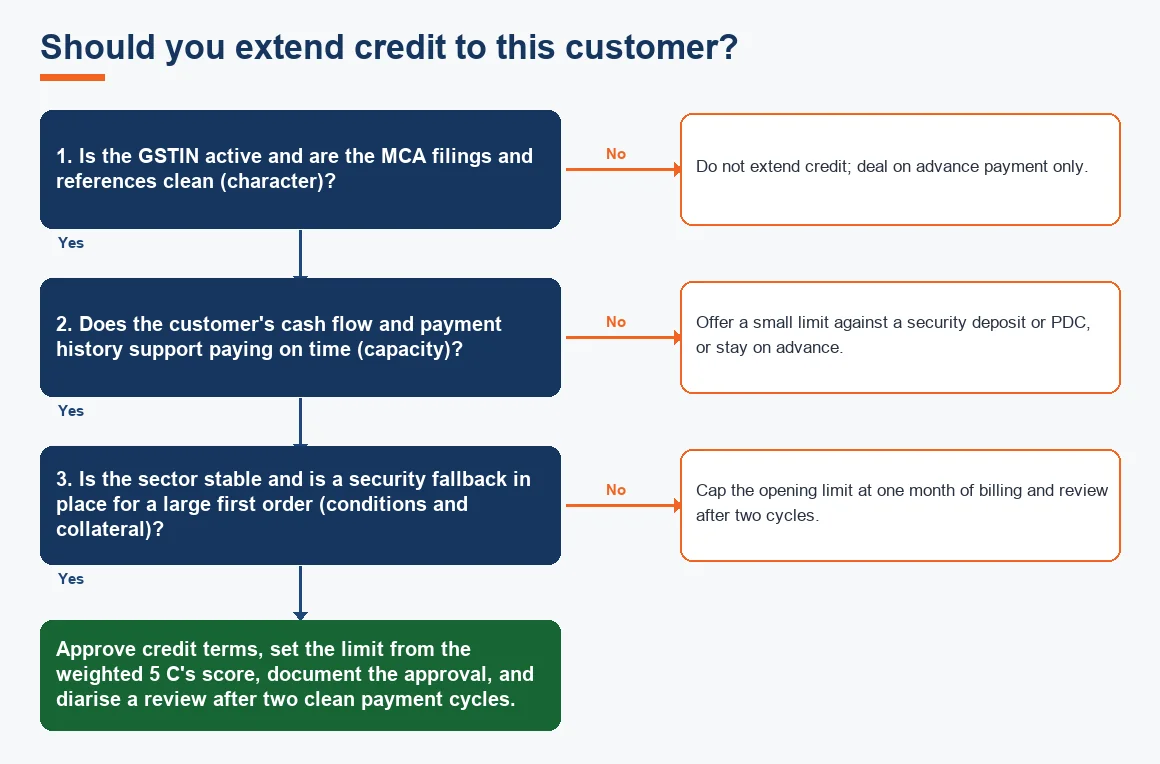
Collateral is the security a lender can fall back on if the borrower defaults: property, plant, a fixed deposit or a personal guarantee. In trade credit, formal collateral is rare, so the equivalent protections are a security deposit, a post-dated cheque or a bank guarantee for a large first order.
Conditions
Conditions cover the wider context: the purpose of the credit, the interest rate, and the economic and sector outlook. A customer in a cyclical or stressed sector carries more risk at the same balance sheet strength than one in a stable market.
Which of the 5 C's of credit is the most important?
Capacity is generally treated as the most important, because a loan or an invoice is repaid out of cash flow, not out of a balance sheet on paper. Character runs a close second: a borrower who can pay but chooses not to is as much a loss as one who genuinely cannot. Collateral, by contrast, is the last line of defence, not the first test. Recovering against security is slow, costly and uncertain, so a lender who relies on collateral to justify a weak capacity assessment has usually mispriced the risk. The sensible reading is that no single C stands alone: they are weighted, and capacity simply carries the largest weight.
How the 5 C's affect lending and protect lenders
The 5 C's affect lending because they drive both the decision and the price. A strong profile across all five earns a larger limit at a finer rate; a weak capacity or thin capital either raises the rate, shrinks the limit, or attaches conditions such as additional security. They protect lenders by spreading the assessment across independent factors, so that a single flattering number cannot carry a weak application. A borrower with healthy reported profits but erratic cash flow will still fail on capacity, and the framework surfaces that mismatch before money goes out.
The same logic protects a supplier. Extending credit is lending in all but name: you ship goods now and collect later, and every unpaid invoice funds the customer's working capital at your expense. Running each new customer through the five Cs is what keeps your receivables book from quietly becoming an unsecured loan portfolio.
Applying the 5 C's to trade receivables
Translating the framework from a bank loan to a sales ledger is straightforward once you map each C onto the tools a finance team actually has. The flow below shows how a new-customer credit request moves from application to an approved limit.
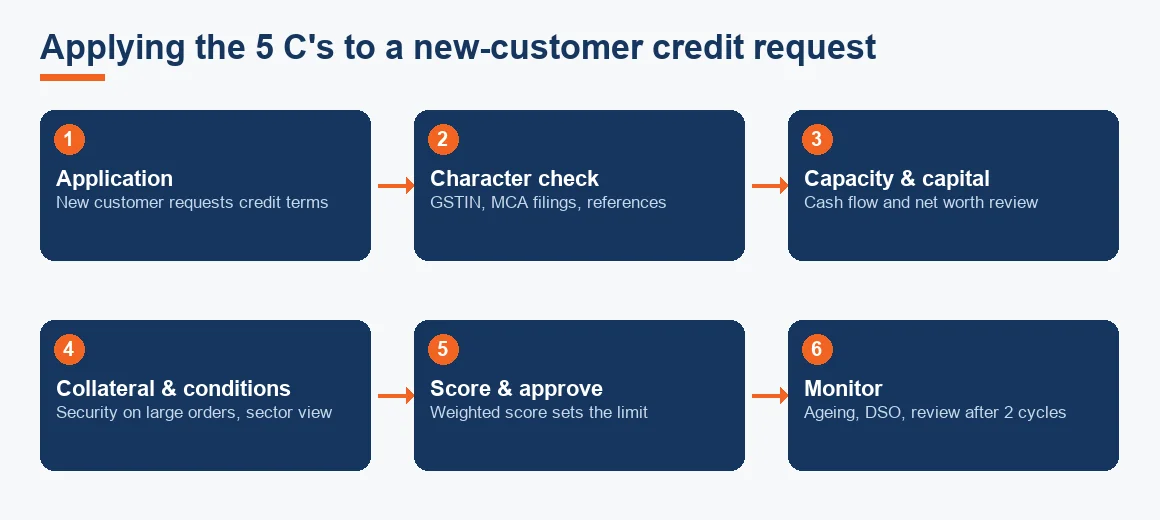
The table maps each C onto the check a supplier can realistically run and the receivables outcome it drives.
| The C | Question it answers | Trade credit check | Receivables outcome |
|---|---|---|---|
| Character | Will they pay? | GSTIN status, MCA filings, trade and bank references | Go / no-go on any credit at all |
| Capacity | Can cash flow pay on time? | Customer's own collection cycle and payment history | Size of the credit limit |
| Capital | Do they have skin in the game? | Net worth from latest filed financials | Confidence in a higher limit |
| Collateral | What is the fallback? | Security deposit, PDC or bank guarantee on large orders | Protection on the first exposure |
| Conditions | What is the context? | Sector health, order purpose, seasonality | Tightness of terms and review frequency |
Set the opening limit at roughly one month of expected billing, and release more only after two clean payment cycles. Once credit is live, the five Cs give way to monitoring: read the AR ageing report every month, track days sales outstanding, and run a disciplined collections process the moment an invoice slips. For the underlying mechanics of how a sale becomes a receivable and then cash, see our explainer on the order-to-cash cycle.
Step by step: running a 5 C's credit check on a new B2B customer
- Verify identity and character. Confirm the GSTIN is active, pull the latest MCA filings, and take at least one trade reference and one bank reference.
- Test capacity. Ask for the customer's stated credit period and, where possible, their payment history with other suppliers. The question is whether their collection cycle funds your invoice before due date.
- Read capital. Check net worth and the debt position from the most recent filed financials to gauge how much of the business is the promoter's own money.
- Decide on collateral. For a first large order, ask for a security deposit, post-dated cheque or bank guarantee. For a modest opening limit, none may be needed.
- Weigh conditions. Factor in the sector, seasonality and the purpose of the purchase, then set the review frequency accordingly.
- Score, approve and document. Record a score against each C, set the limit and the approval level in writing, and diarise a review after two payment cycles.
Worked example: scoring a new customer's credit application
Suppose a distributor applies for credit terms and expected monthly billing is around 4,00,000 (indicative, Exl GST). Your policy weights the five Cs and the reviewer scores each out of 10. The weighted total then maps to an approved opening limit.
| The C | Weight | Score (out of 10) | Weighted score |
|---|---|---|---|
| Character | 20% | 8 | 1.60 |
| Capacity | 30% | 6 | 1.80 |
| Capital | 20% | 7 | 1.40 |
| Collateral | 15% | 5 | 0.75 |
| Conditions | 15% | 6 | 0.90 |
| Total | 100% | 6.45 |
A weighted score of 6.45 sits in the middle band: credit is approved, but conservatively. The opening limit is held at one month of billing (around 4,00,000, indicative, Exl GST), the moderate collateral score triggers a request for a post-dated cheque on the first shipment, and the file is diarised for review after two clean cycles, at which point the limit can be raised toward two months of billing.
Can you improve your 5 C's of credit?
Yes, and the levers differ by C. Character improves with a clean, documented repayment record. Capacity improves as operating cash flow strengthens and leverage falls. Capital improves when promoters retain earnings or infuse funds. Collateral can be offered voluntarily to unlock a better rate, and conditions, while outside your control, can be met with timing (borrowing when the sector is stable rather than stressed). For an individual consumer the same five map onto a credit score, income and job stability, savings and assets, any security offered, and the loan's purpose, so the framework scales from a personal loan to a corporate facility.
Where the 5 C's meet Indian accounting and tax
The credit decision has a tail in your books. When a receivable does go bad despite the five Cs, the accounting and tax treatment matter. Under Ind AS 109 a trade receivable is measured for impairment on the expected credit loss basis, using the simplified approach that carries a lifetime expected credit loss allowance from initial recognition rather than the three-stage general model; under Accounting Standards the equivalent is a specific provision for doubtful debts. For the tax deduction, a bad debt is allowable under section 36(1)(vii) of the Income Tax Act in the year it is actually written off in the books, provided the amount was earlier offered as income under section 36(2). Since the Supreme Court ruling in TRF Ltd, you need not prove the debt is irrecoverable: the write-off entry itself suffices, so retain the ledger and the board approval. Where the customer is a micro or small enterprise, the section 43B(h) MSME clock also cuts the other way on your own payables, disallowing the expense until you pay within the MSMED time limit. If you would rather not run this end to end in-house, accounts receivable outsourcing puts a documented credit policy, ageing discipline and collections behind your ledger; the same team can pick up accounts payable outsourcing, bank and credit card reconciliation, and any backlog bookkeeping catch-up needed to get clean numbers in the first place. To size the provision itself, our ECL estimator works the Ind AS 109 simplified approach.
Key terms
- Accounts Receivable: money owed to a business by customers for goods or services already delivered.
- Days Sales Outstanding (DSO): the average number of days it takes to collect payment after a sale.
- Accounts Receivable Aging Schedule: a report grouping unpaid invoices by how long they have been outstanding.
- Working Capital: current assets less current liabilities, the short-term funds a business runs on.
- Section 43B(h) MSME Clock: the rule disallowing an expense until a micro or small supplier is paid within the MSMED time limit.
Key takeaways
- The 5 C's of credit are character, capacity, capital, collateral and conditions, and there are exactly five.
- Capacity, the ability to repay from cash flow, is usually the most heavily weighted; collateral is a fallback, not a substitute for it.
- The framework applies to trade credit: it decides whether a new customer gets terms and how large the opening limit should be.
- Document a weighted score for each C so every credit limit has a named owner and a date for audit.
- Monitor after approval with an ageing report and DSO, and treat a bad debt correctly under section 36(1)(vii) when it arises.
Decision guide