In this guide
The accounts receivable process is the sequence of steps a business follows to turn a credit sale into collected cash: checking a customer's credit, raising the invoice, recording the amount owed, tracking it, chasing it when overdue, and applying the receipt against the right invoice. It is one stage inside the broader order-to-cash cycle, and it is where most working-capital problems quietly begin. This guide walks through each step, shows where collections actually break down, and works a numeric example using current Indian rates.
What is the accounts receivable process?
Accounts receivable is money customers owe you for goods or services already delivered on credit. On the balance sheet it appears under current assets as trade receivables, so it is very much an asset rather than a cost. The process is everything that happens to that balance from the point a sale is agreed to the point the cash lands and is matched off. Because Indian books run on accrual accounting, the receivable is created when you earn the revenue, not when the customer eventually pays. If you want the pure definition rather than the workflow, our glossary entry for accounts receivable keeps it to one line.
Handled well, receivables convert into cash predictably and fund the next round of purchases and payroll. Handled loosely, they swell your working capital requirement and force you to borrow to bridge a gap that your own customers created. That is why the process, not just the ledger balance, is worth getting right.
What is the order-to-cash (O2C) process, and where does AR sit?
Order to cash is the end-to-end cycle that runs from receiving a customer order to collecting and applying the cash. It covers order capture, credit approval, fulfilment, invoicing (including e-invoice and e-way bill generation where thresholds apply), receivable tracking, collections and cash application. Accounts receivable is not a separate process running alongside O2C; it is the middle-to-back stretch of that same cycle, from the moment the invoice is raised to the moment the receipt is reconciled.
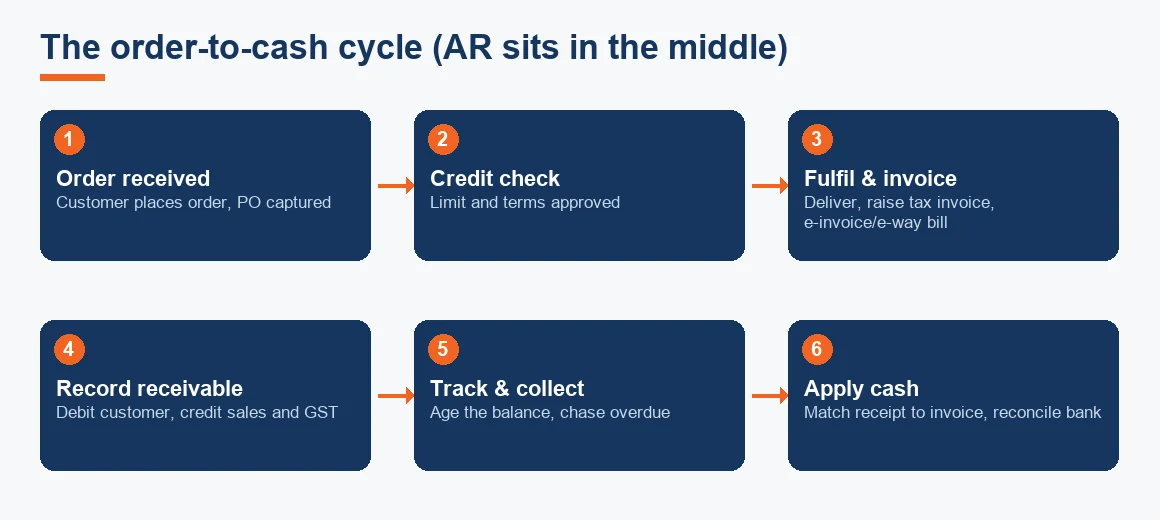
Seeing it this way matters because a breakdown often starts upstream. A missing purchase-order number at order capture becomes a disputed invoice three weeks later, which becomes an ageing receivable two months after that. The receivables team gets blamed for a problem that was created at the order desk.
What are the steps in the accounts receivable process?
The AR process has six repeatable steps. Each one produces a record that the next step depends on, which is why skipping or rushing an early step shows up as a collection problem later.
- Credit assessment and terms. Before you extend credit, agree a limit and payment terms in writing. Frameworks such as the 5 C's of credit and receivables management help you set a limit you can defend.
- Invoicing. Raise a tax invoice that carries the customer PO reference, correct GST rate and, where applicable, the IRN and e-way bill. A clean invoice is the single biggest lever on how fast you get paid.
- Record the receivable. Post the journal entry that debits the customer and credits sales and output GST. This is the point the asset enters your books.
- Track and age. Group open invoices by how overdue they are. Reading and acting on that report is a discipline of its own, covered in our guide to the AR ageing report.
- Collections. Follow a defined chase sequence: reminder before due date, polite follow-up after, then escalation. A structured collections strategy for overdue invoices recovers more without straining the relationship.
- Cash application. Match each receipt to the correct invoice and post the entry. Un-applied cash sitting in a suspense account is money you cannot see and cannot report.
When do you record a receivable?
You record a receivable when control of the goods or the benefit of the service has passed to the customer and you have an unconditional right to payment, regardless of when the cash arrives. For a product business that is usually dispatch or delivery per the contract terms; for a service business it is when the service is performed. Recording earlier inflates income; recording later understates your assets and can distort your GST liability, which is tied to the time of supply rather than to receipt.
The mechanics rest on double-entry bookkeeping: a credit sale debits the customer account and credits sales, so the receivable increases on the debit side. Accounts receivable therefore carries a debit balance. A credit balance sitting in a customer ledger is a signal, usually an advance received or a receipt that has not been applied to its invoice.
AR cycle versus the wider O2C cycle: a quick comparison
The terms get used interchangeably, but they are not the same span of work. The table sets out where each begins and ends and who typically owns it.
| Aspect | Accounts receivable cycle | Order-to-cash (O2C) cycle |
|---|---|---|
| Starts at | Invoice raised | Customer order received |
| Ends at | Receipt applied to invoice | Cash reconciled and reported |
| Core focus | Tracking, collections, cash application | The whole revenue journey including credit and fulfilment |
| Typical owner | Finance / receivables team | Sales, operations and finance jointly |
| Key metric | Days sales outstanding | Order-to-cash cycle time |
Worked example: journal entries and DSO for a credit sale
Take a Maharashtra business that sells goods worth Rs 1,00,000 on credit at 18% GST (an intra-state supply, so 9% CGST and 9% SGST). The invoice totals Rs 1,18,000. The entries below show the receivable being created and then cleared, followed by the days-sales-outstanding calculation on the year's numbers.
| Stage | Account | Debit (Rs) | Credit (Rs) |
|---|---|---|---|
| On credit sale | Customer (Accounts Receivable) | 1,18,000 | |
| Sales | 1,00,000 | ||
| Output CGST | 9,000 | ||
| Output SGST | 9,000 | ||
| On receipt | Bank | 1,18,000 | |
| Customer (Accounts Receivable) | 1,18,000 | ||
| DSO check | Rs 60,00,000 receivables / Rs 3,60,00,000 credit sales x 365 | = 61 days | |
The receivable exists on the books from the sale entry until the receipt clears it. A DSO of 61 days against 30-day terms tells you customers are, on average, taking a month longer than agreed, which is a collections issue to investigate rather than a customer to blame. Reducing it is the subject of our note on calculating and reducing DSO. All figures are indicative and stated Exl GST where noted.
Where does the accounts receivable process break down?
In practice collections rarely fail because customers refuse to pay. They fail at the joins between steps.
- Invoice disputes: wrong rate, missing PO, or a delivery mismatch that stalls the invoice before the clock even starts.
- No ageing discipline: nobody reviews the ageing schedule weekly, so a 30-day slip becomes a 120-day problem unnoticed.
- Weak follow-up: reminders are ad hoc rather than a fixed sequence of dunning steps.
- Un-applied cash: receipts land in the bank but are not matched to invoices, so the customer looks unpaid and gets chased for money already sent. This is why bank and credit card reconciliation and receivables have to move together.
If your books are months behind and the ageing report cannot be trusted, the fix starts with backlog and catch-up bookkeeping before any collection drive is worth running. The mirror image of this process on the buying side is your accounts payable workflow, which most businesses run in parallel.
The statutory points that touch receivables
Three Indian rules sit on top of the everyday workflow and are worth getting right.
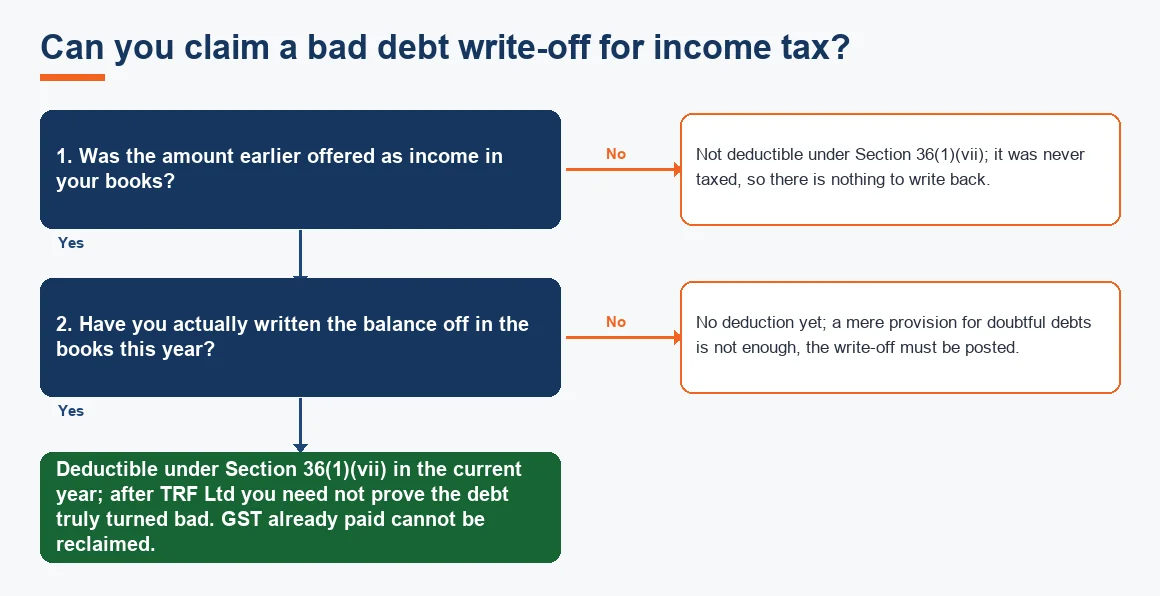
Bad debt write-off. An unrecovered balance is deductible under Section 36(1)(vii) of the Income Tax Act in the year it is actually written off in the books, provided it was earlier offered as income. After the Supreme Court ruling in TRF Ltd, you do not have to prove the debt genuinely turned bad; the write-off in the accounts is enough. The rule is stated on the Income Tax Department portal. Note that GST already paid on that invoice cannot be reclaimed.
Schedule III ageing. Under Schedule III of the Companies Act, trade receivables must be disclosed with an ageing schedule running from less than six months upward, split into current and non-current portions. The format is set out by the Ministry of Corporate Affairs and mirrors the Schedule III balance sheet presentation.
E-commerce receivables. If you sell through a marketplace, the operator collects tax at source under Section 52 of the CGST Act before remitting your money, so your gross receivable and your net settlement differ. The mechanism is documented by CBIC and treated in our note on Section 52 TCS under GST.
Key terms
- Accounts Receivable: money owed to you by customers for credit sales, shown as a current asset.
- Days Sales Outstanding (DSO): the average number of days it takes to collect a receivable.
- Accounts Receivable Aging Schedule: open invoices grouped by how overdue they are.
- Dunning Letters: the structured sequence of reminders sent to chase overdue payment.
- Section 43B(h) MSME Clock: the payment deadline that makes late payments to MSME suppliers non-deductible until paid.
Key takeaways
- Accounts receivable is the middle-to-back stretch of the order-to-cash cycle, from invoice raised to cash applied.
- Record the receivable when the sale is earned, not when the money arrives; it carries a debit balance.
- Six steps, in order: credit terms, invoice, record, age, collect, apply cash.
- Most collection failures are process gaps at the joins, not customer defaults.
- A bad debt is deductible only in the year it is written off in the books, and marketplace TCS makes your gross receivable differ from your net receipt.
Understanding the process is one thing; running it every day without letting balances drift is another. If receivables are eating your working capital, the commercial route is to hand the cycle to a dedicated team through accounts receivable outsourcing, while you keep this guide as the map of what that team should be doing. To size the provision on doubtful balances, our ECL estimator gives a quick working under the Ind AS 109 simplified approach.
Decision guide