In this guide
The short answer to xero vs zoho for an Indian business is that Zoho Books is built around Indian GST while Xero is a foreign-designed platform that reaches India compliance through add-ons. Zoho Books files GST, generates e-invoices and bills you in rupees out of the box; Xero handles the accounting well but leans on a GST Suvidha Provider or manual uploads for Indian statutory work. Which one is better depends less on the software and more on whether your revenue, banking and reporting sit inside India or straddle several countries. This guide compares the two on the points that actually decide the choice.
Xero vs Zoho Books at a glance
Both are cloud accounting tools that run proper double-entry bookkeeping behind a friendly interface, so the difference is not the bookkeeping engine but how each treats Indian tax, banking and cost. The table below summarises where they diverge for a business operating in India.
| Point of comparison | Zoho Books | Xero |
|---|---|---|
| India e-invoicing (IRN, QR, e-way bill) | Built in, generated inside the software | Not built in; needs a GSP integration or manual JSON |
| GST returns (GSTR-1, GSTR-3B data) | Native, India tax rates preloaded | Custom tax rates; reporting largely outside the system |
| Free plan | Yes, turnover below Rs 25 lakh | No free tier |
| Billing currency | Indian rupees | Foreign currency (USD or GBP), FX charge on card |
| Multiple GSTINs | Each GSTIN is a separate organisation | No GSTIN concept; tracked as custom tax rates |
| Indian bank feeds | Direct feeds with several Indian banks | Mostly file import for Indian accounts |
| Audit trail report | India-specific report the auditor can test | History and notes must be exported and explained |
Which is better, Zoho or Xero, for Indian GST?
On GST the gap is wide. Zoho Books carries Indian tax rates, treats each GSTIN as its own organisation and connects directly to the invoice registration portal to produce the invoice reference number, signed QR code and e-way bill. Once your aggregate turnover crosses the Rs 5 crore e-invoicing threshold, that native link matters every day. Xero has no built-in India e-invoicing, so it needs a connector through a GST Suvidha Provider or a manual JSON upload, and GST returns are largely assembled outside the software. You can confirm the current e-invoicing rules and thresholds on the CBIC GST portal and file through the GST portal. For a business that lives entirely on Indian GST, this alone often settles the decision. Our deeper look at whether Xero works for Indian businesses walks through the workarounds in detail.
Is Xero cheaper, and does either offer a free plan?
Zoho Books has a genuinely free plan for Indian businesses with annual turnover below Rs 25 lakh, covering one user plus an accountant with caps on invoices and workflows. Xero has no free tier and is sold only as a monthly subscription per organisation, priced in foreign currency, which adds a foreign exchange charge on the card each month. So at the small end Zoho Books is not merely cheaper, it can be free. On the common question of whether Xero is cheaper than QuickBooks, the point is moot in India: Intuit withdrew QuickBooks from the Indian market and access ended on 30 April 2023, so QuickBooks is no longer a live option here. That leaves the real contest as Zoho Books versus Xero, and on rupee cost Zoho Books usually wins for India-only operations.
Why do accountants prefer Xero, and where does it fall short?
Xero earns loyalty for reasons that have little to do with Indian tax. Its bank reconciliation flow is clean, its general ledger and reporting feel polished, and its ecosystem of third-party apps is large and mature. Practices that serve UK, Australian or New Zealand clients often standardise on it, and that habit carries over. Xero is also beginner friendly: the interface is uncluttered and the learning curve is gentle, so it is not difficult to use for someone new to cloud accounting.
The disadvantages of Xero appear when you point it at Indian compliance. There is no native e-invoicing, no GSTIN structure, limited direct bank feeds for Indian banks, and GST reporting that sits outside the core product. None of these are flaws in the software as accounting software; they simply reflect that Xero was not designed for India. If you want a cheaper alternative to Xero for the Indian context, Zoho Books is the obvious one, and Odoo is worth a look for businesses that also need manufacturing or inventory depth.
Is Xero the same as Tally?
No. Xero is a cloud-first, subscription platform accessed through a browser, while Tally Prime is a desktop-rooted product with strong Indian statutory features and a large installed base of accountants who know it. Xero and Tally sit at opposite ends: Xero is modern cloud with weak native India compliance, Tally is India-native with a more traditional interface. Zoho Books sits in between, cloud-first like Xero but built for India like Tally. Do big companies use Xero? Larger firms tend to move to full ERP systems as complexity grows, but plenty of mid-sized and global small businesses run on Xero happily; in India, size and multi-GSTIN structure usually push growing companies toward Zoho Books or an ERP.
Bank feeds and reconciliation compared
Day-to-day bank reconciliation is where you feel the difference weekly. Zoho Books offers direct automated bank feeds with several Indian banks, plus statement import in CSV, OFX and QIF formats, so most Indian current accounts refresh with little manual work. Xero's direct-feed network was built for the United Kingdom, Australia and New Zealand, so for Indian accounts it depends largely on file import. Where no direct feed exists, both need a daily or weekly statement upload, and both let you write rules to auto-match repeating transactions. Xero's rule engine and its Hubdoc document capture are genuinely strong; our note on how bank feeds and reconciliation work in Xero and the guide to Xero automation rules and repeating invoices cover the mechanics.
The Companies Act audit trail: a quiet but real difference
Since 1 April 2023, Rule 3(1) of the Companies (Accounts) Rules requires accounting software used by companies to keep an unalterable audit trail of every change, and the auditor must comment on it under Rule 11(g). Both Xero and Zoho Books keep an edit history, so both can satisfy the rule. The practical difference is evidence. Zoho Books produces an India-specific audit trail report the auditor can test directly, while Xero's history and notes have to be exported and explained before the auditor is comfortable signing. You can read the notification text on the MCA portal. For a company under statutory audit, the easier report saves real time at year end.
Worked example: three-year cost for a growing GST business
Cost comparisons often stop at the monthly price, which hides the India-specific extras. The worksheet below compares a mid-tier Zoho Books plan against a comparable Xero plan for a company above the e-invoicing threshold, so the Xero side must include a GST Suvidha Provider connector. All figures are indicative, Exl GST, and the foreign exchange rate is indicative; check live pricing before you rely on the numbers.
| Cost line | Zoho Books (Professional) | Xero (Growing) + GSP |
|---|---|---|
| Subscription per month | Rs 1,499 | USD 42 at Rs 87 = Rs 3,654 |
| Subscription per year | Rs 17,988 | Rs 43,848 |
| India e-invoicing / GSP add-on per year | Included | Rs 12,000 |
| Total per year | Rs 17,988 | Rs 55,848 |
| Total over three years | Rs 53,964 | Rs 167,544 |
On these indicative figures the three-year cost of the Xero route is roughly three times the Zoho Books route, driven by the higher subscription, the foreign exchange margin and the mandatory GSP add-on for e-invoicing. The gap narrows if you genuinely need Xero's foreign-currency handling or a shared platform with an overseas group, in which case the extra spend buys something real. Track any software licences you capitalise with a simple depreciation calculator so the accounting stays tidy.
How to choose between Xero and Zoho Books
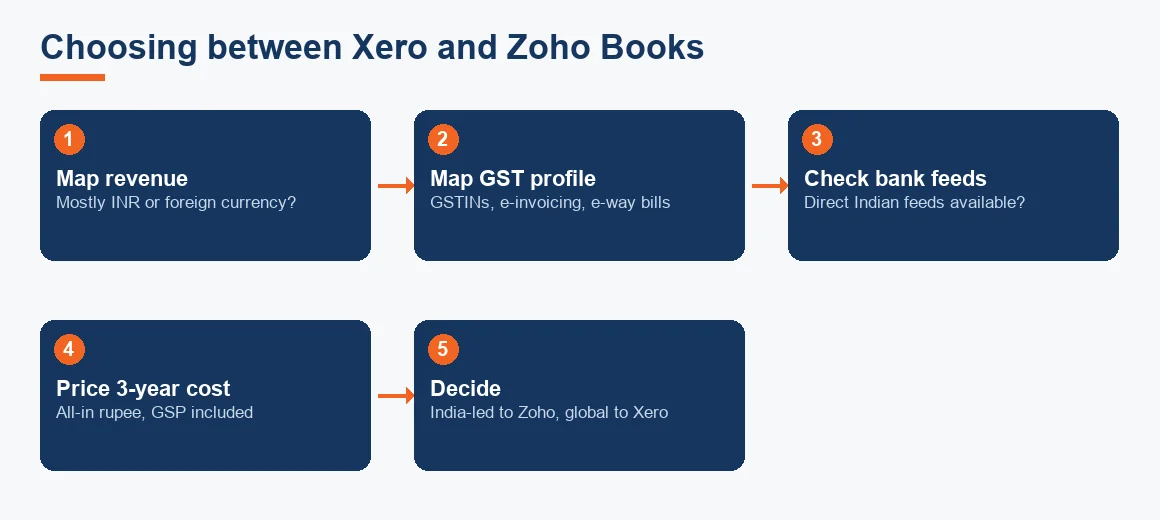
The decision is usually clearer than the marketing suggests. Work through it in order:
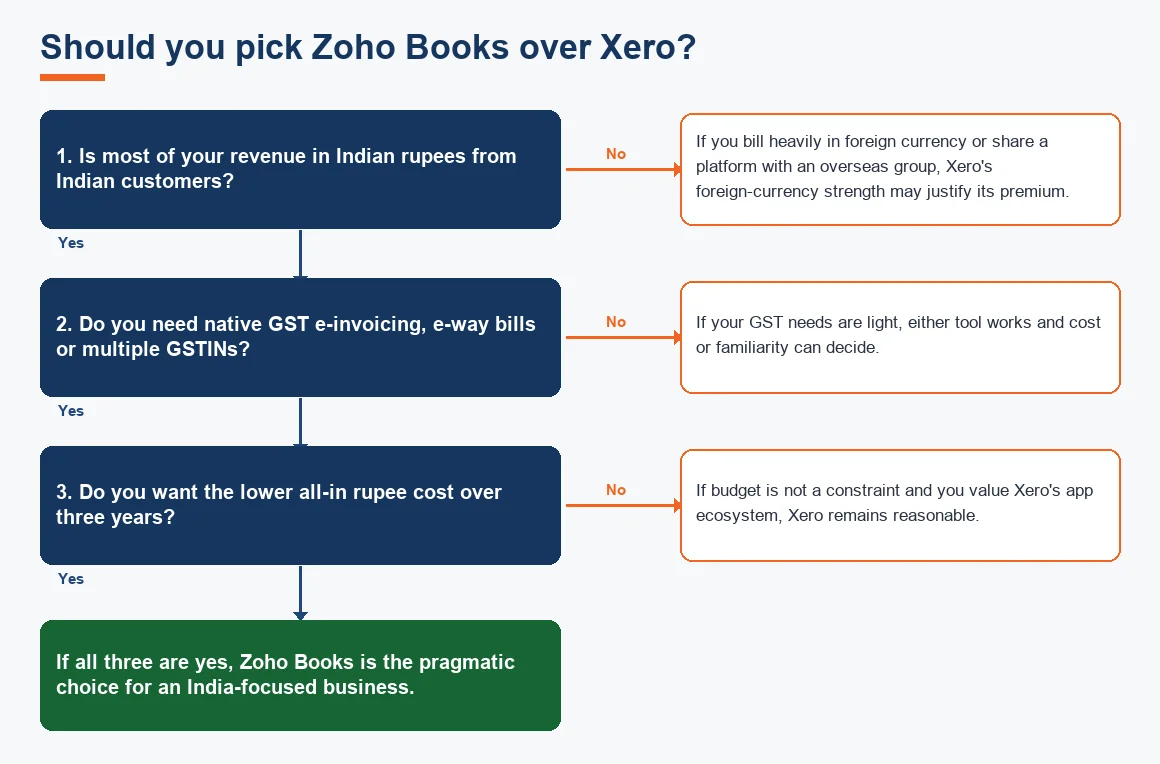
- Check where your revenue sits. Mostly Indian rupees and Indian customers points to Zoho Books; substantial foreign-currency billing or an overseas group points to Xero.
- Check your GST profile. One or more GSTINs, e-invoicing and e-way bills all favour Zoho Books, which handles GSTIN mapping natively.
- Check your banking. If your banks offer Zoho direct feeds, weekly reconciliation gets much lighter.
- Check your reporting and consolidation needs, including multi-currency requirements and how tightly your GST data must line up for GSTR-2B input tax credit matching.
- Price the full three-year, rupee, all-in cost, not the monthly headline.
If most answers land on the India side, Zoho Books is the pragmatic pick; if foreign currency and overseas structure dominate, Xero is worth its premium. For hands-on setup and migration on either platform, the Xero accounting services and Zoho Books accounting pages explain how we implement each.
Key terms
- Xero Bank Rules: conditions that auto-code repeating bank transactions during reconciliation.
- Hubdoc Automation: Xero's document-capture tool that reads bills and receipts into the ledger.
- Zoho GSTIN Mapping: how Zoho Books links each GST registration to a separate organisation.
- Multi-Currency Bank Feed: a feed that imports transactions in more than one currency for foreign accounts.
Key takeaways
- Zoho Books is India-native: e-invoicing, GSTIN handling and rupee billing are built in.
- Xero is a strong general platform with no native India e-invoicing, no free tier and foreign-currency pricing.
- Zoho Books has a free plan below Rs 25 lakh turnover; Xero starts as a paid subscription.
- Both meet the audit trail rule, but Zoho Books gives an India-specific report auditors can test directly.
- Choose on where your revenue, GST and banking sit, then compare the full three-year rupee cost.
Decision guide