
In this guide
Catch-up bookkeeping is the work of recording months, or sometimes years, of transactions that were never entered, and reconciling them into complete books that match the bank, the GST returns and the last filed financials. It is what you need when the accounts have simply fallen behind: sales, purchases, bank movements and expenses exist in real life but were never posted. The aim is a clean, reconciled set of books for the pending period, brought up to the current date without disturbing any year that is already closed and filed.
What is catch-up bookkeeping?
In plain terms, catch-up bookkeeping (sometimes called catch-up accounting) is the process of taking a backlog of unrecorded financial activity and turning it into a proper general ledger using double-entry bookkeeping. Every transaction is posted as a journal entry, banks are reconciled, and the period ends in a trial balance that ties out. "Bookkeeping catch up" and "catch up accounting" mean the same thing: the books were behind, and now they are current.
The output is not just data entry. It is a defensible record: numbers that agree with the bank statements, with GST already filed, and with TDS reflected in Form 26AS. If you only want the commercial help of getting this done for you, that belongs with our Backlog Bookkeeping / Catch-Up service rather than this explainer.
Catch-up vs clean-up bookkeeping: what is the difference?
People use the two terms as if they were interchangeable, and a real backlog usually needs both. But they solve different problems. Catch-up records what was never entered. Clean-up corrects what was entered wrongly: duplicated invoices, misclassified expenses, a stale bank reconciliation that never closed, or a suspense balance nobody cleared. Catch-up and clean-up of financial transactions together mean bringing the books both up to date and up to standard.
| Aspect | Catch-up bookkeeping | Clean-up bookkeeping |
|---|---|---|
| Core problem | Transactions were never recorded | Transactions were recorded incorrectly |
| Typical trigger | Months or years with no entries | Books exist but do not reconcile |
| Main activity | Posting and reconciling the backlog | Correcting, reclassifying, de-duplicating |
| Signal it is done | Trial balance ties out for the period | Balances agree with source and audit-ready |
For the correction side of a large backlog, our sibling explainer on how to clean up years of backlog accounting records goes deeper; this page stays on the catch-up meaning.
When do you need catch-up bookkeeping?
The honest answer is: the moment you cannot say what your bank balance should be from your own books. Common triggers are a GST notice for a mismatch, a lender asking for financials you do not have, a resigned accountant who left the ledgers half-done, or the ITR deadline arriving with no numbers. If you are unsure whether you have crossed that line, the warning signals are set out in signs your books are behind.
How to catch up on bookkeeping, step by step
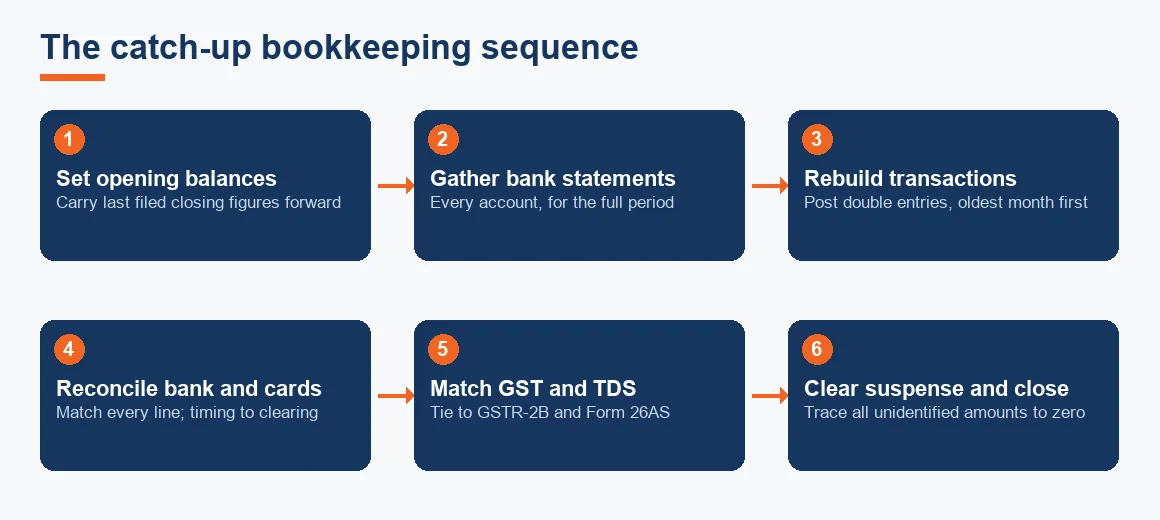
The sequence matters. Doing it out of order creates rework, because opening balances and reconciliations depend on each other.
- Fix the opening position. Take the closing figures from the last audited or filed financials and set them as opening balances. Without a firm starting point, nothing downstream will reconcile.
- Gather every bank statement. For the full period, for every account. This is the spine of the whole exercise.
- Rebuild transactions. Post sales, purchases, expenses and bank movements as double entries, month by month, oldest first.
- Reconcile each bank and card. Match the ledger to the statement line by line. Timing differences go to a clearing account, not into the void. Reconciliation itself is covered by Bank & Credit Card Reconciliation.
- Match GST and TDS. Tie input credit to GSTR-2B and TDS to Form 26AS, so the books agree with what the government already has.
- Clear suspense and close. Every unidentified amount is traced and cleared. A leftover suspense balance is an audit qualification, so the period is not finished until it is zero.
Where the backlog is mostly vendor bills or customer receipts, the payable and receivable side can be run in parallel through Accounts Payable Outsourcing and Accounts Receivable Outsourcing, which keeps the reconstruction moving while the ledger is rebuilt.
Which documents you need before you start
Missing bank statements stall the work faster than missing invoices, because you can estimate an invoice but you cannot invent a bank line. Collect these first:
- Bank statements for every account, for the full period.
- Cash records and petty cash registers.
- Sales and purchase invoices.
- GST returns already filed, plus the GSTR-2B downloads.
- TDS challans and Form 26AS.
- Loan statements and repayment schedules.
- Fixed asset invoices, and payroll registers.
- Last audited or filed financials, for opening balances.
Bringing back a fixed asset the ledger forgot
A frequent catch-up finding is an asset paid for through the bank but never capitalised, so no depreciation was ever charged. Suppose office equipment of Rs 1,20,000 was bought on 1 April 2023 and missed. During catch-up it is capitalised, and depreciation is worked out (a depreciation calculator does this in seconds) as a prior-period adjustment where the earlier year is already closed.
| Particulars | Amount (Rs) |
|---|---|
| Asset cost capitalised (1 Apr 2023) | 1,20,000 |
| Depreciation at 15% WDV, FY 2023-24 | 18,000 |
| Written-down value at 31 Mar 2024 | 1,02,000 |
| Depreciation at 15% WDV, FY 2024-25 | 15,300 |
| Written-down value carried forward | 86,700 |
The point is not the rate but the discipline: catch-up does not stop at posting the payment, it restores the accounting the payment triggered.
The deadlines that make catch-up urgent
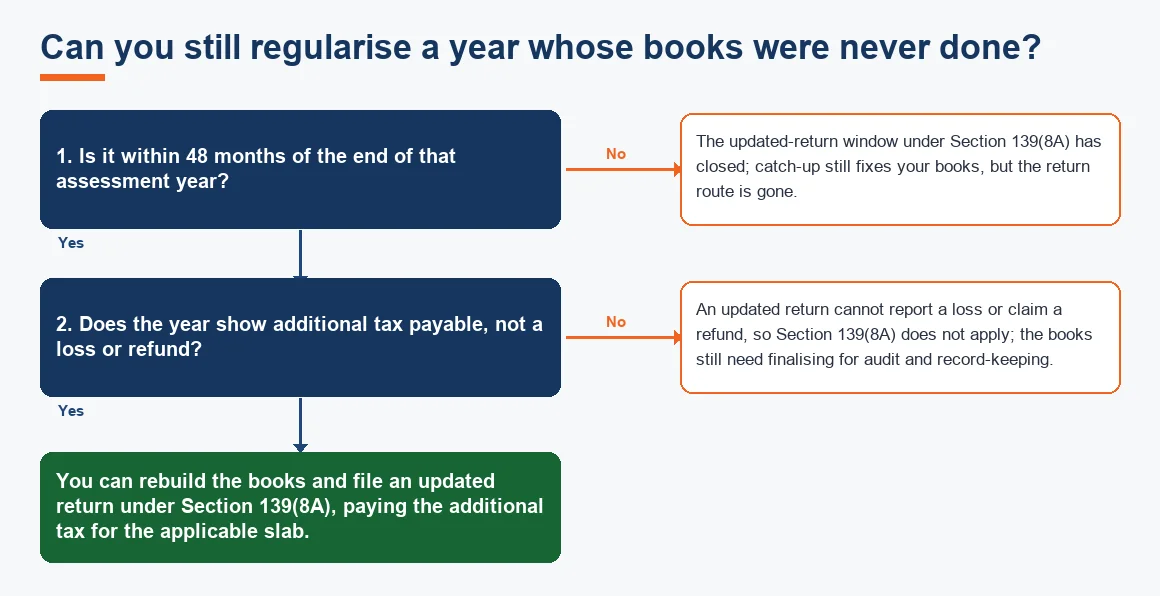
Catch-up is not only tidiness. Two statutory clocks turn a backlog into a real risk. First, a year whose return was never filed can often still be regularised: an updated return under Section 139(8A) can be filed within 48 months of the end of the assessment year, after the Finance Act 2025 extended the earlier 24-month window, per the Income Tax Department. Additional tax rises with delay, from 25 percent of the tax and interest in the first slab to 70 percent in the last. An updated return cannot report a loss or claim a refund, so it only helps where tax is payable.
Second, you cannot simply discard old books. A company must keep books and vouchers for eight financial years before the current one under Section 128(5) of the Companies Act, as administered by the Ministry of Corporate Affairs. Professionals and businesses under Rule 6F keep records for six years. Reassessment under Section 149 can reach back five years and three months where escaped income exceeds Rs 50 lakh, so a backlog that old still matters.
Worked example: additional tax on a regularised year
Say catch-up for FY 2023-24 (AY 2024-25) surfaces income that was never returned, on which the tax and interest together come to Rs 75,000. The updated-return route lets you regularise it, but the additional tax depends on how late you file. The slabs work off the aggregate of tax and interest, and the GST portal data and Form 26AS are what you reconcile the underlying figures against.
| When the updated return is filed | Additional tax rate | Additional tax (Rs) |
|---|---|---|
| Within 12 months of AY end | 25% | 18,750 |
| 12 to 24 months | 50% | 37,500 |
| 24 to 36 months | 60% | 45,000 |
| 36 to 48 months | 70% | 52,500 |
Same year, same omitted income, and the cost of delay nearly triples. That is the arithmetic behind starting catch-up sooner rather than later.
Catch-up in finance versus catch-up bookkeeping
A quick clarification, because the word travels. "Catch-up" in finance often means a clause in a fund's profit waterfall, where a manager receives a larger share until a target return is reached. That is unrelated to bookkeeping. In accounting, an example of catch-up is exactly what this page describes: six unrecorded months entered, reconciled and closed. There is nothing to "calculate" in the finance sense; the work is measured in months of backlog and transactions posted, not in a percentage formula. Where a backlog also involves reconstructing figures purely from bank data, the method is set out in reconstructing financial statements from bank statements, which pairs naturally with accrual accounting once the cash movements are placed.
Key terms
- Catch-Up Bookkeeping: recording and reconciling a backlog of unentered transactions into complete books.
- Trial Balance: the list of ledger balances that must tie out before a period is considered caught up.
- Bank Reconciliation: matching the ledger to the bank statement, line by line, to confirm the books are complete.
- Prior-Period Adjustments: corrections that relate to a year already closed, routed through reserves rather than reopened.
- GSTR-2B Input Tax Credit Matching: tying claimed input credit to the auto-drafted GSTR-2B so the books agree with GST records.
Key takeaways
- Catch-up bookkeeping records unentered transactions; clean-up corrects wrong ones. A real backlog usually needs both.
- Lock opening balances first, then gather every bank statement: the reconciliation depends on both.
- A missed year can often still be regularised via an updated return under Section 139(8A) within 48 months, at 25 to 70 percent additional tax.
- Records must be kept for eight years (companies) or six years (Rule 6F), so old backlogs cannot simply be dropped.
- The longer you wait, the more the work and the additional tax cost, so start early.
Decision guide