In this guide
To reconstruct accounts from bank statements means to rebuild a complete set of books, a trial balance and financial statements, using the bank statement as the backbone when the original ledgers and vouchers no longer survive. Every credit in the statement is classified as a sale, a loan, a refund or capital introduced, and every debit as an expense, a purchase, a drawing or a repayment, with each classification supported by an invoice, a filed return or a written note. The result should be an auditable set of records, not a summary of the bank account. This is a common last resort after a lost laptop, a corrupted Tally file, a bookkeeper who left without a handover, or simply years of neglected paperwork.
What does it mean to reconstruct accounts from bank statements?
Reconstruction treats the bank statement as the one record that always exists, because the bank keeps its own copy. Working from that spine, you rebuild the general ledger line by line, applying double-entry bookkeeping so that every transaction lands in two accounts. A NEFT credit of goods sold becomes a debit to bank and a credit to sales; a vendor payment becomes a credit to bank and a debit to the relevant expense or purchase account. Where the bank narration is thin, the invoice or agreement behind the transaction decides the head. This is the technique-level heart of catch-up bookkeeping, and it is what a backlog bookkeeping and catch-up engagement actually does under the bonnet.
Bank reconstruction is not the same as a bank reconciliation
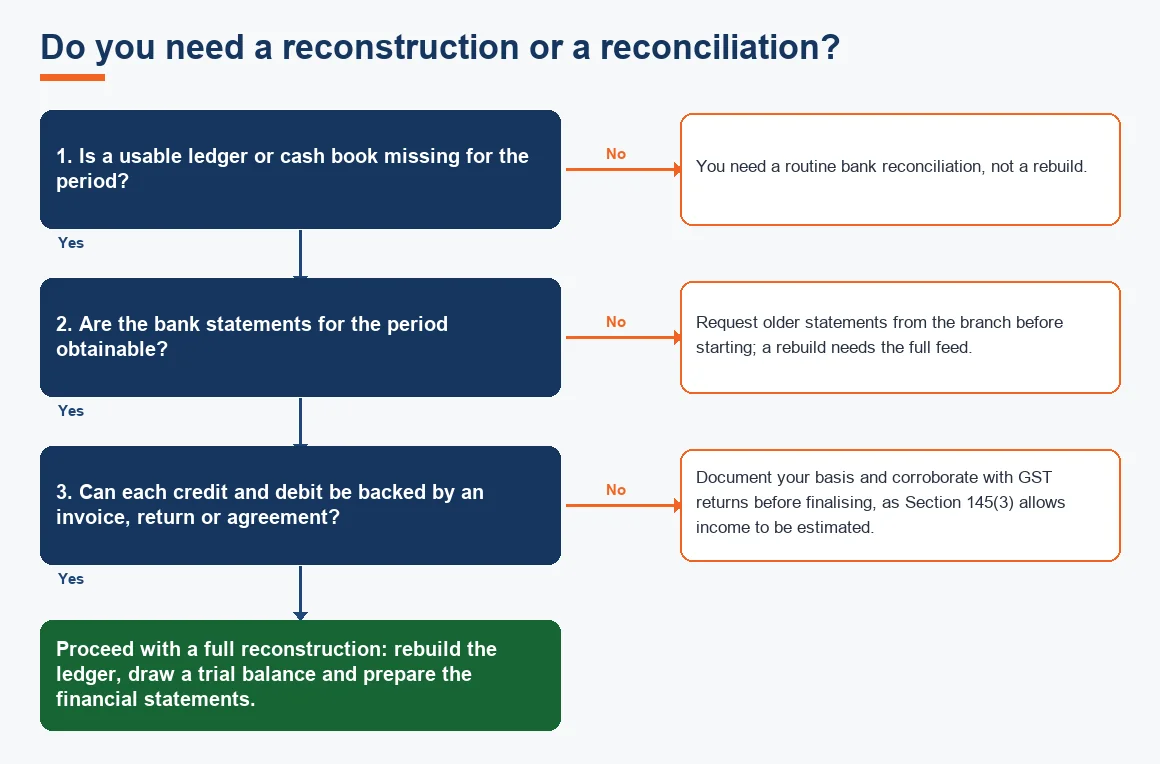
The two terms sound alike and are constantly confused. A bank reconciliation assumes you already have a cash book and simply proves it against the statement, listing timing differences such as cheques issued but not yet presented. A bank reconstruction statement, by contrast, is the set of books itself, rebuilt where no ledger exists at all. One verifies; the other creates. If you have a working cash book and only need it checked against the bank each month, that is ongoing bank and credit card reconciliation, a routine control rather than a rebuild.
What is a bank reconciliation statement, and how do you reconcile one?
A bank reconciliation statement starts from the closing balance in your bank ledger, adds deposits banked but not yet credited, deducts cheques issued but not yet presented, and posts items that appear only in the bank record such as charges, interest and direct credits. The adjusted figure must equal the statement balance. The first step is always to line up the ledger and the statement for the same period; the broad three steps are then to tick matching items, list the timing differences, and post the bank-only entries before proving that the two adjusted balances agree.
When do you need to rebuild books from bank statements?
You reach for a full rebuild when the ledger is gone rather than merely behind. Common triggers are a data loss with no backup, a dispute with a former accountant, an income-tax or GST notice for a year whose books were never written up, a bank asking for financials to process a loan, or a buyer conducting due diligence. If the records exist but are stale, the lighter path is described in our note on what catch-up bookkeeping is and when you need it. If they are missing or unreliable, reconstruction is the honest answer, and the warning signs are covered in the signs your books are behind.
How to reconstruct accounts from bank statements, step by step
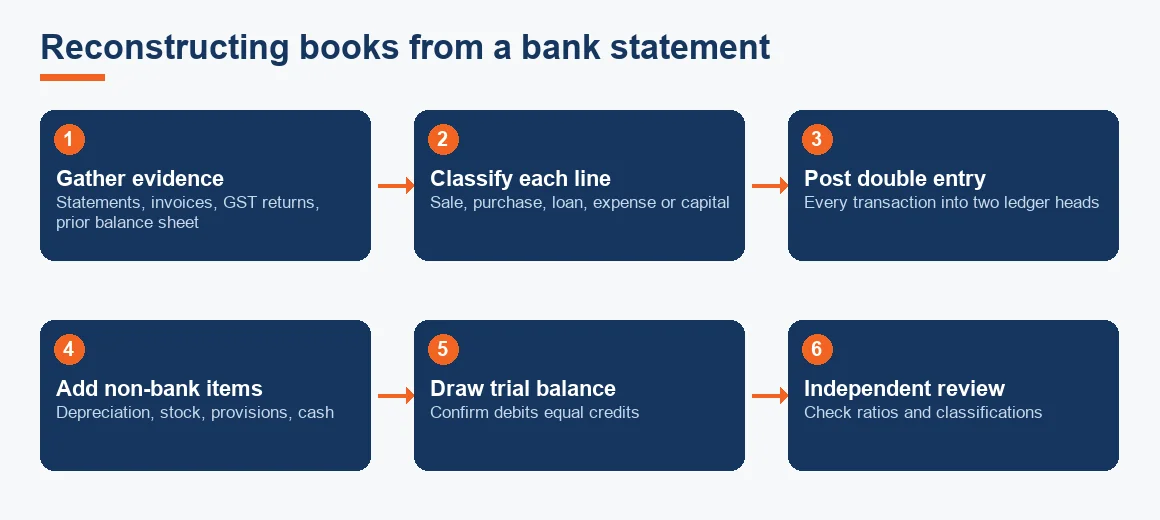
The work is methodical rather than clever. Do it one month at a time, in strict date order, and never skip forward to chase a total.
- Assemble the evidence. Collect every bank statement for the period, plus sales invoices, purchase bills, filed GST returns, TDS statements, loan agreements and the previous year's audited balance sheet if one exists, to fix opening balances.
- Classify each line. Tag every credit and debit to a ledger head, using the supporting document, not the narration, wherever the two disagree.
- Post the double entry. Record each transaction as a journal entry so that debits equal credits, building the ledger account by account.
- Add the non-bank entries. Layer in depreciation, closing stock, provisions and any cash transactions that never touched the bank, because these do not appear in the statement at all.
- Draw the trial balance. Extract a trial balance and confirm it balances before you build the profit and loss account and balance sheet.
- Get it independently reviewed. Have someone other than the preparer sanity-check the classifications and the gross-profit ratio against comparable years.
What types of accounts are reconciled, and how often?
Once the books are rebuilt, the discipline that keeps them right is regular reconciliation. Bank and credit-card accounts, loan and cash-credit accounts, key vendor and customer control accounts, and GST and TDS ledgers should all be reconciled to an external record. Bank and card accounts warrant a monthly reconciliation at the very least, and a fast-moving current account is best reconciled weekly. Vendor and customer balances are typically confirmed quarterly, while GST reconciliation against GSTR-2B follows the monthly return cycle. The heavier receivables and payables side of this routine can sit with accounts receivable outsourcing and accounts payable outsourcing once the base is clean.
| Aspect | Bank reconstruction | Bank reconciliation |
|---|---|---|
| Starting point | No usable ledger exists | A cash book already exists |
| Purpose | Create the missing books | Prove books against the statement |
| Primary source | Bank statement plus invoices and returns | Bank statement plus existing ledger |
| Frequency | One-off, per affected period | Recurring: weekly or monthly |
| Typical output | Trial balance and financial statements | A reconciliation statement |
What happens if the reconciliation does not balance?
A residual difference is a signal, not a nuisance to be smoothed over. Trace it: look for a transposed figure, a transaction posted to the wrong head, a duplicate entry, an omitted bank charge, or an opening balance carried incorrectly. Common causes are timing items that were forgotten, direct debits the business never recorded, and interest or charges that only the bank knew about. What you must never do is post the gap to a suspense or clearing account and leave it there, because an unexplained plug is exactly what an assessing officer or auditor will question first.
Can turnover be proved from bank credits alone?
Not on its own. Bank credits understate turnover wherever cash was collected and spent without ever being banked, so a reconstruction built only from the statement will miss that layer of sales. This is why the rebuild must be corroborated with GST returns already filed, e-way bills, purchase invoices, stock movement and the gross-profit ratio of comparable years. Section 145(3) of the Income-tax Act allows the assessing officer to reject incomplete books and estimate income, so the method and its assumptions have to be documented in writing. The Central Board of Indirect Taxes and Customs guidance on the GST portal and the returns themselves become independent evidence of declared sales, and the Income Tax Department record of filed ITRs anchors the direct-tax side.
How many years of bank statements can you actually get?
Most Indian banks retain and supply up to ten years of statements. The last one or two years are usually available for self-download in net banking, and older periods are issued at the branch on a written request against a charge. That reach matters because Section 128(5) of the Companies Act separately requires a company to preserve its books of account and vouchers for eight financial years immediately preceding the current one, a duty explained in the Ministry of Corporate Affairs material at mca.gov.in. In practice both records should exist, and the bank statement fills the gap when the internal set has been lost.
Worked example: rebuilding one month from a bank feed
Suppose a trader lost the books but pulled the April statement. The opening bank balance was 2,10,000. Below, each line is classified to a ledger head and posted as a double entry; the closing bank figure must tie back to the statement. Amounts are in INR.
| Date | Bank narration | Amount | Classified as | Debit / Credit to bank |
|---|---|---|---|---|
| 03 Apr | NEFT from customer | 1,80,000 | Sales (goods) | Debit bank |
| 08 Apr | Payment to supplier | 1,15,000 | Purchases | Credit bank |
| 12 Apr | Loan credit from bank | 5,00,000 | Term loan (liability) | Debit bank |
| 18 Apr | Rent paid | 45,000 | Rent expense | Credit bank |
| 25 Apr | UPI from customers | 90,000 | Sales (goods) | Debit bank |
| 30 Apr | Bank charges | 1,200 | Bank charges | Credit bank |
| Closing bank balance | 2,10,000 + 1,80,000 + 5,00,000 + 90,000 − 1,15,000 − 45,000 − 1,200 = 8,18,800 | |||
The classification carries the real weight. The 5,00,000 loan credit is a liability, not income; only the 1,80,000 and 90,000 credits are sales, giving April turnover of 2,70,000. If cash sales were also collected and spent outside the bank, the GST return for April would show a higher figure, and that gap has to be investigated and added, not ignored. The same logic sits behind a formal financial statement preparation engagement once the monthly rebuilds are complete.
Keeping the rebuilt books clean afterwards
Reconstruction is only worth doing if the books stay right afterwards. Set an opening balance from the completed trial balance, reconcile the bank every month from day one, and keep the supporting classifications on file so the basis for each entry can be shown later. A structured clean-up, then a monthly rhythm, is the pattern set out in our guide to cleaning up years of backlog accounting records, and it is what turns a one-off rescue into a set of books you can actually rely on for tax, audit and financing.
Key terms
- Bank Statement Reconstruction: rebuilding a full set of books from the bank statement and supporting documents when no ledger survives.
- General Ledger: the master record of all accounts into which every classified transaction is posted.
- Trial Balance: a listing of all ledger balances used to confirm that debits equal credits before drawing the financial statements.
- Bank Reconciliation: the routine check that an existing cash book agrees with the bank statement after timing differences.
- Catch-Up Bookkeeping: writing up accounts that are behind, of which reconstruction is the extreme case.
Key takeaways
- Reconstruction rebuilds missing books; reconciliation only checks books that already exist.
- Classify every credit and debit against a document, not the bank narration, and never treat all credits as sales.
- Corroborate turnover with filed GST returns and gross-profit ratios, because cash sales rarely show fully in the bank.
- Trace any residual difference to its source; never bury it in a suspense account.
- Preserve statements and vouchers for eight years, and reconcile monthly once the rebuild is done.
Decision guide