In this guide
Cleaning up backlog bookkeeping means bringing years of unrecorded transactions to a reliable, reconciled state: posting missing entries, clearing the suspense account, matching bank and vendor ledgers, and correcting wrongly coded GST and TDS heads until the trial balance agrees with the bank statement, GSTR-2B, Form 26AS and a stock count for each year involved. It is a finite project with a clear finish line, not open-ended data entry, and it is best done backwards, from external evidence towards the ledger. This guide explains the meaning, the sequence and the statutory windows that decide how much of a backlog can still be corrected. If you would rather hand the whole exercise over, our Backlog Bookkeeping / Catch-Up team runs it end to end.
What is a clean up in bookkeeping?
A clean up is a one-time remediation of books that have drifted out of a trustworthy state. It is not the same as routine monthly bookkeeping, which keeps current books tidy; a clean up reaches back into periods that are already closed and fixes what was never posted or was posted wrongly. The scope usually covers unrecorded purchase bills and bank entries, GST and TDS heads booked to the wrong ledgers, personal and business money mixed in one account, and a swelling suspense balance that hides the difference. The exercise ends only when the trial balance ties out against every external source for each year.
If your books are only a few months behind rather than years, the lighter version of this is catch-up bookkeeping, which shares the same logic on a smaller scale.
What is a backlog in accounting, and what causes it?
Backlog in accounting is the volume of unrecorded transactions for periods that have already closed: months or years of unposted bills, bank entries and payroll. The important point is that it is measured in periods, not rupees. A business three financial years behind has to rebuild each year on its own, because returns, audits and reconciliations are all year-specific. You cannot average three years into one.
The usual causes are familiar. A founder does the books personally until the volume outgrows the evenings available. An in-house accountant leaves and no handover happens. The firm switches software and the migration is never finished. Or the year simply gets busy and reconciliation slips, quarter after quarter, until nobody is sure which entries were ever posted. Whatever the trigger, the warning signs tend to appear well before the backlog is admitted.
Is backlog on the balance sheet? Is it an asset or a liability?
Here two different meanings of backlog get confused, so it is worth separating them. In bookkeeping, a backlog is a work state, the pending data-entry queue. It is neither an asset nor a liability, and it does not appear on the balance sheet at all. What appears is its consequence: an unreliable trial balance, an unexplained suspense balance and reconciling items that have not been cleared.
The word backlog also has a second, unrelated meaning in sales and manufacturing: confirmed customer orders not yet delivered. That order backlog is a future performance obligation, disclosed in management commentary rather than recognised as a balance sheet item, and it becomes revenue only when the goods or services are delivered. Neither meaning puts a line item on the balance sheet, so if someone asks whether backlog is an asset or a liability, the honest answer is that it is neither.
How to clean up a general ledger: a step-by-step
The reliable way to reconstruct a ledger is to start from accounts that have an independent external source and work inwards. Follow the sequence in the same order for every year in the backlog.
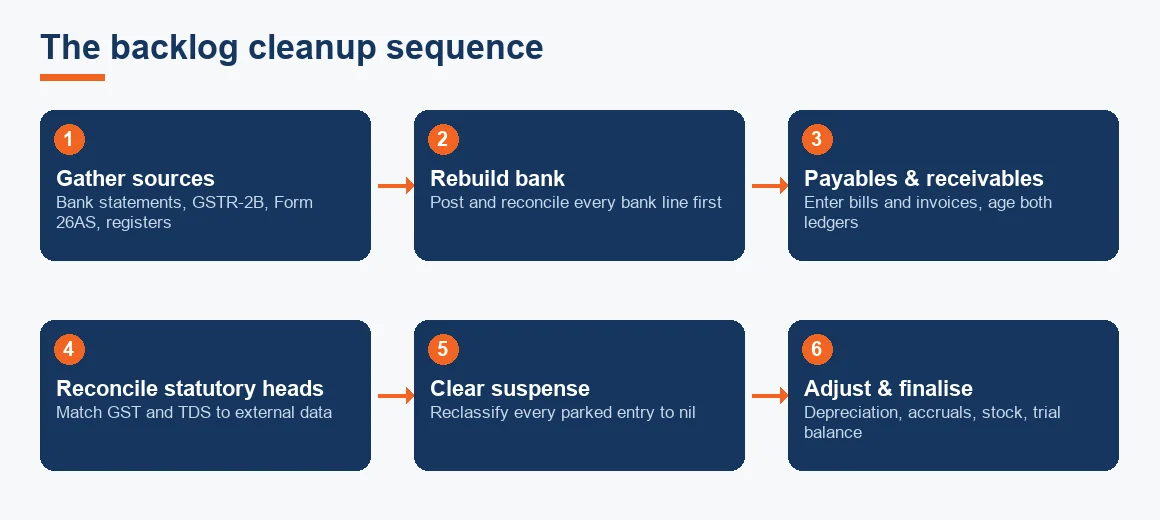
- Gather the sources. Collect bank statements, GSTR-2B and GSTR-1 downloads, Form 26AS, lender statements, the fixed asset register and a physical stock figure for each year-end.
- Rebuild the bank first. Post every bank line for the year, then run a bank and credit card reconciliation so the book balance agrees with the statement. The bank is the spine everything else hangs from.
- Rebuild payables and receivables. Enter purchase bills and match them to payments through accounts payable, then raise the missing sales invoices and clear receipts through accounts receivable. Age both ledgers.
- Reconcile the statutory heads. Match input tax credit to GSTR-2B, output tax to GSTR-1, and TDS receivable to Form 26AS. Correct any GST or TDS booked to the wrong ledger.
- Clear the suspense account. Investigate every entry parked in suspense, reclassify it, and bring the balance to nil. A residual suspense balance means the cleanup is not finished.
- Adjust and finalise. Book depreciation, accruals, prepaids and stock, then produce a trial balance that agrees with all external sources.
Where does cleanup fit in the four phases of accounting?
The four phases of accounting are recording, classifying, summarising and interpreting. A backlog cleanup is really the first two phases done late and at scale: recording the transactions that were never entered, then classifying them to the correct heads. Only once those are complete can you summarise into financial statements and interpret the result. This is why a cleanup that stops at data entry is only half done; without correct classification, the summary that follows will still be wrong.
Worked example: reconciling the bank in a backlog year
Suppose you have posted every bank line for a backlog year and the ledger shows a closing bank balance of Rs 4,18,000, but the bank statement closes at Rs 3,86,500. The reconciliation below explains the Rs 31,500 gap and is the point at which the year can be signed off. All figures are illustrative.
| Particular | Amount (Rs) |
|---|---|
| Closing balance as per books | 4,18,000 |
| Add: cheques issued but not yet cleared | 46,000 |
| Less: deposit in transit at year-end | (75,000) |
| Less: bank charges not yet posted in books | (3,500) |
| Add: interest credited by bank not posted in books | 1,000 |
| Adjusted balance as per bank statement | 3,86,500 |
The Rs 3,500 charge and Rs 1,000 interest are genuine omissions and must be posted as journal entries before the year closes; the uncleared cheques and deposit in transit are timing differences that need no entry. Once the adjusted figure equals the statement, the bank is clean and the rest of the year can be finalised against it.
Statutory correction windows you cannot miss
Rebuilding the books is only useful if the resulting corrections can still be filed. Each tax has its own outer limit, and once it passes, the correction is lost even though your ledger is now accurate.

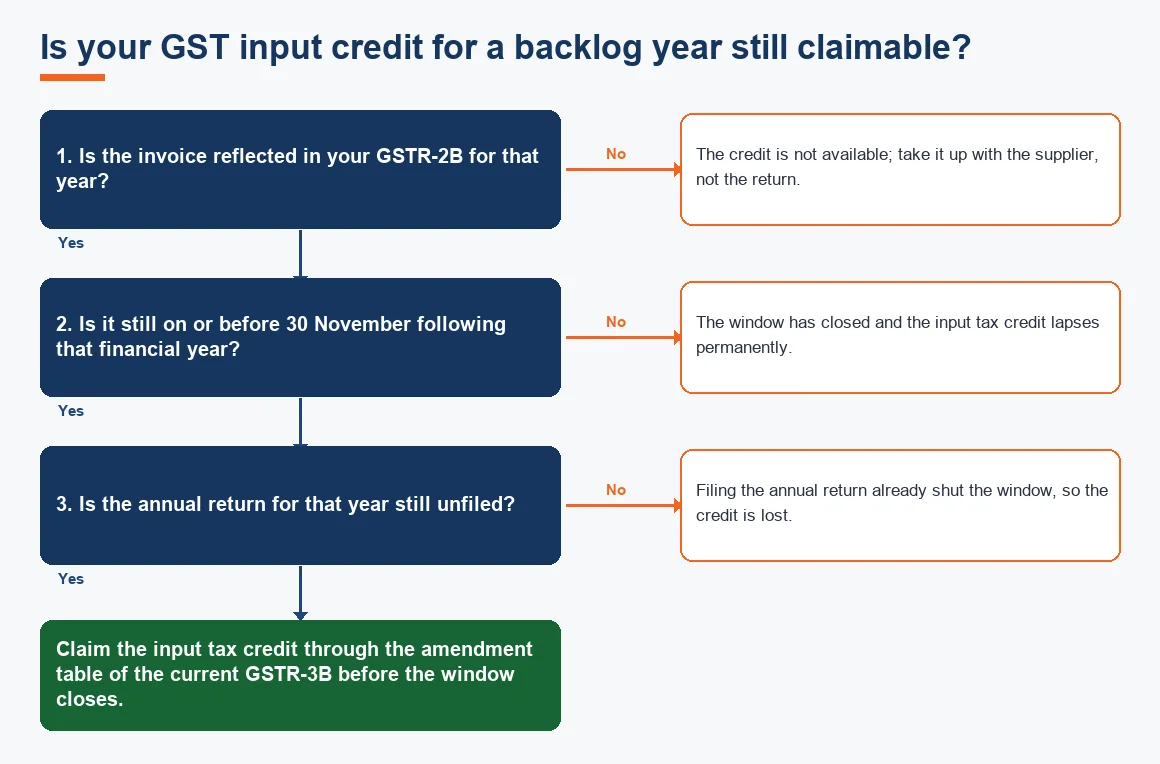
GST. Once filed, GSTR-1 and GSTR-3B cannot be revised. Errors are corrected through the amendment tables of a later return, and the outer limit is 30 November following the end of the financial year or the date of filing the annual return, whichever is earlier. Input tax credit for a year that is missed by that date lapses permanently, so match input credit to GSTR-2B before the window shuts. The CBIC and the GST portal carry the current return timelines.
Income tax. A belated or updated return has its own deadline, and reassessment reaches back further: a notice under section 148 can be issued up to three years and three months from the end of the relevant assessment year, extended to five years and three months where the income escaping assessment is Rs 50 lakh or more and is represented by an asset. Check TDS credits against Form 26AS on the Income Tax Department portal as you rebuild.
MSME payables. If the backlog hides overdue dues to micro and small suppliers, the section 43B(h) clock means those amounts are deductible only in the year of actual payment when settled beyond the agreed limit, which can move profit between years once the bills are finally posted.
How to do a cleanup in accounting software
People still search for how to do a cleanup in QuickBooks, but it is worth knowing that Intuit withdrew QuickBooks from India, with access ending on 30 April 2023, so it is no longer an option for Indian books. The cleanup logic is identical in the tools that remain, such as Zoho Books or Tally. Reconnect and re-import the bank feed for the backlog period, use bank rules to bulk-categorise repetitive entries, rebuild the vendor and customer ledgers, then run the software's own reconciliation and trial balance reports to confirm each year ties out. The software changes; the sequence of reconcile-first, classify-second does not. For a broader view of how cleanup sits alongside routine work, see our accounting services overview, and note that a finished cleanup should roll straight into a disciplined year-end closing so the backlog does not build again.
Key terms
- Trial Balance: a list of all ledger balances used to confirm that total debits equal total credits.
- General Ledger: the master record of every account into which transactions are posted.
- Catch-Up Bookkeeping: bringing recent, still-open periods up to date, a lighter cousin of a full cleanup.
- Bank Reconciliation: matching the book bank balance to the bank statement and explaining every difference.
- Prior-Period Adjustments: corrections to figures reported in earlier, closed accounting periods.
Key takeaways
- A cleanup is a finite project that ends when the trial balance agrees with every external source for each year.
- Rebuild backwards from bank statements, GSTR-2B and Form 26AS; never start from the profit and loss.
- Backlog is measured in periods, so each closed financial year is reconstructed separately.
- Clear the suspense account to nil, or the cleanup is not complete.
- The GST correction window closes on 30 November following the financial year, so file before the ledger accuracy becomes moot.
Decision guide