
In this guide
If you are behind on bookkeeping, the first signs are rarely a missed return. They are small, everyday things: a bank balance that never quite matches the books, a vendor chasing a payment you thought was cleared, a scramble to guess figures before a GST deadline. This piece sets out how to recognise those signals early, what the statutory risks actually cost, and how to check in a few minutes whether your books are current or slipping. It is a symptom guide, not a sales pitch: where a real fix is needed, we point you to the right place.
How do you know if your books are behind?
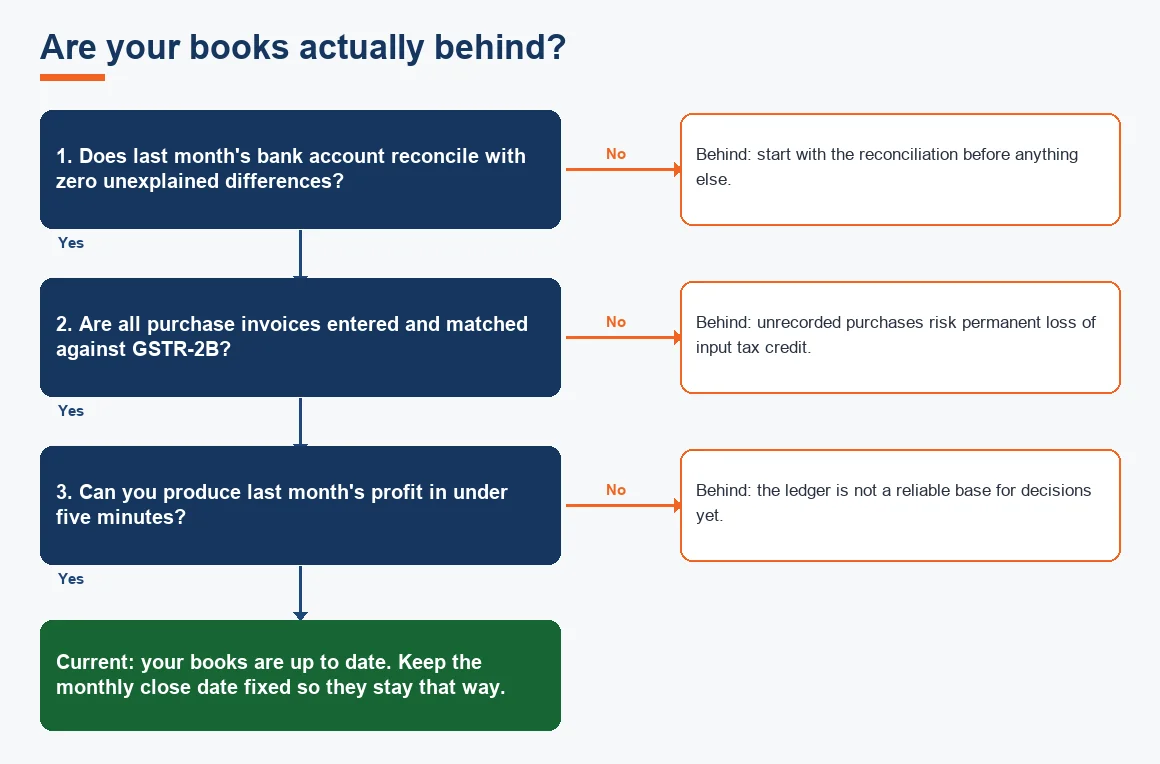
Books are behind when the record no longer reflects what has actually happened in the business. The clearest test is timing: if you cannot see last month's profit, closing bank balance and outstanding dues by the middle of this month, the records are lagging. A well-kept set of books lets you answer three questions on any given day: how much cash do I have, who owes me, and whom do I owe. If any of those needs a phone call, a spreadsheet or a guess, the books are already behind.
The lag tends to compound. One unrecorded month makes the next month's bank reconciliation harder, because the opening balance is wrong. Two months in, the general ledger stops being a reliable base for any decision. This is why a backlog is best caught at the one-month mark, not the one-year mark.
What are the signs of poor bookkeeping?
Most owners feel the problem before they can name it. The common symptoms of a business whose books have fallen behind are consistent across industries:
- The bank account does not reconcile, or nobody has tried to reconcile it in weeks.
- The trial balance does not tie, or suspense accounts are quietly absorbing differences.
- GST returns are prepared from bank figures rather than from recorded invoices.
- Vendor and customer balances in the books do not match what the parties themselves say.
- Invoices, bills and receipts sit in email or a drawer rather than in the accounting system.
- You cannot produce a profit figure for last month without a manual exercise.
Individually, each looks minor. Together, they are the signature of disorganised books, and they are the reason a filing eventually gets missed.
What happens if you don't keep up with bookkeeping?
Falling behind is not just untidy: it carries costs set by statute, and those costs run whether or not you meant to fall behind. Three matter most for Indian businesses.
GST late fees and interest
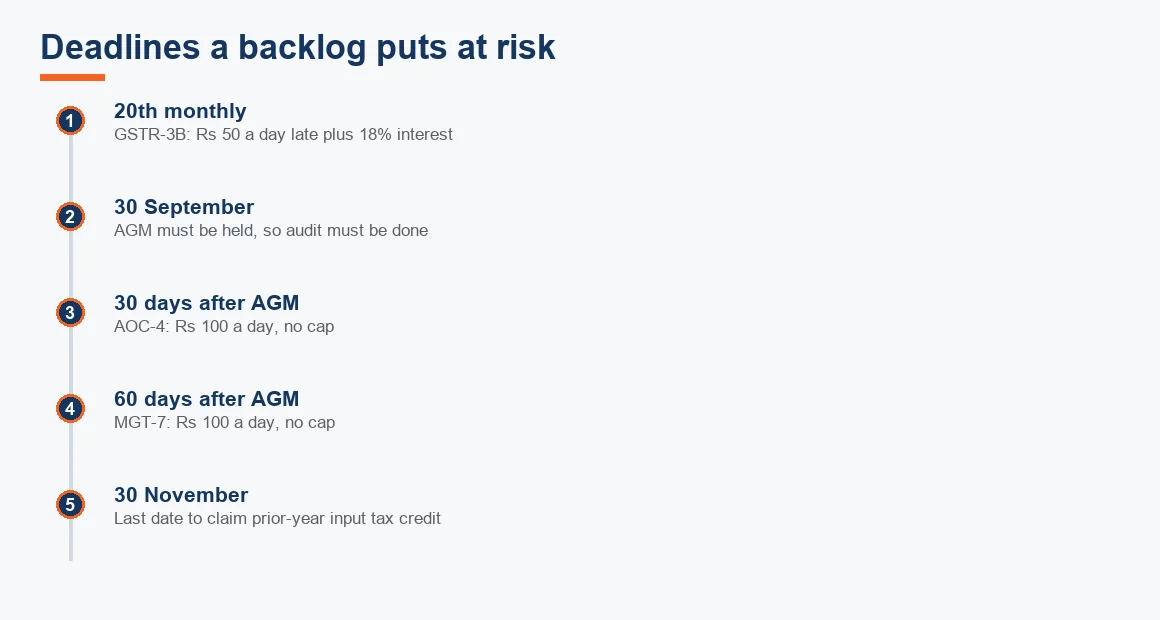
A late GSTR-3B attracts a late fee of Rs 50 a day (Rs 25 CGST and Rs 25 SGST), or Rs 20 a day for a nil return, plus interest at 18% a year on any unpaid tax. The rates and the mechanism are published by the CBIC. Because interest runs on the tax, not the return, a backlog quietly meters up every day it stays open.
Lost input tax credit
Credit for a financial year must be claimed by 30 November following the end of that year, or the date of the annual return, whichever is earlier. Miss it and the credit is gone for good. The invoice must also appear in your GSTR-2B for the claim to hold, so purchases discovered late in an unrecorded pile are the ones most likely to lapse. The GST portal shows exactly which invoices have auto-populated against your GSTIN.
ROC penalties for companies
For a private limited company, Form AOC-4 is due within 30 days of the AGM and MGT-7 within 60 days, and late filing costs Rs 100 a day per form with no upper cap, as set out by the MCA. Because the AGM must be held by 30 September, the audit (and therefore the books) has to be finished well before that. A backlog that reaches the audit stage is the most expensive kind.
What are the risks of falling behind on bookkeeping beyond penalties?
The penalties are the visible cost. The larger risk is the decisions you make on numbers that are not real. Provisional figures from incomplete books tend to flatter cash and understate liabilities, so pricing, hiring and drawings all get made on a picture that is out of date.
Financing is where this bites hardest. Working capital limits are renewed against audited financials and monthly stock and debtor statements, and banks reduce drawing power or charge penal interest when those statements are late. A cash credit account can be treated as irregular where stock statements are more than three months old. If your receivables ledger is behind, you also lose sight of your days sales outstanding, which is the first number a lender looks at. Keeping the accounts receivable aging schedule current is not optional if you rely on a bank line. Where receivables have slipped, structured accounts receivable outsourcing restores the ledger and the follow-up discipline together; the payables side is handled the same way through accounts payable outsourcing.
What is the hardest part of bookkeeping, and why do books fall behind?
The hardest part is rarely the accounting itself. It is the consistency: doing a small, dull task on the same day every month when nothing is on fire to force it. Books fall behind for ordinary reasons, not dramatic ones.
- No fixed close date. Without a month-end close checklist and a date, the work slides to "when there is time", which never arrives.
- Documents scattered across sources. Invoices in email, receipts in WhatsApp, statements in the bank portal: gathering takes longer than recording.
- Reconciliation left too long. A bank feed reconciled weekly takes minutes; left for a quarter it becomes a project.
- Growth outpacing the system. A method that worked at 20 invoices a month breaks silently at 200.
None of these is a moral failing. They are the predictable disadvantages of bookkeeping done around the edges of running a business, which is exactly why a routine matters more than effort.
A quick monthly self-check
You do not need software or a review meeting to know where you stand. Run this five-step check on the tenth of each month. If every answer is yes, your books are current.
- Is last month's bank account reconciled to the closing statement balance, with zero unexplained differences?
- Does the trial balance tie, with nothing sitting in suspense?
- Is every purchase invoice for last month entered and matched against GSTR-2B?
- Do your top five vendor and customer balances agree with theirs?
- Can you produce last month's profit figure in under five minutes?
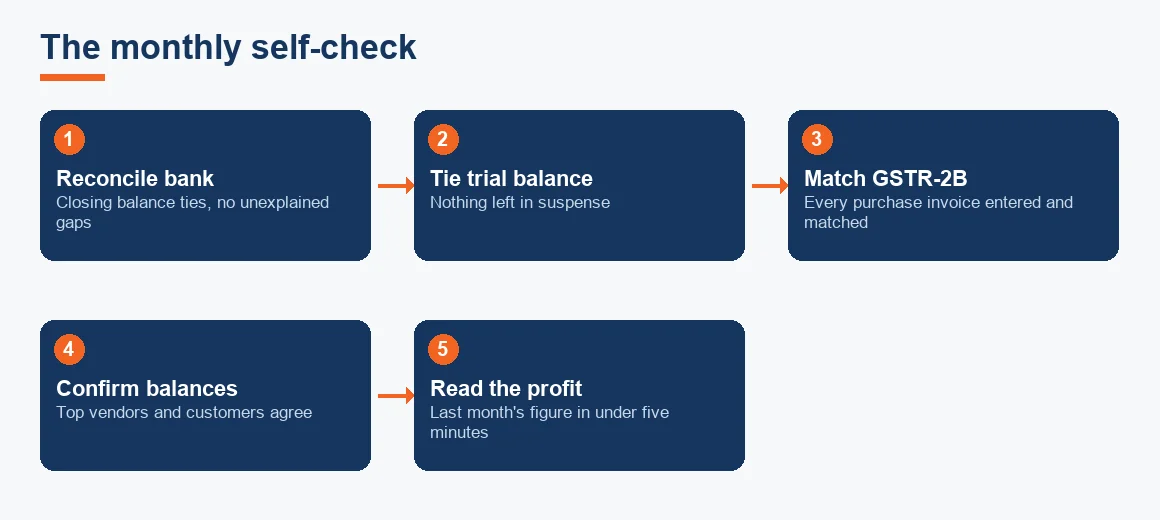
A single "no" is a warning, not a crisis. Two or more "no" answers for two months running means you have a genuine backlog and should plan a catch-up rather than hope to absorb it into normal work.
Worked example: the cost of ignoring one quarter
Numbers make the risk concrete. Take a small company that leaves one quarter unrecorded: GSTR-3B goes in 60 days late on Rs 2,00,000 of tax, Rs 10,00,000 of purchases are found after the credit cut-off, and the ROC forms slip by 90 days. The figures below are indicative; interest uses 18% a year on a 365-day basis.
| Cost head | How it is worked out | Amount (Rs) |
|---|---|---|
| GSTR-3B late fee (60 days) | Rs 50 per day x 60 days | 3,000 |
| Interest on unpaid GST | Rs 2,00,000 x 18% x 60/365 | 5,918 |
| Input tax credit lost (past cut-off) | Rs 10,00,000 x 18% | 1,80,000 |
| ROC late fee (AOC-4 and MGT-7, 90 days) | Rs 100 per day x 2 forms x 90 days | 18,000 |
| Total avoidable cost | 2,06,918 |
The interest and late fee are irritating; the lost credit is the real damage. Rs 1.8 lakh of tax you had already paid to your suppliers simply cannot be recovered once the window shuts. That is money leaving the business purely because invoices sat unrecorded, and no amount of tidy filing afterwards brings it back.
What to do if you are already behind
If the self-check told you the books are behind, the answer is a structured clean-up, not a late-night scramble. In outline, the work runs in a fixed order: gather every bank and card statement for the open period, rebuild the ledger month by month, reconcile each month before moving to the next, then match GST and close. For the mechanics of rebuilding from source records, see our guides on what catch-up bookkeeping is and when you need it, cleaning up years of backlog records, and reconstructing financial statements from bank statements. Where the backlog is deep or the deadlines are close, a dedicated backlog bookkeeping and catch-up service clears it in one pass and hands back reconciled books; ongoing bank and credit card reconciliation then keeps it from happening again. If your catch-up crosses a year-end, remember that the closing entries include depreciation, which our depreciation calculator works out under Schedule II.
The point of catching up is not just to stop the fines. It is to get back a set of books you can actually run the business on: one where the bank ties, the credit is claimed and last month's profit is a fact rather than a guess.
Key terms
- Catch-Up Bookkeeping: bringing an overdue set of books up to date, one open period at a time.
- Bank Reconciliation: matching the ledger's cash balance to the bank statement so differences are explained.
- Trial Balance: a list of all ledger balances that must tie, confirming the books are internally consistent.
- GSTR-2B Input Tax Credit Matching: checking purchase invoices against the auto-drafted GSTR-2B before claiming credit.
- Accounts Receivable Aging Schedule: a breakdown of who owes you and for how long, used to chase dues and assess credit.
Key takeaways
- The earliest sign of a backlog is an unreconciled bank account, not a missed return.
- GST late fees, 18% interest and (worst of all) permanently lost input tax credit make a backlog expensive fast.
- ROC forms cost Rs 100 a day per form with no cap, so a company's backlog must be cleared before the audit and AGM deadlines.
- A five-question monthly self-check on the tenth tells you in minutes whether you are current.
- If you are already behind, plan a structured catch-up in date order rather than a deadline-night scramble.
Decision guide