In this guide
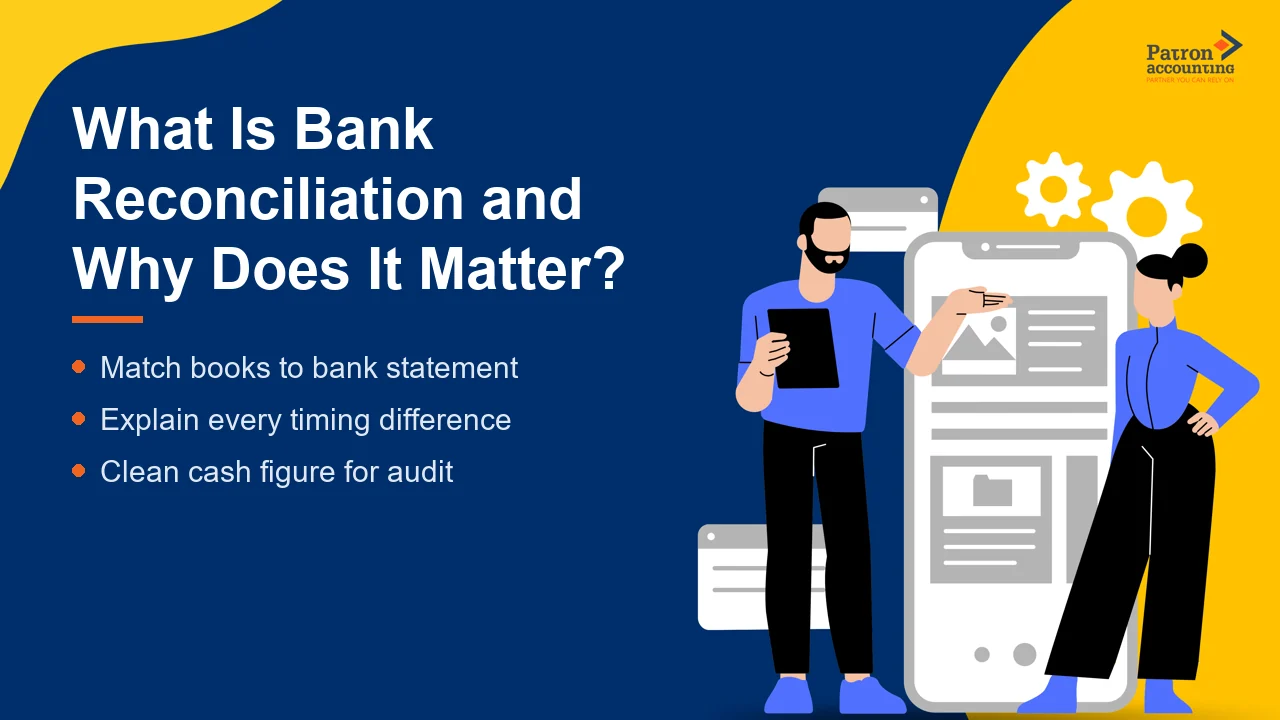
Bank reconciliation is the process of comparing the bank balance in your own books (the cash book) against the balance on the bank statement for the same date, and then explaining every difference between the two. If you want it in one word, it is matching: you match what you recorded against what the bank recorded, and you account for anything that appears on one side but not the other. The document that sets out this comparison is called the bank reconciliation statement, or BRS.
What is bank reconciliation? A plain-English meaning
Your books say one thing about the bank balance, and the bank statement often says another, even when nothing is wrong. That gap exists because the two records are written at different moments. You record a cheque the day you issue it; the bank records it only when the payee presents it. You record a deposit when you bank it; the bank credits it a day or two later. A bank reconciliation lists these differences, checks that each one is genuine and temporary, and confirms that the true cash position is what you think it is. It sits on top of your general ledger and relies on the discipline of double-entry bookkeeping, but it is a control step, not a fresh set of books.
A completed reconciliation answers one question with evidence: is the bank figure in my accounts real? For a full step-by-step walkthrough of building the statement itself, see our guide on how to prepare a bank reconciliation statement step by step.
Why bank reconciliation matters
The purpose of reconciliation is assurance. The cash and bank line is usually the most liquid asset on the balance sheet and the easiest to misstate, whether by an honest posting slip or by fraud. Reconciling it regularly gives you four practical benefits.
- It catches errors early. A cheque entered twice, a wrong amount keyed in, or a receipt posted to the wrong account shows up as an unexplained difference within days rather than at year end.
- It surfaces bank-only movements. Bank charges, GST on those charges, interest credited, standing instructions and auto-debits often reach you only through the statement. Reconciliation is how they enter the books in the right period.
- It protects downstream numbers. Your month-end bank balance feeds the GST working, cash-flow reports and management accounts. If the base is wrong, everything built on it is wrong.
- It is your audit evidence. Auditors treat the reconciliation as basic proof of the cash figure, so a clean file makes the statutory audit faster and cheaper.
What goes into a bank reconciliation statement (BRS)
Differences fall into two families. Timing differences are real transactions that both sides will eventually record, but one side is simply ahead: deposits in transit and unpresented (outstanding) cheques are the classic pair. Statement-only items are movements the bank has processed that you have not yet booked: charges, interest, direct credits and dishonoured cheques. The table below shows where each item lives and how it is treated when you reconcile from the cash book to the statement.
| Reconciling item | Recorded first in | Treatment in the BRS |
|---|---|---|
| Deposit in transit | Cash book | Add to the bank statement balance |
| Unpresented / outstanding cheque | Cash book | Deduct from the bank statement balance |
| Bank charges and GST on charges | Bank statement | Deduct from the cash book (post the entry) |
| Interest or direct credit | Bank statement | Add to the cash book (post the entry) |
| Dishonoured (bounced) cheque | Bank statement | Deduct from the cash book (reverse the receipt) |
| Posting error in your ledger | Cash book | Correct the ledger, do not adjust the statement |
The timing items resolve themselves within days, so they belong in the statement and need no journal entry. The statement-only items are permanent facts you had simply not yet recorded, so they must be posted into the books. If old timing items are piling up rather than clearing, read our note on common bank reconciliation errors and how to avoid them.
Who prepares a bank reconciliation, and how often?
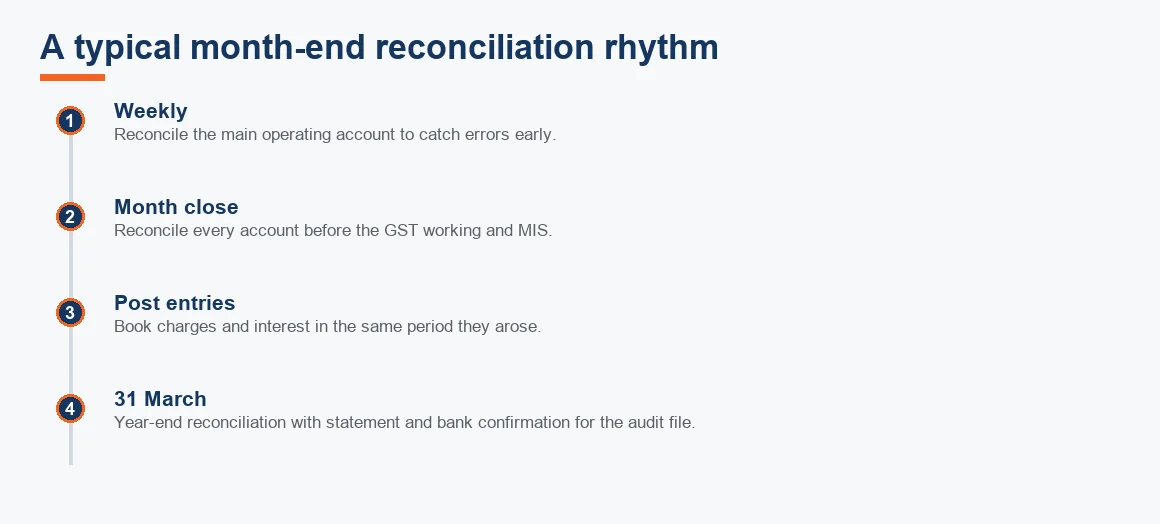
In a small business the bookkeeper or accountant prepares it; in a larger one it is usually someone in accounts payable or the finance team, ideally not the same person who signs cheques, so that there is a basic separation between recording and reconciling. On frequency, the working rule is weekly for the main operating account and at least monthly for every account, because month-end balances feed the GST return and management reports. A business with heavy daily collections should reconcile daily. Much of this becomes lighter once you switch on automated bank feeds, which pull transactions straight from the bank so you match rather than key. Keeping accounts current is also why backlog cases matter: if months of statements are unreconciled, a structured backlog bookkeeping and catch-up exercise is the right way to clear them.
The two and three methods of BRS
People ask about the two methods and the three methods, and both refer to your starting point, not to different maths. The two methods are: start from the bank statement balance and work back to the cash book balance, or start from the cash book balance and work forward to the bank statement balance. Both reach the same adjusted figure. The so-called three methods simply add a third framing used in teaching and in software, the adjusted-balance approach, where you correct both sides independently until each lands on the same true balance. Accounting software normally starts from the statement, since that is the document produced independently of you. The reconciliation you build for accounts payable and accounts receivable follows the same logic, which is why disciplined accounts payable outsourcing and accounts receivable outsourcing both depend on the bank being reconciled first.
A worked example of a bank reconciliation
Assume that on 31 March the cash book shows a balance of INR 2,45,000, while the bank statement shows INR 2,80,410. The following items explain the gap: interest of INR 1,200 credited by the bank, bank charges of INR 500 plus GST at 18 per cent (INR 90), a deposit in transit of INR 15,000 banked on 31 March but not yet credited, and cheques totalling INR 49,800 issued but not yet presented. The statement reconciles as follows.
| Particulars | Amount (INR) |
|---|---|
| Balance as per cash book | 2,45,000 |
| Add: interest credited by bank | 1,200 |
| Less: bank charges (500 + GST 90) | (590) |
| Adjusted cash book balance | 2,45,610 |
| Balance as per bank statement | 2,80,410 |
| Add: deposit in transit | 15,000 |
| Less: unpresented cheques | (49,800) |
| Adjusted bank balance | 2,45,610 |
Both sides now agree at INR 2,45,610, so the reconciliation is complete. Note that only the statement-only items (interest and charges) changed the cash book; the deposit in transit and the unpresented cheques were left in the statement column because the bank will clear them on its own within a few days.
The journal entry for bank reconciliation
A reconciliation itself is not journalised, but the statement-only items it reveals must be posted so the ledger catches up with the bank. Using the example above, you would record a journal entry debiting bank charges INR 500 and the input GST ledger INR 90, and crediting the bank account INR 590. Separately, you debit the bank account INR 1,200 and credit interest income INR 1,200. The GST of INR 90 on the bank fee can be claimed only once the bank uploads its invoice and it appears in your GSTR-2B input tax credit matching, so match before you claim. If interest is credited, check whether any TDS was deducted and trace it to Form 26AS on the Income Tax Department portal. GST on bank charges follows the normal input-credit rules set out by the CBIC.
Is a bank reconciliation compulsory in India?
No statute names the bank reconciliation statement by title, but Section 128 of the Companies Act 2013 requires every company to keep books that give a true and fair view, and the reconciliation is the evidence that the cash and bank figure is one you can stand behind. The Ministry of Corporate Affairs sets out those bookkeeping obligations at the MCA, and the Reserve Bank's own rules on bank statements and passbooks, published by the RBI, mean the statement you reconcile against is an independent, reliable record. In practice, then, for any company the reconciliation is not optional even though no section forces it by name. Credit card accounts follow the same discipline; see our note on reconciling credit card statements with your books.
Key terms
- Bank Reconciliation: matching the cash book to the bank statement and explaining every difference.
- Bank Clearing Account: a holding ledger used to park in-transit items until they clear the bank.
- Outstanding Cheques / Timing Differences: cheques issued but not yet presented, and similar timing gaps.
- Automated Bank Feeds: a direct link that imports bank transactions into your software for matching.
Key takeaways
- Bank reconciliation matches your books to the bank statement and explains every remaining difference.
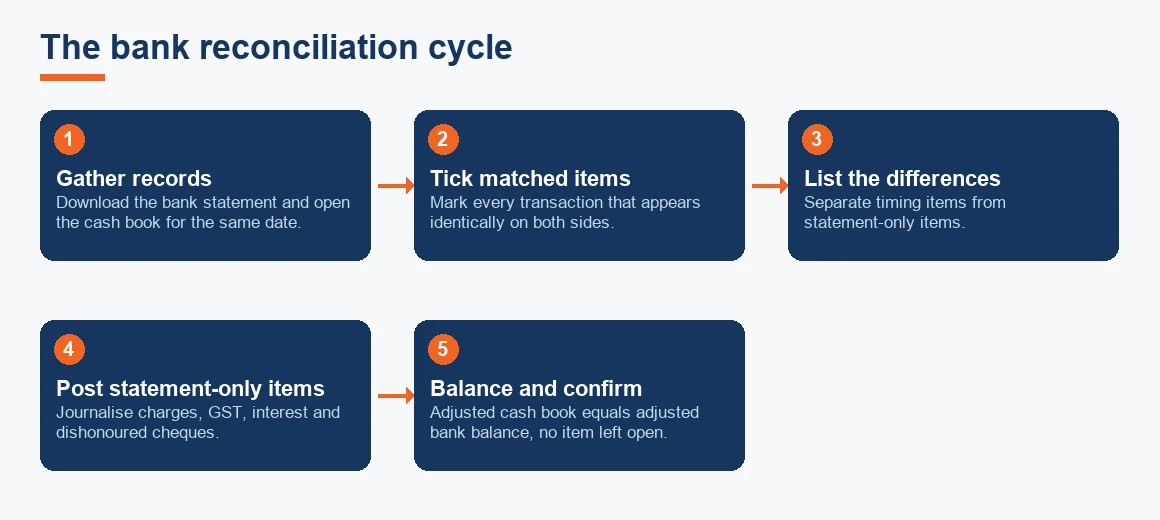
- Timing items (deposits in transit, unpresented cheques) go in the statement; statement-only items (charges, interest) are posted into the books.
- Both starting points, cash book or bank statement, reach the same adjusted balance.
- Never force a match with a plug entry; an unexplained balancing figure means the work is not done.
- Reconcile weekly for the main account and at least monthly for all accounts, with a supported 31 March reconciliation for the audit file.
If you would rather have every bank and card account reconciled on a fixed monthly rhythm with the entries posted for you, that is exactly what our bank and credit card reconciliation service is built to do, freeing you to read a clean cash figure instead of chasing it. And because reconciliation touches depreciation, GST and other month-end tasks, a broader set of finance calculators, including our depreciation calculator, can help with the surrounding close.
Decision guide