In this guide
A bank reconciliation error is any unexplained gap between the cash at bank figure in your books and the balance on the bank statement that is not a simple timing difference. The usual culprits are duplicated payments, omitted charges, a wrong opening balance and transposed digits. Sorting the genuine errors from the harmless timing items is the whole job, and doing it every month keeps a small gap from becoming twelve months of untraceable entries at the year end. This guide walks through the common mistakes, how to find them quickly and how to correct them cleanly.
What is a reconciliation error?
A reconciliation error is a difference that survives after you have listed the legitimate timing items. When you agree the general ledger cash balance to the statement, some differences are expected: a cheque you issued has not yet been presented, or a deposit paid in on the last day has not yet cleared. Those are timing differences and they resolve themselves. An error, by contrast, is a mistake in recording: the same payment entered twice, a bank charge never posted, or an amount keyed with its digits reversed. If you want the full grounding on the exercise itself, our explainer on what bank reconciliation is and why it matters covers the basics; this piece is about what goes wrong.
What are the common bank reconciliation errors?
Most reconciliation differences fall into a handful of recurring types. Recognising the pattern tells you where to look rather than forcing you to reread every statement line.
| Error type | What it looks like | How to spot it |
|---|---|---|
| Transposition | Rs 45,900 recorded as Rs 49,500 | Gap divides evenly by nine |
| Duplicate entry | One supplier payment posted twice | Two identical amounts, one date apart |
| Omission | Bank charges or interest never posted | Statement line with no matching book entry |
| Wrong opening balance | Prior month never fully cleared | Gap equals last month's residual |
| Wrong side / sign | A receipt entered as a payment | Gap is exactly double the item |
| Stale item left standing | Cheque uncleared beyond three months | Old date in outstanding cheques list |
A journal entry keyed on the wrong side produces a gap that is exactly twice the value of the item, which is another quick arithmetic tell: halve the difference and look for that amount.
Timing differences versus true errors
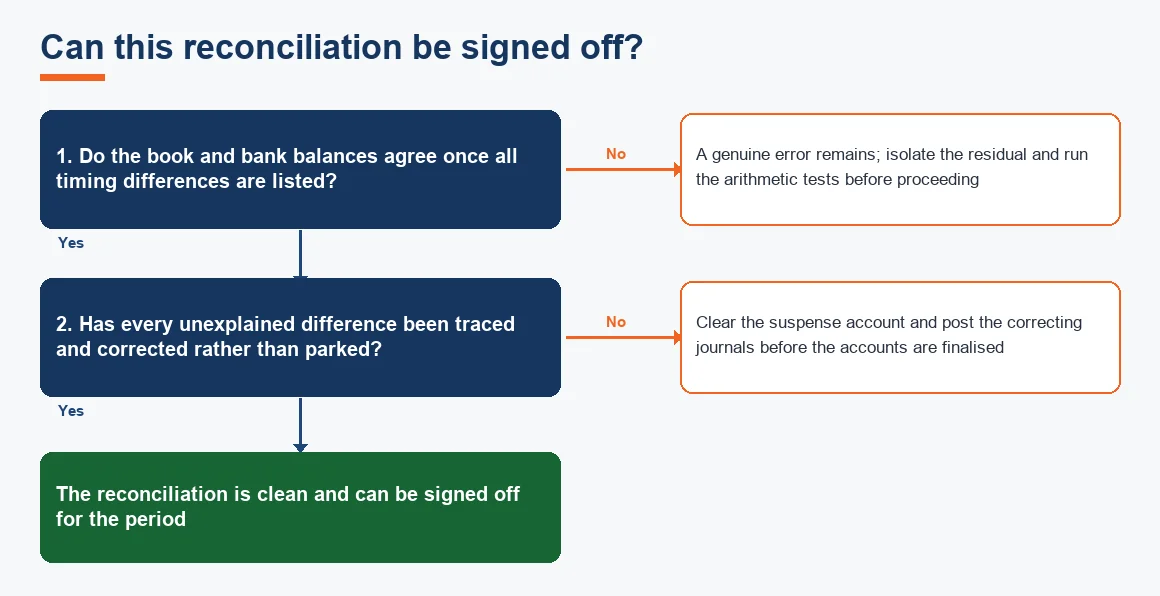
The single most common confusion is treating a timing difference as an error and "correcting" it, which then unbalances the next month. Unpresented cheques, deposits in transit and cheques deposited but not yet credited are all normal. They sit on the reconciliation as outstanding cheques and timing differences and disappear once the bank processes them. You never pass a journal for a timing difference. You pass a journal only for a genuine recording error, such as an omitted charge or a duplicate. Keeping the two apart is what stops the reconciliation from drifting month on month.
How to find mistakes in a bank reconciliation
A disciplined sequence finds errors far faster than staring at the statement. Work through it in order.
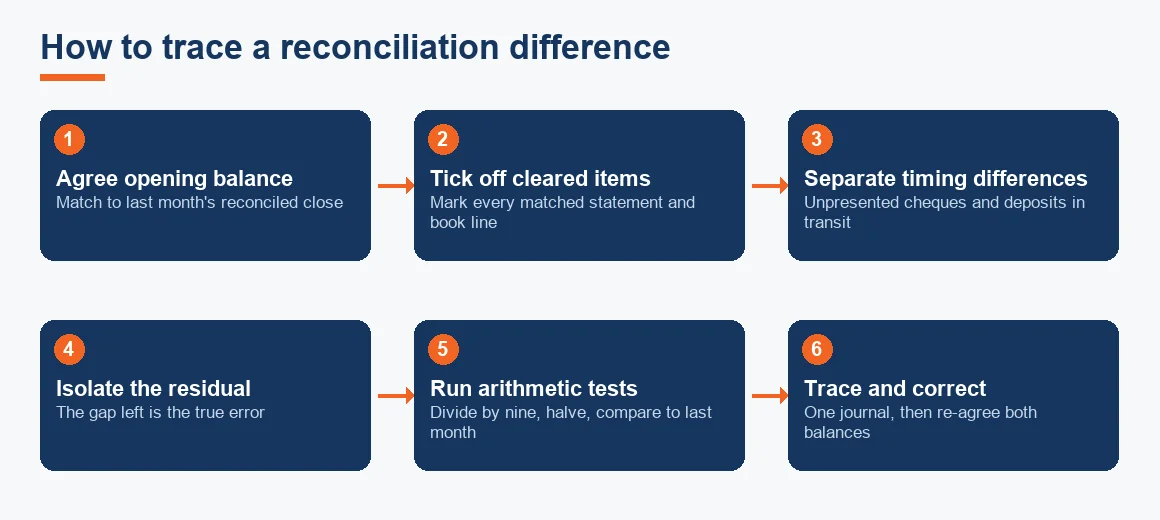
- Agree the opening balance. Confirm this month's opening figure equals last month's closing reconciled balance. A wrong opening balance masquerades as a current error.
- Tick off cleared items. Match every statement line to a book entry and mark both. What is left unmatched on either side is your working list.
- Separate the timing differences. Move unpresented cheques and deposits in transit onto the reconciliation. They are not errors.
- Isolate the residual. Whatever gap remains after timing items is the true error to trace.
- Run the arithmetic tests. Divide by nine for a transposition, halve for a wrong side, compare to last month for an opening error.
- Trace and correct. Find the offending entry, pass one correcting journal and re-agree both balances.
Our step-by-step guide to preparing a bank reconciliation statement sets out the full format if you need the layout alongside this troubleshooting flow.
Worked example: tracing a Rs 3,600 difference
A business finds its cash book will not agree with the bank statement at 31 March. After listing the timing items a residual of Rs 3,600 remains. Because 3,600 divides evenly by nine (3,600 / 9 = 400), the accountant checks for a transposition and finds a sales receipt of Rs 45,900 was recorded as Rs 49,500. The completed reconciliation looks like this.
| Particulars | Amount (Rs) |
|---|---|
| Balance as per bank statement | 4,42,700 |
| Less: cheques issued but not yet presented (timing) | (68,000) |
| Add: deposit in transit paid in on 31 March (timing) | 9,000 |
| Adjusted bank balance | 3,83,700 |
| Balance as per cash book | 3,88,200 |
| Less: bank charges not yet recorded (error: omission) | (900) |
| Less: transposition, receipt recorded as 49,500 instead of 45,900 (error) | (3,600) |
| Adjusted book balance | 3,83,700 |
Both sides now agree at Rs 3,83,700. Note that only the two book-side items are true errors requiring journals: a charge posted for Rs 900 and the receipt corrected by Rs 3,600. The bank-side items are timing differences and need no entry.
How to solve BRS problems and resolve discrepancies
Once you have identified the error, the fix is a single correcting journal entry passed on the book side, because you cannot change the bank statement. An omitted bank charge is posted as an expense against the bank. A duplicate payment is reversed. A transposition is corrected to the true figure. Where the gap cannot be traced within the close, it is parked in a suspense account and cleared before the accounts are signed. Businesses that carry many stale, unmatched entries usually need a backlog bookkeeping and catch-up exercise before monthly reconciliation becomes manageable again. Recurring differences on the payments side often trace back to weak accounts payable controls, and on the receipts side to accounts receivable that are recorded before the money actually lands.
Stale and duplicate items nobody clears
The quiet killers are the items that sit untouched. A cheque is valid for three months from its date under RBI instructions, so an uncleared cheque older than that should be written back by reversing the original payment and restoring the creditor balance. Left inside the outstanding cheques list, it understates both the bank balance and liabilities. Duplicates are the mirror image: the same amount clears once at the bank but appears twice in the books. A bank clearing account makes both far easier to catch, because every item must pass through and net to nil.
What are the limitations of bank reconciliation?
Reconciliation is powerful but not complete. It confirms that recorded cash agrees with the bank; it does not prove a transaction was genuine or authorised. A well-disguised fraud, where a fake payment matches a fake statement line, still reconciles. It also says nothing about whether an expense was correctly classified or GST correctly applied. Reconciliation is one control among several: it works best sitting alongside a reviewed trial balance, sound double-entry bookkeeping and a documented month-end close checklist, not on its own.
How often should you reconcile, and how to keep it clean?
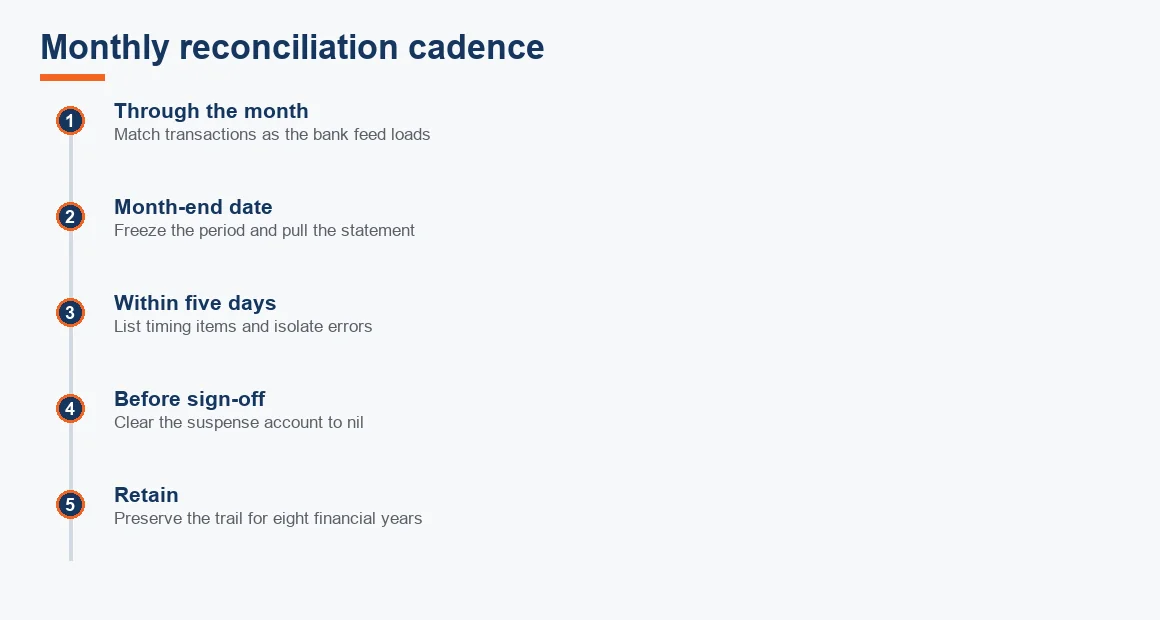
Monthly is the minimum, and weekly where daily collections are heavy, so that GSTR-3B and TDS payments rest on a verified cash position rather than an assumed one. Leaving everything to the 31 March year end turns a solvable monthly task into an audit problem. Under Section 128 of the Companies Act, books must give a true and fair view, which an unreconciled balance cannot support, and Section 128(5) requires the records to be preserved for eight financial years (see the MCA for the statute). Bank feeds in Tally, Zoho Books or Xero let you match transactions daily at almost no extra effort.
The same monthly rhythm applies to card statements; if that is where your differences cluster, our guide on reconciling credit card statements with your books covers the added complications of settlement dates and fees.
Key terms
- Bank Reconciliation: the monthly exercise of agreeing the book cash balance to the bank statement and correcting the differences.
- Outstanding Cheques / Timing Differences: legitimate gaps caused by cheques or deposits not yet processed by the bank; not errors.
- Bank Clearing Account: a holding account every bank item passes through, making duplicates and stale entries easy to isolate.
- Automated Bank Feeds: a live link that pulls bank transactions into the ledger so matching happens continuously.
Key takeaways
- Separate timing differences from true errors first; you journal the errors, never the timing items.
- Divide any unexplained gap by nine as your opening test for a transposition; halve it to test for a wrong-side entry.
- Write back cheques uncleared beyond three months and post omitted charges; do not leave them standing.
- Any untraceable residual goes to suspense and must be cleared before sign-off, never hidden in the bank balance.
- Reconcile monthly at least, weekly for heavy collections, and use bank feeds to keep the unmatched list short.
Reconciliation errors are almost always simple once isolated; the skill is in a disciplined method rather than in extra effort. If your accounts have fallen behind or the differences have grown beyond a quick fix, our bank and credit card reconciliation service can bring the balances back into agreement and keep them there.
Decision guide