
In this guide
A credit card reconciliation is the monthly check that matches every transaction on your business card statement to a recorded expense voucher, then confirms that the card control account in your books equals the outstanding amount the bank says you owe. When those two numbers agree and every line is explained, the card is reconciled. This guide sets out what a credit card reconciliation is, why it matters, the exact steps to follow, and the four adjustments that explain almost every difference you will meet. It is a process how-to; if you want the work done for you, that sits with our Bank & Credit Card Reconciliation service.
What is a credit card reconciliation?
In simple terms, reconciliation is the act of comparing two independent records of the same thing and clearing any gap between them. For a company card, one record is the statement issued by the bank and the other is the card control account you maintain under double-entry bookkeeping in your general ledger. Every time an employee swipes the card, an expense should be posted; every time you pay the bank, the control account is cleared. A credit card reconciliation confirms that nothing was posted twice, nothing was missed, and that the closing balance in the books ties back to the statement. The idea is identical to a bank reconciliation, only the second record is a card statement rather than a bank passbook.
What is the purpose of credit card reconciliation?
The purpose is control, not tidiness. A company card is a shared spending instrument, so it is the easiest account for duplicate claims, personal spend and quiet fraud to hide in. Reconciling it monthly does four things: it confirms that the expense in the books is real and supported by a bill, it catches interest and late fees the bank has charged but you have not booked, it makes sure refunds actually arrived, and it fixes the coding so your profit and loss is not overstated. It also protects your GSTR-2B input tax credit matching, because a card expense only carries credit when the underlying tax invoice is captured and matched, and reconciliation is where that check happens.
Which accounts should be reconciled, and how often?
Yes, credit cards do need to be reconciled, and they sit alongside the other accounts every business should reconcile: bank accounts, the card control account, key vendor and customer ledgers, and inter-company balances. The card belongs on that list precisely because it feeds directly into expenses. On frequency, reconcile monthly, aligned to the statement cycle, and finish before your GSTR-3B filing date so credit on card expenses is claimed in the right period. Businesses running more than about 100 card transactions a month benefit from weekly matching so the month-end is not a scramble. The hard deadline to remember is 30 November following the financial year end: input tax credit not claimed by then under Section 16(4) is lost permanently, as confirmed on the CBIC portal.
Key terms
- Bank Reconciliation: matching your bank statement to the cash book; the card version follows the same logic.
- Bank Clearing Account: a holding ledger where in-transit amounts sit until they settle on both sides.
- Journal Entry: the double-sided posting used to correct each reconciling difference.
- GSTR-2B Input Tax Credit Matching: checking supplier invoices against the auto-drafted GSTR-2B before claiming credit.
The credit card reconciliation process, step by step
The reconciliation process is a short, repeatable loop. The same steps apply whether you reconcile in a spreadsheet or inside accounting software with a card feed.
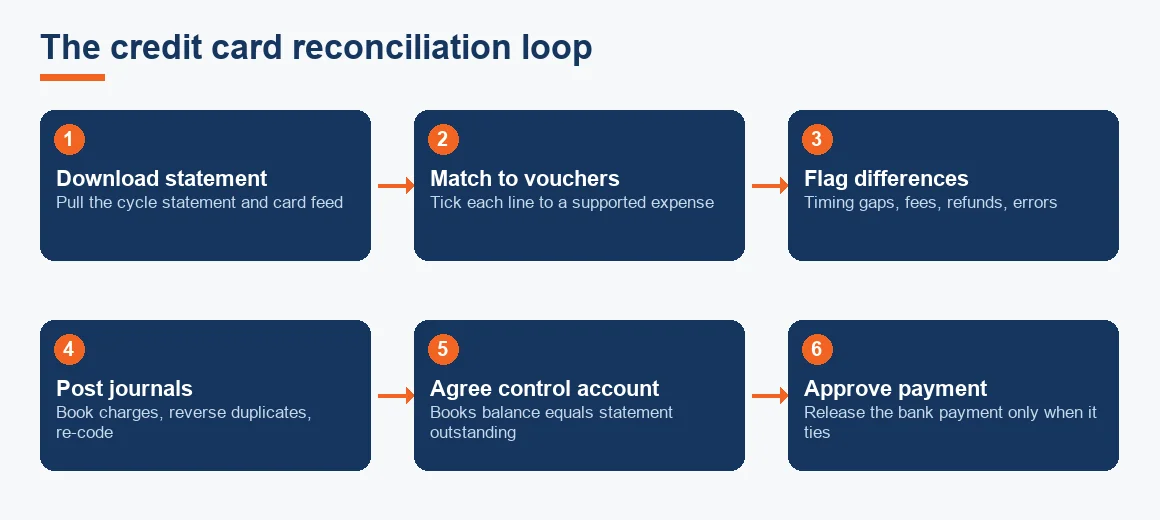
- Download the statement. Pull the closing statement for the cycle and, if available, the card feed into your accounting system.
- Match each line to a voucher. Tick every statement line against a recorded expense that has a supporting bill. Unmatched lines are your working list.
- Identify timing gaps and errors. Separate the genuine differences: transactions swiped near month-end but billed later, interest and fees not yet booked, refunds and reversals, and posting errors.
- Post adjusting journals. Clear each difference with a journal entry, booking unrecorded charges, removing duplicates and re-coding wrong heads.
- Agree the card control account. The control account balance should now equal the statement's outstanding amount. Any residual is investigated, not plugged.
- Approve the payment. Only once the account agrees do you release the payment to the bank, so you never pay a disputed or duplicated charge.
This is the same discipline our step-by-step guides apply to cash books; see How to Prepare a Bank Reconciliation Statement (BRS) Step by Step for the parallel workflow, and fold both into your month-end close checklist alongside the schedules our Depreciation Calculator and Deferred Tax Calculator support.
The four common reconciling adjustments
Almost every difference between a card statement and the books falls into one of four buckets. Knowing which bucket a difference belongs to tells you which side to adjust and what journal to pass. This is the summary to keep beside you at close.
| Adjustment | Why it arises | How to treat it |
|---|---|---|
| Swiped but not yet billed | Transaction near the cycle cut-off is recorded in books but not on this statement, or vice versa | Timing difference; carry forward and match in the next cycle |
| Interest, late fee and annual charge | Bank levies a charge that was never entered in the books | Book the charge to finance cost or bank charges via a journal |
| Refund or chargeback | Merchant credits a reversal that one side has recorded and the other has not | Post the credit to the original expense or control account |
| Error or duplication | A voucher is entered twice, coded to the wrong head, or keyed at the wrong amount | Reverse or reclassify with a correcting journal |
If a residual survives all four, it usually points to a missing bill or an unauthorised swipe, which is exactly what reconciliation is meant to surface. For the equivalent list on cash accounts, see Common Bank Reconciliation Errors and How to Avoid Them and the broader What Is Bank Reconciliation and Why Does It Matter?.
Worked example: agreeing the card control account
Suppose the March statement on a company card shows an outstanding balance of Rs 2,45,000, while the card control account in the books shows Rs 2,31,500, a gap of Rs 13,500. Working through the four buckets clears it exactly, and the adjusted book balance ties to the statement.
| Line | Amount (INR) |
|---|---|
| Card control ledger balance per books | 2,31,500 |
| Add: transactions on the statement not yet recorded in books | 14,000 |
| Add: interest and annual fee charged on the statement, not booked | 1,500 |
| Less: refund recorded in books but not yet on the statement | (2,000) |
| Adjusted book balance | 2,45,000 |
| Card statement closing balance | 2,45,000 |
| Difference | Nil |
The two unrecorded charges are posted (expense or bank charges debited, card control credited), the refund is left to match next cycle, and the account now agrees. Only then is the payment to the bank approved. Where a card also carries backlogged, unmatched months, our Backlog Bookkeeping / Catch-Up service rebuilds the control account before the first clean reconciliation, and the card feeds naturally into Accounts Payable Outsourcing and Accounts Receivable Outsourcing where vendor refunds and customer chargebacks are involved.
Can input tax credit be claimed on credit card expenses?
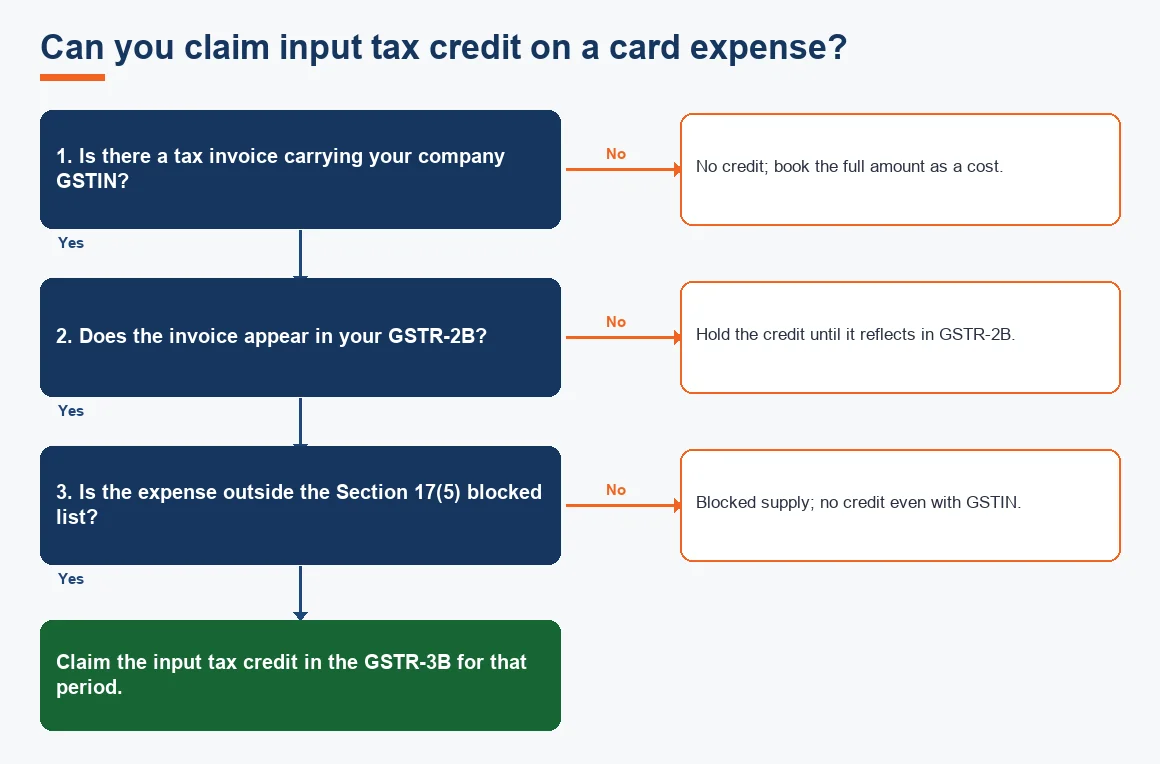
This is where reconciliation earns its keep in India. The card statement is not a valid document for input tax credit. Credit is available only where the supplier has raised a tax invoice carrying your company GSTIN and that invoice appears in your GSTR-2B on the GST portal. Even then, blocked items under Section 17(5), such as food and beverage or employee travel of a personal nature, yield no credit even when the GSTIN is printed on the bill. So a hotel booking swiped on the card may carry credit on the room tariff but not on the restaurant portion. Reconciliation is where you separate the two, capture the invoice, and confirm the match before claiming.
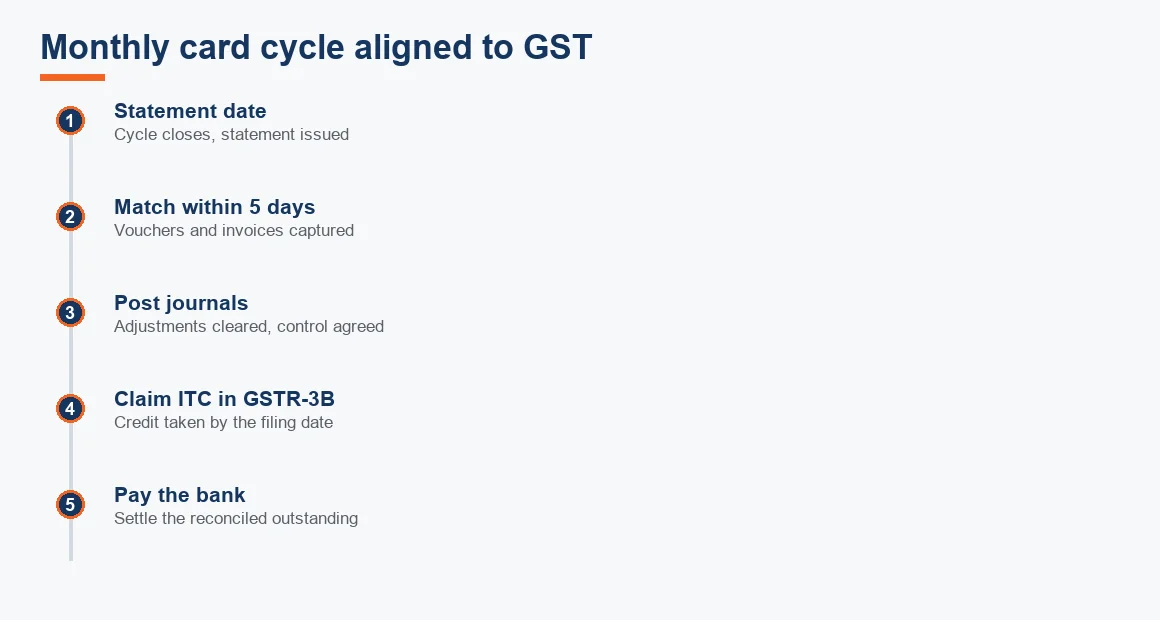
The practical rule is to hold the credit until the invoice is both collected and reflected in GSTR-2B, and to book any expense without a compliant invoice as a full cost. Getting this wrong either inflates your credit and invites a reversal with interest, or quietly forfeits credit you were entitled to.
Foreign currency card transactions
Overseas software subscriptions and travel spend are increasingly booked on company cards, and they need care. Record the expense at the exchange rate the card issuer actually applied on the transaction date, because that is the rate billed to you, and post the cross-currency markup and the GST on that markup separately under bank charges. For example, a USD 200 subscription billed at Rs 86.40 to the dollar is booked as Rs 17,280, with the card network's markup of about 3.5% and 18% GST on that markup shown as bank charges rather than buried in the subscription cost. The RBI framework for such card transactions and markups is set out on the RBI website. Keeping the markup and its GST out of the expense head keeps your cost reporting honest and your reconciliation clean.
Key takeaways
- Credit card reconciliation matches every statement line to a voucher and agrees the card control account to the statement balance.
- Four adjustments explain almost all differences: unbilled timing, interest and fees, refunds and chargebacks, and coding errors.
- Reconcile monthly before the GSTR-3B date, and never leave card credit unclaimed past 30 November following the financial year end.
- Claim input tax credit only on a tax invoice carrying your GSTIN and reflected in GSTR-2B, never on the card statement.
- Book foreign-currency spend at the issuer's applied rate and split the markup and its GST into bank charges.
Decision guide