
In this guide
A bank reconciliation statement (BRS) is a working that explains the difference between the bank balance in your books (the cash book) and the balance shown on the bank statement on the same date. The format is a short vertical schedule: you begin with one balance, add or subtract each item that has reached only one of the two records, and the corrected figure must equal the other balance. Get the two to agree and you have proof that every rupee is accounted for; if they will not agree, the statement is telling you an entry is missing or wrong.
This guide explains the BRS format, the seven steps to prepare one, a fully worked numeric example, and the treatment of awkward items such as bank charges and stale cheques. It is a how-to explainer; if you would rather hand the monthly close to a team, that sits with our Bank & Credit Card Reconciliation service, and the wider background is covered in What Is Bank Reconciliation and Why Does It Matter?
What is the full form of BRS, and who prepares it?
BRS stands for bank reconciliation statement. It is prepared by the account holder, not the bank. In a company the accounts team draws it up and the finance controller signs off; in a small business the external accountant prepares it as part of monthly closing. The bank only issues the statement. A statutory auditor later examines the reconciliation, and especially the age of unpresented cheques, but does not prepare it. The Institute of Chartered Accountants of India treats an unexamined or long-outstanding reconciliation as an audit red flag, which is why reconciling is a control task and not just a tidying exercise.
What is the format for a bank reconciliation statement?
The format is a single-column running schedule with an Add and a Less side. You pick a starting balance, apply the adjustments, and read off the closing balance. There are two accepted directions:
- Cash book to bank statement: start with the balance as per cash book and adjust towards the bank statement balance.
- Bank statement to cash book: the reverse. Each add on one route becomes a less on the other.
The formula is simply: Balance as per cash book + items increasing the bank balance − items reducing it = Balance as per bank statement. The direction you choose does not change the answer, only the signs. Whichever you use, the reconciliation rests on double-entry bookkeeping: every figure in the cash book traces to an entry in the general ledger.
What are the four major parts of a bank reconciliation?
Every reconciling item falls into one of four groups. Learn these and the rest is mechanical.
- Cheques issued but not presented: you have recorded the payment and reduced your book balance, but the payee has not banked the cheque, so the bank balance is still higher.
- Deposits not yet credited: you have banked a cheque and increased your book balance, but the bank has not cleared it, so the bank balance is still lower. These are the classic outstanding cheques and timing differences.
- Bank-originated entries: charges, interest, direct NEFT or UPI credits from customers, and standing instructions. The bank has recorded these; your books have not.
- Errors and dishonoured cheques: a cheque that bounced, a wrong amount posted, or a transposition on either side.
How to do a bank reconciliation statement step by step (the 7 steps)
Reconciling is a fixed routine. Follow the same seven steps every month and nothing slips.
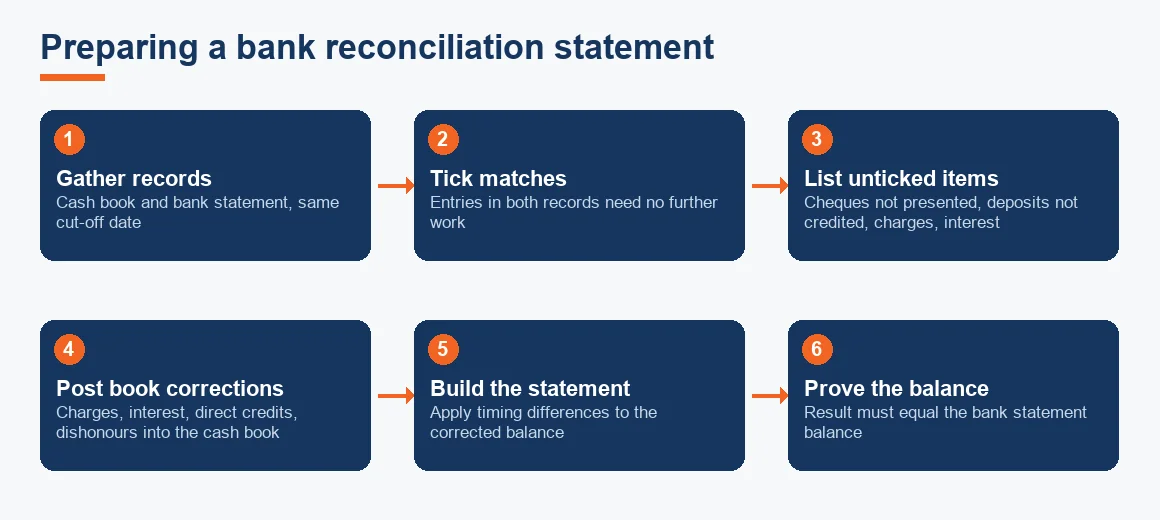
- Gather both records: the closing bank statement and the cash book for the same period and cut-off date.
- Match the opening balances: confirm last month's reconciled figures carried forward correctly.
- Tick line by line: tick every entry that appears in both records. Two ticks means it has cleared and needs no further work.
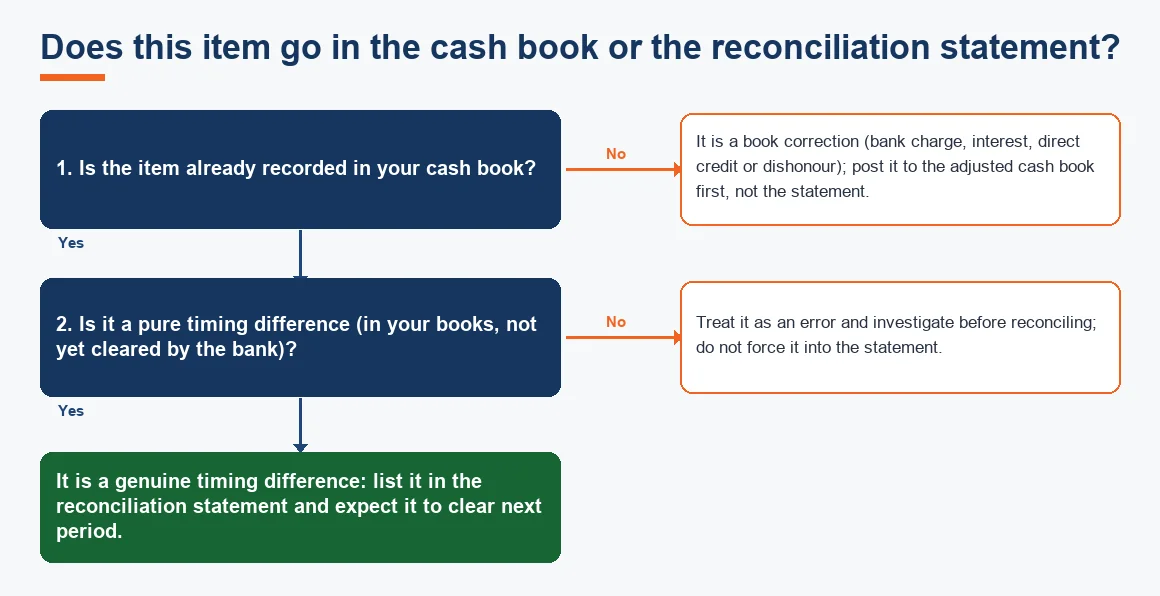
- List the unticked book items: cheques issued not presented and deposits not yet credited.
- List the unticked bank items: charges, interest, direct credits and any dishonour.
- Post the book corrections: record charges, interest, direct credits and dishonoured cheques in the cash book with a journal entry.
- Build the statement and prove it: start from the corrected cash book balance, apply the remaining timing differences, and confirm it equals the bank statement balance.
If several months have been left unreconciled, that is a backlog job rather than a routine close; our Backlog Bookkeeping / Catch-Up service exists for exactly that situation.
What is BRS with an example? A worked reconciliation
Take a business whose cash book shows a favourable (debit) balance of Rs 2,45,000 on 31 March, while the bank statement shows something different. Reconciling from the cash book, the schedule looks like this. All figures are illustrative.
| Particulars | Add (Rs) | Less (Rs) |
|---|---|---|
| Balance as per cash book (Dr) | 2,45,000 | |
| Add: Cheques issued but not yet presented | 60,000 | |
| Add: Interest credited by bank | 3,000 | |
| Add: Direct NEFT credit from customer | 40,000 | |
| Less: Cheque deposited but not yet cleared | 35,000 | |
| Less: Bank charges debited by bank | 1,200 | |
| Less: Cheque dishonoured, not recorded | 15,000 | |
| Balance as per bank statement | 2,96,800 |
The Add column totals Rs 3,48,000 and the Less column Rs 51,200; the difference, Rs 2,96,800, is the bank statement balance. Because the two balances now agree, the reconciliation is proven. In practice you would first post the interest, direct credit, bank charges and dishonoured cheque into the cash book, leaving only the two true timing differences (cheques not presented and deposit not cleared) in the statement itself.
When is an adjusted cash book prepared?
An adjusted cash book is prepared whenever the cash book itself carries omissions, which is nearly always. Bank charges, interest, direct customer credits and dishonoured cheques exist in the bank record but were never entered in your books. You post those four groups into the cash book first to get a corrected balance, and only the genuine timing differences then move into the reconciliation statement.
This corrected cash book figure is the one that flows into your trial balance and month-end books, which is why the adjusted-cash-book route is the professional default over the older single-statement method.
How to prepare a BRS in Excel
The Excel method mirrors the seven steps. Set up two columns, the cash book side and the bank statement side, paste both data sets, and tick (or use a MATCH formula) every entry that appears in both. The unmatched rows are your reconciling items. A simple four-column template (Particulars, Add, Less, Running balance) rebuilds the statement above and lets the closing cell equal the bank balance automatically.
How are stale cheques treated in a reconciliation?
A cheque in India is valid for three months from its date, per Reserve Bank of India instructions. Any cheque still sitting in your unpresented list beyond that has gone stale and can no longer be banked, so it must be reversed in the books: debit the bank ledger and credit the party account. Leaving two and three year old items in the unpresented column is the single commonest reason a reconciliation looks tidy while the bank balance is quietly wrong. Large-value cheques should also be tracked under the RBI Positive Pay System to prevent fraud, another reason the unpresented list must never be allowed to age.
How often should a BRS be prepared?
Monthly for every account without exception, and weekly for the main collection account where volumes are high. Reconciling before you file GSTR-3B catches sales receipts that were never recorded, and reconciling before the TDS deposit date on the 7th catches vendor payments booked to the wrong ledger. The two neighbouring functions, Accounts Payable and Accounts Receivable, both depend on the bank being reconciled, because an unmatched receipt is an invoice someone thinks is still unpaid. Accounts touched only at year end are precisely where duplicate payments and fraud survive undetected.
For the errors that recur across reconciliations, and the credit-card equivalent, see Common Bank Reconciliation Errors and How to Avoid Them and How to Reconcile Credit Card Statements With Your Books.
Key terms
- Bank Reconciliation: the process of matching your cash book against the bank statement to explain and clear differences.
- Outstanding Checks / Timing Differences: entries recorded by you but not yet cleared by the bank, the core of most reconciliations.
- Bank Clearing Account: a holding ledger where in-transit items rest until the bank confirms them.
- Journal Entry: the double-sided record used to post bank charges, interest and dishonoured cheques into the books.
- Month-End Close Checklist: the routine within which the BRS is completed and signed off each period.
Key takeaways
- The BRS format is a vertical Add/Less schedule that moves from one balance to the other; the formula never changes, only the signs.
- Sort every difference into the four groups, and post the two non-timing groups into an adjusted cash book before reconciling.
- The account holder prepares the BRS; a monthly reconciliation of every account is the minimum standard, weekly for high-volume accounts.
- Reverse stale cheques after three months rather than carrying them forward, and never adjust the same item twice.
- Reconcile ahead of GSTR-3B and the TDS deposit date so recording gaps surface before they become filing errors.
Decision guide