
In this guide
Setting up TallyPrime for an Ahmedabad trader means three things working together: GST-ready invoicing, accurate stock records, and e-way bills generated without leaving the software. Get the voucher types and ledger masters right at the start and the GST returns, the e-way bill portal and your stock summary all reconcile on their own. This guide walks through how a trading or manufacturing business in Ahmedabad should configure Tally, what the Gujarat e-way bill and e-invoice thresholds actually require, and where the common setup mistakes cost input tax credit. For the hands-on configuration, migration and monthly support work, that sits with our Tally Prime Accounting Services; here we stay on the practitioner explanation.
What TallyPrime does for an Ahmedabad trader
TallyPrime is the current release in the line that older users still call Tally ERP 9. For a trader it does the accounting and the inventory in one book: every sales or purchase voucher updates both the ledger and the stock item at the same time, so your general ledger and your closing stock never drift apart. On top of that base it produces GSTR-1 and GSTR-3B working figures, e-way bills, e-invoices, and the outstanding statements that a wholesale business in Naroda, Odhav or the Kalupur cloth market relies on to chase payment.
The design rests on double-entry bookkeeping, so each entry carries a debit and a credit. What changes from a spreadsheet is that Tally forces you to pick a voucher type, and that choice has GST consequences. Sales, purchase, credit note and debit note vouchers feed the GST return; a journal entry is treated as an adjustment and does not. Recording a taxable sale through a journal instead of a sales voucher is the single most common reason a return understates turnover.
Setting up GST in TallyPrime
The GST setup has two layers: the company-level details and the master-level tax rates. At company level you enter the GSTIN, the state as Gujarat, and the periodicity of returns. At master level each stock item or sales ledger carries its HSN code and tax rate so the software splits the tax correctly.
The CGST, SGST and IGST split
For a sale inside Gujarat, Tally posts CGST and SGST, each at half the rate. For a sale to another state it posts IGST at the full rate. You do not choose this manually: Tally reads the buyer's state against your own and applies the right heads, which is why the buyer master must show the correct state. A Rajkot or Surat buyer is intra-state; a Mumbai or Jaipur buyer is inter-state.
Recording professional and accounting charges
When your accountant raises a bill, create a ledger such as professional fees under Indirect Expenses and enter the bill through a purchase voucher, not a payment, so the input tax credit reaches the GST reports. Remember that TDS under Section 194J applies at 10 per cent once your payments to that firm cross Rs 50,000 in the financial year. Reconciling that credit against the portal is where a GSTR-2B input tax credit match earns its keep, because credit that is not in your 2B cannot be claimed.
E-way bill rules for a Gujarat trader
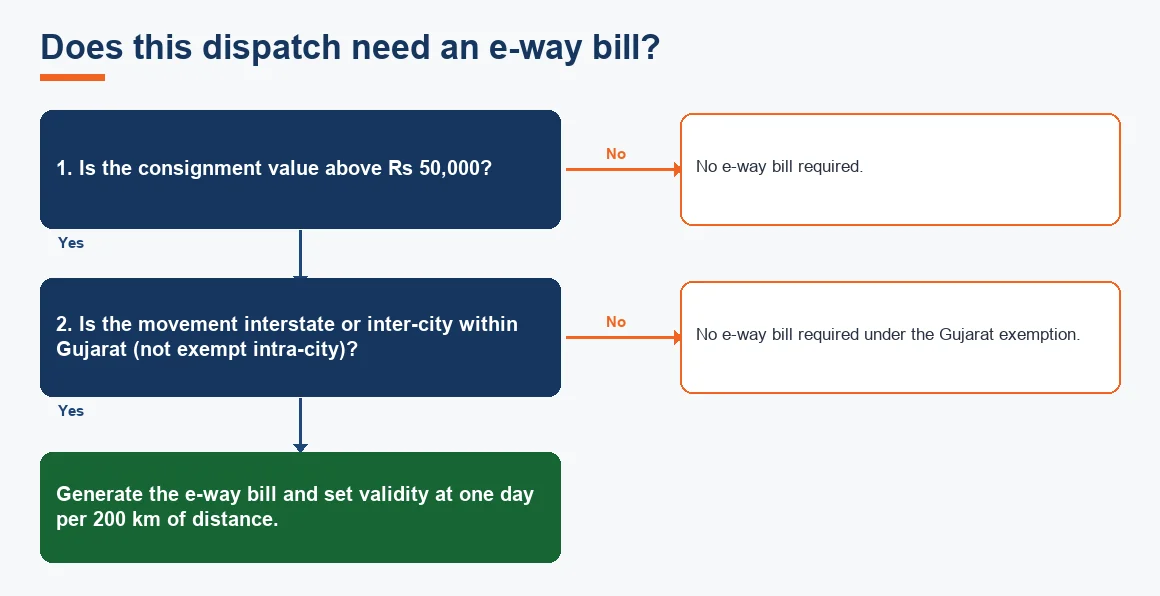
An e-way bill is required where the consignment value exceeds Rs 50,000, both for interstate movement and for movement within Gujarat. What Ahmedabad traders should know is that Gujarat has used its state powers to exempt intra-city movement of goods and the movement of goods outside a notified list within the state, so a large share of purely local deliveries do not need a bill. The threshold and the exemptions are set by the state notification read with the central rules, and the working position is published on the CBIC portal and the e-way bill system.
Validity is the part people misjudge. An e-way bill runs for one day for every 200 kilometres of the approximate distance you enter, so a consignment moving 660 kilometres to Jaipur carries four days, not one. Enter the distance honestly, because an expired bill in transit invites a detention notice under Section 129.
Generating the e-way bill from inside Tally
You do not need to open the portal for each dispatch. Once the online connector is set up, TallyPrime pushes the invoice to the e-way bill system and returns the bill number and validity into the voucher. The steps below show the flow.
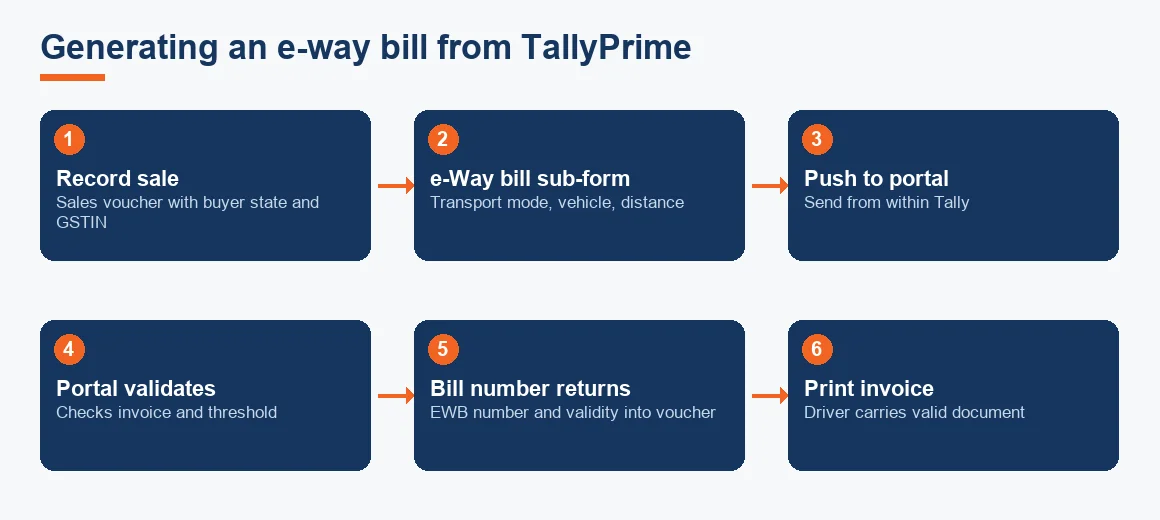
- Record the sale through a sales voucher with the buyer's state and GSTIN correct.
- Fill the e-way bill sub-form: transport mode, vehicle number, distance and transporter ID.
- Send the details to the portal from within Tally.
- The portal validates and returns the e-way bill number and validity date.
- Print the invoice with the bill number so the driver carries a valid document.
Does an Ahmedabad trader have to issue e-invoices
E-invoicing applies where aggregate annual turnover crossed Rs 5 crore in any financial year from 2017-18 onwards. It covers business-to-business supplies, exports and supplies to SEZ units. Business-to-consumer invoices are outside it. Without a valid invoice reference number, or IRN, the document is not a valid tax invoice and the buyer loses the credit, so a manufacturer supplying to larger buyers cannot afford to skip it. The current thresholds and the schema are maintained on the GST portal. In Tally the e-invoice is generated in the same flow as the e-way bill, and where both apply the single upload returns the IRN and the e-way bill together.
TallyPrime editions and what they cost
TallyPrime is priced the same across India, so a licence bought in Ahmedabad costs what it costs in Mumbai. The difference locally is only in what a partner charges for installation, data migration and training. The figures below are indicative and Exl GST.
| Item | Silver (single user) | Gold (multi user) |
|---|---|---|
| Perpetual licence | Rs 22,500 | Rs 67,500 |
| Annual TSS renewal | Rs 4,500 | Rs 13,500 |
| Best fit | One accountant, one location | Multiple users on a LAN |
A single-user Silver licence suits a small trading firm with one person on the books. A wholesaler or manufacturer with a billing counter, a stores clerk and an accountant working at once needs Gold, because Silver allows only one user at a time. Monthly rental plans cost less upfront if you would rather not buy the perpetual licence. If you are still weighing Tally against cloud options, our notes on Zoho Books, Xero and Odoo set out where each fits.
Worked example: an interstate sale with e-way bill
Take an Ahmedabad trader selling goods worth Rs 2,00,000 to a buyer in Jaipur, taxed at 18 per cent IGST. The consignment crosses Rs 50,000 and is interstate, so an e-way bill is required. The road distance is about 660 kilometres, giving four days validity. Recorded through a sales voucher, Tally posts the entries below.
| Ledger | Debit (Rs) | Credit (Rs) |
|---|---|---|
| Jaipur buyer (Sundry Debtor) | 2,36,000 | - |
| Sales - interstate | - | 2,00,000 |
| Output IGST at 18% | - | 36,000 |
| Total | 2,36,000 | 2,36,000 |
The Rs 36,000 IGST flows to the GSTR-1 and GSTR-3B working, the Rs 2,36,000 sits in the buyer's outstanding, and the stock item reduces by the quantity sold. Had the same buyer been in Surat, Tally would have split the Rs 36,000 into CGST Rs 18,000 and SGST Rs 18,000 and no e-way bill would arise if the movement stayed intra-city and within the exempt list.
The monthly compliance rhythm
Once Tally is capturing vouchers cleanly, the month runs to a fixed calendar. GSTR-1 is due by the 11th, GSTR-3B by the 20th for monthly filers, and TDS deducted in a month is paid by the 7th of the next. Building this rhythm into a habit, with a stock and bank reconciliation before you file, is what keeps the return honest.
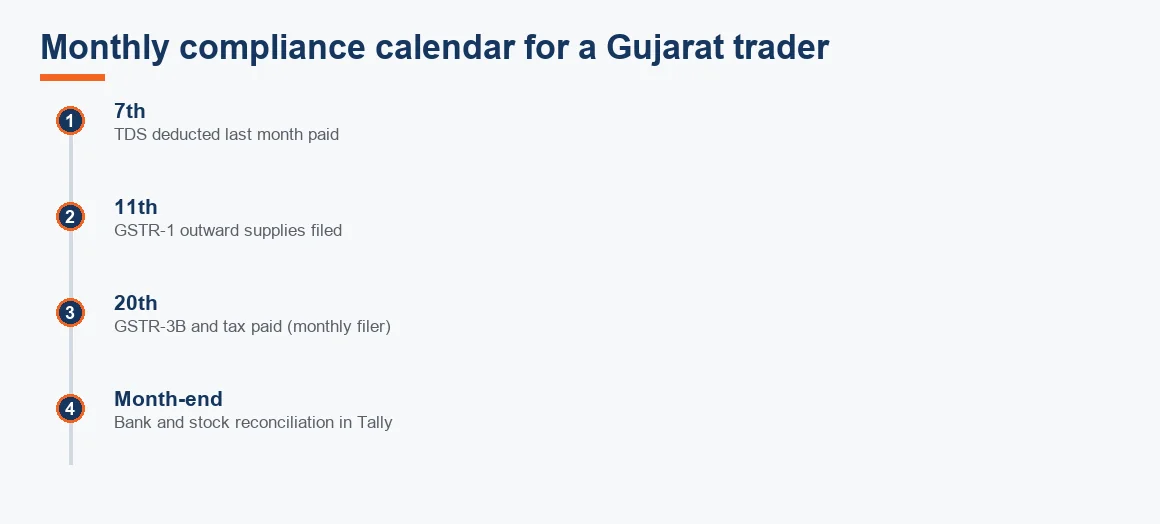
A quick bank reconciliation in Tally before the 20th catches receipts entered against the wrong party and cheques not yet cleared, both of which distort the cash and debtor figures your return leans on. For fixed-asset heavy manufacturers, the depreciation charge feeds the same close; you can sanity-check Schedule II working against our depreciation calculator.
Key terms
- Journal Entry: a voucher used for adjustments; unlike a sales or purchase voucher it does not feed the GST return.
- Tally Vault: the password layer that encrypts company data so books cannot be opened without the key.
- Inventory Voucher Mapping: linking stock movements to the correct voucher so quantity and value stay in step.
- Section 194Q TDS on Goods: TDS at 0.1 per cent on purchase value above Rs 50 lakh from a supplier, for buyers above the turnover limit.
- GSTR-2B ITC Matching: reconciling purchase credit in your books against the auto-drafted 2B before claiming it.
Where local support helps
Software configuration is only half the job. The other half is the local knowledge: which Gujarat movements are exempt, how a GIDC estate supplier should be mapped, and how to keep a manufacturer's stock and job-work records audit-ready. If you want a benchmark before hiring, our guide to the cost of accounting in Ahmedabad and how to choose an accountant in Ahmedabad are the sensible next reads, along with the books cleanup and GST reconciliation guide if your Tally data has drifted. Employers should also review Gujarat professional tax and Shops Act obligations. For the setup itself, our Tally accounting service in Ahmedabad handles migration and monthly filing, and the broader accounting and bookkeeping service covers the full ledger. Manufacturers and retailers have their own workflows, covered on the manufacturing and retail pages.
Key takeaways
- Configure GST at the stock-item level so mixed tax slabs fill GSTR-1 on their own.
- Record taxable sales through sales vouchers, never journals, or the return understates turnover.
- A Gujarat e-way bill is needed above Rs 50,000 for interstate and most inter-city movement; many intra-city deliveries are exempt.
- E-invoicing bites once turnover crosses Rs 5 crore; no valid IRN means the buyer loses credit.
- Reconcile bank and GSTR-2B before you file, every month.
Decision guide