
In this guide
Textile-market inventory accounting for Ahmedabad traders means recording stock lot by lot: each bale, thaan or bundle that arrives at a Maskati Market shop is given a lot number, and every piece sold, returned or sent for processing is booked against that lot. Done this way, the books show what each consignment actually cost and earned, which is the number that decides your margin, your GST and your income tax. This guide sets out how a textile retailer or wholesaler in Ahmedabad can keep those books cleanly. For the commercial engagement itself, see our Retail Accounting Services in India and the local Retail Accounting Services in India Ahmedabad page; this article stays on the how-to.
What lot-wise inventory accounting means for a textile trader
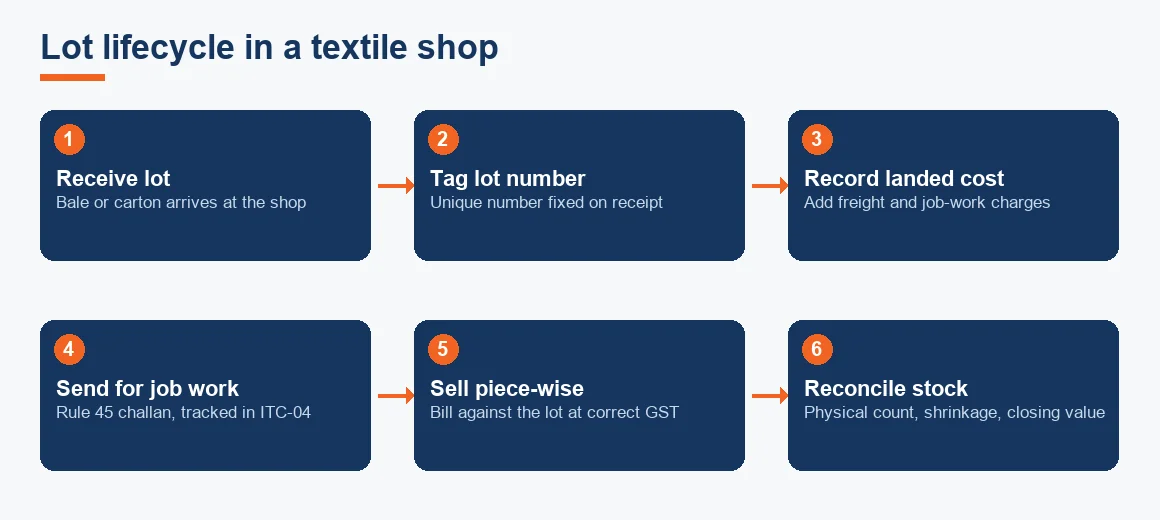
A cloth or garment business rarely sells the way it buys. You buy a bale of 100 thaan or a carton of 500 pieces, then sell in ones and dozens across weeks. If the books only record a bulk purchase and bulk sales, you never learn which lot was profitable and which was dead stock. Lot-wise accounting fixes a unique lot number to each inward consignment and carries cost, quantity, job-work status and closing balance against it. This is the practical form of the retail inventory method for a market shop, and it is what lets you value closing stock defensibly at the year end.
Two costing choices sit underneath this. Under FIFO the earliest lot is deemed sold first; under weighted average all lots of the same item pool into one rate. For fast-moving readymade lines FIFO tracks reality; for loose fabric bought at fluctuating rates, weighted average is simpler. Whichever you pick, apply it consistently, because switching methods mid-year distorts your cost of goods and margin.
Recording bales, thaan and pieces
Set your item master to the unit you actually sell in. A wholesaler selling by the thaan should not keep stock in metres, and a garment shop selling by the piece should not keep it in dozens on paper and pieces at the counter. Where you deal in both, define a base unit and a conversion (1 bale equals 20 thaan, 1 carton equals 500 pieces) so the system converts automatically. A daily counter tally against the till, sometimes called a point-of-sale day-end audit, closes the gap between what the register shows and what left the shelf.
Physical shrinkage is real in a cloth market: cut pieces, sun-faded stock, water damage during monsoon and sample loss. Recognise it as an inventory shrinkage provision at each stock count instead of letting closing stock quietly overstate your profit. A short reconciliation of physical count against book stock every quarter is enough for a single-shop trader.
GST rates on textiles and readymade garments
The rate structure changed materially in late 2025, so old ready-reckoners are misleading. From 22 September 2025, readymade garments and made-up textile articles priced up to Rs 2,500 per piece attract 5 per cent GST, and anything above Rs 2,500 per piece attracts 18 per cent. This replaced the earlier Rs 1,000 threshold and the 5-and-12 per cent pair. Most fabric and yarn continue at 5 per cent. Two points trip traders up: the rate follows the transaction value per piece, not the printed MRP, and the test is per piece, so a Rs 2,400 kurta is 5 per cent even if the buyer takes ten of them. The current rate notifications are published by the CBIC.
On the buy side, reconcile the tax you claim against your GSTR-2B every month. Suppliers in a wholesale market are not always prompt filers, and credit that has not landed in your 2B cannot be taken.
Accounting for goods sent for job work
Very little textile stock is sold in the exact form it arrives. Grey cloth goes out for dyeing, printing, embroidery or stitching and comes back changed. Under GST this movement is not a sale. Goods travel to the processor on a delivery challan under Rule 45 of the CGST Rules without charging tax, and they remain in your stock as goods lying with a job worker. Inputs must return within one year and capital goods within three years, or the challan is treated as a supply on which tax becomes due. The movement is reported in Form ITC-04, and the filing rules are set out on the GST portal.
In the books, keep a job-work sub-ledger by challan number so you always know how many pieces are out, with whom and against which lot. The processor's charge is a service you receive, booked as a direct cost of that lot and added to its landed cost before you compute margin. Traders who also stitch in-house should look at manufacturing treatment; our Manufacturing Accounting Services - Ahmedabad page covers work-in-progress for that model.
Cash receipts and Section 269ST in a wholesale market
Counter cash is a way of life in Maskati Market, but the income tax law draws a hard line. Section 269ST prohibits receiving Rs 2,00,000 or more in cash from one person in a single day, for a single transaction, or against one event. Section 271DA imposes a penalty equal to the amount received in breach. Critically, splitting one order across several bills to keep each under Rs 2,00,000 still breaches the section, because the limit reads per person per day and per transaction together. The provision text sits with the Income Tax Department.
The safe habit is simple: enter every counter receipt the same day against a named buyer, and route large settlements through bank or UPI. Large-turnover buyers should also watch Section 194Q TDS on goods, which can apply at 0.1 per cent on annual purchases above Rs 50 lakh from a single supplier once the buyer's turnover crosses Rs 10 crore.
Goods returned by retailers
Return of unsold stock from downstream retailers is normal in the trade, and GST treats it through a credit note under Section 34. That credit note reduces your output tax only if it is reported by 30 November following the financial year, or the date of filing the annual return, whichever is earlier. Miss that window and the return can only be handled by a commercial credit note with no tax adjustment, and the buyer, if registered, must reverse the credit. Book returns against the original lot so your closing stock and margin correct themselves automatically.
Composition scheme or regular scheme
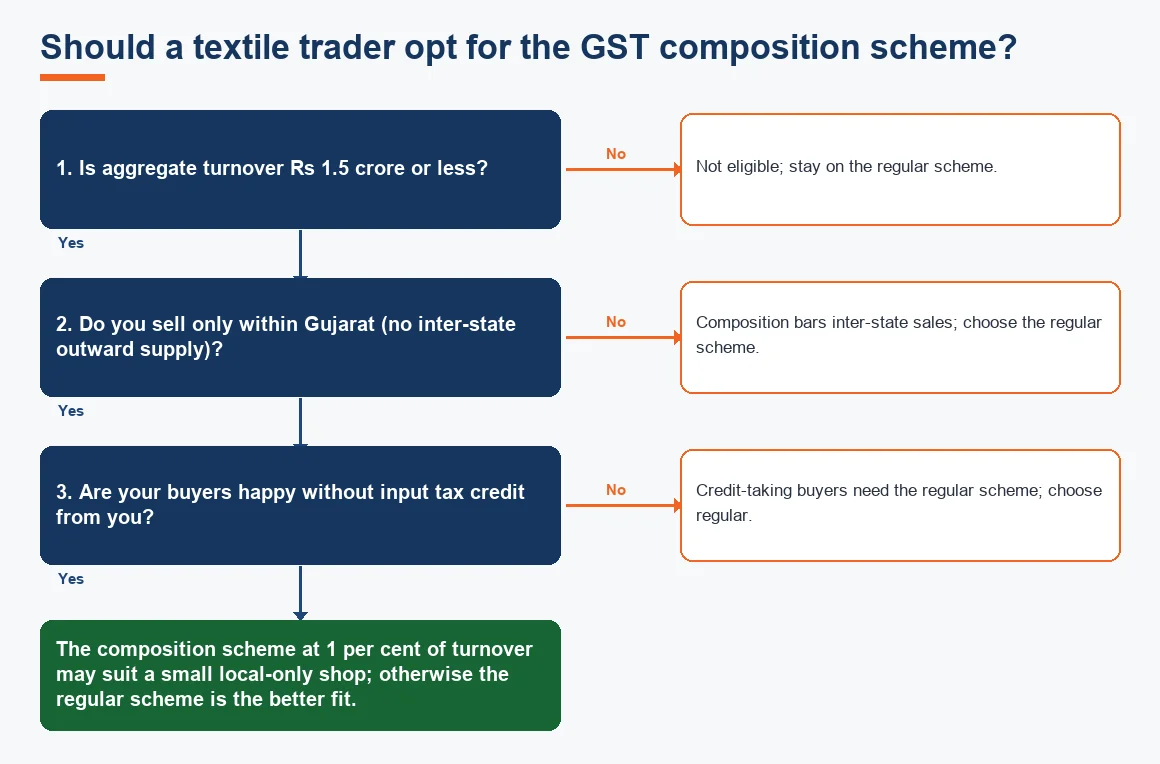
A trader with aggregate turnover up to Rs 1.5 crore can pay 1 per cent of turnover under the composition scheme, but the trade-offs are heavy for a market wholesaler. The comparison below sets out the choice.
| Feature | Composition scheme | Regular scheme |
|---|---|---|
| Tax on outward supply | 1 per cent of turnover | 5 per cent or 18 per cent per piece |
| Inter-state outward sales | Not allowed | Allowed |
| Collect GST from buyers | No | Yes |
| Input tax credit | Not available | Available |
| Turnover ceiling | Up to Rs 1.5 crore | No ceiling |
| Suits | Small local-only shop | Wholesaler selling across states or to credit-taking buyers |
For a Maskati Market wholesaler selling into other states or to registered buyers who want credit, the regular scheme almost always works out better despite the higher headline rate, because composition forecloses inter-state trade and ITC entirely.
Setting up the books: a step-by-step
- Fix an item master in the unit you sell, with bale-to-piece conversions defined.
- Adopt one costing method (FIFO or weighted average) and record it in your accounting policy.
- Open a lot register and give every inward consignment a lot number on receipt.
- Add freight and job-work charges to each lot as landed cost before computing margin.
- Reconcile purchases to GSTR-2B and file GSTR-1 and GSTR-3B on time each month.
- Track job-work challans in a sub-ledger and file ITC-04 for the period.
- Count physical stock each quarter, book shrinkage, and value closing stock lot-wise at year end.
A trader on Tally can automate most of this with stock groups and batch tracking; see Tally Prime Accounting Services - Ahmedabad. Shop fixtures, racks and display counters are capital assets: work their write-off through a depreciation calculator rather than expensing them in one go.

Worked example: lot-wise margin on a garment consignment
Take a single lot of 500 kurtis bought at Rs 300 per piece (transaction value under Rs 2,500, so 5 per cent GST), with Rs 2,000 inward freight, sold at Rs 420 per piece. All figures are indicative and Exl GST where a value is a price.
| Line item | Amount (Rs) |
|---|---|
| Purchase value (500 pcs @ 300) | 1,50,000 |
| Input GST @ 5 per cent | 7,500 |
| Add: inward freight (landed cost) | 2,000 |
| Landed cost of lot | 1,52,000 |
| Per-piece landed cost | 304 |
| Sale value (500 pcs @ 420) | 2,10,000 |
| Output GST @ 5 per cent | 10,500 |
| Gross profit (2,10,000 minus 1,52,000) | 58,000 |
| Gross margin | 27.6 per cent |
| Net GST payable (10,500 minus 7,500) | 3,000 |
The lot earned Rs 58,000 of gross profit over its cost of goods, a 27.6 per cent margin, and left Rs 3,000 of GST to remit after credit. Read this way, one dull lot with a 6 per cent margin cannot hide inside a healthy monthly total, because each lot answers for itself.
Key terms
- Retail Inventory Method: valuing stock from selling prices adjusted to cost, practical for high-volume shops.
- FIFO vs Weighted Average Cost: the two consistent ways to move cost out of stock as goods sell.
- Form ITC-04 Job Work Tracking: the GST return that reports goods sent to and received from a processor.
- Point-of-Sale Day-End Audit: the daily reconciliation of counter sales against the till and stock.
- Inventory Shrinkage Provision: the charge that recognises damaged, faded or lost stock.
Key takeaways
- Number every inward consignment and account for it lot by lot, adding freight and job-work as landed cost.
- Apply the per-piece GST test: 5 per cent up to Rs 2,500, 18 per cent above, on transaction value not MRP.
- Move job-work stock on a Rule 45 challan, keep it in your stock, and file ITC-04 within the return-back limits.
- Enter every counter receipt the same day against a named buyer; do not split bills to dodge Section 269ST.
- Report Section 34 credit notes for returns by 30 November following the year to preserve the tax reduction.
For local pricing and how to choose a firm, our Ahmedabad guides on the cost of accounting and bookkeeping in Ahmedabad and choosing an accountant in Ahmedabad are the right next reads, along with the books cleanup and GST reconciliation guide if your ledgers are behind. Employers should also review Gujarat professional tax and Shops Act compliance. A growing trader planning outside investment can look at Startup Accounting Services India, and general bookkeeping for a single Ahmedabad shop sits under Accounting and Bookkeeping Services Ahmedabad.
Decision guide