
In this guide
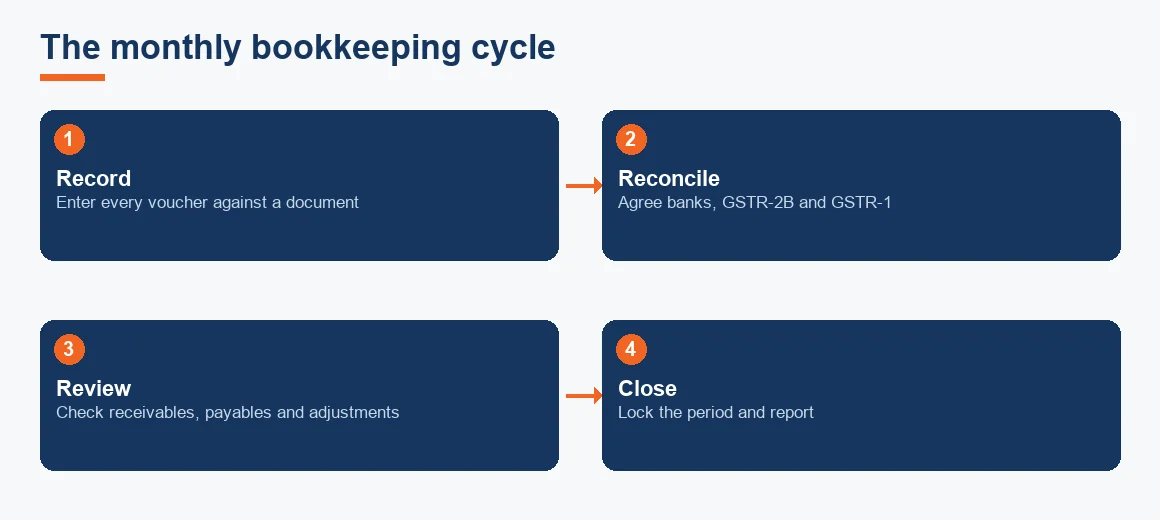
A monthly bookkeeping checklist is the fixed list of tasks you repeat every month so that the previous month's books are complete, reconciled and ready for filing before GST and TDS fall due. For most Indian small and medium businesses the whole cycle comes down to four repeatable steps, record, reconcile, review and close, wrapped around a handful of statutory deadlines. Get that rhythm right and month end stops being a scramble. This guide sets out what belongs on the checklist, the order to work through it, and the dates that decide when it has to be finished.
What is included in monthly bookkeeping?
Monthly bookkeeping is the ongoing work of recording, classifying and reconciling every transaction for the month, so that the ledgers show a true position before any return is filed. It is not the same as accounting, which interprets those numbers; if that distinction still feels blurred, our explainer on bookkeeping versus accounting for an Indian business covers it in full. A monthly cycle usually includes the following.
- Recording all sales invoices, purchase bills, expenses, bank and cash entries into the accounting software using double-entry bookkeeping, so debits always equal credits.
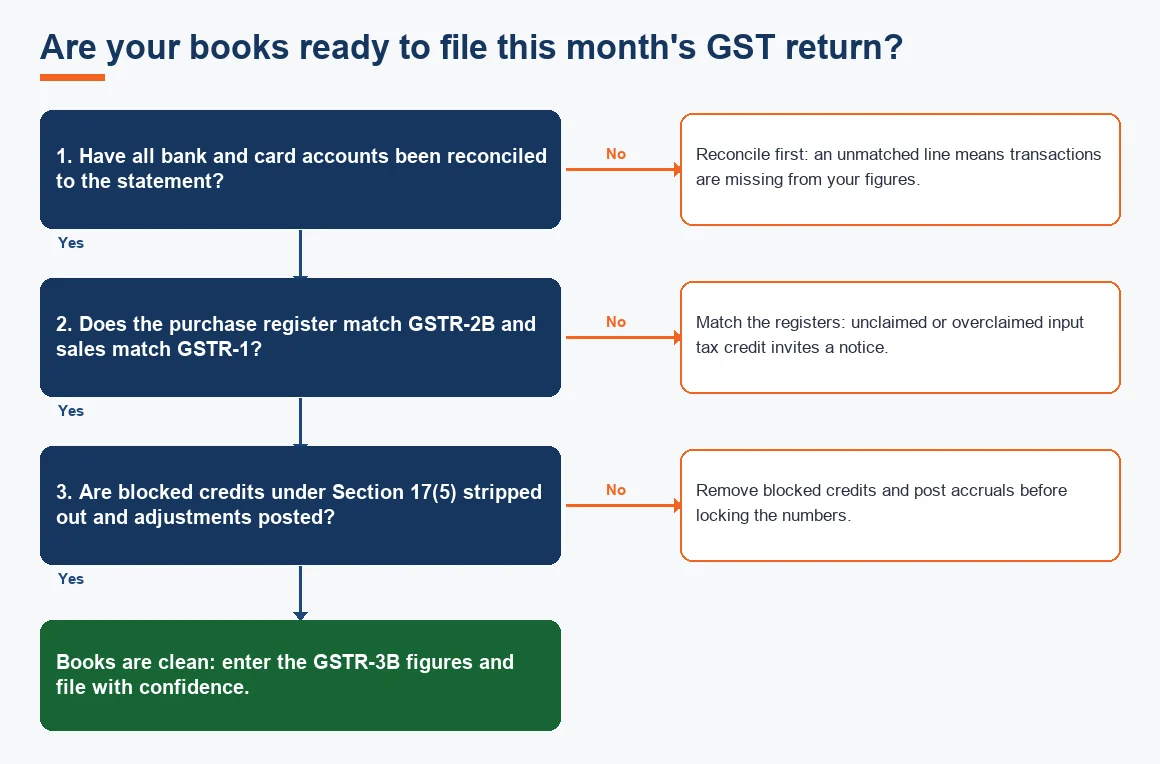
- Reconciling every bank and credit card account against the statement, and clearing suspense or unmatched items.
- Matching the purchase register to GSTR-2B and the sales register to GSTR-1 before the input tax credit and output tax figures are locked.
- Reviewing receivables and payables, chasing overdue customers and confirming what is owed to suppliers.
- Posting month-end adjustments such as depreciation, prepaid expense amortisation and accrued liabilities, then producing a trial balance and a short set of management figures.
Everything on that list feeds a single outcome: a clean general ledger that any return, or your accountant, can rely on.
The monthly bookkeeping process, step by step
The process is easier to keep on top of when it runs in the same order every month. This is the full cycle most Indian SMEs follow, from the first week to close.
- Collect the paperwork. Gather sales invoices, purchase bills, expense receipts, bank statements and payroll data for the month. Nothing is recorded without a supporting document.
- Record every transaction. Post sales, purchases, expenses, payments and receipts as a journal entry in the correct period. If you use software with bank feeds, categorise each feed line rather than leaving it in a holding account.
- Reconcile the banks. Agree every bank and card account to its statement and investigate differences. This is where most errors surface, so it comes before any filing.
- Match the tax registers. Reconcile the purchase register to GSTR-2B invoice by invoice and tie sales to the GSTR-1 already filed, stripping out blocked credits under Section 17(5).
- Review receivables and payables. Run an accounts receivable ageing schedule, follow up overdue invoices, and confirm supplier balances, keeping the 45-day MSME payment clock in mind.
- Post adjustments. Enter depreciation, accruals, prepayments and provisions so the month reflects the correct expense, not just what was paid.
- Close and report. Produce the trial balance, a profit and loss summary and a cash position, then lock the period so the numbers cannot drift.
The monthly bookkeeping checklist
The table below groups the recurring tasks by area, with why each one matters and how often it is done inside the month. Treat it as the master list to work down each cycle.
| Task | Why it matters | Frequency in the month |
|---|---|---|
| Record sales and purchase invoices | Keeps revenue, input tax credit and payables complete | Weekly |
| Categorise bank and card feeds | Stops entries sitting in suspense | Weekly |
| Bank and card reconciliation | Confirms the cash position is real | Month end |
| GSTR-2B and GSTR-1 matching | Protects input tax credit and avoids notices | Before filing |
| Receivables ageing and follow-up | Improves collections and cash flow | Month end |
| Payables and MSME 45-day check | Avoids Section 43B(h) disallowance | Month end |
| Depreciation, accruals, prepayments | Shows the true monthly profit | Month end |
| Trial balance and management report | Gives you numbers to make decisions on | Close |
Close your books by the tenth: why the date matters
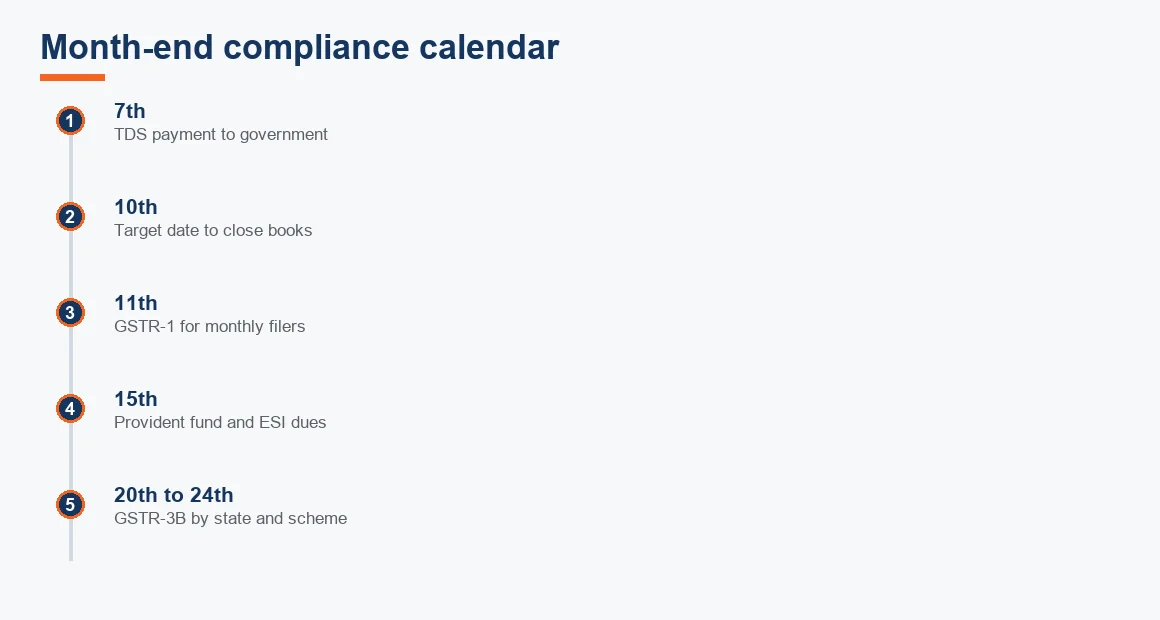
The single most useful discipline is a hard closing date, and the tenth of the following month works because it sits ahead of every major deadline. TDS deposited to the government is due on the 7th, GSTR-1 on the 11th for monthly filers, provident fund and ESI on the 15th, and GSTR-3B between the 20th and the 24th depending on the state and whether you are on the QRMP scheme. You can confirm the current return calendar on the GST portal and TDS due dates on the Income Tax Department site. Closing after the tenth means you are filing from incomplete books and correcting the difference later.
The retention rule sits behind all of this. Section 128(5) of the Companies Act 2013 requires books and vouchers to be preserved in good order for at least eight financial years, a requirement set out by the Ministry of Corporate Affairs, and GST records for seventy two months from the due date of the annual return. Closing cleanly each month is what makes those records defensible if they are ever examined.
Reconciliations to complete before you file
Three reconciliations decide whether your return is right. Do them in this order.
Bank and card reconciliation
Agree the closing balance in your books to the bank statement, adjusting for cheques issued but not yet presented, deposits in transit and any charges or direct credits the bank has recorded but you have not. A completed bank reconciliation is the evidence that the cash figure in your accounts is genuine.
GSTR-2B input tax credit matching
Match the purchase register to GSTR-2B supplier by supplier. Credit only appears in 2B when the supplier has filed, so any missing invoice is credit you cannot claim yet. The reconciliation rules are published by the Central Board of Indirect Taxes and Customs.
Sales and output tax tie-out
Tie the sales in your books to the GSTR-1 you have filed, and agree the electronic cash and credit ledger balances to the accounts. Only once these three agree should the GSTR-3B figures be entered.
Full cycle bookkeeping tasks versus monthly tasks
People often ask what the full cycle bookkeeping tasks are and how they differ from the monthly checklist. The monthly checklist is one turn of a larger wheel. The full accounting cycle runs from recording a transaction, through posting to the ledger, an unadjusted trial balance, adjusting entries, an adjusted trial balance, financial statements and finally closing entries at year end. Your monthly work performs the first six of those steps in miniature every month; the closing entries and statutory statements are pulled together once a year during year-end closing and finalisation. The cleaner your twelve monthly closes, the shorter that year-end work becomes. Reviewing the summarised numbers each month is also what turns bookkeeping into useful MIS reporting rather than a compliance chore.
Worked example: a month-end bank reconciliation
Assume your cash book shows a closing balance of INR 8,45,000 at month end, but the bank statement disagrees. Working through the differences gives the reconciliation below and confirms the true balance.
| Particulars | Amount (INR) |
|---|---|
| Balance as per cash book | 8,45,000 |
| Add: customer direct credit not yet recorded in books | 40,000 |
| Less: bank charges debited by bank, not in books | (2,500) |
| Adjusted cash book balance | 8,82,500 |
| Add: cheques issued but not yet presented | 1,20,000 |
| Less: deposits in transit | (65,000) |
| Balance as per bank statement | 9,37,500 |
The two adjusting items at the top are entries the bank has recorded but the books have not, so they correct the cash book itself. The bottom two are timing differences that will clear on their own once cheques are presented and deposits credited, so they only explain the gap to the statement. After this exercise the balance you carry forward is the adjusted INR 8,82,500, not the original figure. The same discipline applies to non-cash adjustments such as depreciation; a depreciation calculator aligned to Schedule II can size that monthly entry in seconds.
Key terms
- Double-Entry Bookkeeping: the method where every transaction is posted as an equal debit and credit.
- Trial Balance: a listing of all ledger balances used to check that debits equal credits.
- Bank Reconciliation: agreeing the cash book balance to the bank statement and explaining the differences.
- Month-End Close Checklist: the standard set of tasks completed to lock a period's books.
- Accrued Liabilities: expenses incurred in the month but not yet invoiced or paid.
Can I do my own monthly bookkeeping?
Yes, many owners of small businesses keep their own books, especially with accounting software that automates bank feeds and GST reports. It is realistic if your transaction volume is modest, you understand the golden rules of accounting, and you can commit to the monthly rhythm without letting it slip. It becomes harder as you add employees, cross border invoices, inventory or multiple GST registrations, where the reconciliations grow and the cost of an error rises. Software helps, and automation is changing the routine work, but it does not remove the judgement. Many businesses do the recording themselves and bring in support for month end and filing; if you are weighing that up, our in-house versus outsourced cost comparison lays out the trade-offs, and you can read how a firm handles this on our accounting and bookkeeping services page or the wider accounting services overview.
Key takeaways
- Run the same four-step cycle every month: record, reconcile, review and close.
- Set a hard closing date of the tenth so books are ready before TDS, GST, PF and ESI fall due.
- Complete the bank, GSTR-2B and GSTR-1 reconciliations before any return is filed, never after.
- Post depreciation, accruals and prepayments so each month shows true profit, not just cash paid.
- Preserve books for eight financial years and GST records for seventy two months.
Decision guide