

In this guide
The golden rules of accounting are three simple debit and credit rules that tell you how to record any transaction in a journal. You first classify each account involved as a personal, real or nominal account, then apply the matching rule: debit the receiver and credit the giver, debit what comes in and credit what goes out, and debit all expenses and losses while crediting all incomes and gains. This guide explains each rule in plain English and works through the journal entries an Indian business actually passes, from a cash sale to a GST payment.
What are the three golden rules of accounting?
The three golden rules are the traditional foundation of double-entry bookkeeping. Every transaction touches at least two accounts, and every rupee debited must be matched by a rupee credited, so the books always balance. The rules exist because different kinds of accounts behave differently: a supplier ledger does not increase the same way a cash box or a rent expense does. Before you can pass a correct journal entry, you have to know which of the three account types you are dealing with.
Get the classification right and the rest is mechanical. Get it wrong and your trial balance can still tie while the profit and loss account reads incorrectly, which is one of the hardest errors to spot after the fact. If you are still deciding how detailed your records should be, our explainer on bookkeeping versus accounting for an Indian business sets the context before you reach the journal stage.
The three types of accounts
Under the traditional approach, every ledger in your general ledger falls into exactly one of three buckets.
- Personal accounts
- Accounts of people and entities you deal with: customers, suppliers, banks, the proprietor's capital account, a director's loan account. Shah Traders as a debtor and HDFC Bank as your bank are both personal accounts.
- Real accounts
- Accounts of things you own or possess, whether tangible or intangible: cash, stock, furniture, machinery, buildings, goodwill. These map to your assets.
- Nominal accounts
- Accounts of expenses, losses, incomes and gains: rent, salaries, electricity, interest received, discount allowed. These feed the profit and loss account and cover your expenses and income.
How to record a journal entry, step by step
A single journal entry has four parts: the account debited, the account credited, the amount, and a short narration explaining the transaction. Recording one follows the same routine every time.
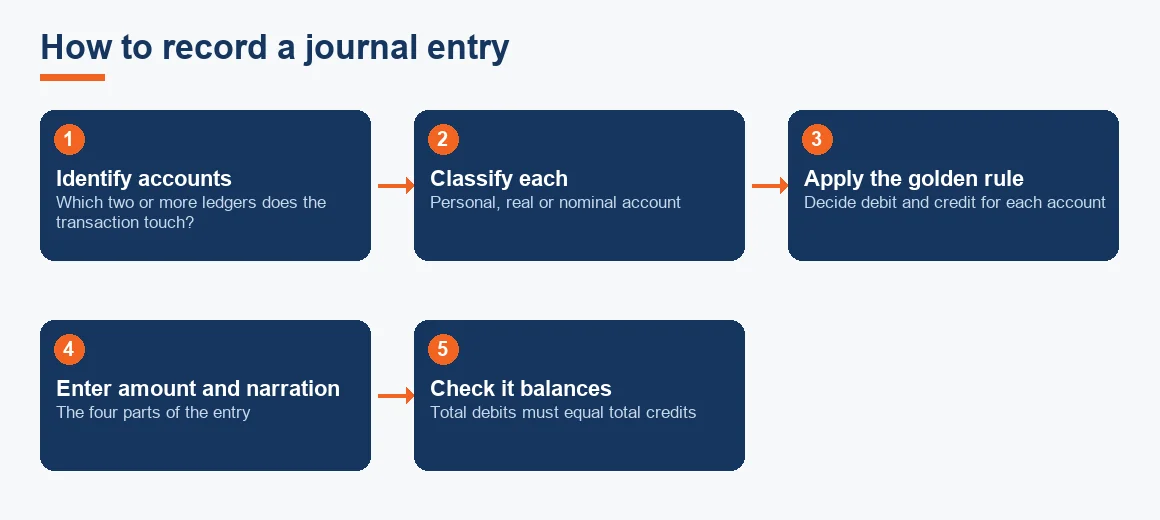
The discipline is worth building early. If you would like a repeatable routine around this, our monthly bookkeeping checklist for Indian SMEs folds journal review into the wider month-end close.
Rule 1: Debit the receiver, credit the giver (personal accounts)
When value moves to a person or entity, that account receives and is debited; the one giving value is credited. Suppose you pay Shah Traders, a supplier, 50,000 rupees by bank transfer. Shah Traders receives the money, so debit Shah Traders (the receiver); the bank gives the money, so credit Bank.
Debit Shah Traders 50,000; Credit Bank 50,000. The supplier balance, part of your accounts payable, reduces by 50,000.
Rule 2: Debit what comes in, credit what goes out (real accounts)
When an asset enters the business, debit it; when an asset leaves, credit it. Buy office furniture for 30,000 rupees in cash: furniture comes in, so debit Furniture; cash goes out, so credit Cash.
Debit Furniture 30,000; Credit Cash 30,000. Both are real accounts, and the entry simply swaps one asset for another.

Rule 3: Debit expenses and losses, credit incomes and gains (nominal accounts)
Expenses and losses are debited; incomes and gains are credited. Pay 20,000 rupees office rent by bank: rent is an expense, so debit Rent; bank gives the money, so credit Bank.
Debit Rent 20,000; Credit Bank 20,000. Rent is a nominal account and closes to the profit and loss account at year end, unlike the furniture above which stays on the balance sheet.
Seven common journal entries with examples
These are the entries a typical Indian business passes most often. The rule column shows which golden rule drives each debit and credit.
| Transaction | Debit | Credit | Rule applied |
|---|---|---|---|
| Cash sale of goods | Cash | Sales | Real (in) / Nominal (income) |
| Credit purchase from supplier | Purchases | Supplier A/c | Nominal (expense) / Personal (giver) |
| Owner introduces capital | Bank | Capital A/c | Real (in) / Personal (giver) |
| Salary paid by bank | Salaries | Bank | Nominal (expense) / Personal (giver) |
| Depreciation on machinery | Depreciation | Machinery | Nominal (loss) / Real (out) |
| Interest received in bank | Bank | Interest Received | Real (in) / Nominal (income) |
| GST paid to government | CGST & SGST Payable | Bank | Personal (receiver) / Real (out) |
The capital entry credits the owner because, in accounting, the business and the proprietor are separate; the owner gives money to the business, so their capital account, a personal account, is credited. The depreciation entry treats the wear on machinery as a loss debited to depreciation and reduces the asset. To size that charge under Schedule II and the tax rules, our depreciation calculator does the working; the rates themselves are published by the Income Tax Department.
The GST payment entry in detail
GST trips people up because the payable ledger represents the government. Payment of GST debits the GST payable ledger, a personal account with the government as the receiver, and credits bank, a real account, because the money goes out. Input tax credit is first set off against the same payable ledger, and only the net cash liability is paid. The mechanics of deposits and set-off sit on the GST portal, but the golden rule behind the entry never changes.
A worked example: one day of entries for a Pune trader
To see the three rules working together, here is a single day at a small Pune based trader. Watch the cash sale in particular: the goods are listed at 25,000 rupees (indicative, Exl GST), GST at 18 per cent adds 4,500 rupees, so the buyer hands over 29,500 rupees in cash. Every row below balances, with the debit equal to the credit.
| Transaction | Account debited | Account credited | Amount (INR) | Golden rule applied |
|---|---|---|---|---|
| Cash sale of goods (25,000 list plus 18% GST of 4,500) | Cash | Sales, plus Output CGST and SGST | 29,500 | Real (in) / Nominal income and Personal (govt.) |
| Bought a laptop for office use, paid by bank | Computer | Bank | 45,000 | Real (in) / Real (out) |
| Collected dues from customer Rao & Co by bank | Bank | Rao & Co | 30,000 | Real (in) / Personal (giver) |
| Paid the electricity bill in cash | Electricity | Cash | 6,500 | Nominal (expense) / Real (out) |
Read each row against its rule and the logic holds: cash comes in on the sale so it is debited, the laptop comes in so it is debited while the bank goes out, the customer gives money so their personal account is credited, and electricity is an expense so it is debited. On the sale, the 25,000 rupees of goods plus 4,500 rupees of GST equal the 29,500 rupees debited to cash, so the entry stays balanced.
Key terms
- Double-Entry Bookkeeping: the system where every transaction is recorded with equal debits and credits.
- Journal Entry: the dated record of a transaction showing the account debited, credited, amount and narration.
- General Ledger: the master set of accounts where all journal entries are posted.
- Trial Balance: a list of every ledger balance used to check that total debits equal total credits.
- Liabilities: amounts the business owes, such as supplier payables and GST payable.
Traditional versus modern rules
The three golden rules are the traditional method. Modern accounting classifies ledgers into five types instead: assets, liabilities, equity, income and expenses, and applies a single principle: assets and expenses increase by debit, while liabilities, equity and income increase by credit. This is the structure Tally, Zoho Books and Odoo use to group ledgers. The two systems are not in conflict; they produce identical journal entries. Indian textbooks still teach the traditional three, while software leans on the modern five. Knowing both means you can read either. The wider debate over how much of this a machine can handle is covered in our piece on whether AI is replacing bookkeepers in India.
Who needs to know the golden rules?
Founders and proprietors who approve entries should understand the rules even if a bookkeeper posts them, because signing off on a wrong classification is still your risk. Commerce students need them for exams. Anyone moving from spreadsheets to software benefits, since the software posts standard vouchers automatically but still asks you to choose the ledger and its group, and every provision, accrual or rectification entry is passed by hand. If you are weighing who should own this work, our comparison of in-house versus outsourced bookkeeping costs in India lays out the trade-off. When you would rather hand the whole ledger to a team, Patron's accounting and bookkeeping service and its accounting and bookkeeping services in India cover the day-to-day posting and month-end close. The classification discipline itself is set by the accounting standards the ICAI issues.
Key takeaways
- Classify each account as personal, real or nominal before you pass any entry.
- Personal: debit the receiver, credit the giver. Real: debit what comes in, credit what goes out. Nominal: debit expenses and losses, credit incomes and gains.
- A journal entry has four parts: account debited, account credited, amount and narration.
- Apply each account's own rule; a two-sided entry can use two different rules.
- The traditional three rules and the modern five-type system produce the same journal entries.
- Software automates standard vouchers, but ledger grouping and adjustment entries still need a human who knows the rules.
The golden rules look abstract until you attach them to real transactions, and once you do, most day-to-day entries become obvious. Keep the three account types in mind, apply each account's rule on its own side, and check that debits equal credits before you move on. That habit alone prevents the majority of posting errors that surface only at year end.