In this guide
The honest answer to outsourced bookkeeping cost in India is that a small business usually pays between Rs 5,000 and Rs 25,000 a month (indicative, Exl GST), against roughly Rs 25,000 to Rs 45,000 a month in salary alone for a single in-house accountant. That salary figure looks smaller until you add provident fund, gratuity, software licences, a desk and the senior review time needed to keep the books clean. This guide sets out both sides of that calculation so you can compare like with like, rather than a monthly fee against a headline salary.
What does bookkeeping actually cost in India?
Bookkeeping is priced on effort, not on a fixed tariff. The three levers that move a quote are transaction volume (how many invoices, bills and bank entries pass through each month), the number of GST registrations you hold across states, and the scope: whether payroll processing, TDS returns and month-end reporting sit inside the fee or outside it. A trader with one GSTIN and 200 monthly entries sits at the low end. A multi-state services firm with payroll and two registrations sits near the top. Because the underlying task, recording every transaction under double-entry bookkeeping and reconciling it to the bank, is the same whether staff or a firm does it, the fairest comparison is total annual cost against total annual cost.
The true cost of an in-house bookkeeper
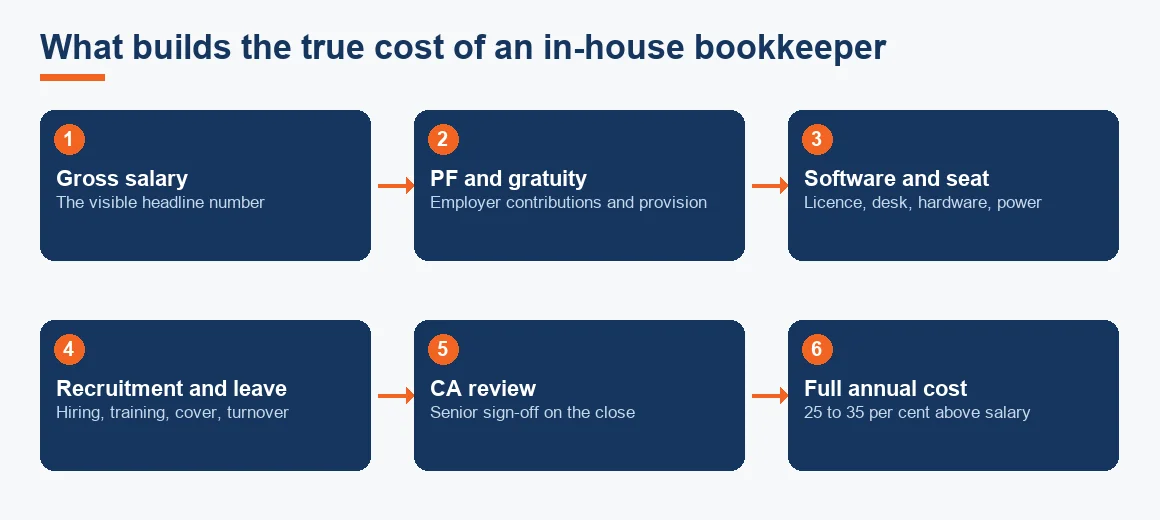
The salary is the visible number. The full cost of employment is larger, and most owners underestimate it by 25 to 35 per cent. On top of gross pay you carry the employer provident fund contribution, a gratuity provision that accrues from day one, paid leave, an accounting software licence, a workstation and its running cost, and the recruitment and training spend every time the role turns over. There is also a quality cost: a junior bookkeeper needs a senior or a CA to review the trial balance and sign off the month-end close, and that review time is rarely budgeted.
Single points of failure matter too. When your only bookkeeper takes leave, resigns or falls ill, filings can slip. A firm absorbs that continuity risk within its team.
How much does it cost to outsource bookkeeping?
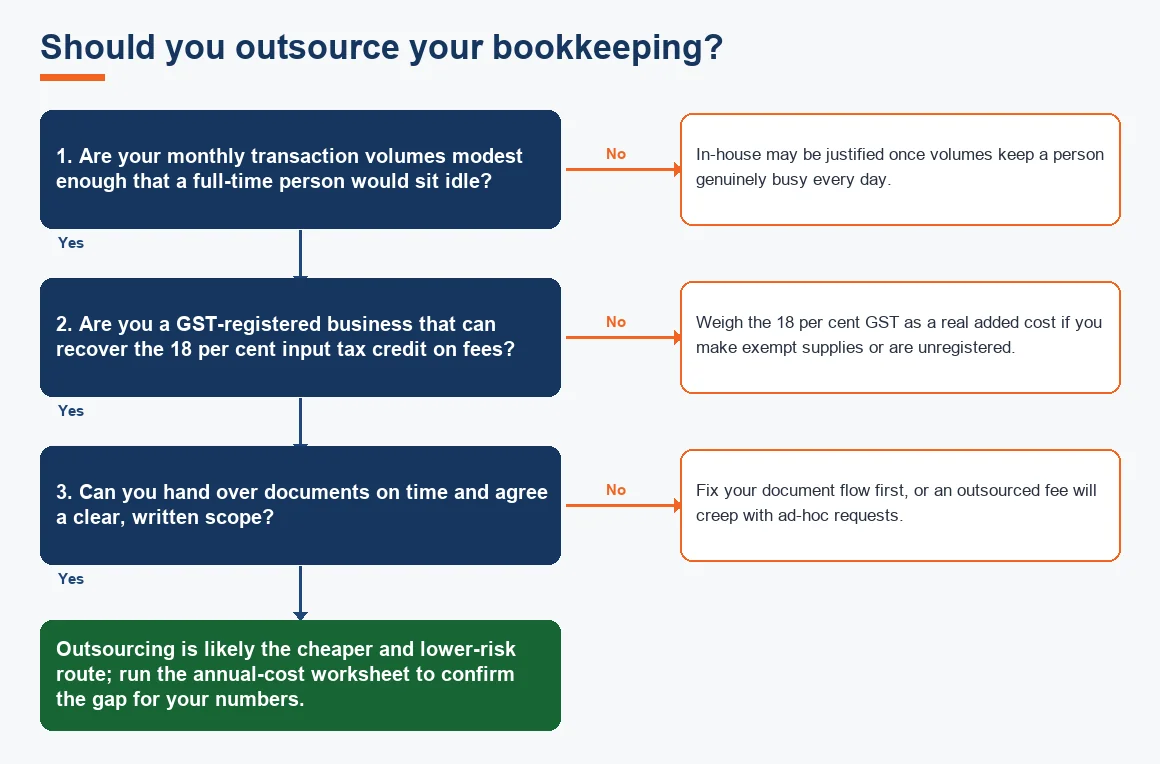
Outsourced pricing is usually a flat monthly retainer tied to a transaction band, with clear add-ons for payroll, TDS and annual filing work. You pay for output, not for a chair. There is no PF, no gratuity, no software licence to buy and no recruitment cost, because the firm carries its own tools and staff. For a young business the appeal is that the cost scales with activity: a quiet quarter costs less than a busy one, which a fixed salary can never do. The trade-off is that you must hand over documents on time and agree a clear scope, or the fee creeps as ad-hoc requests pile up. If your bottleneck is specifically supplier invoices and vendor payments, a focused arrangement such as accounts payable outsourcing can sit alongside or inside a bookkeeping retainer.
In-house vs outsourced bookkeeping cost: a side-by-side view
The table below compares the two models on the cost elements owners most often overlook. Figures are indicative and Exl GST.
| Cost element | In-house accountant | Outsourced firm |
|---|---|---|
| Base pay or fee | Rs 25,000 to Rs 45,000 / month salary | Rs 5,000 to Rs 25,000 / month fee |
| Employer PF and gratuity | Yes, on your books | None, borne by the firm |
| Accounting software licence | You buy and renew it | Included in the fee |
| Seat, hardware, electricity | You provide it | Not applicable |
| Cover during leave or exit | Filings can slip | Team provides continuity |
| Senior or CA review | Extra, often unbudgeted | Usually built in |
| GST on cost | None, and none recoverable | 18 per cent, fully recoverable as ITC if registered |
| Scales with activity | No, fixed monthly | Yes, by transaction band |
How to calculate bookkeeping fees, step by step
Whether you are pricing an in-house role or reading an outsourced quote, the same worksheet lets you compare them honestly.
- Count your average monthly transactions: sales invoices, purchase bills, bank and cash entries, and journal vouchers.
- List every GST registration you hold, because each state adds a return cycle.
- Decide the scope: bookkeeping only, or with payroll, TDS returns and month-end reporting.
- For the in-house route, take the gross salary and add roughly 30 per cent for PF, gratuity and leave, then add software, seat and review costs.
- For the outsourced route, take the annual fee and add 18 per cent GST, then subtract that GST back out if you are registered and can claim input tax credit (most bookkeeping runs on an accrual basis, matching cost to the month it relates to).
- Compare the two annual totals, not the two monthly headline numbers.
A tidy set of source documents keeps either route cheaper. Our monthly bookkeeping checklist sets out what to gather before each close, and a clean bank reconciliation is the single biggest time-saver you can hand a bookkeeper.
Worked example: the real annual cost compared
Take a services business with one GSTIN and about 250 monthly transactions, choosing between a Rs 30,000-a-month accountant and an outsourced firm quoting Rs 12,000 a month (indicative, Exl GST). The GST of 18 per cent is assumed fully recoverable as input tax credit.
| Line item | In-house (Rs / year) | Outsourced (Rs / year) |
|---|---|---|
| Gross salary or fee | 3,60,000 | 1,44,000 |
| Employer PF | 21,600 | 0 |
| Gratuity provision (4.81%) | 17,316 | 0 |
| Accounting software licence | 12,000 | 0 |
| Seat, hardware, electricity | 24,000 | 0 |
| Recruitment and CA review | 30,000 | 0 |
| GST at 18% (recoverable as ITC) | 0 | 0 |
| Total annual cost | 4,64,916 | 1,44,000 |
On these assumptions the outsourced route costs about Rs 3,20,916 a year less. The gap narrows for a high-volume business that genuinely needs a full-time person on site, and it widens for a small firm with modest volumes. The GST line is zero for the outsourced column only because the client is registered and recovers it; a business making exempt supplies, or one below the registration threshold, would carry that 18 per cent (about Rs 25,920 here) as a real cost.
Is a bookkeeper cheaper than an accountant?
Yes, and the distinction is worth keeping straight. A bookkeeper records transactions, reconciles the bank and maintains the general ledger. An accountant, and above them a CA, interprets those records, prepares statements, plans tax and signs off compliance. You pay a bookkeeper's rate for data entry and reconciliation, and an accountant's or a CA's rate for judgement. We cover where one ends and the other begins in bookkeeping versus accounting for an Indian business. Good outsourced firms package both, so a bookkeeper handles the daily entries while a senior reviews the close, which is exactly the layered structure an in-house junior lacks unless you also pay for supervision.
Tax treatment: TDS and GST on outsourced fees
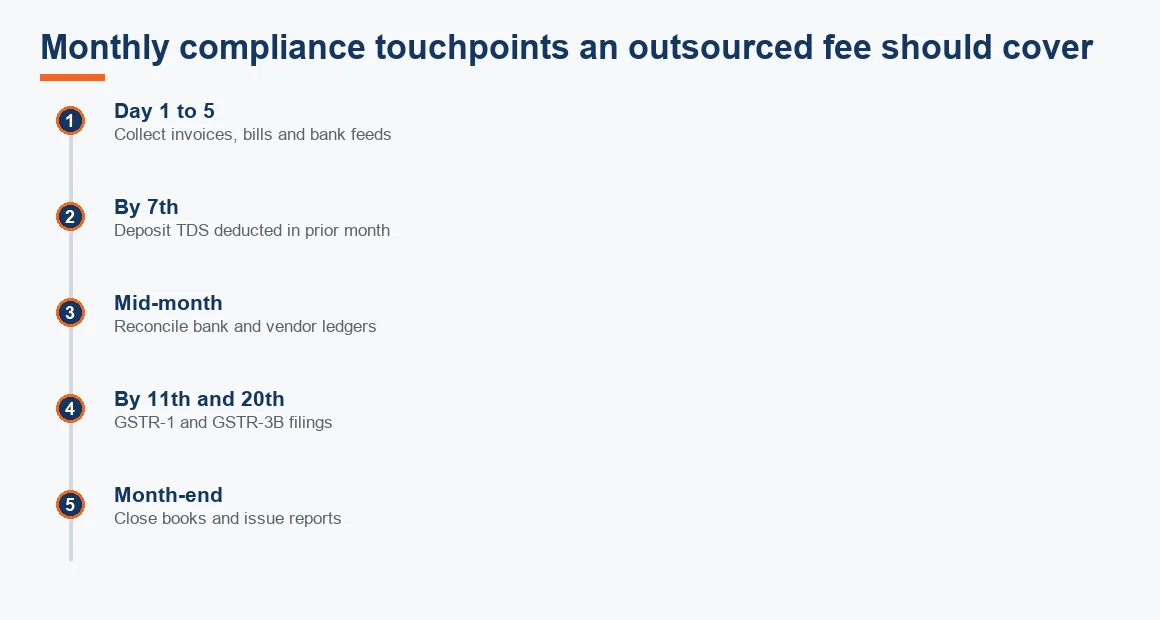
Two statutory points change the real cost of an outsourced arrangement. First, TDS under section 194J applies to fees for professional services at 10 per cent, once payments to that firm cross Rs 50,000 in a financial year, the threshold applicable from 1 April 2025. You deduct at credit or payment, whichever is earlier, deposit by the 7th of the following month and report it in the quarterly Form 26Q, per the Income Tax Department. TDS is a withholding, not an added cost: it is the firm's tax, collected through you.
Second, GST at 18 per cent is charged on professional fees, and a registered client takes full input tax credit because the service is used in the course of business, as set out by the CBIC. That recoverability is what makes the outsourced column cheaper on a like-for-like basis, since an in-house salary carries no tax you can claim back.
When does in-house still make sense?
Cost is not the only axis. Once transaction volumes are high, or you need someone physically present to chase approvals, handle cash and sit in on operational decisions daily, a full-time hire earns its keep. Businesses with sensitive, high-frequency data or bespoke systems sometimes prefer direct control. The point is to choose deliberately: run the annual-cost worksheet, weigh the continuity and supervision factors, and decide. For most SMEs under moderate volume, the numbers favour outsourcing; above a threshold, in-house wins on responsiveness. Automation is shifting that line too, as we discuss in what automation means for Indian bookkeepers. Whichever route you take, the accounting fundamentals do not change: the golden rules of accounting and a disciplined month-end close govern both.
When you are ready to compare a firm's scope against your own worksheet, our accounting and bookkeeping services and broader accounting services in India pages set out what a typical engagement covers. If you also capitalise software or hardware for an in-house setup, the depreciation calculator helps you cost those assets over their life rather than in year one.
Key terms
- Double-Entry Bookkeeping: the method of recording every transaction as an equal debit and credit.
- General Ledger: the master record where all accounts and balances are held.
- Bank Reconciliation: matching your books to the bank statement to catch missing or timing entries.
- Catch-Up Bookkeeping: bringing overdue, backlogged books up to date as a one-off project.
- Accounts Payable: money your business owes to suppliers, tracked and paid on terms.
Key takeaways
- Compare total annual cost against total annual cost, never a monthly fee against a headline salary.
- In-house cost runs 25 to 35 per cent above gross salary once PF, gratuity, software, seat and review are added.
- Outsourced fees carry 18 per cent GST, fully recoverable as input tax credit for a registered business.
- Section 194J TDS at 10 per cent applies past Rs 50,000 of annual fees, and is a withholding, not a cost.
- Outsourcing moves the work, not the statutory duty to keep proper books, which stays with the business and its directors.
Decision guide