In this guide
Will AI replace bookkeepers? The honest answer for an Indian business is no, but the job is changing quickly. Automation now handles the repetitive part of bookkeeping, roughly 60% to 70% of routine hours, such as sorting bank transactions, reading invoices and flagging duplicates. What it does not do is take legal responsibility, apply tax judgement or sign a GST return. So the question is less about replacement and more about which tasks move to software and which stay with a person.
What bookkeeping tasks can AI already automate?
Modern accounting software in India (Zoho Books, Xero, Odoo, TallyPrime with add-ons) leans on rules and machine learning to clear the mechanical work. The tasks it handles reliably are the high-volume, low-judgement ones:
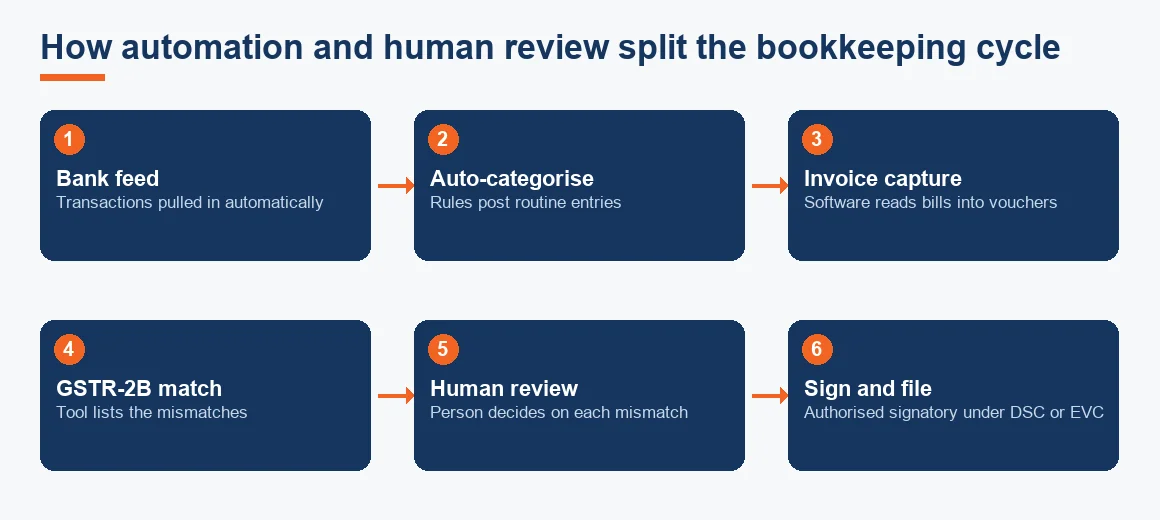
- Bank statement categorisation: once a rule learns that a recurring payee is an electricity bill, it posts the entry every month without help. This runs on automated bank feeds pulling transactions straight from the bank.
- Invoice data capture: tools read a PDF or photo of a bill and lift the vendor, amount, tax and date into a draft voucher.
- Duplicate detection: the software spots the same invoice entered twice, a common error in busy accounts payable.
- GSTR-2B matching: it compares your purchase register against the auto-drafted GSTR-2B input tax credit statement and lists the mismatches.
- Payment reminders: automatic follow-ups on overdue receivables without anyone drafting an email.
These five together are why the productivity gains feel large. They also sit on top of double-entry bookkeeping, which software enforces automatically so the general ledger stays balanced and the trial balance ties out. Most of this also assumes accrual accounting, where income and cost are recorded when earned or incurred, not when cash moves.
What still needs a qualified human?
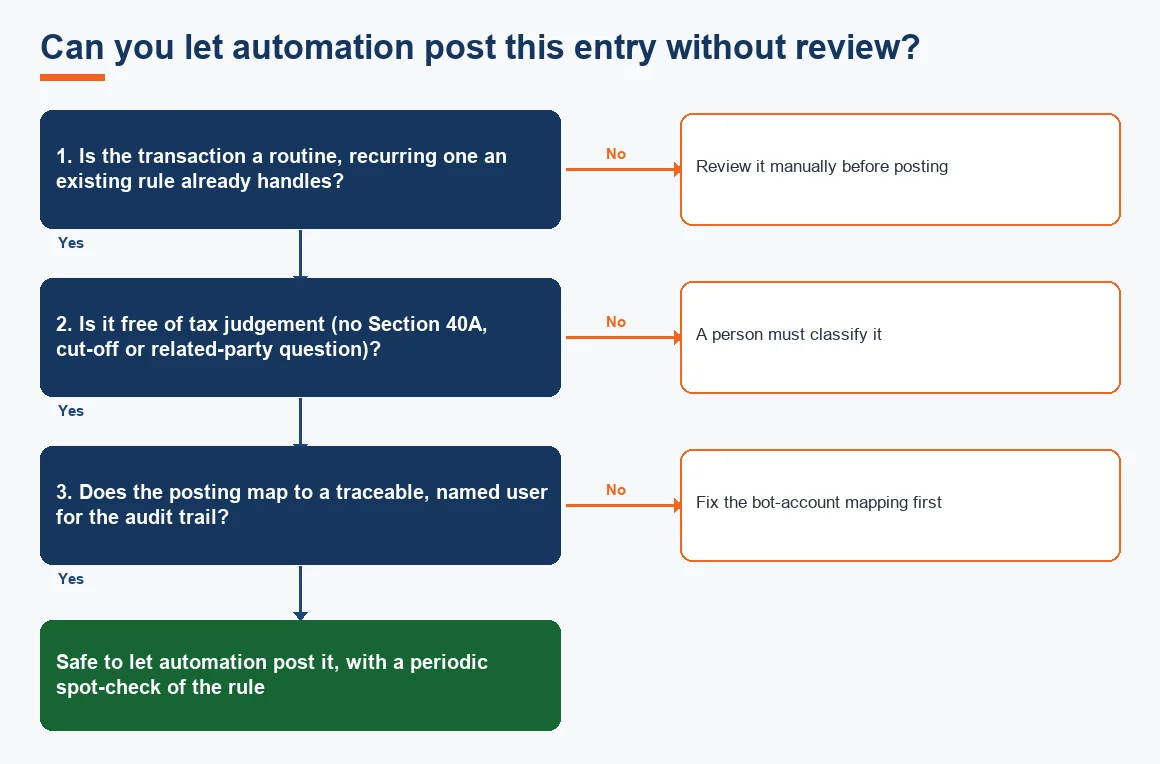
The work that survives automation is the work that needs a decision, not just a match. A tool can capture an invoice, but it cannot decide whether a cash payment above Rs 10,000 is disallowed under Section 40A(3), whether a vendor is a related party, or whether an expense belongs to March or April for cut-off. These are the calls that change taxable income and that an assessing officer will question.
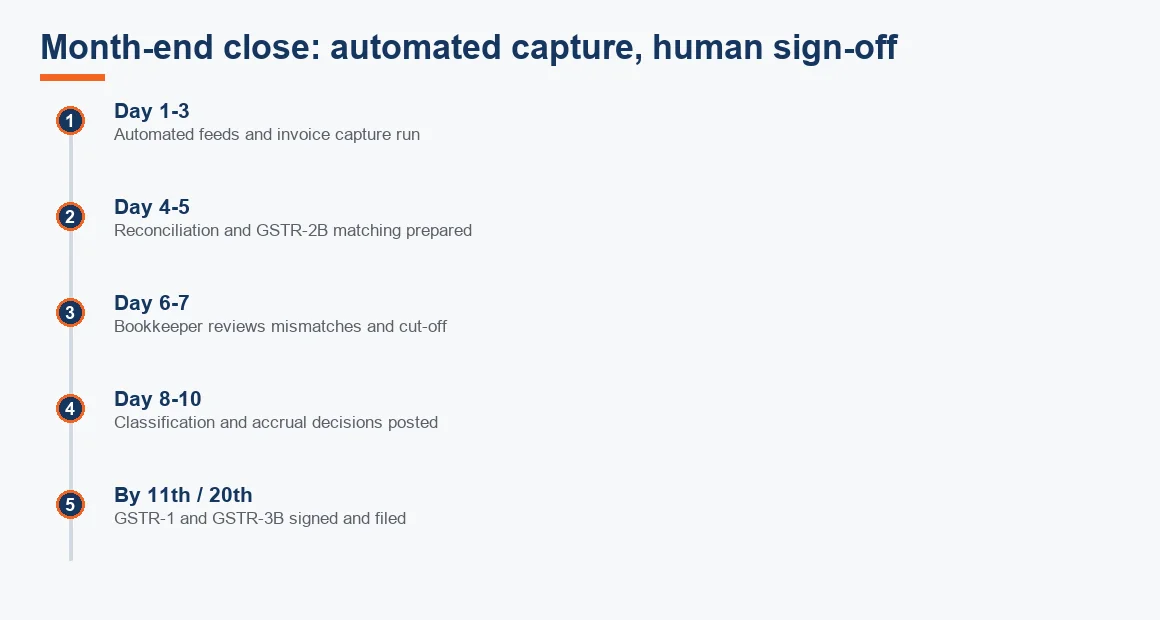
Reconciliation review is the clearest example. Software prepares the bank reconciliation and the GSTR-2B comparison, but someone has to decide what to do about a mismatch: chase the supplier, hold the credit, or accept a timing difference. Getting that wrong on input tax credit is expensive. Credit claimed without a matching supplier invoice attracts interest at 18% a year plus penalty under the GST law (see the GST portal).
Can AI handle bookkeeping end to end? Can ChatGPT do my bookkeeping?
Not on its own, and here it helps to separate two things. Purpose-built accounting software with automation is genuinely useful for the mechanical tasks above. A general chatbot like ChatGPT is different: it can explain a concept or draft a policy, but it has no live access to your bank feed, your GSTIN or your ledgers, and it will produce a confident but wrong journal entry if you feed it loose facts, because it does not truly apply the golden rules of accounting the way a trained person does. It cannot post to your books, reconcile your bank or file anything.
Even the best-configured software stops at the point of responsibility. It can prepare GSTR-1 and GSTR-3B down to the last figure, but the return is filed under the digital signature or EVC of an authorised signatory. A named person takes legal responsibility for every return. No automation removes that step, and no vendor agrees to take it on: software terms almost always exclude liability for tax consequences.
Who is responsible if an automated tool posts a wrong entry?
This is the part owners underestimate. Under Section 128 of the Companies Act, the duty to keep proper books sits with the managing director, the whole-time director in charge of finance and the chief financial officer. A bot does not shift that duty. Penalty under Section 128(6) runs from Rs 50,000 to Rs 5,00,000 for the officers in default, whatever software created the entry. The Act text is available on the MCA website.
The audit trail rule reinforces this. Rule 3(1) of the Companies (Accounts) Rules requires the accounting software to keep an unalterable edit log with date and user identity, and it applies regardless of what creates the entry. An automated posting still needs a traceable user, so a bulk import through a bot account must map to a real person. The statutory auditor comments on whether the audit trail was maintained under Rule 11(g) of the audit rules.
Will AI replace bookkeepers by 2030? The realistic view
Look at the direction of travel rather than the headline. Data-entry hours are falling and will keep falling. But three things anchor the role in India: statutory sign-off that only a person can give, the audit-trail and responsibility rules above, and the sheer amount of judgement in GST, TDS and cut-off. The likely 2030 picture is a smaller number of hours spent typing and a larger share spent reviewing, interpreting and configuring the software. The bookkeeper who only does data entry is exposed. The one who reviews and interprets is not.
If you are weighing how to resource this, the trade-off between building the skill in-house and buying it in is worth reading separately in our note on in-house vs outsourced bookkeeping costs, and the routine itself is set out in our monthly bookkeeping checklist. For the underlying distinction between recording and interpreting, see bookkeeping vs accounting.
Automation level by bookkeeping task
The table below summarises where automation is strong today and where a person still owns the decision. Treat the automation level as a guide, not a promise, because it depends on how well the rules are configured.
| Bookkeeping task | Automation level | What the human still does |
|---|---|---|
| Bank statement categorisation | High | Review new or unusual payees; correct mis-mapped rules |
| Invoice data capture | High | Confirm tax head and expense nature |
| GSTR-2B reconciliation | Medium | Decide on each mismatch; hold or claim credit |
| Expense classification (Section 40A, capital vs revenue) | Low | Apply the tax judgement |
| Cut-off and accruals at month end | Low | Decide the period an item belongs to |
| Filing GSTR-1 / GSTR-3B | Prepare only | Sign under DSC or EVC and take responsibility |
Worked example: how many hours does automation actually save?
Take a small Mumbai trading company whose bookkeeper spends 40 hours a month on the books. Applying realistic automation rates to each block of work shows where the time goes and, importantly, what is left. All figures are indicative and the rate is Rs 600 per hour Exl GST.
| Task block | Hours before | Automatable | Hours after | Human hours left |
|---|---|---|---|---|
| Bank and invoice entry | 16 | 85% | 2.4 | 2.4 |
| GSTR-2B and reconciliation | 10 | 50% | 5.0 | 5.0 |
| Classification and cut-off | 8 | 10% | 7.2 | 7.2 |
| Reporting and review | 6 | 20% | 4.8 | 4.8 |
| Total | 40 | - | 19.4 | 19.4 |
The 40 hours fall to about 19.4, a saving of 20.6 hours, or roughly 51%, worth about Rs 12,360 a month at Rs 600 per hour Exl GST. Notice that the hours which remain are the higher-value ones: reconciliation decisions, classification and review. Automation removed the typing, not the judgement. This is why the sensible move is to redeploy the freed time into review, not to cut the role.
Which skills should an Indian bookkeeper build now?
If data entry is shrinking, value shifts to the work no tool performs unattended. Four skills hold up well:
- Reconciliation review: reading a GSTR-2B mismatch or a bank difference and deciding the action, not just running the match.
- GST and TDS interpretation: knowing when a credit is blocked, when Section 194Q applies to a purchase, or when a payment triggers TDS.
- Software configuration: setting up GSTR-2B matching rules, chart of accounts mapping and audit-trail settings in Zoho Books or Odoo. A person who can configure the automation is more valuable than one who competes with it.
- Client reporting and communication: turning clean books into something an owner can act on.
For the tax side, a working feel for the rules matters. The rate and threshold for something like Section 194Q TDS on goods is exactly the kind of call automation flags but does not decide, and the official position sits with the Income Tax Department.
Key terms
- Automated Bank Feeds: a live link that pulls bank transactions into the books for auto-categorisation.
- Bank Reconciliation: matching the ledger cash balance to the bank statement and explaining every difference.
- GSTR-2B Input Tax Credit Matching: comparing the purchase register to the auto-drafted GSTR-2B before claiming credit.
- Double-Entry Bookkeeping: the system where every entry has an equal debit and credit, which software enforces.
So, where does this leave your business?
Use automation for the mechanical work, keep a competent person on review and sign-off, and be clear that the legal responsibility never leaves your officers. If you would rather hand the whole function to a team that already runs the software and the review, that is a commercial decision, and our accounting and bookkeeping services and broader accounting services in India are built around exactly this split of automated capture plus qualified review. To sanity-check a related calculation such as asset depreciation that software also automates but which needs the right method, our depreciation calculator shows the workings.
Key takeaways
- AI is automating bookkeeping tasks, not replacing bookkeepers: expect 50% to 70% fewer data-entry hours, not a vanished role.
- Judgement work (Section 40A classification, cut-off, related-party calls) and reconciliation decisions stay human.
- No software signs a GST return; GSTR-1 and GSTR-3B go out under a named person's DSC or EVC.
- The audit-trail rule and Section 128 responsibility apply to automated entries too, so every bot posting needs a traceable user.
- Bookkeepers who move into review, GST and TDS interpretation and software configuration gain value as automation spreads.
Decision guide