In this guide
If you run a software or SaaS company out of Nehru Place, Okhla or the wider Delhi IT belt, the accounting question that decides your GST, your working capital and your refund position is a single one: is a given invoice an export of services or a domestic supply? Export of software services is a zero rated supply, so it is billed without GST under a Letter of Undertaking, while a domestic subscription carries GST at 18 percent. This explainer walks through how a Delhi IT firm treats export revenue, place of supply, contract billing and the recent equalisation levy change, with a worked schedule you can copy. For the commercial engagement itself, our SaaS Accounting Services (IT & SaaS) page and its Delhi city page are the right starting points.
What IT and SaaS accounting means for a Nehru Place or Okhla firm
The bookkeeping mechanics are the same double-entry discipline every business runs, but a software company has three features that a trading firm does not: most of its cost is people rather than stock, a large share of its revenue may be earned in foreign currency, and revenue is often recognised over time rather than at a single point of sale. Getting those three right is most of the job. A trading business worries about inventory and landed cost; a Delhi software house worries about whether each rupee of revenue is an export, when it should be recognised, and whether the input tax credit on its office rent and cloud subscriptions is being matched correctly in GSTR-2B input tax credit matching. Product companies and funded startups add a fourth layer, share-based pay and deferred revenue, which is why we keep IT & Software Company Accounting Services and Startup Accounting Services India as separate reads.
Software export revenue and GST: the zero rated supply
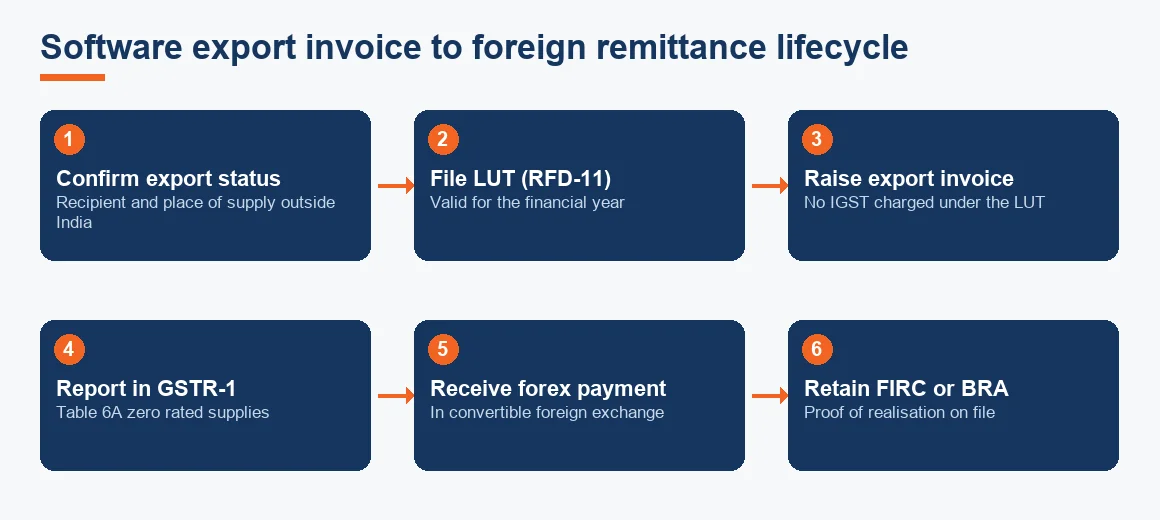
Export of a service is a zero rated supply under the GST law, which is not the same as an exempt or nil rated supply. Zero rated means the output attracts no GST but you keep full entitlement to the input tax credit on the costs behind it, and you can recover that credit rather than let it lapse. There are two lawful routes to bill an export.
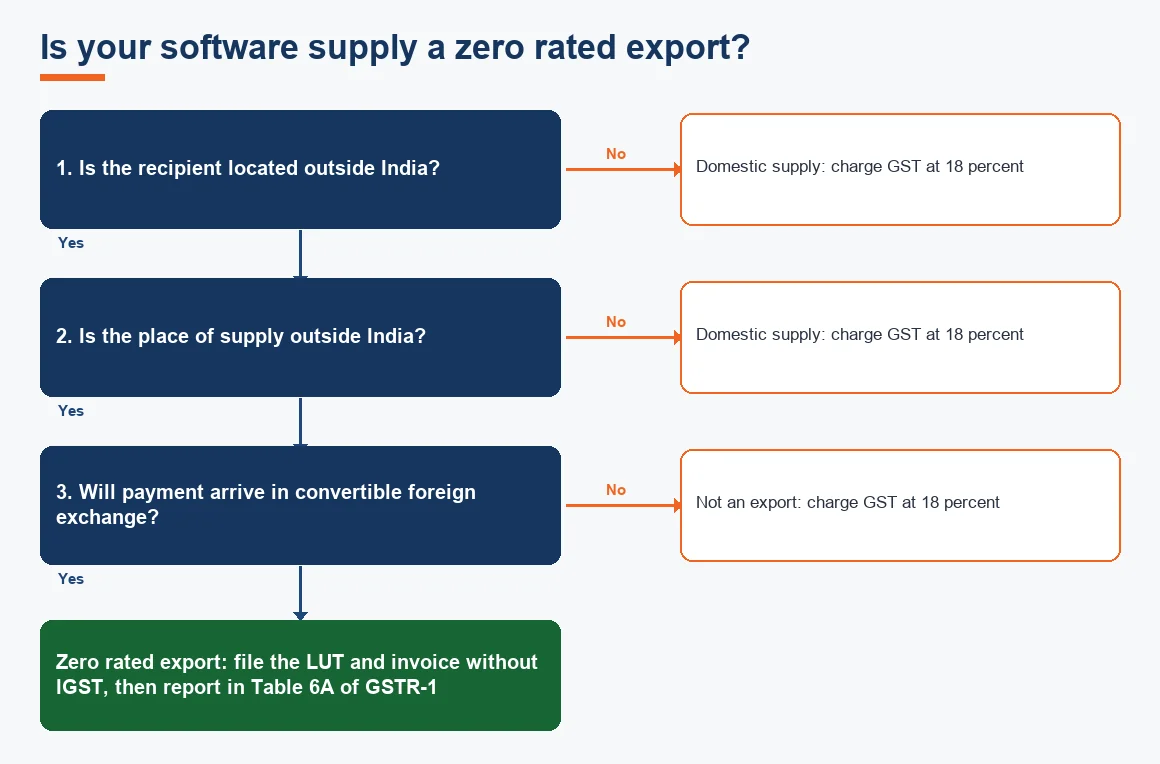
The first is to file a Letter of Undertaking in Form RFD-11 and invoice the overseas client with no IGST at all. The second is to charge IGST on the export invoice, pay it, and then claim it back as a refund. Both are legitimate; the LUT route simply avoids parking cash with the department for months. Whichever route you take, the transaction is reported in Table 6A of GSTR-1 and you retain the Foreign Inward Remittance Certificate or bank realisation advice as proof of receipt in convertible foreign exchange. The Central Board of Indirect Taxes lays out the LUT and refund procedure on its portal at cbic-gst.gov.in, and returns are filed on the GST portal.
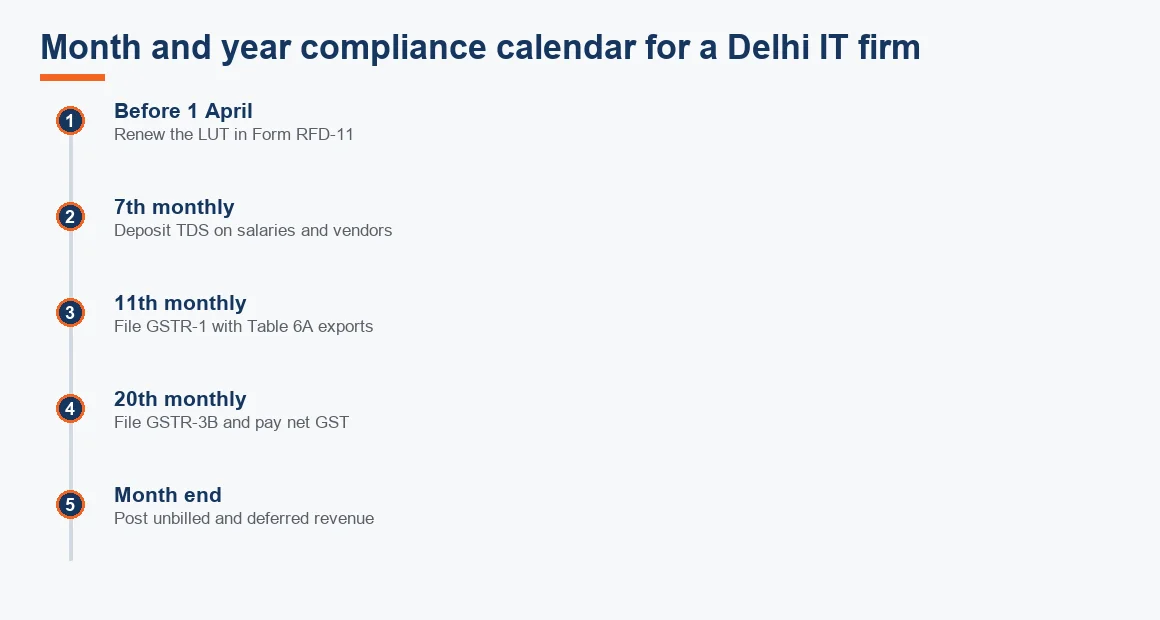
How to file and renew the LUT
- Log in to the GST portal and open Services, then User Services, then Furnish Letter of Undertaking.
- Select the financial year and confirm the two witnesses and their details.
- Accept the three self declarations on export, receipt of payment and non-payment of tax.
- Sign with the authorised signatory's digital signature or EVC and download the acknowledgement.
- Save the acknowledgement number in your compliance file so every export invoice for the year can cite it.
When is a supply an export? The place of supply test
The word that carries the most weight here is not export, it is place of supply. A supply of services qualifies as an export only when the supplier is in India, the recipient is outside India, the place of supply is outside India, payment is received in convertible foreign exchange, and the two parties are not merely establishments of the same person. Miss any one of those and the invoice is a domestic supply taxable at 18 percent, however international it feels. The most common trap for a Delhi firm is billing the Indian subsidiary of a foreign group: the customer's address is in India, so the place of supply is in India, and it is not an export.
Domestic software and SaaS: the 18 percent question
When the supply is not an export, domestic software development, customisation, implementation, maintenance and SaaS subscriptions attract GST at 18 percent under SAC 9983 or 9973 depending on the arrangement. The rate does not change with the delivery method: whether the software sits on media, is downloaded, or is accessed on a monthly subscription, the supply of software is treated as a service in most contracting models and the rate is 18 percent. For a Nehru Place firm selling a subscription to an Indian customer, that means an 18 percent line on every invoice and a matching input tax credit on the AWS, Azure or Google Cloud bills behind the product, subject to the usual matching in GSTR-2B.
Recognising revenue on time and material and subscription contracts
Two billing shapes dominate Delhi software work, and each has its own revenue rule. On a time and material development contract you bill and recognise income as approved hours are delivered, using signed timesheets as the measure. Hours worked but not yet invoiced at month end are carried as unbilled revenue and reversed when the invoice goes out, so the same work is never counted twice. GST on that work falls due when the invoice is issued or payment is received, whichever is earlier, which is why unbilled revenue and the GST liability do not always move together.
A subscription or SaaS contract works the other way round. If a customer pays a year upfront, you cannot book a year of revenue on day one. The upfront amount sits as deferred revenue and is released to the profit and loss account month by month as the service is delivered, in line with Ind AS 115 where that standard applies. The GST, by contrast, is due at the point of invoice, so the tax and the revenue deliberately diverge in timing. This is exactly the pattern our sibling e-commerce read picks up for platform settlements, so we will not repeat it here; see E-Commerce Accounting Services for the marketplace version.
Equalisation levy: what changed and what you still record
Many Delhi software firms buy advertising from foreign platforms and used to deduct an equalisation levy on it. That has changed. The 6 percent equalisation levy on online advertisement payments to a non-resident was withdrawn with effect from 1 April 2025, so no levy and no Form 1 statement is due on foreign advertising bought after that date. The separate 2 percent levy on non-resident ecommerce supplies had already gone from 1 August 2024. Payments made before those dates remain assessable, so keep the older records intact. The Income Tax Department's guidance sits at incometax.gov.in. In practice this simplifies the monthly close: foreign ad spend is now just an expense with its usual reverse charge GST consideration, not a levy computation.
The Delhi angle: no professional tax, Shops and Establishment, and the NCR spread
Delhi gives a software employer one genuine advantage over Mumbai, Pune or Bengaluru: the capital levies no professional tax, so there is no monthly PT deduction or PT return on payroll. That is the Delhi nil professional tax regime, and it is a real saving in compliance time, not just rupees. What you do still carry is registration under the Delhi Shops and Establishments Act, TDS on salaries and vendor payments, and GST. A further Delhi reality is that many teams sit in Delhi but bill or hire across Gurugram and Noida, so an inter-state GST view across the NCR matters; our Delhi Shops & Establishment and GST/TDS compliance note and the GST & TDS health-check for Delhi MSMEs cover the payroll and filing side in full. For what all of this typically costs in the city, the 2026 Delhi price guide and the note on choosing an accountant in Delhi are the practical companions.
The two export routes compared
The choice between the LUT route and the pay-and-refund route is really a working capital decision. The table sets out the trade-off for a firm exporting software services from Delhi.
| Point | LUT route (RFD-11) | Pay IGST and claim refund |
|---|---|---|
| GST charged on export invoice | Nil | IGST at 18 percent |
| Cash locked with department | None | Full IGST until refund clears |
| Working capital impact | Neutral | Blocked for weeks or months |
| Annual admin | File one LUT before 1 April | File a refund claim each period |
| Best suited to | Regular exporters | Occasional or one-off exporters |
Worked example: a domestic annual subscription and its deferred revenue
Suppose a Nehru Place SaaS firm sells an annual subscription to an Indian customer for INR 240000 plus GST, billed upfront on 1 April (indicative and Exl GST on the base). GST at 18 percent is INR 43200, so the invoice totals INR 283200. The entire GST of INR 43200 falls due in April at the point of invoice, but revenue is recognised at INR 20000 a month across the year. The schedule below shows the first few months and the deferred revenue balance being released.
| Month | Opening deferred revenue (INR) | Revenue recognised (INR) | Closing deferred revenue (INR) |
|---|---|---|---|
| April | 240000 | 20000 | 220000 |
| May | 220000 | 20000 | 200000 |
| June | 200000 | 20000 | 180000 |
| July | 180000 | 20000 | 160000 |
| March (year end) | 20000 | 20000 | 0 |
By 31 March the deferred revenue balance is nil and the full INR 240000 has reached the profit and loss account, while the GST of INR 43200 was paid back in April. The tax and the revenue moved on different clocks, which is the whole point of the treatment.
Key terms
- Software Export Revenue (Section 10AA SEZ): revenue from services supplied outside India, zero rated for GST and eligible for income tax benefits where an SEZ unit qualifies.
- Foreign Currency Receivables: amounts billed to overseas clients in foreign exchange, revalued at the closing rate at period end.
- Unbilled Revenue (WIP Hours): work delivered but not yet invoiced at month end, carried as an asset and reversed on billing.
- Deferred Revenue (Unearned Revenue): subscription amounts collected before the service is delivered, released to income over the term.
- Monthly Recurring Revenue (MRR): the normalised monthly value of active subscriptions, the core operating metric for a SaaS firm.
Key takeaways
- Export of software services is zero rated: use a Letter of Undertaking to bill without GST, or pay IGST and claim a refund.
- The place of supply, not the currency, decides whether an invoice is an export or an 18 percent domestic supply.
- Renew the RFD-11 LUT every financial year before 1 April to avoid IGST becoming payable on exports.
- Time and material work uses unbilled revenue at month end; subscriptions use deferred revenue released monthly.
- The equalisation levy on foreign advertising was withdrawn from 1 April 2025, and Delhi charges no professional tax.
You can pressure-test the standard treatment on your own numbers with our Ind AS Applicability Checker before applying Ind AS 115 to a subscription book. When you are ready to hand the recurring close to a team, the SaaS Accounting Services in Delhi page and the wider Delhi accounting and bookkeeping service page carry the commercial detail this explainer deliberately leaves out.
Decision guide