
In this guide
Accounting for an Ahmedabad school, college or education trust is fund-based accounting layered on top of two separate compliance systems: the Income Tax Act, which protects the Section 12A exemption, and Gujarat state law, which governs professional tax on staff and filing with the Charity Commissioner. The core idea is simple. A trust does not measure success by profit; it measures whether income has been applied to its educational objects. Everything in the books, from how a corpus donation is parked to how a teacher's professional tax is deducted, follows from that. This guide explains the local and statutory mechanics for institutions in Ahmedabad. When you are ready to hand the books to a specialist, the Accounting Services for Schools & Colleges page is the place to start.
Why school and college accounting is fund-based
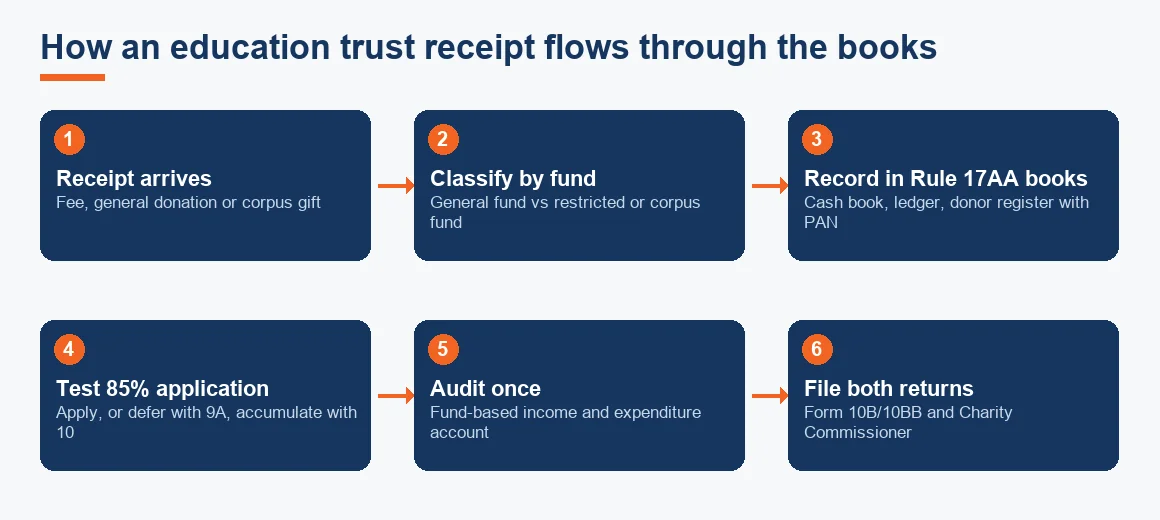
A commercial company runs one set of books that ends in a profit figure. An education trust instead runs fund-based accounting, where receipts are separated by the purpose for which they may be spent. General fee income sits in the general fund and is freely applicable to running the institution. A building-fund donation, a scholarship endowment or a corpus gift sits in its own restricted fund and cannot be diverted to salaries or electricity. The books still use ordinary double-entry bookkeeping and a proper general ledger, but the chart of accounts is built around funds so that the income and expenditure account shows, fund by fund, what came in and what was applied.
This matters because the exemption under Section 11 (and the parallel route under Section 10(23C) for approved educational institutions) turns on application of income to the objects. If your books cannot show that clearly, the exemption is fragile. This is the opposite of, say, a startup's accounts, where the whole point is to arrive at a profit and a runway. An education trust that treats itself as a business in its books invites questions it does not need.
Gujarat professional tax for school and college staff
Professional tax is a Gujarat state levy and it has two limbs for an Ahmedabad institution. The first is the tax deducted from each employee's salary. Gujarat charges nil where the monthly salary is up to Rs 12,000 and Rs 200 a month where it is above Rs 12,000. So a teacher, administrator or lab assistant earning Rs 15,000 a month has Rs 200 deducted each month, Rs 2,400 across the year. Support staff earning under Rs 12,000 have nothing deducted.
The second limb is the institution's own employer liability. The school or college needs its own enrolment certificate and pays the employer levy separately from the amounts it deducts from staff. Deducting from teachers but never registering the institution itself is a common gap. This is a local obligation that the national Section 12A framework says nothing about, and it is one reason education accounting in Ahmedabad is not the same as education accounting elsewhere. The mechanics of enrolment, registration and the Shops Act sit alongside it, covered in the guide to Gujarat professional tax and Shops Act compliance.
Books an Ahmedabad trust must keep under Rule 17AA
Since the tightening of the trust regime, Rule 17AA prescribes exactly what a Section 12A institution has to maintain. It is not a suggestion; missing books can support cancellation of registration under Section 12AB(4). The prescribed set is:
- a cash book and ledger recording all receipts and payments;
- a register of voluntary contributions carrying, for each donor, name, address and PAN;
- records of the projects and activities the trust undertakes;
- records of loans and borrowings, and of investments;
- records of any property held by the trust.
These records must be kept for ten years from the end of the relevant assessment year. The register of voluntary contributions is where most Ahmedabad trusts slip, because donations arrive at admission time, at annual functions and through alumni, and the PAN detail is easy to leave blank. The Income Tax Department's guidance on trust and institution compliance sets out the record obligations in full.
The 85 percent income application rule
The central exemption test is that at least 85 percent of income must be applied to the trust's objects during the year. A trust with Rs 1 crore of fee and donation income must therefore spend Rs 85 lakh on education-related expenditure to stay fully exempt. Two release valves exist when it cannot. If the shortfall is because income was received late or could not be spent in time, Form 9A lets the trust defer application to the following year. If the trust wants to set money aside for a defined purpose, such as a new building, Form 10 lets it accumulate the amount for up to five years. Both forms must be filed at least two months before the due date of the return, not afterwards. The 85% income application rule is where good fund accounting pays off, because the figure is only defensible if the books cleanly separate what was applied from what was merely set aside.
How a corpus donation is recorded
A corpus donation is not income. It is credited to a corpus fund on the liabilities side of the balance sheet, not to the income and expenditure account, and it stays exempt only if it is invested and held in a mode specified under Section 11(5). Two conditions matter in practice. First, the donor must give a written direction that the gift is towards corpus; without that direction it is an ordinary donation and taxable as income. Second, spending corpus money on running costs makes it taxable, unless the fund is later restored from other income. These are restricted corpus donations and the restriction is the whole point. An institution that also receives foreign donations has a further layer, an FCRA designated bank account, which cannot be mixed with domestic funds at all.
Form 10B or Form 10BB: the income tax audit
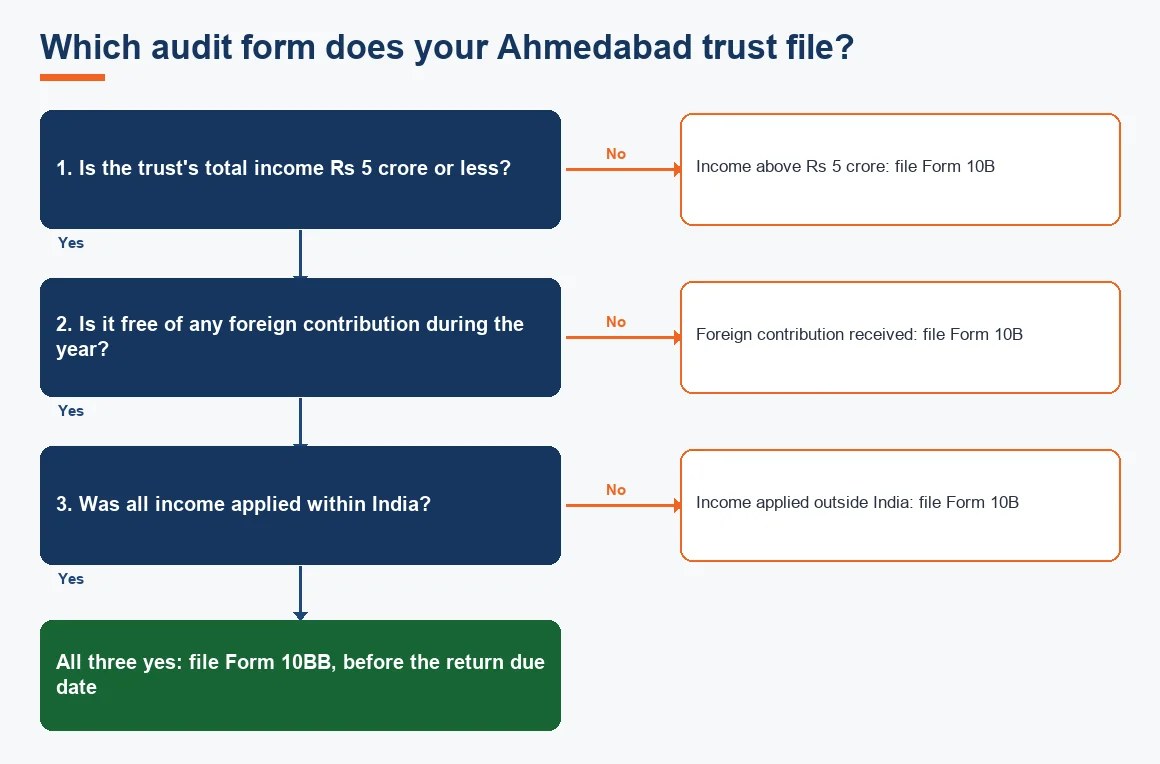
An education trust that has to get its accounts audited files the audit report in either Form 10B or Form 10BB before the return. Which one depends on the trust's circumstances. The two are not interchangeable, and filing the wrong form is treated as not filing at all.
| Factor | Form 10B | Form 10BB |
|---|---|---|
| Total income (before exemption) | More than Rs 5 crore | Rs 5 crore or less |
| Foreign contribution received | Yes, use 10B | No |
| Income applied outside India | Yes, use 10B | No |
| Typical Ahmedabad institution | Larger colleges, trusts with foreign donors | Most small and mid schools |
| Filing deadline | One month before the ITR due date (by 30 September for audit cases) | |
A larger college with foreign donations or income spent abroad uses Form 10B; a mid-sized Ahmedabad school under the Rs 5 crore line uses Form 10BB. The report must reconcile to your fund-based income and expenditure account and to the same figures you file with the state, which brings us to the Charity Commissioner.
Filing with the Gujarat Charity Commissioner
A trust registered under the Gujarat Public Trusts Act has a state obligation that runs parallel to income tax. Its accounts must be audited and the audited balance sheet and income and expenditure account filed with the Charity Commissioner, together with the annual contribution payable on the trust's gross income. This is entirely separate from the income tax audit in Form 10B or 10BB. Critically, the two sets of figures must agree. An Ahmedabad trust that reports one surplus to the Charity Commissioner and a different one to the Income Tax Department has created a discrepancy that either authority can pick up. One clean set of fund-based books, audited once, feeding both filings, is the only sensible way to run it. Keeping the Section 12A and 80G annual upkeep on a single calendar avoids the mismatch.

Worked example: the 85 percent application test
Take an Ahmedabad school trust with Rs 1 crore of income for the year, made up of tuition fees and general donations (corpus gifts are excluded from this test because they are not income). It spends Rs 78 lakh on salaries, upkeep and educational costs, and wants to set aside Rs 10 lakh for a new science block. The worksheet below shows whether it stays exempt. All figures are indicative and Exl GST where any taxable service is involved.
| Line | Amount (Rs) | Treatment |
|---|---|---|
| Total income for the year | 1,00,00,000 | Base for the 85% test |
| Required application (85%) | 85,00,000 | Must be applied or deferred |
| Actually applied to objects | 78,00,000 | Salaries, upkeep, education |
| Shortfall before accumulation | 7,00,000 | Below the 85% mark |
| Accumulated via Form 10 | 10,00,000 | Set aside for science block, up to 5 years |
| Position after Form 10 | 0 | Shortfall covered, exemption intact |
The trust applied only Rs 78 lakh, Rs 7 lakh short of the Rs 85 lakh mark. By filing Form 10 at least two months before the return due date to formally accumulate Rs 10 lakh for the building, it covers the shortfall and keeps the exemption. Had it filed nothing, the Rs 7 lakh would have been taxable. The arithmetic is easy; the discipline of filing the form on time is what protects the trust.
Key terms
- Fund-Based Accounting: books organised by fund and purpose rather than by profit, standard for trusts and NGOs.
- 85% Income Application Rule: the requirement to apply at least 85 percent of income to the objects each year to stay exempt.
- Restricted Corpus Donations: donor-directed corpus gifts held on the liabilities side and invested under Section 11(5).
- Section 10(23C) Exemption Rules: the alternative exemption route for approved educational institutions.
- Section 12A / 80G Annual Upkeep: the recurring registration and filing tasks that keep exemption and donor deduction alive.
Putting the Ahmedabad picture together
An education trust in Ahmedabad is running three books at once in a single set of records: fund-based accounts for its own management, the Income Tax file that protects Section 12A and drives Form 10B or 10BB, and the state file for professional tax and the Charity Commissioner. They only stay in step if the underlying ledger is clean and audited once. If you are still comparing what in-house versus outsourced bookkeeping costs locally, the 2026 Ahmedabad benchmarks and the guide to choosing an accountant in Ahmedabad are useful next reads, and a trust inheriting messy records will want the books cleanup and GST reconciliation guide first. For fixed assets like a new building or lab equipment, the depreciation calculator helps schedule the write-down. General Ahmedabad bookkeeping and Tally-based work are covered on the Ahmedabad accounting and Tally Prime Ahmedabad pages.
Key takeaways
- School and college accounting is fund-based: classify every receipt by fund, because the exemption turns on application of income, not profit.
- Gujarat professional tax is nil up to Rs 12,000 a month and Rs 200 above, and the institution needs its own enrolment certificate for the employer levy.
- Rule 17AA fixes the books to keep, including a donor register with PAN, retained ten years; gaps can cost the Section 12A registration.
- Apply 85 percent of income each year, or use Form 9A to defer and Form 10 to accumulate, always at least two months before the return due date.
- Record corpus donations to a corpus fund with the donor's written direction, and keep the Charity Commissioner and income tax figures identical.
This article is an informational explainer for Ahmedabad institutions. To engage a team on your trust's books, see Accounting Services for Schools & Colleges in Ahmedabad. Statutory positions are summarised from the Income Tax Department and the audit and reporting standards issued by the ICAI; verify current thresholds before filing.
Decision guide