
In this guide
GST accounting for Ahmedabad textile marketplace sellers begins with one habit: reconcile the marketplace settlement report before you touch the sales figure. Amazon, Flipkart, Meesho and Myntra do not pay you what your dashboard shows. They pay the invoice value less commission, shipping, promotion fees, tax collected at source and tax deducted at source. If your books record only the money that lands in the bank, your turnover, your input tax credit and your GST returns will all be wrong. This guide explains how a seller or textile exporter working out of SG Highway, Navrangpura, Ashram Road or the GIDC belts around the city should record marketplace activity. It is an explainer only; if you want someone to run the books, that sits with our E-Commerce Accounting Services and, locally, with E-Commerce Accounting Services Ahmedabad.
What e-commerce accounting means for an Ahmedabad marketplace seller
A marketplace is not a customer. It is an operator that lists your goods, collects the money from the buyer and then settles a net amount to you after its own deductions. So a single sale generates several accounting events: the sale itself to the end customer, the commission expense to the operator, the tax the operator collects on your behalf, and the settlement receipt. Recording only the net payout collapses all of these into one line and understates both revenue and expenses. For a Gujarat textile business selling cotton apparel and made-ups, where GST runs at 5% up to the notified price threshold and 12% above it, that error also distorts your output tax. Getting the structure right from the first month is far cheaper than a clean-up later, a point we cover in the books cleanup and GST reconciliation guide for Ahmedabad SMEs.
How to do ecommerce accounting: reconciling a marketplace settlement
Every settlement cycle follows the same path from an order to money in the bank. Working through it in order is what keeps the books tied to the returns.
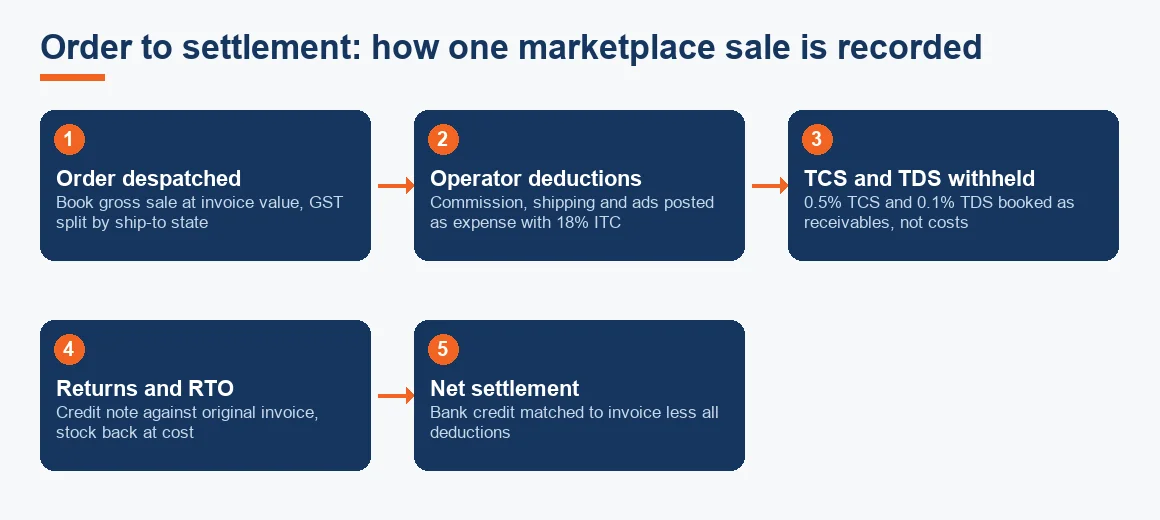
- Book gross sales at invoice value. Record the taxable value plus output GST for every order despatched, city and state split by the ship-to address, not by where the payout arrives.
- Post operator deductions separately. Commission, closing fee, shipping, storage and advertising are expenses with their own 18% GST, which becomes input tax credit. Do not net them against sales.
- Record TCS and TDS as receivables. The TCS under Section 52 and the TDS under Section 194-O the operator withholds are amounts you reclaim, so they belong in asset ledgers, not expense ledgers.
- Reverse returns and RTO. Raise a credit note against the original invoice and bring stock back at cost.
- Match the net settlement to the bank. The bank credit should equal invoice value minus commission and fees minus TCS minus TDS minus returns. Any gap is an unreconciled item to chase.
Marketplace TCS under Section 52 and TDS under Section 194-O
Two separate taxes are withheld on the same sale, and sellers routinely confuse them. TCS under Section 52 of the CGST Act is a GST mechanism: the operator collects it on the net value of taxable supplies and deposits it, and it appears in your electronic cash ledger to set against your GST liability. The rate is 0.5% overall, reduced from 1% with effect from 10 July 2024, so read as 0.25% CGST plus 0.25% SGST for intra-Gujarat sales, or 0.5% IGST for inter-state sales. TDS under Section 194-O is an income-tax mechanism on the gross amount of sales, and the rate is 0.1%, reduced from 1% with effect from 1 October 2024. It shows up in your Form 26AS and is adjusted against your income-tax liability. The table below sets the two side by side.
| Feature | TCS (Section 52, GST) | TDS (Section 194-O, Income Tax) |
|---|---|---|
| Law | CGST Act, Section 52 | Income-tax Act, Section 194-O |
| Rate | 0.5% of net taxable supplies | 0.1% of gross sales |
| Base | Taxable value net of returns | Gross amount of sale of goods or services |
| Where credit appears | Electronic cash ledger (GST) | Form 26AS (income tax) |
| How you reclaim it | Accept in GSTR-2X, set off GST payable | Adjust against advance tax or refund |
Worked example: an Amazon settlement for an Ahmedabad textile seller
Assume a Navrangpura seller despatches cotton apparel through Amazon in a settlement cycle. Net taxable sales after returns are 5,00,000, output GST at 5% is 25,000, and Amazon charges commission and fees of 50,000 plus 18% GST. All figures are in rupees and illustrative.
| Line | Amount (INR) | Ledger treatment |
|---|---|---|
| Taxable sales (net of returns) | 5,00,000 | Sales (credit) |
| Output GST at 5% | 25,000 | Output GST payable |
| Invoice value collected from buyers | 5,25,000 | - |
| Less: commission and fees | (50,000) | Expense |
| Less: GST on fees at 18% | (9,000) | Input tax credit |
| Less: TCS at 0.5% of 5,00,000 | (2,500) | TCS receivable (cash ledger) |
| Less: TDS at 0.1% of 5,00,000 | (500) | TDS receivable (26AS) |
| Net settlement to bank | 4,63,000 | Bank (debit) |
The 4,63,000 is what hits the account, but the books have recorded 5,25,000 of gross receipts, 59,000 of deductible cost with 9,000 of ITC, and 3,000 of tax you will reclaim. Booked only at the net figure, your turnover would read 62,000 short and your reclaimable tax would vanish. This is exactly the discipline that marketplace settlement reconciliation enforces.
Recording returns, RTO and credit notes
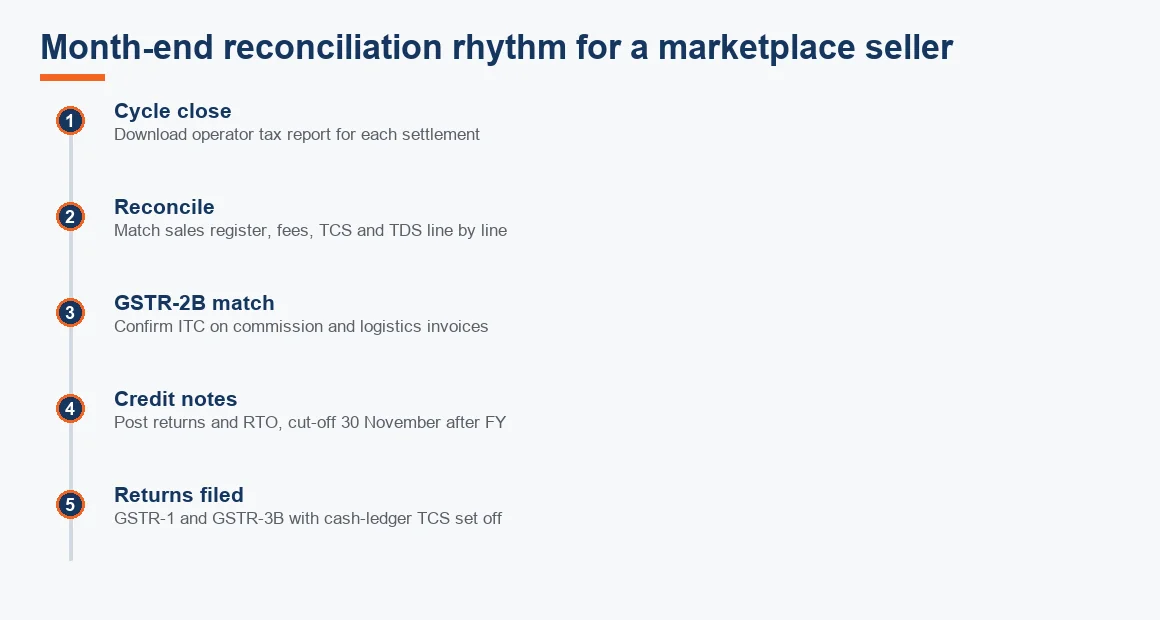
Return to origin is a fact of textile selling: size, colour and fit drive high return rates. When an order comes back, reverse the sale with a credit note linked to the original invoice so that output GST reduces, and bring the stock back into inventory at cost. The forward and return shipping and any RTO handling fee the operator deducts are expenses in their own right, not reductions of the sale value. Timing matters: a credit note can reduce your output tax only if it is reported by 30 November following the end of the financial year, after which the reversal is stuck in your books but the GST is not recoverable. Track RTO volumes as a monthly provision if returns are heavy, using the logic behind return to origin provisions.
Exports, LUT and foreign-currency invoices for Ahmedabad textile houses
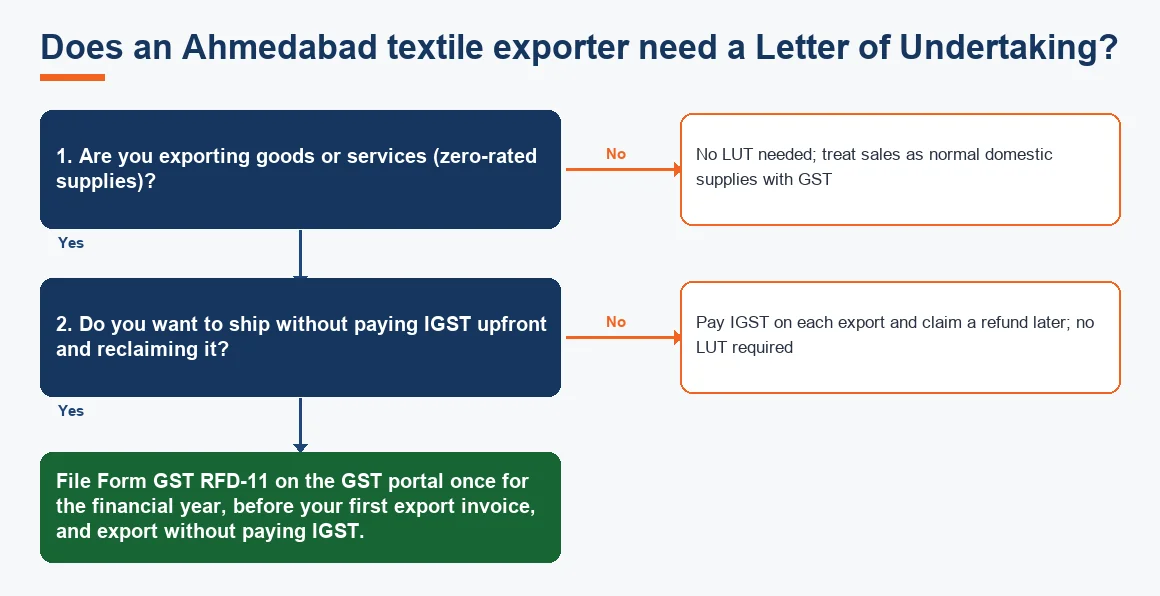
Many Ahmedabad textile businesses sell both on domestic marketplaces and directly to overseas buyers, so the same set of books carries rupee marketplace payouts and dollar export invoices. Exports of goods and services are zero-rated. To ship without paying IGST and then reclaiming it, file a Letter of Undertaking in Form GST RFD-11 on the GST portal, once for each financial year and before the first export invoice of that year. Record an export invoice at the exchange rate on the invoice date, using the CBIC notified customs rate or a consistently applied bank rate. When payment is realised, the difference between the invoice rate and the realisation rate is a foreign exchange gain or loss under AS 11 (or Ind AS 21), and any balance still open on 31 March is restated at the closing rate. If you are unsure which framework applies to your company, the AS vs Ind AS comparison matrix is a quick reference, and open dollar balances are tracked as foreign currency receivables. Sellers whose model is closer to software or subscription rather than goods should read our SaaS accounting services (IT and SaaS) and IT and software company accounting services notes instead, as export-of-services rules differ.
Key terms
- Marketplace Settlement Reconciliation: matching an operator's payout report to your sales register, line by line.
- Section 52 TCS under GST: the 0.5% tax an e-commerce operator collects on your net taxable supplies.
- Return to Origin (RTO) Provisions: accounting for goods that come back undelivered, via credit notes and stock re-entry.
- GSTR-2B Input Tax Credit Matching: confirming operator and vendor invoices before claiming ITC.
- Foreign Currency Receivables: export dues in dollars, restated at period end under AS 11 or Ind AS 21.
Duty drawback, RoDTEP and other export incentives
Export incentives are income, not a discount on sales. Duty drawback is recognised when the shipping bill is filed and the claim becomes due; RoDTEP is recognised when the e-scrip is issued in the customs ledger. Credit both to a separate incentive income account rather than netting them against export revenue, because both are taxable business income. The sale of a duty credit scrip itself, however, is exempt from GST, so keep that transaction distinct. For a textile exporter these credits can be a meaningful share of margin, and misclassifying them either overstates export sales or hides taxable income.
GST registration and input tax credit for Gujarat sellers
Registration is not optional for goods sellers on a marketplace. Any supplier selling through an operator that collects tax at source must register under Section 24 regardless of turnover, and while Notification 34/2023 carves out small intra-state suppliers who meet strict conditions, marketplaces in practice require an active GSTIN before approving a seller account. Once registered, your ITC discipline decides your working capital: claim the GST on commission, logistics and advertising, match it in GSTR-2B, and watch for the operator raising invoices under a different GSTIN than the one you reconcile against. If you also buy goods above the notified limit from a single supplier, keep an eye on Section 194Q TDS on goods on the purchase side. Employer obligations such as Gujarat professional tax and Shops Act registration sit alongside all of this and are covered in our Gujarat professional tax and Shops Act compliance guide.
Key takeaways
- Reconcile the settlement report first; book gross sales, fees, TCS and TDS separately, never the net payout alone.
- TCS under Section 52 is 0.5% (GST cash ledger); TDS under Section 194-O is 0.1% (Form 26AS). Both are reclaimable, not costs.
- Reverse returns and RTO through credit notes linked to the original invoice, and report them by 30 November following the financial year.
- Textile exporters file a Letter of Undertaking (Form GST RFD-11) once a year and record dollar invoices at the CBIC rate, restating open balances at year end.
- Duty drawback and RoDTEP are taxable income; GST registration under Section 24 is compulsory for marketplace goods sellers.
For the underlying rules, check the source: TCS provisions on the CBIC GST portal, the Letter of Undertaking facility on the GST portal, and Section 194-O guidance on the Income Tax Department site. To have the whole set of books maintained end to end, use a general accounting and bookkeeping service in Ahmedabad or, if your data still sits in Tally, Tally Prime accounting services in Ahmedabad. Fast-growing sellers seeking investor-ready books should look at startup accounting services India. This blog explains the bookkeeping; the commercial engagement stays on the city service page.
Decision guide