In this guide
Common account reconciliation errors are the handful of posting mistakes that stop your books and an outside statement, usually the bank, from agreeing: a transposition, a duplicated entry, a receipt booked to the wrong account, an omitted bank charge or a debit and credit entered the wrong way round. They are different from timing differences, which resolve themselves, and once you can name each one you can find it in minutes rather than an afternoon. This guide walks through the recurring errors, the quickest tests to locate each, and the disciplined way to correct them without damaging the audit trail.
What is a reconciliation error?
A reconciliation error is a genuine mistake in your own records that creates a gap between two sets of figures that should match, for example the cash book against the bank statement or a supplier ledger against a statement of account. It is worth separating from a timing difference, which is not an error at all: a cheque you have issued but the payee has not yet banked, or a deposit the bank credits a day later, will clear on its own. An error will not. It sits there until someone traces it, which is why an unexplained difference should never simply be carried forward. Reconciliation itself rests on double-entry bookkeeping, so every real error has a mirror image somewhere in the general ledger that you can hunt down.
What are the most common reconciliation errors?
Most differences a small business meets each month fall into five buckets. Recognising the pattern is half the battle, because each type has its own giveaway.
Transposition errors
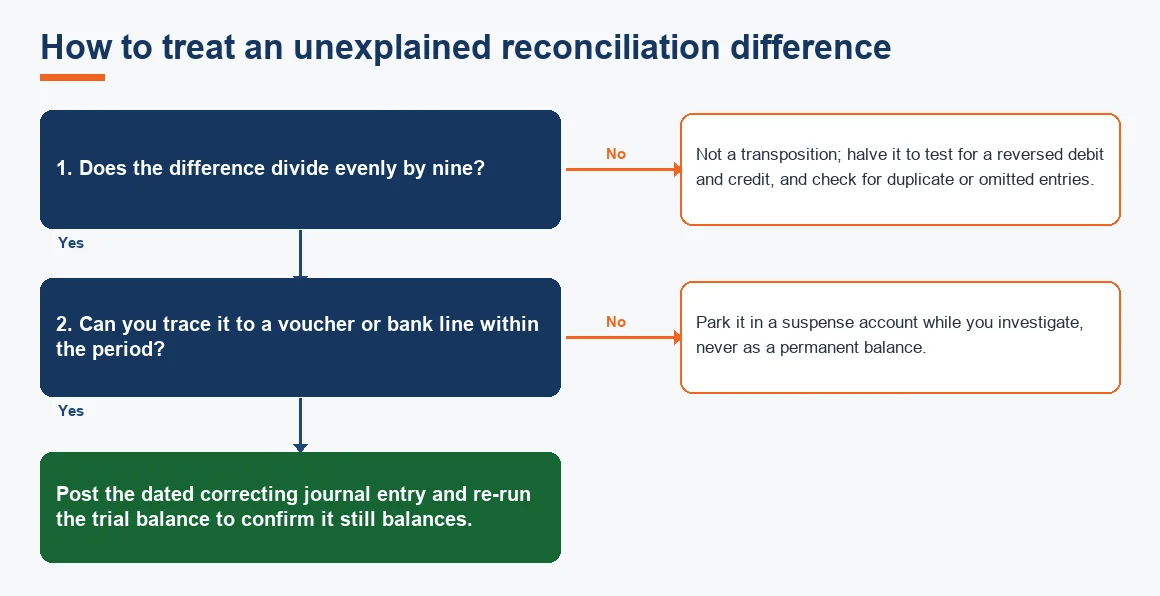
Digits recorded in the wrong order, such as Rs 54,000 keyed as Rs 45,000. The tell-tale sign is that the resulting difference is always divisible by nine, so dividing an unexplained gap by nine is the single fastest first test you can run. Here the gap is Rs 9,000, which divides cleanly, and scanning the ledger for an entry whose digits are a scramble of the difference usually locates it within a couple of minutes.
Duplicate entries
The same invoice or receipt posted twice, often because two people booked it or a bank feed imported a line already entered by hand. Duplicated purchases are the more dangerous of the two because they also inflate input tax credit, so your GSTR-2B matching will catch many of them before the bank reconciliation does.
Wrong-account and reversed postings
A receipt recorded against the wrong bank account, an expense booked to the wrong head, or a debit and credit swapped so the entry hits the ledger in the opposite direction. A reversed posting produces a difference that is exactly twice the transaction value, which is its own useful clue.
Omitted bank items
Bank charges, interest, NACH mandates and direct customer credits that the bank knows about but you have not yet posted. These are strictly errors of omission rather than mis-posting, and they are why the bank statement almost always shows entries your cash book has not caught up with. They should not be confused with true outstanding cheques and timing differences, which need no correction.
How to find errors in a bank reconciliation
Work outward from the figure that does not agree rather than re-reading every line. A tidy sequence saves hours.
- Confirm the opening balances match last period's closing figures on both sides. A wrong brought-forward number contaminates everything after it.
- Tick off every item that appears on both the statement and the cash book, so only unmatched lines remain.
- Separate the survivors into genuine timing differences, which need no action, and real gaps.
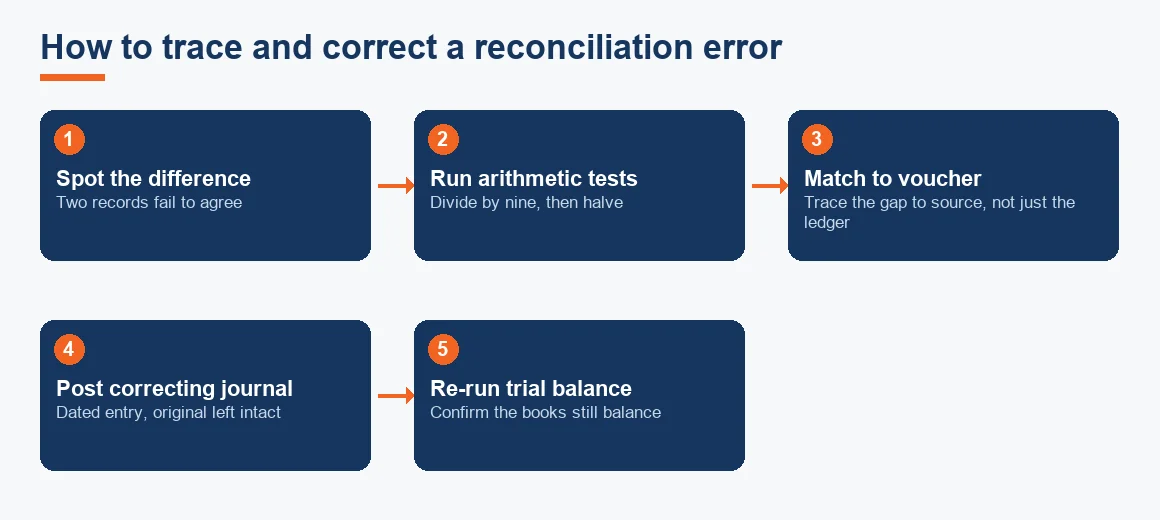
- Run the divide-by-nine and halving tests on each remaining gap.
- Trace anything still unexplained back to the underlying voucher, not just the ledger line.
If you are working through months of un-reconciled statements rather than a single period, that is a backlog bookkeeping catch-up exercise, and it pays to reconstruct one month fully before moving to the next.
How to correct errors in accounting records
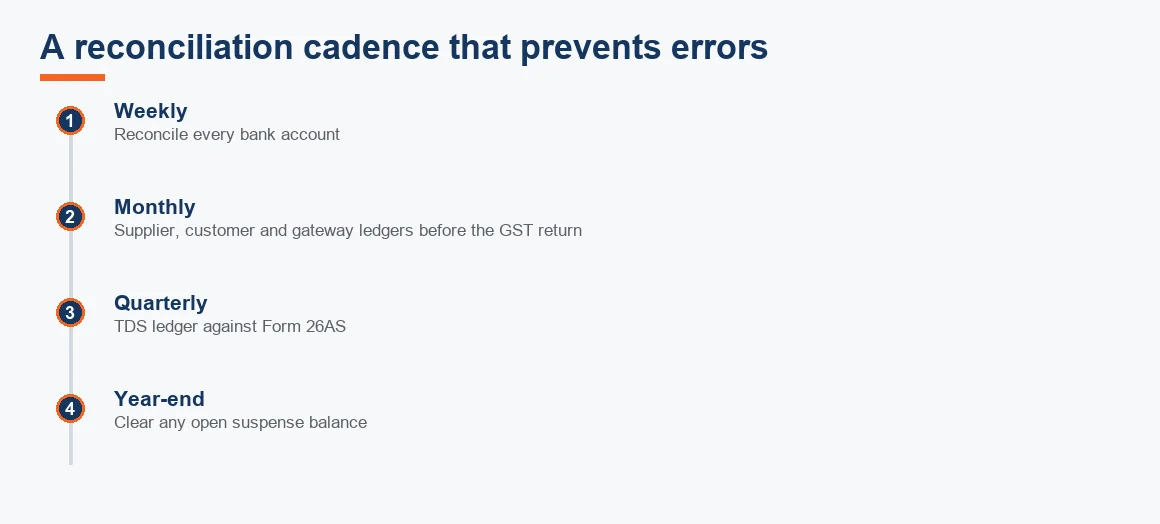
The correction principle is simple: never overwrite or delete the original voucher, because that destroys the audit trail an auditor relies on. Post a fresh, dated journal entry that puts the ledger right, with a narration that says what it corrects and why. For a genuinely unexplained figure, park it in a suspense account only while the investigation runs, then clear it once the cause is found. A suspense balance that is still open at the year end must be written off to the statement of profit and loss with management approval, since a carried-forward suspense figure will not survive an audit. After posting any correction, re-run the trial balance to confirm it still balances and that you have not introduced a new one-sided entry.
How do you prevent errors in reconciliation?
Prevention is mostly cadence and controls, not effort. The single biggest lever is frequency: a business that reconciles bank accounts weekly and every other ledger monthly rarely accumulates a difference large enough to become untraceable. Beyond that, a few habits remove whole categories of error.
- Reconcile supplier ledgers against GSTR-2B, customer balances against statements you have sent, and payment gateway or UPI settlements against bank credits, each before the monthly GST return is filed.
- Match the TDS ledger against Form 26AS every quarter so tax-credit gaps surface early.
- Let accounting software import bank lines through a feed, then review rather than re-key, which kills most transposition and duplicate errors at source. Software such as TallyPrime and Zoho Books flags repeated invoice numbers automatically.
- Separate the person who posts entries from the person who reviews the reconciliation, so an error has a second pair of eyes before month-end close.
If reconciliation keeps slipping because the same team also chases invoices and pays bills, moving the routine to a dedicated accounts payable or accounts receivable function often fixes the discipline problem before it fixes the numbers. For the underlying month-end sequence, our balance sheet reconciliation checklist sets out each account in order, and if you are still unsure how the whole exercise fits together, start with what account reconciliation is.
Types of reconciliation error at a glance
The table summarises the five recurring errors, the clue that gives each away and the standard fix. Treat it as the checklist you reach for the moment two figures refuse to agree.
| Error type | Give-away clue | How to fix |
|---|---|---|
| Transposition | Difference divisible by nine | Correct the digits with a journal entry |
| Duplicate entry | Identical amount, date or invoice number appears twice | Reverse the second entry; check input tax credit |
| Reversed debit/credit | Difference is exactly twice the transaction | Pass a rectifying journal for double the value |
| Wrong account | Both totals right, one head over and another under | Transfer entry between the two ledgers |
| Omitted bank item | On the statement, absent from the cash book | Post the charge, interest or credit |
Worked example: a bank reconciliation statement
A firm's cash book shows a closing balance of Rs 4,52,000 but the bank statement does not agree. Working through the unmatched items, some are timing differences and one is an omission. The reconciliation below reconciles the cash book to the statement balance. Figures are illustrative.
| Particulars | Amount (Rs) |
|---|---|
| Balance as per cash book | 4,52,000 |
| Add: cheque issued to supplier, not yet presented | 68,000 |
| Less: cheque deposited, not yet cleared | (40,000) |
| Less: bank charges not recorded in the cash book | (2,500) |
| Add: NEFT from customer credited by bank, not posted | 25,000 |
| Balance as per bank statement | 5,02,500 |
Of these, the first two lines are pure timing differences and need no entry: they will clear on their own. The bank charge of Rs 2,500 and the NEFT of Rs 25,000 are omissions, so both must be posted to the cash book. Once those two entries go in, the corrected cash book agrees with the statement and the reconciliation holds.
Key terms
- Bank Reconciliation: matching the cash book against the bank statement to explain every difference.
- General Ledger: the master record of all accounts where the mirror side of any error sits.
- Trial Balance: the list of ledger balances you re-run to confirm a correction still balances.
- Journal Entry: the dated correcting posting used to fix an error without deleting the original.
- Month-End Close Checklist: the ordered routine that catches errors before the books are locked.
When reconciliation errors point to a bigger problem
An occasional transposition is normal. A pattern of them, or differences that reappear every month, usually signals a process gap rather than carelessness: no segregation of duties, a bank feed nobody reviews, or accounts that are only reconciled at the year end under audit pressure. That is the point at which a structured accounts reconciliation and audit review, or a dedicated bank and credit card reconciliation routine, earns its keep, because it fixes the cause instead of the symptom. If you want to understand how these checks sit inside the wider assurance picture, our note on internal versus statutory audit explains where each fits. A quick self-audit of your close process, alongside a tool such as the depreciation schedule calculator for the fixed-asset ledger, will tell you whether your errors are one-offs or structural.
Key takeaways
- Separate timing differences, which clear on their own, from real errors that need correcting.
- Run the divide-by-nine and halving tests before hunting line by line.
- Correct with a dated journal entry, never by overwriting the original voucher.
- Use a suspense account only during investigation, and clear it before the year end.
- Reconcile banks weekly and ledgers monthly to stop small gaps compounding.
For the statutory anchors behind this routine, GSTR-2B is generated on the GST portal, Form 26AS is available from the Income Tax Department, and the treatment of a suspense balance follows the guidance of the ICAI.
Decision guide