
In this guide
A balance sheet reconciliation is the month-end control that agrees every balance sheet ledger account to an independent supporting schedule before the books are signed off. Put simply, you take each figure in your general ledger, from cash and receivables to GST input credit and loan balances, and prove it against outside evidence: a bank statement, a fixed asset register, the GST portal, a challan summary or a vendor confirmation. If the two agree, the account is clean. If they do not, you find and explain the difference. This article sets out the rule, the checklist and a worked example, so your next close is a review of small, recent differences rather than a year-end scramble.
What is a balance sheet reconciliation?
Where a bank reconciliation matches a single ledger, your bank account, to one external statement, a balance sheet reconciliation applies that same discipline to every line on the balance sheet. Each control account is matched to a schedule that is built independently of the ledger itself. The bank line is one small part of the wider exercise. The reason it works is double-entry bookkeeping: because every transaction posts twice, an unexplained gap between the ledger and its support is a signal that something has been missed, duplicated or posted to the wrong account.
For a deeper primer on the different reconciliation categories, our companion piece on account reconciliation types and process covers the ground; here we stay focused on the balance sheet checklist itself.
Why reconcile the balance sheet?
Three reasons. First, accuracy: reconciliation is how you catch a supplier invoice booked twice, a bank charge never recorded or GST credit claimed but never appearing in the electronic ledger. Second, statutory readiness: your Schedule III balance sheet and the numbers your auditor tests must be supportable, and reconciliation is the paper trail that supports them. Third, control: a monthly rhythm means the year-end audit deals with differences that are days old, not months old, which shortens the audit and reduces the risk of a qualified opinion. Weak reconciliation is one of the most common sources of restated accounts, a theme we cover in common reconciliation errors and how to fix them.
The balance sheet reconciliation process, step by step
The first step in the balance sheet reconciliation process is not opening the ledger; it is closing the sub-ledgers and cut-off, so no more entries land in the period after you begin. Once the period is locked, work each account in the same order every month.
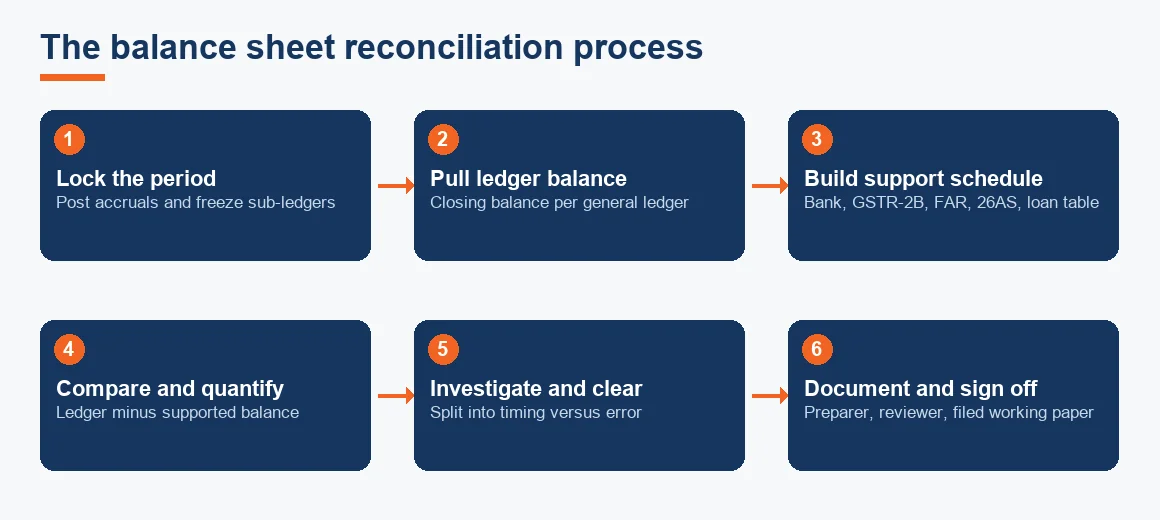
- Lock the period: post accruals, prepayments and depreciation, then freeze the sub-ledgers so the trial balance stops moving.
- Pull the ledger balance: extract the closing balance for each control account from the general ledger.
- Build the support schedule independently: from the bank statement, fixed asset register, GSTR-2B, loan amortisation table, TDS challan summary or payroll report, whichever supports that line.
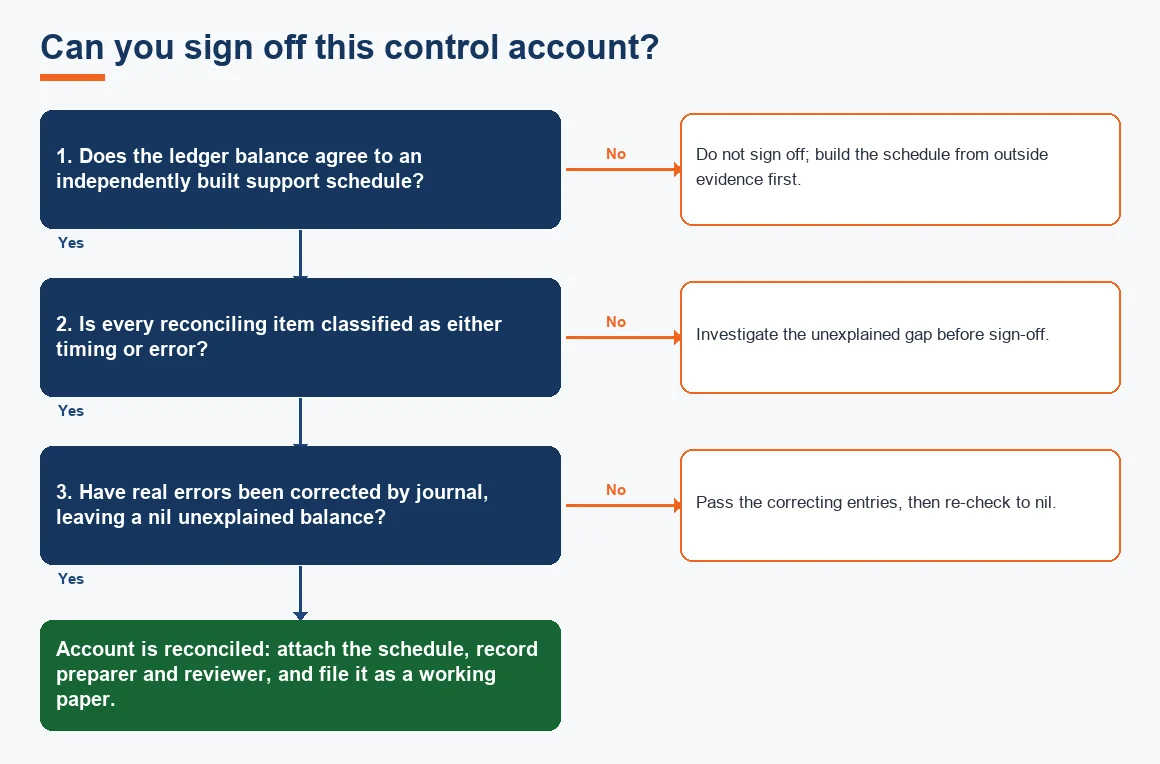
- Compare and quantify the difference: ledger balance minus supported balance. A nil difference means the account ties.
- Investigate and clear: identify every reconciling item, decide whether it is a genuine timing difference or an error, and pass a journal entry to correct real errors.
- Document and sign off: attach the schedule, note the preparer and reviewer, and file it as a working paper.
Segregating the preparer from the reviewer matters: the person who posts the entries should not be the only person who signs off the reconciliation. This is basic segregation of duties and a core financial internal control.
How many types of balance sheet reconciliation are there?
In practice you are running several reconciliation methods across the balance sheet, chosen to fit the account:
- Documentation match: tie the ledger to an external document, for example bank, loan or fixed asset register.
- Third-party confirmation: agree balances directly with the counterparty, such as a vendor or inter-company entity.
- Analytical review: test the reasonableness of a balance, for example checking that accrued electricity broadly tracks usage.
- Roll-forward: opening balance plus additions minus disposals or amortisation should equal the closing balance, used for fixed assets, prepayments and provisions.
A single account may need two of these. Trade payables, for instance, are documentation-matched to the sub-ledger and then confirmed with key vendors, which links to the discipline that accounts payable outsourcing and accounts receivable outsourcing teams run as standard.
The month-end balance sheet reconciliation checklist
Not every account carries the same risk, so a workable checklist sets the frequency by risk and names the support document. Reconcile high-risk, high-volume accounts monthly; low-volume accounts can be quarterly, provided every line is reconciled at least once before the 31 March close.
| Balance sheet account | Supporting evidence | Frequency |
|---|---|---|
| Bank and cash | Bank statement, cash count | Monthly |
| GST input tax credit | Electronic credit ledger and GSTR-2B on the GST portal | Monthly |
| TDS receivable / payable | Challan summary, Form 26AS, TRACES | Monthly |
| Trade receivables / payables | Ageing schedule, vendor and customer confirmations | Monthly |
| Payroll liabilities (PF, ESI, salary) | Payroll register, PF/ESI challans | Monthly |
| Fixed assets and depreciation | Fixed asset register, Schedule II working | Quarterly |
| Loans and borrowings | Lender statement, amortisation schedule | Quarterly |
| Security deposits, prepaid, provisions | Contract, roll-forward schedule | Quarterly |
The GST line deserves particular care. Compare the input tax credit in the books against the electronic credit ledger and GSTR-2B on the GST portal line by line, because credit for a financial year lapses after the 30 November return deadline of the following year. Blocked credits under section 17(5), listed by CBIC, are a frequent reconciling item and should be reversed, not carried.
How to reconcile GL accounts to the trial balance
Reconciling GL accounts to the trial balance is a sequence, not a lookup. The trial balance is only a listing of every ledger balance; it will always foot, even when individual accounts are wrong, so agreeing the trial balance total proves nothing on its own. The real work is proving each ledger account inside it against its schedule. Extract the account balance from the general ledger, sum the supporting schedule for the same account, and confirm the two agree to the rupee. Where they do not, the difference is either a timing item that will clear next period or an error that needs a correcting journal now. Only when each control account is individually supported can you say the trial balance, and therefore the balance sheet drawn from it, is reconciled. Businesses recovering from months of unreconciled books usually route this through a structured backlog bookkeeping and catch-up exercise before a normal monthly rhythm resumes.
Worked example: reconciling a TDS receivable control account
A services company's ledger shows a TDS receivable of INR 5,80,000 at 31 March. The independent support is Form 26AS on the income tax portal, which reflects TDS actually deposited against the company's PAN. The reconciliation isolates each difference and ends at a nil unexplained balance.
| Item | Amount (INR) | Treatment |
|---|---|---|
| TDS receivable per general ledger | 5,80,000 | Ledger balance under test |
| TDS reflected in Form 26AS | 5,42,000 | Independent support |
| Gross difference | 38,000 | To be explained |
| Less: customer deducted but not yet deposited | 22,000 | Timing, follow up with customer |
| Less: credit shown in next quarter's 26AS | 10,000 | Timing, clears Q1 |
| Less: TDS booked at wrong rate, correcting entry | 6,000 | Error, pass journal to reduce receivable |
| Unexplained balance | 0 | Account reconciled and signed off |
Of the INR 38,000 gap, INR 32,000 is genuine timing that will clear, and only INR 6,000 is a real error requiring a journal. The account now ties: INR 5,80,000 in the ledger, INR 5,42,000 in 26AS plus INR 32,000 in transit, less the INR 6,000 correction. You can cross-check deposits against Form 26AS on the Income Tax Department portal.
Fixed asset, GST and inter-company balances follow the same shape: ledger figure, independent support, explained differences, nil residue. This account-by-account proof is what separates a real reconciliation from simply agreeing that the trial balance foots.
Key terms
- General Ledger: the master record of every account, whose balances feed the trial balance and balance sheet.
- Trial Balance: a listing of all ledger balances that foots to zero but does not, by itself, prove any single account.
- Bank Reconciliation: matching the cash ledger to the bank statement, one line inside the wider balance sheet reconciliation.
- GSTR-2B Input Tax Credit Matching: agreeing book input credit to the auto-drafted GSTR-2B and electronic credit ledger.
- Month-End Close Checklist: the standing list of accounts, owners and support documents that drives the monthly close.
How long to keep the working papers
Retention is a statutory point, not housekeeping. Books of account and their supporting reconciliation schedules must be kept for eight financial years immediately preceding the current year under section 128(5) of the Companies Act, 2013, and where an investigation has been ordered the Central Government can require a longer period. Electronic records must remain accessible and unaltered with the audit trail enabled. The current requirements are published by the Ministry of Corporate Affairs. Because the same working papers are tested in both a statutory and an internal audit, filing them cleanly each month pays off twice, as our note on internal audit versus statutory audit explains.
Key takeaways
- Reconcile every balance sheet control account to independent support, not just the bank line.
- The first real step is locking the period; the trial balance footing to zero proves nothing on its own.
- Set frequency by risk: monthly for bank, GST, TDS and payroll; quarterly for low-volume lines; all lines before 31 March.
- Clear reconciling items into timing or error, and pass a journal for real errors rather than rolling them forward.
- Retain reconciliation working papers for eight years under section 128(5) of the Companies Act, 2013.
For a full-service handover of the monthly close and audit trail, our Accounts Reconciliation and Audit service, along with year-end closing and finalisation and financial statement preparation, carries the checklist above end to end. To size the fixed asset roll-forward line quickly, the depreciation calculator follows Schedule II and Ind AS 16.
Decision guide