In this guide
The account reconciliation process is the routine of comparing a ledger balance in your books against an independent record, such as a bank statement or a supplier confirmation, and then explaining every difference between the two before that number is reported anywhere. Done properly, it proves a balance is complete and real. This guide sets out what reconciliation is, the main types, the step-by-step process, the order to run them in, and a fully worked bank reconciliation with the numbers shown.
What is account reconciliation?
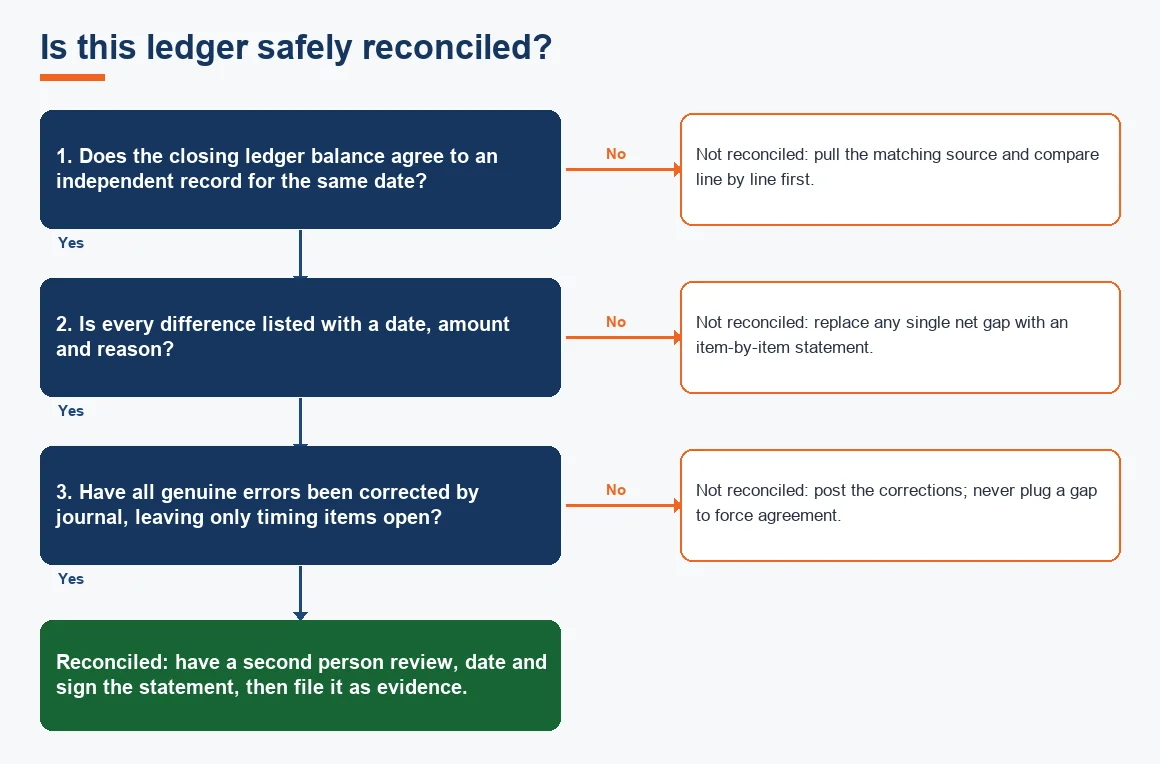
Account reconciliation is the check that a balance recorded in your general ledger agrees with a second, independent source for the same figure on the same date. Your books say one thing; the bank, the vendor, the tax portal or a supporting schedule says another. Reconciliation is the discipline of tying the two together and accounting for the gap in full, item by item, rather than simply writing off a difference to make the two sides meet.
The purpose is quality control. It catches duplicate entries, missed bank charges, unrecorded vendor bills and wrongly coded GST heads early, so that your monthly MIS, your GSTR-3B filing and your annual financial statements all begin from one verified set of figures. Without it, a small posting error quietly compounds across the year and surfaces as a painful gap at audit time. For a full clean-up of neglected books, structured backlog bookkeeping and catch-up work is a separate exercise, but reconciliation is the ongoing habit that keeps the books trustworthy once they are current.
What are the four types of reconciliation?
Most Indian businesses run five recurring reconciliations rather than four, all of which sit beneath the broader balance sheet reconciliation. The core types are set out below.
Bank reconciliation
A bank reconciliation matches the bank balance in your cash book with the balance on the bank statement for the same date. The usual differences are cheques issued but not yet presented, deposits in transit and bank charges the bank has debited but you have not yet posted. These are timing differences that clear on their own; anything that is not a timing difference is an error to correct.
Vendor (accounts payable) reconciliation
Vendor reconciliation agrees your payables ledger to statements or balance confirmations received from suppliers. It confirms you have booked every bill, applied the right GST and are not about to pay an invoice twice. Businesses that run heavy purchase volumes often hand this to accounts payable outsourcing so nothing slips.
Customer (accounts receivable) reconciliation
Receivables reconciliation agrees your debtor ledger to what customers say they owe, and underpins the aging analysis that drives collections. Where recovery is slow, disciplined accounts receivable outsourcing keeps the ledger accurate and the follow-up consistent.
Inter-company reconciliation
Where group entities transact with each other, inter-company reconciliation ensures that what one company books as a receivable, the other books as a matching payable, so the balances net to nil on consolidation.
Stock reconciliation
Stock reconciliation compares the inventory value in the books with a physical count and the stock register, flagging shrinkage, damage or entries posted to the wrong item.
What are the 5 steps to reconcile your account?
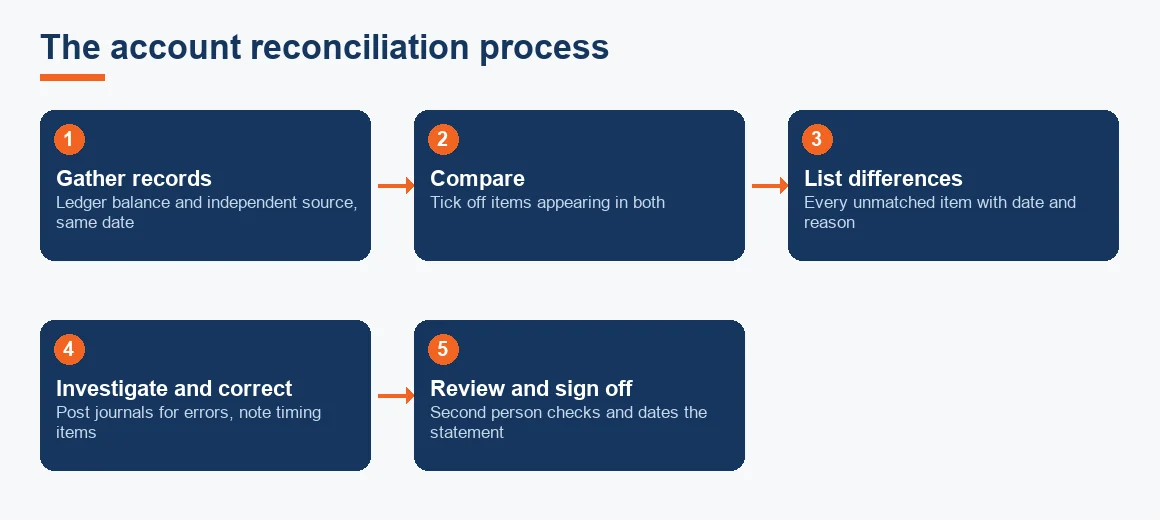
Whatever the account, the process follows the same five steps. Keeping to them turns reconciliation from a scramble into a repeatable routine.
- Gather the records. Pull the ledger balance and the independent source for the same cut-off date: the bank statement, the vendor statement, the GSTR-2B, the asset register or the physical count.
- Compare line by line. Tick off items that appear in both records. What remains unticked on either side is your reconciling population.
- List the differences. Write every unmatched item into a reconciliation statement with its date, amount and a short reason, rather than reporting a single net gap.
- Investigate and correct. Post journal entries for genuine errors and omissions (bank charges, missed bills, wrong GST head). Leave true timing differences to clear on their own and note them.
- Review and sign off. A second person checks the statement, confirms the adjusted balances agree and signs it off. The dated, signed statement is your evidence.
What is the process of GL account reconciliation?
General ledger, or GL, account reconciliation extends the same five steps to every balance sheet ledger, not just the cash and bank accounts. Each GL balance is proved against an independent supporting schedule: GST input credit ties to the GSTR-2B matching summary, TDS receivable ties to Form 26AS on the Income Tax Department portal, and fixed assets tie to the asset register. Any balance sitting in the ledger with no schedule behind it is investigated and cleared before the accounts are finalised.
The trial balance is the natural starting point: it lists every ledger, and GL reconciliation is the work of standing a supporting schedule behind each material line. For the payables and receivables control accounts, a robust three-way match of purchase order, goods receipt and invoice removes most differences before they ever reach the ledger. A structured balance sheet reconciliation checklist covers the schedule for every line in one place.
The order to run reconciliations
Sequence matters, because a corrected bank balance feeds the cash position that every other schedule relies on. Reconcile the bank first, then the subsidiary ledgers that hang off it, then close out the remaining balance sheet accounts. The table below sets out a practical monthly order, the source each one is checked against and a sensible frequency.
| Order | Reconciliation | Checked against | Frequency |
|---|---|---|---|
| 1 | Bank and cash | Bank statement | Monthly |
| 2 | GST input and output | GSTR-2B and GSTR-3B | Monthly |
| 3 | Vendor (payables) | Supplier statements | Monthly to quarterly |
| 4 | Customer (receivables) | Customer confirmations | Monthly to quarterly |
| 5 | Inter-company | Counterpart ledger | Monthly to quarterly |
| 6 | Stock | Physical count and register | Quarterly |
| 7 | Fixed assets, TDS, loans | Registers, 26AS, statements | Before audit |
Dedicated bank and credit card reconciliation handles the first two lines for many firms, while the wider clean-up sits within day-to-day accounting and bookkeeping.
What is an example of account reconciliation?
Here is a worked bank reconciliation for a firm closing its books on 31 July. The cash book shows a balance of Rs 4,20,000, while the bank statement shows Rs 4,55,000. The Rs 35,000 gap is explained item by item below, and the adjusted figures agree.
| Particulars | Effect | Amount (Rs) |
|---|---|---|
| Balance as per cash book (books) | Opening | 4,20,000 |
| Add: cheques issued but not yet presented | Add | 60,000 |
| Less: cheque deposited but not yet cleared | Less | (22,000) |
| Less: bank charges debited by bank, not yet posted | Less | (3,000) |
| Balance as per bank statement | Reconciled | 4,55,000 |
The two timing items, the unpresented cheques and the uncleared deposit, will settle on their own and need no entry, only a note. The bank charges are a genuine omission, so a journal entry debiting bank charges and crediting the bank account brings the books into line. The statement is dated, signed and filed as evidence.
How often should reconciliation be done in an Indian business?
Bank and GST ledgers need reconciling every month. GSTR-2B is generated on the 14th of the following month and GSTR-3B is filed by the 20th, per the GST portal, so a monthly rhythm keeps input tax credit claims clean and the return accurate. Vendor and customer ledgers suit a monthly to quarterly cycle, and every remaining balance sheet account is reconciled before the statutory audit. Understanding how that audit differs from an internal review is covered in internal audit versus statutory audit, and the errors that most often derail a close are set out in common reconciliation errors and how to fix them.

On record-keeping, section 128(5) of the Companies Act 2013 requires books and vouchers to be kept in good order for eight financial years preceding the current year, a rule the Ministry of Corporate Affairs administers. Reconciliation statements, bank statements and confirmations support those books, so they follow the same eight-year rule. GST records under section 36 of the CGST Act are kept for 72 months from the annual return due date. Where you need a formal, evidenced close each period, the discipline sits within accounts reconciliation and audit, and depreciation schedules can be proved quickly with a depreciation calculator before the fixed-asset ledger is signed off.
Key terms
- Bank Reconciliation: matching the cash book balance to the bank statement and explaining the difference.
- General Ledger: the master record holding every account balance a business reports.
- Trial Balance: a listing of all ledger balances used as the starting point for reconciliation.
- GSTR-2B Input Tax Credit Matching: agreeing booked input GST to the auto-drafted GSTR-2B statement.
- Three-Way Matching: checking purchase order, goods receipt and invoice agree before a bill is booked.
Key takeaways
- Reconciliation proves a ledger balance against an independent record and explains every difference in full.
- The five recurring types are bank, vendor, customer, inter-company and stock, under the wider balance sheet reconciliation.
- Follow the same five steps every time: gather, compare, list, investigate and correct, then sign off.
- Run bank first, then subsidiary ledgers, then the balance sheet, so each stage feeds the next.
- Reconcile bank and GST monthly around the 14th and 20th; keep the signed statements for eight years.
Decision guide