In this guide
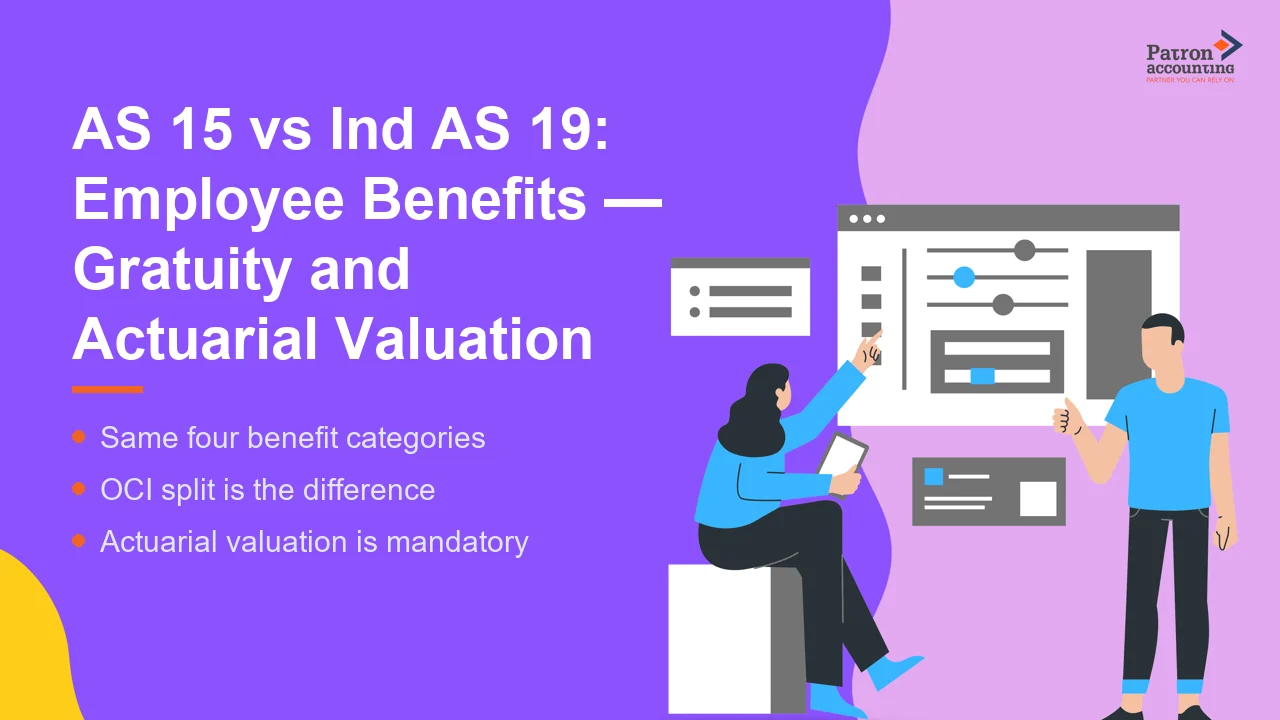
The practical difference between AS 15 and Ind AS 19 on employee benefits comes down to one number and where it lands. Both standards define employee benefits in the same four categories and both make an actuarial valuation of gratuity compulsory at each balance sheet date. Ind AS 19, however, takes the actuarial gain or loss on a defined benefit plan and recognises it in other comprehensive income (OCI), where it is never recycled to profit or loss. AS 15 does the opposite and charges that same remeasurement straight through the profit and loss account. Everything else in this comparison is detail; this is the point that changes reported profit.
What AS 15 and Ind AS 19 actually cover
AS 15, Employee Benefits, applies to companies and other entities that prepare their accounts under Indian GAAP. Ind AS 19, the converged version, applies to entities that have moved to Indian Accounting Standards under the Companies (Indian Accounting Standards) Rules, 2015. Both group employee benefits into the same four buckets, and knowing the bucket tells you the accounting.
- Short-term benefits: salary, bonus, leave travel allowance and paid casual leave, all payable wholly within twelve months.
- Post-employment benefits: gratuity, provident fund and pension, split further into defined contribution and defined benefit plans.
- Other long-term benefits: encashable leave and long-service awards payable beyond twelve months.
- Termination benefits: amounts payable when employment ends, such as voluntary retirement schemes.
Only defined benefit obligations, of which gratuity is the common Indian example, force an actuarial valuation. The rest are far simpler. For the wider family of standards this sits within, our reference list of Accounting Standards (AS) in India sets out where each one applies.
The core difference: where actuarial gains and losses land
A defined benefit obligation is re-estimated every year. The estimate changes because assumptions change: the discount rate moves with government bond yields, salary growth is revised, and attrition turns out different from what was assumed. The resulting swing in the obligation is the actuarial gain or loss, formally the remeasurement.
Under Ind AS 19 the year's cost is split. Current service cost and net interest go to the profit and loss statement, while the remeasurement is parked in OCI and stays there permanently. Under AS 15 there is no OCI route, so the whole movement, remeasurement included, is a charge or credit in profit or loss for the year. In a year when the discount rate falls a full percentage point, the obligation jumps, and under AS 15 that jump lands directly on net profit. Under Ind AS 19 the same jump bypasses profit entirely. The interactive AS vs Ind AS comparison matrix lets you see the treatment line by line across standards.
Short-term employee benefits: no actuary required
Short-term employee benefits are the easy end. Because they are payable wholly within twelve months of the service being rendered, both standards require them to be charged undiscounted in the period the employee works. Salary for March is a March cost; the March bonus accrued but unpaid at year-end sits in accrued liabilities. No projection, no discount rate, no actuarial valuation. The same logic covers defined contribution plans such as provident fund, where the employer's only obligation is the fixed monthly contribution, so the expense is simply the amount contributed for the period.
Gratuity as a defined benefit plan: why the actuary is mandatory
Gratuity is different because the employer promises a formula-based amount at exit, not a fixed contribution during service. That promise is a defined benefit obligation, and estimating today's value of a payment that depends on future salary, future service and the chance the employee stays needs an actuary. Both AS 15 and Ind AS 19 require the Projected Unit Credit method and a valuation at every balance sheet date. The Payment of Gratuity Act ceiling of Rs 20 lakh per employee is built into the actuary's projection, so the obligation is capped at that figure per head.
Smaller non-corporate entities classified at Level IV may use a simplified basis rather than a full actuarial valuation, but any company of size is expected to obtain the full report. The charge that reaches your accounts is the actuary's cost for the year, which is why it almost never equals the premium you paid to the LIC group gratuity scheme or your own trust.
How the gratuity charge reaches your accounts
The flow is the same under both standards up to the final posting, where the two frameworks part ways.
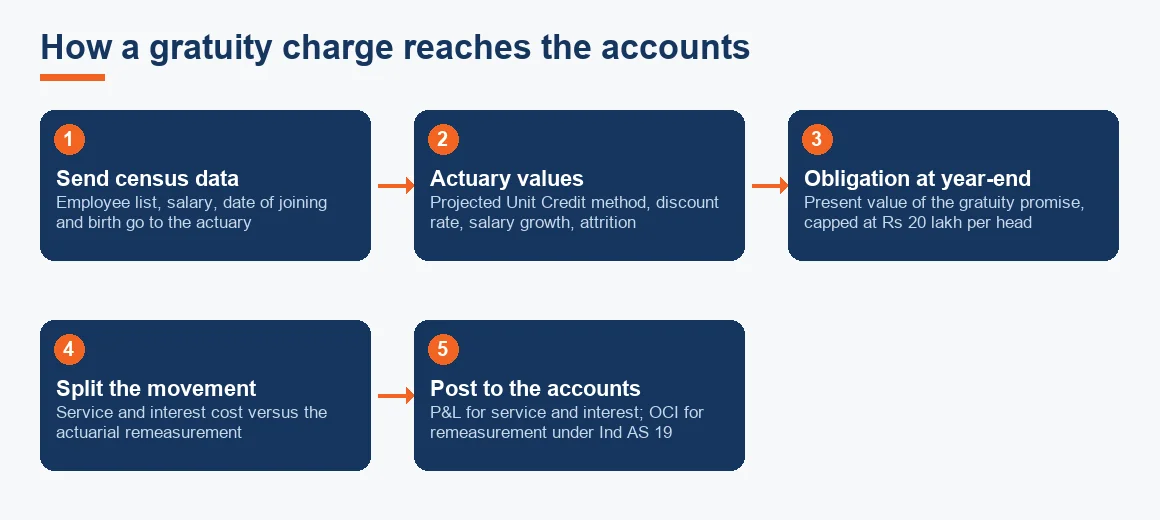
The journal entry at year-end debits the gratuity expense in the profit and loss account for service and interest cost, debits or credits OCI for the remeasurement under Ind AS 19, and adjusts the net gratuity provision on the balance sheet. Under AS 15 the OCI leg simply becomes part of the profit and loss charge.
Which framework applies to you
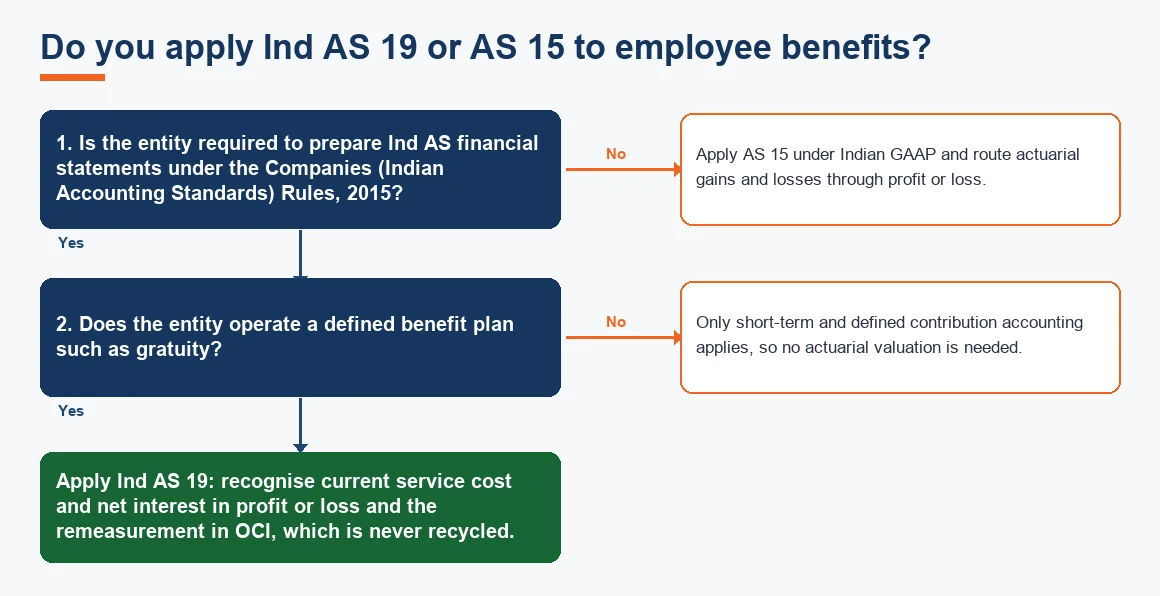
You do not choose between AS 15 and Ind AS 19; the applicability rules choose for you. Listed companies, companies with net worth at or above the prescribed threshold, and their holding, subsidiary, associate and joint venture entities apply Ind AS. Everyone else stays on AS 15 under Indian GAAP. If you are unsure which side of the line you sit on, the Ind AS applicability checker walks through the net-worth and listing tests. The related question of the deferred tax that arises when a remeasurement goes to OCI is worth modelling too, and the deferred tax calculator handles the DTA or DTL that follows.
Worked example: gratuity obligation roll-forward and the OCI split
Take an unfunded gratuity plan for a mid-sized company. The actuary reports the following movement for the year, with an opening discount rate that has since fallen, producing an actuarial loss. All figures are in rupees and are illustrative.
| Movement in the defined benefit obligation | Amount (Rs) | Under Ind AS 19 | Under AS 15 |
|---|---|---|---|
| Opening obligation (1 April) | 50,00,000 | Balance sheet | Balance sheet |
| Current service cost | 8,00,000 | Profit and loss | Profit and loss |
| Interest cost (7.2% on opening) | 3,60,000 | Profit and loss | Profit and loss |
| Benefits paid during the year | (4,00,000) | Reduces obligation | Reduces obligation |
| Actuarial loss on remeasurement | 2,40,000 | Other comprehensive income | Profit and loss |
| Closing obligation (31 March) | 60,00,000 | Balance sheet | Balance sheet |
The closing obligation is identical under both standards: 50,00,000 + 8,00,000 + 3,60,000 minus 4,00,000 plus 2,40,000 equals 60,00,000. The balance sheet provision is the same. What differs is the profit and loss charge. Under Ind AS 19 it is service cost plus net interest, that is 8,00,000 + 3,60,000 = Rs 11,60,000, with the Rs 2,40,000 loss sitting in OCI. Under AS 15 the charge is 8,00,000 + 3,60,000 + 2,40,000 = Rs 14,00,000, all through profit or loss. Reported profit before tax is Rs 2,40,000 lower under AS 15 for the identical economic event. That gap is not a rounding difference; on a larger workforce or a bigger rate move it runs into several lakh rupees and can turn a small profit into a small loss.
Presentation in the financial statements
In the Schedule III balance sheet, the gratuity provision sits within long-term and short-term provisions, split by the portion expected to be settled within twelve months. The employee benefits expense line in the statement of profit and loss groups salaries and wages, contribution to provident and other funds, share-based payment expense, staff welfare and the gratuity charge. The notes to accounts then carry the full actuarial disclosure: the assumption table, the reconciliation of the obligation, and, under Ind AS 19, the remeasurement recognised in OCI. If a prior year was misstated because the wrong charge was booked, the correction runs through prior-period adjustments rather than the current year's expense. Getting this presentation right is part of clean financial statement preparation.
Employee benefits are one of several standards where AS and Ind AS diverge on the OCI question. The same OCI-versus-P&L logic and lease-style balance sheet grossing up appears in our companion piece on AS 19 versus Ind AS 116 on leases, and share-settled rewards follow their own path under ESOP accounting under Ind AS 102, which we cover separately.
AS 15 versus Ind AS 19 at a glance
The table below summarises the points that actually change your numbers.
| Feature | AS 15 | Ind AS 19 |
|---|---|---|
| Applies to | Indian GAAP entities | Entities on Ind AS (Companies Ind AS Rules, 2015) |
| Benefit categories | Four | Four (same) |
| Actuarial gain or loss on gratuity | Profit and loss | Other comprehensive income, never recycled |
| Actuarial valuation for gratuity | Mandatory each year | Mandatory each year |
| Valuation method | Projected Unit Credit | Projected Unit Credit |
| Effect on reported profit | Fully absorbs remeasurement | Insulated from remeasurement |
Key terms
- Schedule III Balance Sheet: the prescribed format under the Companies Act where the gratuity provision is disclosed.
- Accrued Liabilities: expenses incurred but not yet paid, such as an unpaid year-end bonus.
- Notes to Accounts: the disclosures that carry the actuarial assumption table and obligation reconciliation.
- Journal Entry: the debit-and-credit posting that records the gratuity charge and provision.
- Ind AS 102 Share-based Payment: the standard for ESOPs, a separate employee reward not covered by Ind AS 19.
Key takeaways
- The single accounting difference between AS 15 and Ind AS 19 is that Ind AS 19 sends the gratuity actuarial gain or loss to OCI and never recycles it, while AS 15 charges it to profit or loss.
- Both standards use the same four benefit categories and both make an actuarial valuation of gratuity compulsory at every balance sheet date.
- Short-term benefits and defined contribution plans need no actuary; only defined benefit obligations do.
- The gratuity expense is the actuary's cost for the year, not the premium paid to the fund, so the two rarely agree.
- Check applicability first, then read the actuary's assumption table before comparing two years of expense.
The statutory basis for these standards sits with the Institute of Chartered Accountants of India, which issues AS 15 and Ind AS 19, while the Ind AS applicability rules are notified by the Ministry of Corporate Affairs. The deductibility of gratuity for tax, under Sections 36(1)(v) and 40A(7), is governed by the Income Tax Department and follows its own timing, separate from the accounting charge.
Decision guide