In this guide
The core difference between AS 19 and Ind AS 116 is where a lease sits. AS 19 asks a lessee to classify each lease as a finance lease or an operating lease, and an operating lease stays off the balance sheet as a simple rent expense. Ind AS 116 removes that choice for lessees: almost every lease, including the office and equipment rentals that used to be operating leases, now comes on to the balance sheet as a right-of-use asset with a matching lease liability. This article explains the rule, the thresholds that still keep some leases off balance sheet, and what the switch does to your profit and loss in practice.
AS 19 vs Ind AS 116 at a glance
Both standards deal with the same transaction, a business paying to use an asset it does not own, but they answer the recognition question very differently. AS 19 is a classification standard. Ind AS 116 is a recognition standard that treats a lease as a financed purchase of the right to use an asset. The table below sets out the practical contrast for a lessee.
| Feature | AS 19 | Ind AS 116 |
|---|---|---|
| Lessee model | Two models: finance lease and operating lease | Single model: recognise almost all leases |
| Operating lease on balance sheet? | No, rent charged to profit and loss | Yes, as a right-of-use asset and lease liability |
| What appears in profit and loss | Straight line rent for operating leases | Depreciation of the asset plus interest on the liability |
| Measurement of liability | Only for finance leases, at fair value or present value | Present value of unpaid payments at the discount rate |
| Exemptions | Land, film licensing, mineral and oil rights | Short-term leases and low-value asset leases |
| Lessor accounting | Finance or operating classification retained | Broadly unchanged, still classified |
One point that surprises many owners: for lessors, Ind AS 116 keeps the old finance-or-operating split. The big change is almost entirely on the lessee side, which is why this comparison focuses there. If you want to see where each standard sits in the wider hierarchy, our guide to Accounting Standards (AS) in India: Complete List maps them out.
What AS 19 covers in lease accounting
AS 19 covers accounting for leases by both lessees and lessors. It asks a single question at inception: does the lease transfer substantially all the risks and rewards of ownership? If it does, it is a finance lease, and the lessee capitalises the asset with a matching liability. If it does not, it is an operating lease, and the lessee simply charges the rent to the statement of profit and loss on a straight line basis over the term. AS 19 deliberately excludes lease agreements for land, licensing of films and video, and rights to explore for minerals, oil and similar non-regenerative resources.
The practical effect under AS 19 is that a five-year office lease never touched the balance sheet. The annual rent went through profit and loss and the future commitment sat only in the notes to accounts as a disclosure. That kept reported assets and borrowings low, which was exactly the criticism that led international standard setters to change the rule.
How Ind AS 116 changes lease accounting
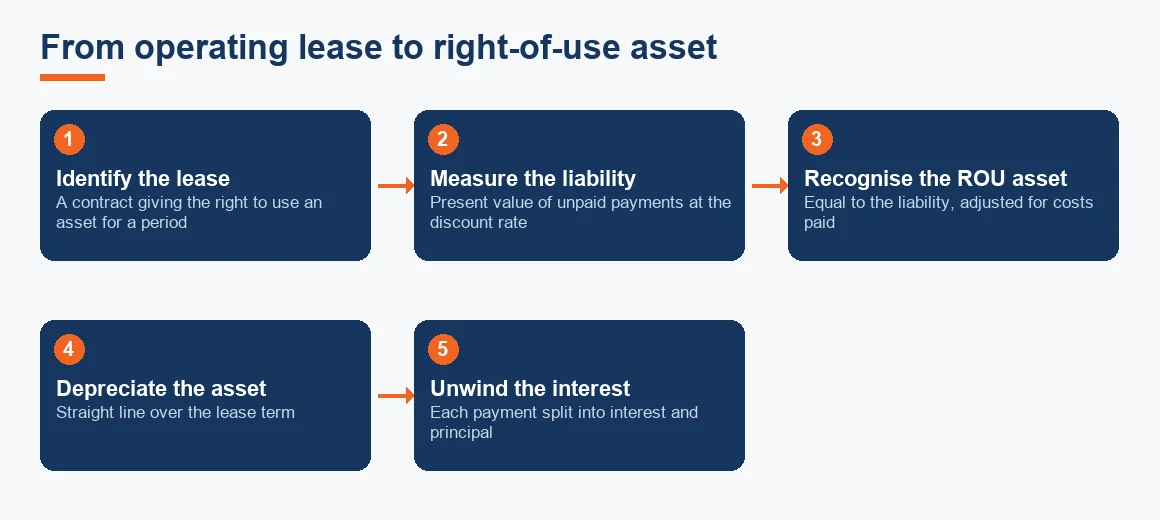
Ind AS 116 starts from a different premise: if you have the right to use an asset for a period, you control an economic resource and you owe the payments, so both belong on the balance sheet. At the start of the lease the lessee recognises a right-of-use asset and a lease liability. Over the term the asset is depreciated, usually on a straight line basis, and the liability is unwound using the effective interest method so that each payment is split between interest and principal.
This is why the profit and loss pattern changes. Instead of a flat rent line, you now report depreciation plus interest. Because interest is higher in the early years when the liability is largest, the total charge is front-loaded: higher in year one and lower by year five, even though the cash paid is unchanged. The right-of-use asset is treated much like an owned fixed asset for presentation, and the liability is split between current and non-current.
The two exemptions that keep leases off balance sheet
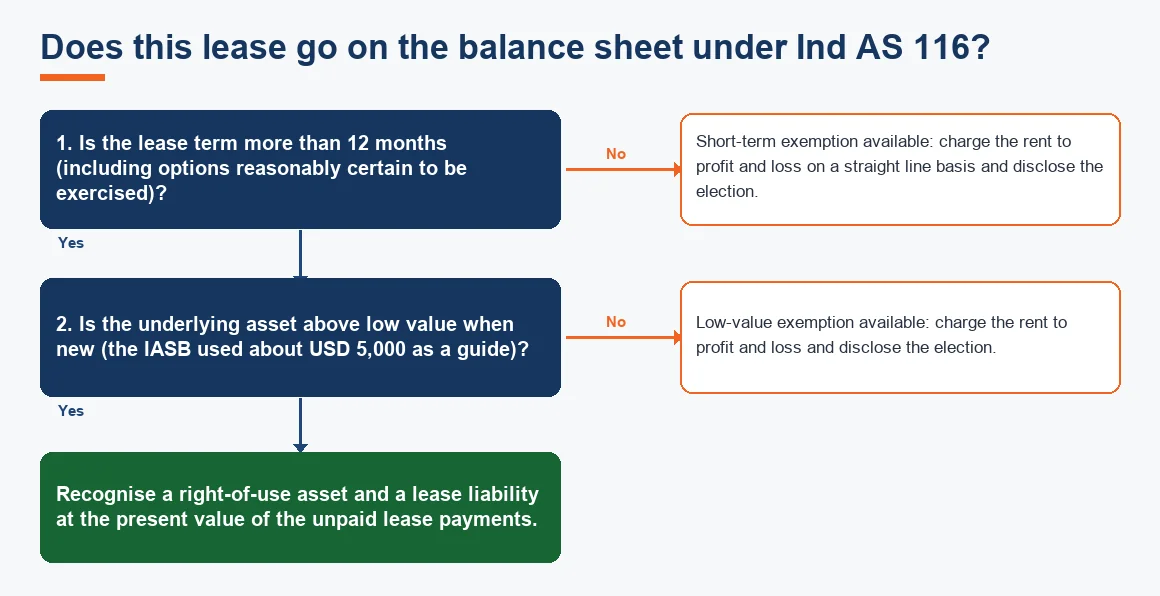
Ind AS 116 does not force every lease on to the balance sheet. Two elections survive, and used well they save a great deal of tracking on small contracts.
Short-term leases
A lessee can exempt any lease with a term of 12 months or less that carries no purchase option. Rent on such a lease is charged to profit and loss on a straight line basis, exactly as an operating lease behaved under AS 19. The election is made by class of underlying asset and must be disclosed in the notes.
Low-value asset leases
A lessee can also exempt leases of individually low-value assets, judged by the value of the asset when new, such as laptops, small office equipment and furniture. The standard does not fix a rupee figure, though the international basis for the conclusion referred to assets of around USD 5,000 when new as a guide. This election is made lease by lease.
Which companies still apply AS 19 instead of Ind AS 116
The standard you follow is not a choice, it depends on the Ind AS roadmap. Under Rule 4 of the Companies (Indian Accounting Standards) Rules 2015, Ind AS applies to all listed companies and to companies with a net worth of Rs 250 crore or more, together with their holding, subsidiary, associate and joint venture companies. Everyone else, which is most unlisted private companies with net worth below Rs 250 crore, continues to apply the older Accounting Standards including AS 19.
So a growing private company can cross the threshold and move from AS 19 to Ind AS 116 in a single year. That transition brings previously invisible operating leases on to the balance sheet for the first time, which can materially change gearing and asset ratios that lenders watch. The Ministry of Corporate Affairs publishes the Rules and their amendments at mca.gov.in, and the Institute of Chartered Accountants of India hosts the full text of both standards at icai.org. If you are unsure which side of the line you sit on, the Ind AS Applicability Checker walks through the net worth and listing tests.
Measuring the lease liability and the discount rate
Under Ind AS 116 the lease liability is measured at the present value of the lease payments that are still unpaid, discounted at the interest rate implicit in the lease. In most Indian office and equipment leases that implicit rate cannot be readily determined because the lessee does not know the lessor's assumptions, so the lessee falls back to its incremental borrowing rate: the rate it would pay to borrow, over a similar term and with similar security, to buy an asset of similar value.
The right-of-use asset starts at the same amount as the liability, adjusted for any lease payments made at or before commencement, initial direct costs and an estimate of dismantling or restoration costs. Choosing the discount rate is the single biggest judgement in the whole exercise, because a higher rate produces a smaller liability and a smaller asset. This is one reason the transition sits close to financial statement preparation, where the numbers finally land in the accounts.
Worked example: a five-year office lease
Take a five-year office lease of Rs 10 lakh a year, paid at each year end, with no escalation and an incremental borrowing rate of 10%. The present value of the five payments is about Rs 37.91 lakh, so both the right-of-use asset and the lease liability start there. The asset is depreciated straight line at Rs 7.58 lakh a year, and the liability unwinds as shown below. All figures are in Rs lakh and rounded.
| Year | Opening liability | Interest at 10% | Payment | Principal repaid | Closing liability | ROU depreciation |
|---|---|---|---|---|---|---|
| 1 | 37.91 | 3.79 | 10.00 | 6.21 | 31.70 | 7.58 |
| 2 | 31.70 | 3.17 | 10.00 | 6.83 | 24.87 | 7.58 |
| 3 | 24.87 | 2.49 | 10.00 | 7.51 | 17.36 | 7.58 |
| 4 | 17.36 | 1.74 | 10.00 | 8.26 | 9.09 | 7.58 |
| 5 | 9.09 | 0.91 | 10.00 | 9.09 | 0.00 | 7.58 |
Look at year one. Ind AS 116 charges depreciation of Rs 7.58 lakh plus interest of Rs 3.79 lakh, a total of Rs 11.37 lakh, against the flat Rs 10 lakh that AS 19 would have shown as rent. Over the full five years both standards charge exactly Rs 50 lakh, the cash paid, but Ind AS 116 loads more of it into the early years. The opening journal entry is a debit to the right-of-use asset and a credit to the lease liability of Rs 37.91 lakh; each subsequent journal entry records depreciation, interest and the cash payment. You can reproduce this with the Lease Accounting Calculator (Ind AS 116 ROU).
Presenting a right-of-use asset in the accounts
A right-of-use asset is presented within property, plant and equipment on a Schedule III balance sheet, and the lease liability is split between current and non-current financial liabilities. The 2021 amendment to Schedule III requires right-of-use assets to be shown distinctly in the property, plant and equipment note, so owned assets and leased assets are not blended into one figure. The current portion of the liability, the principal falling due within twelve months, sits in current liabilities.
The pattern echoes the wider move to substance-over-form recognition that also drove the revenue rules. If you are working through several standards at once, our companion piece on AS 9 vs Ind AS 115: Revenue Recognition covers the same before-and-after logic for income. Businesses with significant property commitments, such as developers and retailers, should also read our note on construction and real estate accounting, where lease and land treatment interact.
Deciding whether a lease goes on balance sheet
For a lessee under Ind AS 116 the decision is short. If the lease runs longer than twelve months and the asset is not low value, it goes on the balance sheet as a right-of-use asset and a lease liability. If either exemption applies, the rent goes straight to profit and loss. The AS vs Ind AS Comparison Matrix and the Depreciation Calculator help when you are stress-testing the numbers across several assets.
Key terms
- Schedule III Balance Sheet: the prescribed Companies Act format where a right-of-use asset now sits within property, plant and equipment.
- Depreciation: the systematic write-down of the right-of-use asset over the lease term.
- Fixed Assets: owned long-term assets that a right-of-use asset is presented alongside but disclosed separately from.
- Current Liabilities: where the portion of the lease liability due within twelve months is reported.
- Notes to Accounts: where AS 19 disclosed future lease commitments and where Ind AS 116 exemptions are disclosed.
Key takeaways
- AS 19 classifies leases and keeps operating leases off the balance sheet; Ind AS 116 recognises almost all lessee leases on the balance sheet.
- The lease liability is the present value of unpaid payments, discounted at the implicit rate or the incremental borrowing rate.
- Ind AS 116 replaces flat rent with depreciation plus interest, front-loading the profit and loss charge.
- Short-term leases of 12 months or less and low-value asset leases stay off balance sheet.
- Whether you apply AS 19 or Ind AS 116 depends on the Rule 4 net worth and listing tests, not on the lease itself.
Decision guide