
In this guide
A Shortfall Is Fixable Before Filing, Not After the Authority Objects
There is no minimum net worth for a RERA promoter written into the Act itself. The bar comes from the annexure the state authority publishes. What the requirement rests on is a different question from what to do once the sum comes out short. A gap found on a spreadsheet is a problem with options. The same gap found by a scrutiny desk is a problem with a queue.
The window is the gap between computing the position and filing. Once a file is in, section 5 gives the authority thirty days to grant registration or to reject, with reasons recorded in writing. A deficiency query inside that window is not a rejection, but it is a rebuild: revised annexures, a fresh certified statement, and a return to the back of the line.
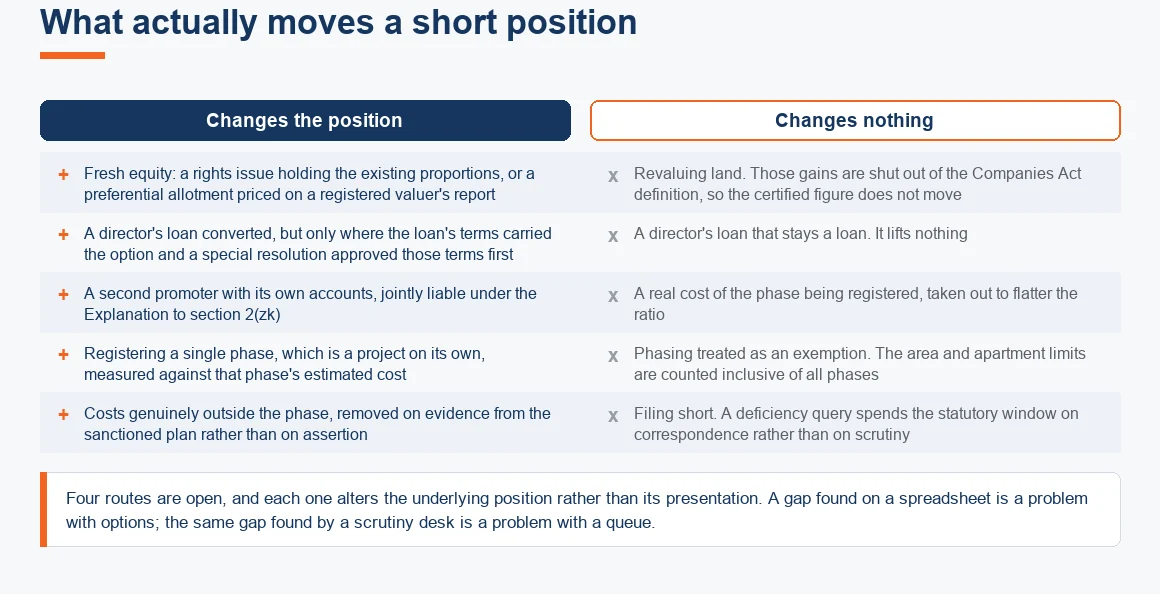
Four routes are open, and they take effect at different speeds. Capital infusion moves the position as soon as the money lands and the resolutions exist. Converting a loan already on the books depends on what was resolved when that loan was taken. Bringing in a second promoter depends on an agreement being signed. Phasing depends on the scheme being genuinely divisible.
Reworking the Project Cost Estimate Honestly
A ratio has two sides, and the denominator is often the side that was wrong. The Explanation to section 3 of the RERA Act 2016 treats each phase as a project standing on its own. An estimate built for a three-tower scheme but filed for one tower overstates what is being registered, and therefore overstates what has to be shown against it.
Costs genuinely outside the current phase come out on evidence rather than on assertion. Land left out of the phase's sanctioned layout, infrastructure serving a later phase, and approvals not yet applied for are all identifiable from the approved plan. What cannot come out is a real cost of the phase being registered. Section 60 attaches a penalty of up to five per cent of estimated cost to false information. Beyond that, directions issued in Uttar Pradesh show how closely the same estimate is tracked through the separate bank account afterwards.
The revised basis has to be written down. A certifying accountant works from an architect's or engineer's cost sheet for the phase, the sanctioned plan areas behind it, and a note of what was excluded and why. The numerator will not move by revaluing land either. Gains that only exist on paper are shut out of the Companies Act definition, so a revaluation lifts the balance sheet and not the certified figure.
Infusing Capital or Converting Director Loans
Fresh equity is the route that changes the numerator directly. A rights issue under section 62(1)(a) of the Companies Act 2013 holds the existing shareholding proportions. A preferential allotment under section 62(1)(c) needs a special resolution and a price set by a registered valuer's report. Private placement under section 42 carries its own clock. Securities are allotted within sixty days of the application money arriving, failing which the money goes back within fifteen days after that.
Converting a director's loan is the route most often assumed to be available. Section 62(3) exempts a conversion only where the loan's terms carried the option, and where a special resolution approved those terms before the loan was raised. A loan taken without that resolution is not convertible under the sub-section, and the honest answer is a fresh issue instead. Where the loan is to stay a loan, it lifts nothing. The Companies (Acceptance of Deposits) Rules 2014 keep a director's money outside the deposit definition only on a written declaration that it is not itself borrowed.
The evidence a certifying accountant asks for barely changes between the versions. Bank statements showing the inflow and its source, the board and members' resolutions, the return of allotment, and the declaration behind a director's money. Which reserves genuinely count then decides how much of what is already sitting there can be relied on. Where accumulated losses have eaten the capital, the figure below zero is a different problem from a shortfall.
Bringing In a Co-Promoter or Joint Development Partner
A second party does not merge into the first party's balance sheet. The Explanation to section 2(zk) deems the person who constructs and the person who sells to be promoters together, jointly liable for the same functions and responsibilities. MahaRERA's circular of 4 December 2017 reads that clause as making a landowner or investor with an area share or a revenue share a promoter. Each promoter's position stays its own, and the file carries both.
In a joint development the land is usually the substantial contribution, and whose worth applies follows the agreement. Where the landowner keeps a share of the built area or of revenue, the landowner carries promoter obligations, including a share of the designated account. An outright sale of the land for a fixed sum is treated differently, because nothing in the project is retained. So the agreement, not the intention, decides whose accounts are examined.
The paperwork has to exist before the file does. Where the promoter is not the owner of the land, Tamil Nadu's rule 3(1)(e) requires the owner's consent. It also requires the collaboration, development or joint development agreement and the owner's own title documents. Adding a promoter after registration is a heavier exercise. A transfer of majority rights under section 15 needs the written consent of two thirds of the allottees plus the Authority's prior written approval. The rules Tamil Nadu notified are one state's version of a list every authority keeps.
Phasing the Project to Match Available Worth
Registering less is the one route that lowers the requirement without adding anything to the balance sheet. A phase registered on its own is a project on its own, with its own registration number, its own completion date and its own designated account. What the authority compares the promoter against is that phase's estimated cost.
Cost allocation across phases is where the idea is won or lost. Land, access roads, a clubhouse and trunk services serve more than one phase, and the basis on which they are split has to be stated once and then repeated. An apportionment by saleable area that suits the first phase and is quietly redrawn for the second is visible the moment the second file is opened.
Two limits are worth knowing before a scheme is redrawn. Phasing buys no exemption, because the five hundred square metre and eight apartment limits are counted inclusive of all phases. The later phases do not disappear either. Each comes back for its own registration and its own certified position, at a point when the first phase is already consuming the promoter's funds.
What Happens If You File Anyway
Filing short rarely produces a swift rejection. It produces a query. The authority raises a deficiency, the promoter answers, and the thirty day period in section 5 is spent on correspondence rather than on scrutiny. Section 5(2) does deem a project registered where the authority neither grants nor rejects in time, which is not something to build a launch on.
Rejection, when it comes, is reasoned and heard first. Section 5(1)(b) requires the reasons to be recorded in writing, and its proviso bars rejection until the applicant has had an opportunity of being heard. Re-application then means rebuilding the file around a position that has actually changed, which is the same work avoided earlier, done later and in public.
Waiting is not free either. Section 3(1) bars a promoter from advertising, marketing, booking, selling or offering for sale in a planning area until the project is registered. The Act's own text puts a penalty of up to ten per cent of estimated cost behind that bar, in section 59. Reaching a defensible figure first is the shorter order of operations, and a statement the authority can rely on is what closes it.
This post supports When Promoter Net Worth Falls Short, which sets out what Patron delivers and for whom.