
In this guide
State Authorities Set the Bar as a Share of Estimated Project Cost
Nothing in the Real Estate (Regulation and Development) Act of 2016 fixes the promoter net worth a RERA authority must see. The Act lists what a section 4 filing must contain and leaves the financial annexures to rules made by each state and to formats each authority notifies. That is why the bar is proportional rather than absolute: an authority sizes the promoter against the project in front of it.
Where an authority does state a figure, it states it against the estimated cost of that project. Bihar's authority asks for a statement of assets and liabilities showing net worth equivalent to ten per cent of the total estimated development value. It asks for this where the promoter's financial statements do not already show that much. Its published guidance for promoters gives the reason: ten per cent is the booking money a promoter may take before a registered agreement for sale exists.
Other authorities answer the same question differently. Tamil Nadu's rule 3(1)(b) asks for the audited balance sheet of the promoter firm or company for the preceding financial year, and names no worth figure at all. So the number a promoter must be able to evidence is set by the authority the project sits under, read on the date the file goes in.
Where the Promoter's Certified Figure Is Actually Used
The certified statement does not sit inside the declaration. That declaration, sworn on affidavit under section 4(2)(l), carries the title, the encumbrance position, the completion date and the seventy per cent undertaking. Tamil Nadu prescribes it as Form B under rule 3(4). The financial documents, including the audited balance sheet and any statement of worth the authority asks for, travel with the file as separate attachments.
Inside the authority the file is read twice. A technical wing checks the plans, the title and the approvals. A scrutiny desk reads the money: the estimated cost, the audited accounts, the bank account details and the promoter's declared position. Section 5 gives the authority thirty days from receipt to grant registration or to reject for reasons recorded in writing. No application may be rejected without the applicant first being heard.
How much weight the figure carries depends on what the state asked for at the outset. Maharashtra publishes its own document list for promoters, and no statement of worth appears on it. What appears instead is a chartered accountant's certificate on project cost and fund withdrawal, numbered Form 3. The list Maharashtra publishes for promoters and the Bihar requirement are two answers to one statutory clause.
How Promoter Net Worth Is Computed for This Purpose
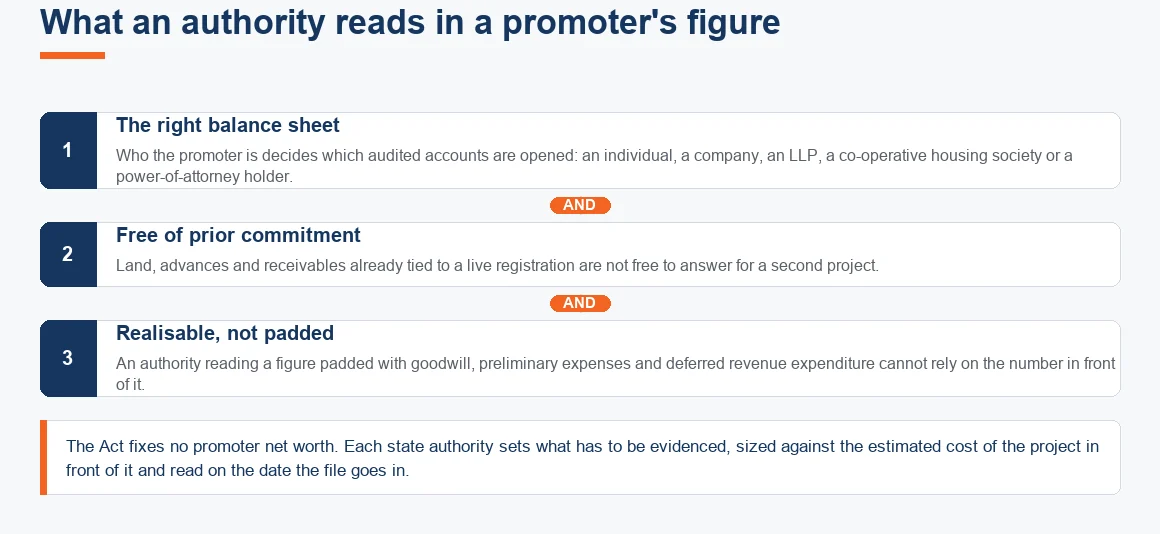
Who the promoter is decides which balance sheet is opened. Section 2(zk) reaches an individual builder, a company, a development authority, a co-operative housing society and a person acting under a power of attorney from the landowner. Where the promoter is an individual or a proprietary concern, the personal position is the only position there is. Where it is a company or an LLP, the entity's audited accounts are the record, and the directors' or partners' own affairs sit outside them.
For a company the arithmetic is already defined. The Companies Act 2013 sets it out at section 2(57). The clause starts with paid-up capital, the reserves a company creates out of profits, its securities premium account and the profit and loss balance. From that it deducts accumulated losses, plus deferred and miscellaneous expenditure that has not been written off, as read from the audited balance sheet. The same clause then excludes revaluation reserves, write-back of depreciation and amalgamation reserves. How a company's figure is built follows from there.
Two adjustments matter more here than in an ordinary financing file. The first is commitment. Section 4(2)(b) requires brief details of every project launched in the past five years, with its current status, any delay and the payments still pending. Land, advances and receivables already tied to a live registration are not free to answer for a second one. The second adjustment is realisability. An authority reading a figure padded with goodwill, preliminary expenses and deferred revenue expenditure is reading a number it cannot rely on. Stripping out what cannot be realised gives the version that survives scrutiny.
Certification and UDIN Expectations of State Portals
Formats are notified, not chosen. Maharashtra runs Form 3 for withdrawals from the designated account and Form 5 for the annual statement of accounts. Other authorities number and word their own annexures, and several print the fields the signer has to complete rather than leaving the layout open. A statement drafted in a house format and uploaded where a notified annexure exists is returned before the figure is read.
The face of a certificate carries more than the figure. A unique document identification number became compulsory for every certificate a practising chartered accountant signs from 1 February 2019. ICAI phased it in on a Council decision taken on 17 and 18 December 2018. The institute's own list of certificates that need one names a net worth certificate and a certificate issued under RERA. The number has to be generated within sixty days of signing, and the practising status a signature requires is what entitles the signer to generate it.
Submission is digital almost everywhere. Portals accept a signed PDF against a named field, and the membership number, the firm registration number and the identification number all have to be legible on the scan. ICAI's own guidance on the number lists RERA among the regulators that may ask for it. That is the point at which a mismatch between the paper and the register stops a file that is otherwise complete.
Project Cost Estimation and Its Link to Your Worth
Estimated cost is not a marketing number. Bihar's guidance defines it as the total cost of developing the project, taking in land cost, taxes, cess, development and other charges. Section 4(2)(l)(D) then fixes what the seventy per cent account exists to cover: the cost of construction and the land cost. The two definitions run close enough that a promoter cannot hold one figure for the authority and a different one elsewhere.
Phasing changes the denominator because it changes the project. The Explanation to section 3 makes every phase a stand alone real estate project, registered separately. A promoter registering the first phase alone is measured against that phase's estimated cost and not against the whole scheme. The exemption limits do not move with it, since five hundred square metres and eight apartments are both counted inclusive of all phases.
Consistency is what an examiner tests. The same estimate drives the seventy per cent arithmetic and every later withdrawal certificate, so a figure trimmed to flatter one ratio reappears in all of them. It is also the figure the authority uses when it measures a penalty, which makes an optimistic estimate expensive in more than one direction. Where an honest estimate still leaves the position short, options open before filing are a separate question from the estimate itself.
Filings That Keep the Certified Figure Current
Registration starts a reporting cycle rather than closing one. Section 11(1) obliges the promoter to keep the project's page on the authority's website current. Quarterly updates cover the apartments and garages booked, the approvals taken and pending, and the status of the project. None of those restate the promoter's worth. All of them are read against it.
The annual obligation touches the accounts directly. Section 4(2)(l)(D) carries a third proviso, and it requires the accounts to be audited within six months of each financial year end. The statement produced then has to be certified and signed by a chartered accountant in practice. Withdrawals from the designated account sit on a different footing, certified by an engineer, an architect and a practising chartered accountant. Haryana's 2020 direction on that proviso sets 30 September as the submission date and calls the exercise certification rather than audit.
Some events call for a fresh position rather than a fresh return. Section 15 conditions a transfer of the project to a third party on two thirds of the allottees agreeing in writing, and on the Authority's prior written approval. The incoming promoter's own position is then what gets examined. An extension under section 6, a new phase, or a second promoter joining puts the same question again. Each sends a promoter back for a statement signed for the authority.
This post supports RERA Promoter Net Worth Requirements, Explained, which sets out what Patron delivers and for whom.