In this guide
Paid-Up Capital Is One Input; NOF Is What Survives the Deductions
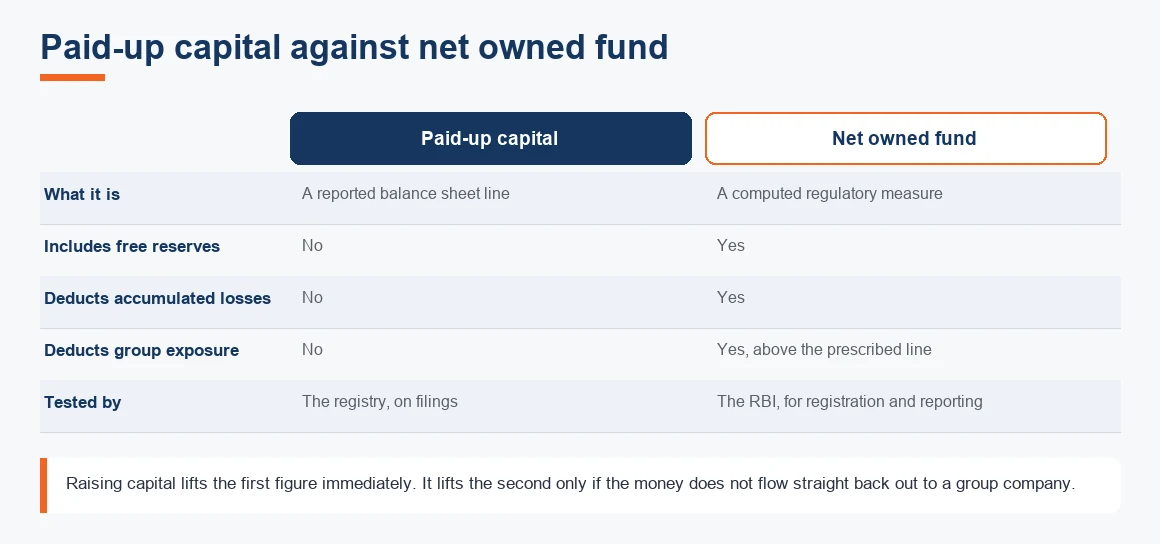
Set net owned fund vs paid-up capital side by side and the two turn out not to be the same kind of thing. Paid-up capital is a balance sheet line fixed by company law and reported to the Registrar. The other is a computation the Reserve Bank defines for its own purposes, and capital is only the first entry in it.
The regulator tests the computed measure and not the line. Clause (b) of section 45-IA(1), in the 1934 Act, makes a stated amount of net owned fund a condition of commencing or carrying on business. No quantity of issued capital answers that condition by itself.
Which of the two reads larger is genuinely open, and the common assumption that one is a shrunken version of the other is wrong. Reserves and securities premium sit above the capital line and push the computed measure up. Accumulated losses, intangible assets and money deployed inside the group pull it down. A profitable company with a premium account usually reports the larger number on the regulatory side, while a holding structure that has pushed its capital downward reports the smaller one.
How Paid-Up Capital Is Fixed and Reported
Company law separates three figures that get collapsed into one in conversation. Subscribed capital, under section 2(86) of the Companies Act 2013, is the part of the capital members have taken up. Called-up capital, under section 2(15), is the part the company has actually asked them to pay. Paid-up capital, under section 2(64), is the amount credited as paid up against the shares issued, and nothing else received on those shares counts towards it.
Premium forms no part of it. Section 52 requires a sum equal to the premium received to be transferred to a securities premium account. The Act then protects that account by applying the reduction of capital rules to it. So a share of ten rupees face value issued at ninety rupees premium adds ten rupees to paid-up capital and ninety rupees to where a premium is credited.
Partly paid shares and calls in arrears behave the same way. Only what has been credited as paid up counts, so an unpaid call sits outside the figure until the money arrives. Section 60 requires that wherever authorised capital is published, subscribed and paid-up capital are published alongside it, which is why all three appear on the public record together.
The Reserves and Adjustments That Sit Between the Two
Four additions stand between the capital line and the regulatory base. Free reserves come first, and only a reserve that could lawfully be paid out as dividend qualifies. The securities premium balance comes second. Capital reserves that represent surplus from selling an asset come third, and preference shares that must convert into equity come fourth. Reserves created by revaluing an asset are admitted at no point in the sequence.
Three subtractions follow inside the same step. Carried-forward deferred revenue expenditure comes off. So does any accumulated loss balance, and so do intangible assets. What is left is owned fund, and that figure does double duty. It is the base the regulatory measure is built from, and it is the starting point for what a supervisor counts as core when a ratio has to be struck.
The final adjustment has no company law counterpart at all. Investments in subsidiary and group shares, holdings in other finance companies, and lending to and deposits placed with group entities are added together. The part standing above the ten per cent line is then removed. That single step is what separates the two figures for anyone running a group, and the full arithmetic set out takes each basket in turn.
A Side-by-Side Computation on the Same Company
Take a company that has raised capital twice and lent inside its group. Its paid-up equity capital is 25 crore rupees. Its securities premium balance is 40 crore rupees and its free reserves are 4 crore rupees. Against those it carries an accumulated loss of 6 crore rupees and intangible assets of 3 crore rupees. Nothing in the accounts is unusual and nothing has been revalued.
Owned fund is therefore 60 crore rupees, and the ten per cent line stands at 6 crore rupees. Group exposure runs to 19 crore rupees, being 14 crore rupees of shares in a subsidiary and 5 crore rupees lent to another company in the group. The excess above the line is 13 crore rupees, so the regulatory figure lands at 47 crore rupees.
Three numbers now describe one company. A reader working only from the capital line sees 25 crore rupees. A reader working from owned fund sees 60 crore rupees. The figure that is actually tested is 47 crore rupees, and neither shortcut arrives at it. The 22 crore rupee gap above the capital line is premium and reserves; the 13 crore rupee gap below owned fund is capital already working somewhere else in the group.
Which Figure Regulators, Lenders and Tender Boards Ask For
The Reserve Bank asks for the computed measure and says so in terms. Its registration and scale based regulation directions specify the net owned fund an applicant must hold before it may trade. The annual statutory auditor's certificate return then reports the position reached. Nothing in that chain asks for issued capital standing alone.
Forms drafted outside the sector often ask for capital when they mean standing. A tender condition set on capital is testing whether a bidder is substantial. A bidder whose strength sits in reserves rather than in face value can read below the bar on paper while sitting well above it in substance. The wording of the condition governs, not the intention behind it.
Reading the form before answering it is the whole discipline. Where a form cites a section, the section decides which figure is meant. Where it names only a phrase, the phrase is taken at face value and answered with the figure that phrase describes. A form asking for a company law measure is answered with the company law measure beside it, not with the regulatory computation.
Verdict: Raising Capital Does Not Always Lift Your Position
The honest answer is that it depends entirely on where the money goes. Take the company above and add 10 crore rupees of fresh equity that stays in government securities. Owned fund rises to 70 crore rupees, the ten per cent line rises to 7 crore rupees, and the excess falls to 12 crore rupees. The regulatory figure rises to 58 crore rupees, an increase of 11 crore rupees on a raise of 10 crore rupees.
Now put the same 10 crore rupees straight into a loan to a group company. Owned fund still rises to 70 crore rupees and the line still rises to 7 crore rupees. Group exposure, though, rises to 29 crore rupees and the excess to 22 crore rupees. The regulatory figure lands at 48 crore rupees. Ten crore rupees raised has moved the tested number by one.
So the deployment matters more than the amount. A raise held outside the group carries through and a little more, because the allowance widens as the base widens. A raise passed down the group is absorbed almost entirely. Where the resulting figure has to be stated as at a date and supported, the computation an auditor certifies is different work from the allotment that produced it.
This post supports Net Owned Fund vs Paid-Up Capital, which sets out what Patron delivers and for whom.