
In this guide
The Bank Wants Proof You Can Absorb the Guarantee If It Is Invoked
A guarantee moves no money on the day it is issued. The bank promises a beneficiary that it will pay if the applicant fails to perform, and it then recovers that payment from the applicant. Everything the bank risks sits in that second step. So the question at appraisal is not only whether the work will be done. It is whether the applicant could repay the bank if the beneficiary called the instrument in.
That is why the position is examined before the limit is sanctioned, rather than when each instrument is printed. Once a guarantee reaches the beneficiary the bank is committed for its full tenor, and a later check changes nothing. The certificate belongs with the appraisal papers, not with the issuance request that follows them.
The figure is read against a specific sum. A net worth certificate for a bank guarantee is measured against the limit applied for, together with the guarantees already outstanding in the same name. An applicant whose statement runs to a few crore is thin cover once three live performance guarantees are counted against it.
Where the Certificate Enters the BG Sanction File
Three steps run in order. The customer applies for a guarantee limit, the branch and the credit team appraise it, and the sanction fixes the limit with its conditions. Individual guarantees are then issued against that sanctioned limit as contracts are won, and the mechanics of how the instrument itself works sit behind each issuance. The certificate is filed at the second step, which is the only point at which it can influence anything.
It is never read alone. The appraisal note sets it beside the audited financial statements, the underlying contract or tender document, the order copy and the statement of existing exposure. Where the applicant is a company, the promoters' own statements usually travel with it, because personal guarantees from directors are routine on a closely held company's limits. What the credit team then does with all those numbers is a separate exercise, set out in how appraisers discount a stated position.
Limits are renewed, not left standing. A guarantee limit is reviewed on a cycle, and the renewal file is assembled much like the original one. A statement drawn up two years earlier cannot carry that review, because the assets behind it have moved and so has the exposure. A refreshed certificate is part of the renewal rather than an optional extra. Applicants asked for one at short notice are usually those who assumed otherwise.
Margin Money and Counter-Guarantee Alongside Net Worth
Net worth is one of three levers, and the other two are contractual. The first is cash margin. The bank takes a deposit and marks a lien on it, so part of the guarantee is covered by the customer's own money before the instrument leaves the branch. Cash set aside against the limit reduces the bank's clean exposure to whatever remains above it.
The second is the counter-guarantee. The customer executes a counter-indemnity in the bank's favour, promising to reimburse any amount the bank pays out under the instrument. Directors of a private company usually sign personal guarantees alongside it. None of this creates new assets. It converts the bank's exposure into a claim it can enforce quickly against people it has already assessed.
A stronger certified position can move the margin a bank asks for, though it does not fix it. RBI's master circular on guarantees tells banks to satisfy themselves that the customer can reimburse them, and to avoid unsecured guarantees in large amounts. It prescribes a margin in only one place. Guarantees issued on behalf of share and commodity brokers carry a minimum margin of 50 per cent, including a minimum cash margin of 25 per cent. Everywhere else the margin is the sanctioning authority's call, made on the file in front of it.
Figures a BG Desk Reads Closely
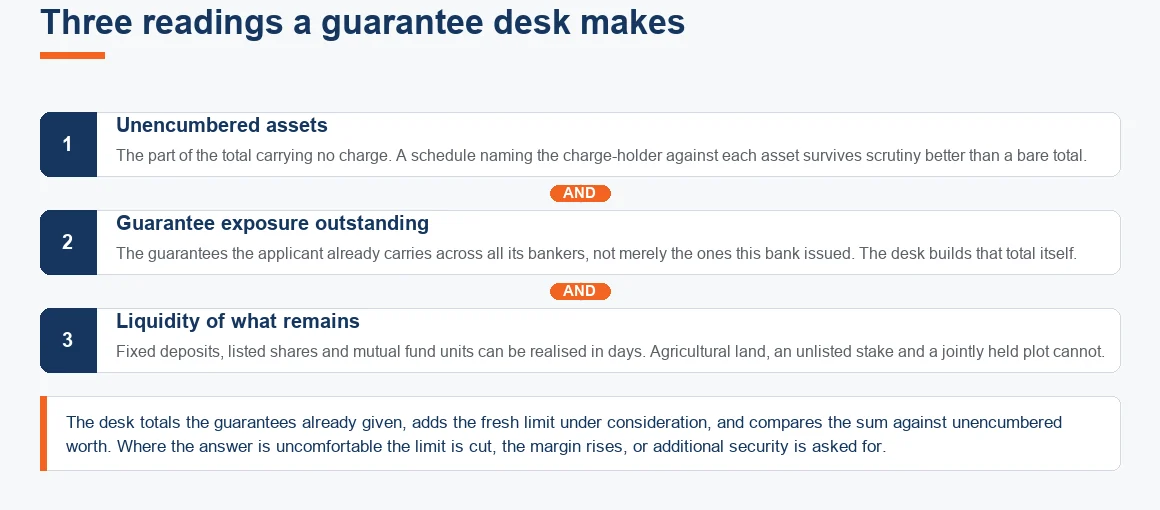
Unencumbered assets come first. A property already mortgaged to another lender is supporting someone else's claim, and a desk reading a total that quietly includes it is being misled. The useful figure is not the total. It is the part of the total carrying no charge, which is why a schedule naming the charge-holder against each asset survives scrutiny better than a bare number does.
Guarantee exposure already outstanding is the second reading. A desk adds up the guarantees the applicant carries across all its bankers, not merely the ones this bank issued. Two performance guarantees of moderate size and one advance-payment guarantee can consume most of an apparently comfortable position. Applicants rarely present the total that way, and the desk builds it anyway.
Liquidity is the third, and it decides how fast the bank could be made whole. Fixed deposits, listed shares and mutual fund units can be realised in days. Agricultural land, a stake in an unlisted company and a plot held jointly with three relatives cannot be. Two applicants with the same certified total can therefore present very different recovery prospects, and the difference between them is what the desk is really measuring.
Contingent Liabilities From Guarantees You Already Carry
Disclosure and deduction are different acts. A guarantee creates an obligation only if someone else fails, so accounting treats it as a contingency rather than as a liability. Schedule III to the Companies Act 2013 places contingent liabilities and commitments in the notes. Ind AS 37 keeps them out of the recognised numbers until an outflow becomes probable. A certified statement follows the same logic, showing the commitment and leaving the arithmetic above it alone.
Personal and group guarantees belong in the same note. A promoter who has guaranteed a group company's term loan has committed personal assets to that loan, whatever the borrowing entity's own balance sheet shows. Obligations that have not yet crystallised are the items that make two identical-looking statements behave very differently under stress.
A guarantee desk aggregates rather than reads line by line. It totals the guarantees the applicant has given, adds the fresh limit under consideration, and compares the sum against unencumbered worth. Where the answer is uncomfortable the file does not usually fail outright. The limit is cut, the margin rises, or additional security is asked for. What does end a file is an undisclosed guarantee surfacing from the credit information report after a clean position has been certified.
Timing Your Certificate Against the BG Cycle
An as-on date decides how long a certificate stays useful. Appraisal takes weeks, and a statement drawn up on a date already months old invites a request for a fresh one at exactly the wrong moment. Dating the position close to submission, with the supporting schedules built to the same date, avoids that second round entirely.
Renewals and extensions run to their own rhythm. A guarantee can carry a long tenor, and RBI's circular says a bank guarantee should not normally mature beyond ten years. Extensions requested near expiry are treated as fresh exposure, so the position is examined again rather than assumed from the earlier file.
Working backwards from the sanction date is the practical step. Title documents, encumbrance searches, valuation reports and confirmations from other lenders all take time to collect, and no certificate can be issued before they arrive. Where the exposure turns on a person standing behind the borrower rather than on the borrower alone, what a surety must hold sets out a different set of tests. Which document a given facility calls for is mapped on certificates prepared for lending files.
This post supports Net Worth Certificates for Bank Guarantees, Explained, which sets out what Patron delivers and for whom.