In this guide
Negative Net Worth Means Accumulated Losses Have Eaten the Capital
Losses do not stop at zero. They pile up as a debit balance carried in the profit and loss account. That balance is subtracted from capital and qualifying reserves under the definition in section 2(57). When the subtraction exceeds everything above it, the equity block turns negative. A negative net worth company is one whose carried-forward losses now exceed what the shareholders put in and what the business managed to retain.
One bad year is not this. A business can lose money for three years running and still show a healthy block, because it had reserves deep enough to absorb the damage. Erosion is cumulative and it is measured against the base, not against the current year's result. The two get the same label in conversation and produce very different credit files.
The crossover is arithmetic rather than judgement. Add paid-up capital to the balances that qualify, subtract the accumulated deficit, and the sign of the answer is the answer. Capital eaten away over time describes the path a company travels; the balance sheet date fixes where along that path it currently stands.
Is Negative Net Worth Illegal? What the Companies Act Says
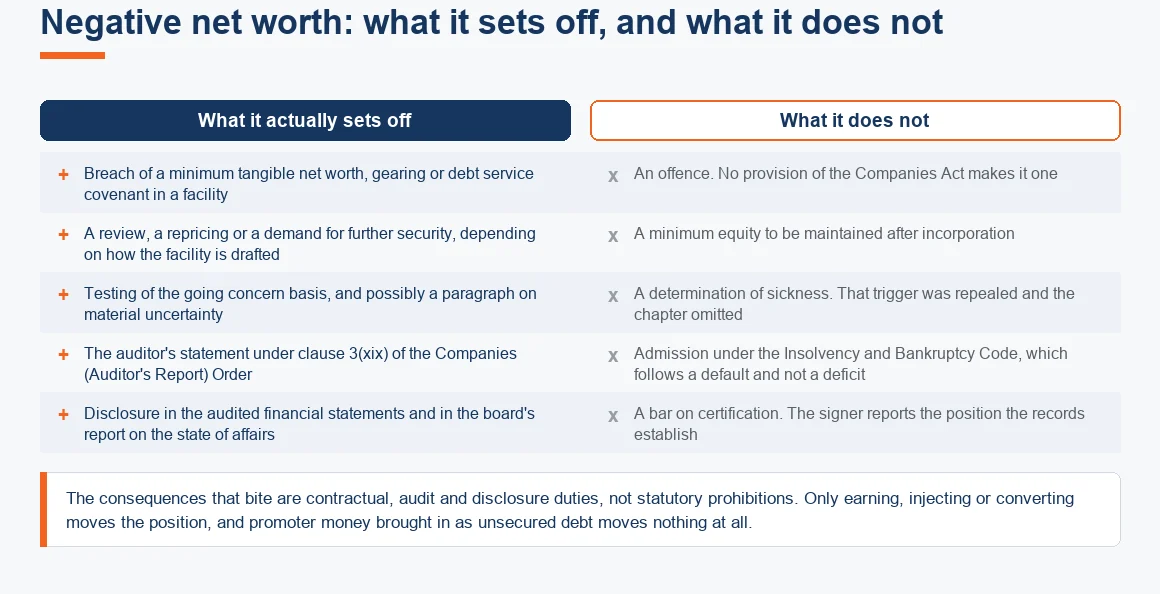
No provision makes it an offence. The Companies Act 2013 sets no minimum equity that must be maintained after incorporation, and it attaches no automatic consequence to the sign of the figure. Directors asking whether they are in breach are usually reaching for the wrong statute.
There used to be a trigger and it has gone. The Sick Industrial Companies (Special Provisions) Act 1985 turned on erosion of net worth, and it was repealed with effect from 1 December 2016. Chapter XIX of the 2013 Act carried its own determination of sickness in section 253. The Insolvency and Bankruptcy Code omitted that whole chapter through its Eleventh Schedule, from 15 November 2016. What replaced both tests is default on payment.
The duties that do bite are duties of disclosure. The position is presented in the audited financial statements and discussed in the board's report on the state of affairs. Where it casts doubt on continuing operations, the going concern basis has to be considered and the accounts have to say so. Reading the company law text itself takes less time than reading what circulates about it.
Is a Low Net Worth Good or Bad in a Lender's Eyes?
It depends entirely on what produced it. A business that raised capital, spent it building a product and shows a deficit against a funded balance sheet is telling one story. A business that traded profitably for a decade, lost its market and consumed its reserves is telling another. The number can be identical in both files and the credit decision will not be.
Lenders read it beside the cash flow statement, never on its own. Operating cash flow, the debt service coverage ratio and the ageing of receivables carry more weight in a working capital review than the equity block does. Gearing measured against equity stops being usable once the denominator drops below zero, and that failure is itself a signal a credit team acts on. Coverage from earnings and demonstrated promoter support take its place.
Some sectors run thin by design. Service businesses with no asset base, early stage technology companies funded through convertible instruments and single project vehicles that distribute as they go are the usual examples. Each can show modest or sub-zero equity in perfectly ordinary conditions. Underwriters there do not treat it as an exception, and how a credit team reads it varies more by industry than by the size of the deficit.
Triggers It Sets Off With Bankers, Auditors and Under the IBC
Facility documents are usually where the consequence lands first. A sanction letter commonly carries a minimum tangible net worth covenant, a ceiling on gearing and a debt service covenant, each tested annually against audited accounts. Breaching one is an event of default under the contract even though nothing statutory has happened at all. What follows is a review, a repricing or a demand for further security, depending on how the facility is drafted.
Auditors arrive at it from a different direction. Where accumulated losses raise doubt about the ability to keep operating, the going concern basis is tested and the report may carry a paragraph on material uncertainty. Clause 3(xix) of the Companies (Auditor's Report) Order 2020 puts a related question directly. The auditor states whether any material uncertainty exists about the company meeting liabilities existing at the balance sheet date as they fall due within one year.
Insolvency is the outcome directors fear most and the one least tied to the figure. Admission under the Insolvency and Bankruptcy Code 2016 follows a default, not a deficit. The minimum amount of default was raised to one crore rupees by a notification dated 24 March 2020. A company with a large deficit that pays everyone on time is not admissible, and a healthy looking company that misses a payment is. The Code's own legal framework sets out the sections in order.
Can a CA Still Certify a Negative Figure?
Yes, and declining would be the actual failure. Such a document reports a position established from evidence the signer has examined. Substituting a preferred answer for that evidence is the one thing an attest function is not permitted to do. A signature says the amount was computed from stated records on a stated basis, not that the amount is comfortable to read.
Presentation is the part that repays care. The deficit is shown in brackets or with a minus sign on the face of the statement, in the same column as everything else, with no softening language around it. The accumulated loss appears on its own line instead of being netted into reserves, so a reader can see exactly what produced the total. The reserves that qualified are still listed in full above it.
A note travels alongside. It names the audited accounts relied on and their date, states the basis of computation, and discloses anything a reader would otherwise reconstruct wrongly. Where the accounts carry a going concern paragraph, the note points at it rather than leaving it to be discovered later. A document that volunteers bad news is read as more reliable than one that waits to be caught.
Routes Out: Capital Infusion, Loan Conversion and Write-Backs
Only three things move the position: earning, injecting or converting. Fresh equity is the direct route, whether by a rights issue offered under section 62(1)(a) or by a preferential allotment made under section 62(1)(c) read with section 42. Promoter money brought in as share capital does the same work. Promoter money brought in as unsecured debt moves nothing at all, which is the point most often missed by the people writing the cheque.
Converting existing director or group loans into equity is the second route, and it carries a timing trap. Section 62(3) allows a loan to convert on a special resolution, but the resolution must have been passed before the loan was raised. Where it was not, the conversion has to run through the ordinary further-issue route instead. Registrars have penalised companies that passed the resolution at conversion rather than at the outset.
Write-backs help only where a liability has genuinely ceased to exist, and the credit then passes through profit on its way to reserves. Revaluing land to close the gap does not help, because the balance it creates is excluded by the same clause that produced the problem. A reduction of capital under section 66 needs tribunal approval and rearranges the block rather than adding to it. Whichever route is taken, the position afterwards is what a signed statement of position reports.
This post supports Negative Net Worth, which sets out what Patron delivers and for whom.