In this guide
It Is Official Confirmation That a Person or Entity Cannot Pay Its Debts
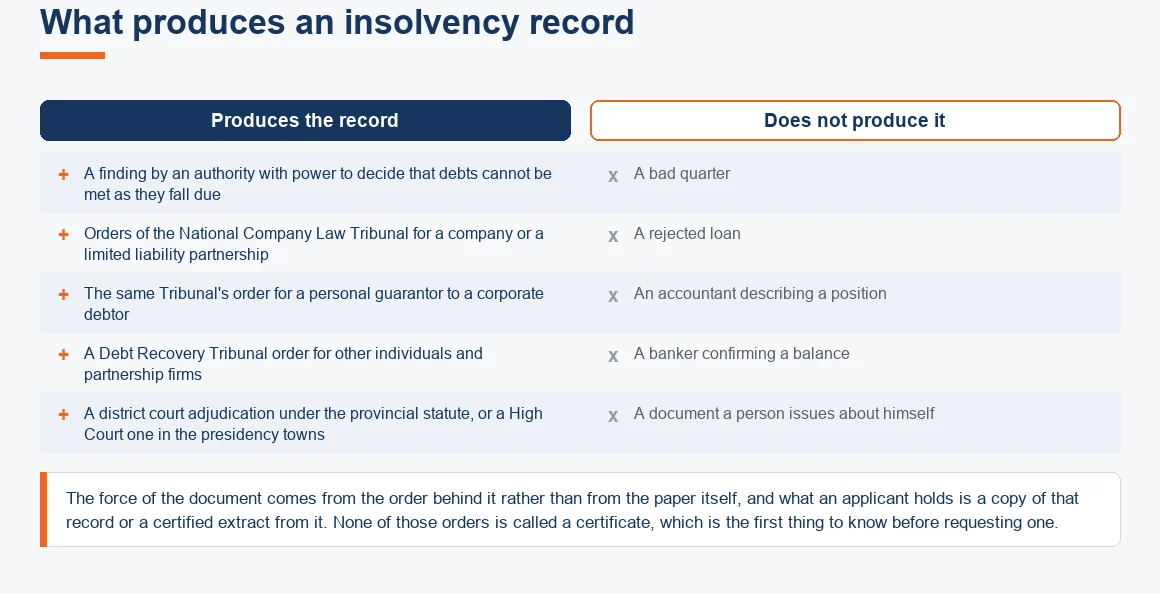
An insolvency certificate confirms a failure, not a shortage. What is recorded is that a person or an entity cannot meet its debts as they fall due. An authority with power to decide that question has decided it. A bad quarter does not produce one. A rejected loan does not produce one. A finding does.
The force of the document comes from the order behind it rather than from the paper itself. A court or a tribunal has heard the matter, tested the claim against records, and made a determination that binds. What an applicant then holds is a copy of that record, or a certified extract from it. The document is evidence of a decision that already exists.
That is what separates it from a professional's view of the same facts. An accountant can describe a position and a banker can confirm a balance, and neither of them can declare anybody insolvent. The ability to convert assets into money is something either of them can assess. Whether a debtor has failed is a judicial finding, and it stays with the bench.
Who Issues It: Courts, Tribunals and Revenue Authorities
For companies and limited liability partnerships the forum is the National Company Law Tribunal. It is the adjudicating authority for corporate persons under section 60(1) of the Insolvency and Bankruptcy Code 2016. What it produces is a series of orders: admission of a resolution process, appointment of a resolution professional, and later a liquidation order if resolution fails. None of them is called a certificate, which is the first thing to know before requesting one. The process record is published through the Board's own portal.
Individuals and partnership firms sit in Part III of the Code, which has been brought into force in stages rather than all at once. From 1 December 2019 it applies to personal guarantors to corporate debtors, whose matters go to the same Tribunal under section 60. For other individuals, section 179 places jurisdiction with the Debt Recovery Tribunal. Which door opens depends on who the debtor is, not on what the applicant would prefer.
The older statutes are still standing, and this surprises people. The 1920 provincial statute governs insolvency of individuals before district courts outside the presidency towns. The Presidency-Towns Insolvency Act 1909 does the same before the High Courts at Calcutta, Madras and Bombay. Section 243 of the Code repeals both, but that section has never been notified. Until it is, both Acts remain in force.
Situations Where Someone Is Asked to Produce One
Most requests come from forms rather than from litigation. Employment applications in the public sector, professional licensing, appointment to office and registration under trade legislation all carry a line asking whether the applicant is an undischarged insolvent. Company law reaches the same question directly. Section 164(1)(b) of the Companies Act 2013 disqualifies an undischarged insolvent from appointment as a director. Section 164(1)(c) does the same where an application to be adjudicated insolvent is pending.
Recovery and settlement proceedings are the second setting. A creditor pressing a claim may point to an existing insolvency record to establish what it is dealing with. A debtor negotiating a settlement may be asked to show the opposite: that no proceeding is pending against him anywhere. That second request is answered from the public record, not by producing a document about oneself.
Family and succession matters make up the third group. A person offered as security for another's debt is checked before the offer is accepted, and so is a proposed guardian of a minor's property. Courts administering an estate ask the same question about anyone taking control of assets. In each case the concern is the same: whether the person standing behind an obligation is in a position to stand behind anything.
Confirming the Document You Actually Need
Read the line in the request before acting on the word in it. Checklists use insolvency loosely, and the sentence around the word usually contradicts the word itself. Some lines ask the applicant to establish capacity to meet a stated obligation, or to show funds sufficient for a bid. Those requests are for the opposite finding from the one this document records.
That is where most readers of this page actually are. The document being asked for confirms that the applicant can pay, and it is issued by a chartered accountant or, within narrower limits, by a bank. Neither is a court and neither declares anything about failure. Which issuer an acceptor names is a question the request answers on its own face, if it is read closely enough.
A third case catches entities that are closing down. Somebody winding up a solvent company or LLP is occasionally told to produce an insolvency document. What the closure procedure actually requires is a sworn statement by the entity's own officers about its ability to pay. What officers swear before closing is a different instrument again, and no authority issues it to anybody.
The Application Route and the Records Required
Where the application is filed follows from the forum. A corporate insolvency resolution process starts with an application to the Tribunal under section 7, 9 or 10 of the Code. Which of the three applies depends on whether a financial creditor, an operational creditor or the corporate debtor itself is filing. A personal guarantor's matter starts under section 94 where the debtor applies and section 95 where a creditor does. An individual outside that class petitions the district court under the provincial statute.
The records are the substance of the exercise. A schedule of creditors with the amount owed to each and the security held. A schedule of property, wherever situated, with what is charged and to whom. Books of account and returns for the recent period. Particulars of transfers, gifts and payments made in the months before the application, because the court will look at whether assets moved out ahead of the filing.
Timelines and objections then take over. An interim moratorium applies from the filing of an application under section 94 or 95, staying proceedings in respect of the debt. The Adjudicating Authority directs the Board to nominate a resolution professional within seven days of the application. Creditors are put on notice and may object, and the debtor is heard before anything is decided.
Consequences of Being Declared Insolvent in India
An order of adjudication changes what a debtor owns. Under the provincial statute the whole of the property vests in the court or in a receiver, and property acquired afterwards vests the same way until discharge. Under the presidency towns statute the official assignee holds it. Either way the debtor stops dealing with his own assets, and the officer holding them divides them among creditors.
The restrictions reach further than property. Appointment as a director is closed while the insolvency is undischarged, and licensing and appointment forms carry the question for years afterwards. The record reaches credit information companies through the lenders reporting on the account, so borrowing is affected long before anybody asks for a document. Offices of trust are usually closed as well.
Discharge is what ends it. The statutes provide for an order of discharge, which releases the insolvent from the debts provable in the proceeding, subject to the exceptions each Act names. Annulment is available where the debts are paid in full or the adjudication should not have been made. Where somebody has come through that and now has to show current capacity to an acceptor, confirming capacity to meet obligations is the exercise that answers it.
This post supports What Is an Insolvency Certificate and Who Needs One?, which sets out what Patron delivers and for whom.