In this guide
One States a Balance, the Other Speaks to Capacity
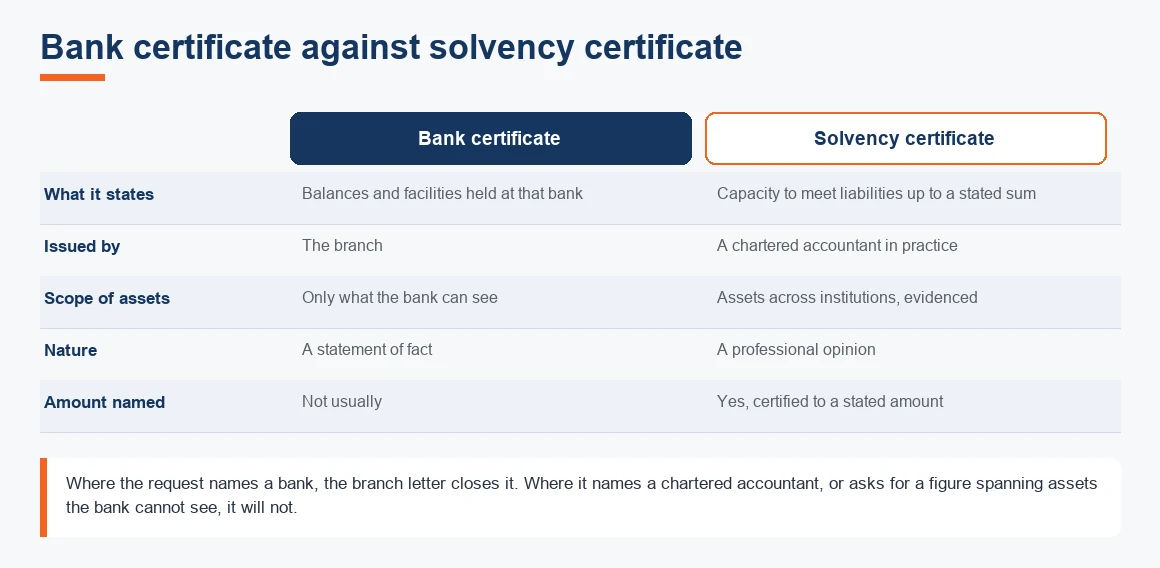
A bank certificate and a solvency certificate get asked for in the same breath, and the wording of the request usually reveals which one is wanted. One reports a fact the bank already holds: an account exists, and a balance stood at a figure on a stated date. The other carries an opinion, that the applicant could meet an obligation of a named size.
Scope follows from that split. A branch writes only about what passes through its own books, so its letter stops at the edge of the relationship. A chartered accountant assembles the wider position, including immovable property, borrowings from other lenders and holdings outside the bank, and then forms a view on it. One document is narrower and easier to check. The other is wider and rests on professional judgement.
Acceptors name one or the other because they are asking different things. The question of a bank certificate vs a solvency certificate turns on whether the recipient wants funds it can verify by telephone, or capacity somebody has assessed. Reading the notice first is worth the minute it takes, because a document outside the request is returned unread.
What a Bank Puts Its Name To, and What It Refuses To
Branches write from their own records, and that is the whole of the boundary. A letter can confirm that an account has been maintained since a stated year, and that the balance stood at a figure on a given date. Fixed deposits held with the branch, and their value, can be stated the same way. Conduct is sometimes added: whether cheques have been returned, whether sanctioned limits have been exceeded. Sanctioned facilities and the amount outstanding on them are within reach too, because the bank is itself the lender.
What sits outside those records is invisible to the officer signing. A flat registered in the applicant's name, shares held with another depository participant, a term loan running with a second lender: none of that reaches the letter. Supplying the documents to the branch does not change it, because the branch is not the verifier of them. How quickly an asset converts is answered only for the money the bank is itself holding.
Wording is where these requests break down. Branches decline to certify what a property is worth, to guarantee future performance, or to describe an applicant as solvent for an open-ended amount. The request is met against a stated sum or not at all. Where a printed format asks for language a branch will not sign, the applicant finds out at the counter rather than in the credit file. The charge for issuing the letter is published in the schedule of service charges displayed at the branch, under the customer service master circular.
How a CA-Issued Certificate Is Built Instead
Evidence for the second route comes from more than one institution, which is the practical reason it exists. Title deeds establish ownership of immovable property. An encumbrance certificate from the sub-registrar shows what stands registered against that property. Loan statements are collected from every lender rather than one. Where a company is involved, charges registered with the Registrar under section 77 of the Companies Act 2013 are searched. A charge binds the asset regardless of who holds the paper.
The opinion itself is narrower than it looks. The signer is not valuing a business and not predicting an outcome. What is stated is that assets realisable at the date examined, less the liabilities owed to outsiders, cover the obligation named in the request. That is a professional judgement, and it is expressed as a judgement rather than as arithmetic.
The face of the document carries its own verification trail. Membership number, firm registration number, the date, the amount certified and the unique document identification number all appear on it. A verifier checks that number against the institute's register instead of telephoning anyone. What sits behind the figure is settled before any of it is printed, and the ratios read alongside it usually accompany the total.
Which Departments and Tender Boards Accept Which
Requests fall into three wordings, and that difference decides more than any general rule about which document is stronger. Some name the institution: a certificate from the applicant's banker, on the bank's letterhead, signed by the branch. That wording exists because the recipient wants an issuer it can approach directly. A professional's letter does not satisfy it, however carefully the letter is drawn.
Others name the profession. Where a notice asks for a certificate from a chartered accountant in practice, the branch letter falls outside the request, and submitting it costs the applicant a cycle. Authorities word it that way when the position being tested runs wider than one account. Nothing about the branch letter is deficient. It answers a question that was not asked.
A third group accepts either, usually phrased as a certificate from the applicant's banker or from a chartered accountant. Reading that line closely beats any assumption, because the same authority sometimes words two of its own formats differently. Where a format is silent on the issuer but names a sum, the sum is the instruction. Whichever document is filed has to speak to that figure rather than to a general standing.
Turnaround, Validity and Renewal on the Two Routes
Processing differs because the underlying work differs. A branch is reading records it already has, so an established relationship moves once the request reaches the officer who signs. Larger amounts travel to a controlling office for approval, and that step is invisible from the counter. The branch route begins with a letter, and drafting that request precisely decides how quickly it moves.
The professional route runs on collection instead. Title documents, a search at the sub-registrar and confirmations from each lender all have to arrive before anything is signed. The sub-registrar search is usually the slowest item in that chain, and it is rarely the one applicants plan for.
Neither document carries a statutory life. How long it is treated as current is fixed by the recipient rather than by any statute, and a properly drafted notice states the window it will accept. Re-issue is the ordinary consequence of a slipped date. Both routes produce a fresh document as at a new date, and both start from evidence rather than reprinting the old one. On the bank side the records have not moved, so that is a small matter. On the other side the registered position and the lender confirmations have to be refreshed.
Verdict: When the Bank Letter Is All You Need
The branch letter closes a file in three situations. The request names the bank. The question is purely about funds held, such as a deposit an authority wants confirmed. Or the applicant's position sits almost entirely inside one institution, which is common for salaried applicants and for firms banking with a single lender. In those cases it is not a weaker substitute for anything. It is the correct document.
It comes back in three others. The notice names a chartered accountant. The amount is carried by property or by holdings the branch cannot see. Or the acceptor wants a view on capacity rather than a statement of balance, which no branch will give. Filing the wrong one costs a cycle, and cycles are what applicants run short of.
Where the wider position has to be examined and certified, where an accountant issues one sets out what that exercise covers and what has to be produced for it. Where the balance is the whole of the answer, the branch is the shorter road, and there is nothing to gain by taking the longer one.
This post supports Bank Certificate vs Solvency Certificate, which sets out what Patron delivers and for whom.