In this guide
Directors or Designated Partners Swear It Before a Voluntary Winding Up
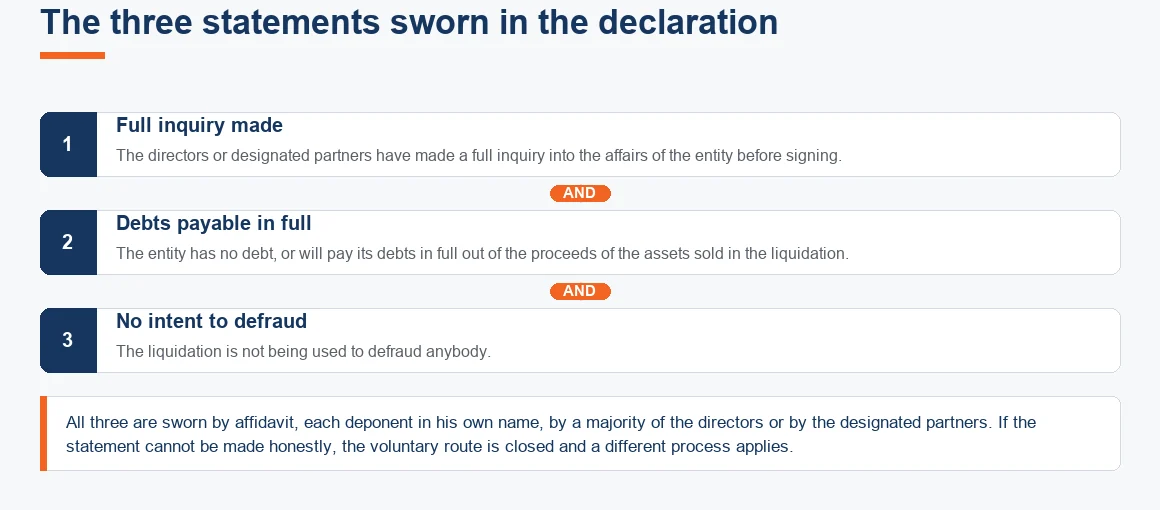
Everything in a voluntary closure hangs off one document, and it comes first. The declaration of solvency precedes the members' resolution, the appointment of a liquidator and the first filing with the registry. At that point the people running the entity have to swear that it can pay what it owes. If that statement cannot be made honestly, the voluntary route is closed and a different process applies.
The signatories are the entity's own officers. For a company it is a majority of the directors; for a limited liability partnership it is the designated partners. Nobody signs on their behalf and no professional signs instead of them. The document is verified by affidavit, which puts each deponent personally behind what it says.
What is sworn is narrow and specific. That a full inquiry into the affairs has been made. That the entity either has no debt, or will be able to pay its debts in full out of the proceeds of the assets to be sold in the liquidation. And that the liquidation is not being used to defraud anybody. Three statements, each of which has to be true.
Statutory Basis Under the Insolvency Code and the LLP Rules
This ground moved, and older articles still get it wrong. Voluntary winding up used to sit in the Companies Act 2013 at sections 304 to 323. Those sections were omitted by the Eleventh Schedule to the Insolvency and Bankruptcy Code 2016, notified on 15 November 2016. Voluntary liquidation of a company now runs under section 59 of the Code, with the procedure in the Board's Voluntary Liquidation Process Regulations 2017, effective 1 April 2017.
Limited liability partnerships travel the same road. An LLP is a corporate person under section 3(7) of the Code, by reference to section 2(1)(n) of the Limited Liability Partnership Act 2008, so section 59 reaches it directly. The Code also removed clause (a) of section 64 of that Act, which had let an LLP ask the Tribunal to wind it up on its own decision. What remains in the LLP Act is the Tribunal route for the cases nobody chooses.
The undertaking about payment is worded the same way for both. It is not expressed as a deadline in months. The declaration says that debts will be paid in full out of the proceeds of the assets sold in the liquidation. That is a statement about sufficiency rather than about timing. The deadlines that do bind are procedural, and section 59 sets them out immediately after the declaration is made.
Contents and the Affidavit That Accompanies It
The declaration itself is short. What gives it weight is the schedule sitting behind it, listing every asset at a basis somebody can defend and every liability at what is actually owed. The schedule of assets and claims is where a closure either holds together or falls apart. The payment undertaking is only as good as the two columns it rests on.
Verification is by affidavit, in the ordinary form. Each signing director or designated partner deposes in his own name, on stamp paper of the value the state prescribes, sworn before a notary or an oath commissioner. The affidavit says the contents are true to the deponent's knowledge and that nothing material has been concealed. That wording is what converts an opinion into a sworn statement.
Two attachments travel with it. Audited financial statements and a record of the entity's business operations, covering the previous two years or the period since incorporation, whichever is shorter. And a valuation of the assets by a registered valuer, where one has been prepared. How the figures are worked out is the same discipline the schedule needs, applied to a different question.
Filing Timelines and the Forms Involved
The sequence is fixed and short. The declaration is made first. Within four weeks of it, the members pass a special resolution in general meeting requiring the entity to be liquidated voluntarily and appointing an insolvency professional as liquidator. That four-week window is in section 59(3)(c), and letting it lapse means the declaration has to be made again on fresh figures.
Filings follow the resolution. The special resolution goes to the Registrar in Form MGT-14 under section 117(3)(a) of the Companies Act 2013. The entity notifies the Registrar and the Board within seven days of the resolution, or of the creditors' approval where that is required, under section 59(4). Liquidation is deemed to have commenced on the date the resolution was passed.
Creditors enter wherever there is debt. Where the entity owes anything, creditors representing two-thirds in value of the debt have to approve the resolution within seven days of it being passed. The liquidator then makes a public announcement and works to the completion timelines in regulation 37 of the liquidation regulations. Those are 270 days from commencement where that creditor approval was involved, and 90 days where it was not.
The Auditor's Report Attached to the Declaration
The audited statements are not a formality bolted on at the end. They are the evidence the declaration rests on, and the Code names them. Financial statements and a record of business operations are required, covering the two years before the declaration. Where the entity is younger than that, the period runs from incorporation instead. A registered valuer's report on the assets joins them wherever a valuation has been carried out.
That period requirement catches entities out. A company that stopped trading two years ago has often stopped getting audited too. The audit for each open year has to be completed before the declaration can be signed. Working from unaudited management figures is not an option, because the whole point of the attachment is that somebody outside the boardroom has looked at the numbers.
What the professional confirms is bounded. The auditor says the statements present the position; the valuer says what an asset would fetch. Neither of them says the entity can pay its debts. That judgement stays with the directors and designated partners who sign, and the ratios behind that judgement are worth running before anybody swears to anything.
Personal Liability for a False Declaration
The affidavit is the reason this matters personally. Section 236 of the Bharatiya Nyaya Sanhita 2023 deals with a false statement in a declaration that an authority is bound or authorised by law to receive as evidence. It is punishable in the same manner as false evidence. That provision replaced section 199 of the Indian Penal Code from 1 July 2024, so anyone working from an older note is citing a repealed section.
The process also has its own check, and it operates during the liquidation rather than after it. Where the liquidator forms the opinion that the entity cannot pay its debts in full out of the proceeds, the regulations bite. They require an application to the Adjudicating Authority to suspend the process. The same applies where the liquidator considers the closure is being used to defraud somebody. A liquidation that should not have started does not simply run to its end, and where a tribunal record begins is often what follows.
None of that is an argument for pessimism about closing an entity. It is an argument for establishing the position before the affidavit is sworn rather than after. Having the position independently checked sets out what an outside examination covers, which is the same evidence the declaration needs and one signature earlier.
This post supports Declaration of Solvency, which sets out what Patron delivers and for whom.