
In this guide
One Prices an Asset, the Other Totals Assets Minus Liabilities
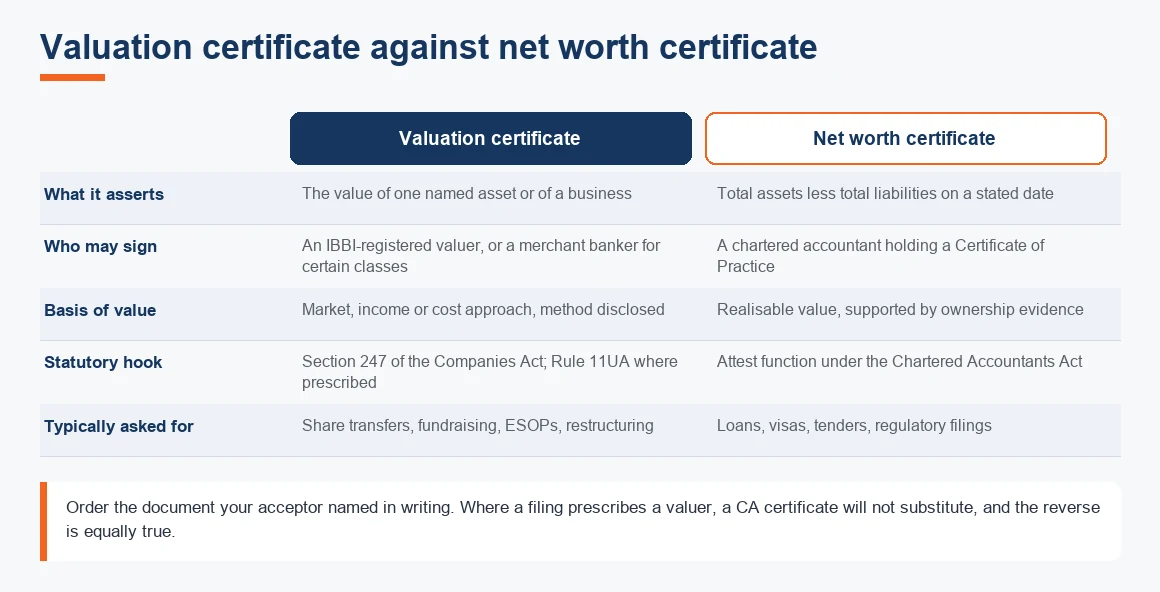
Two documents answer two different questions, and the wrong one lands on a great many files. A valuation report asserts a number for one identified thing on one date: a flat, a plant, a block of shares. A net worth statement asserts a residue, being what survives once everything owed is set against everything owned.
The gap in scope is the whole of it. One is an opinion about a single asset's worth. The other is an arithmetic position across a person or an entity, in which any single asset is one line. The valuation certificate vs net worth certificate question is really a question about which of those an acceptor asked for.
Property backed files are where the two collide. A lender wants the flat priced and the borrower's overall position stated, so both documents arrive together and both carry a figure for the same flat. The two figures rarely match, and neither of them is wrong.
Registered Valuers, Merchant Bankers and CAs: Who Signs What
Eligibility to sign is set by asset class rather than by qualification alone. Section 247 of the Companies Act 2013 requires that any valuation the Act calls for be carried out by a registered valuer. The Central Government delegated the registration function to the Insolvency and Bankruptcy Board of India, and the Registered Valuers and Valuation Rules 2017 set the conditions.
Three classes exist and a professional registers into one of them: land and building, plant and machinery, and securities or financial assets. A chartered accountant with three years' standing after membership is eligible in the securities or financial assets class. The other two are built around engineering and architecture qualifications, so a CA cannot register into them at any level of seniority. The Board's public register of valuers shows the class against each name.
Income tax runs a separate track with a separate signatory. Where the tax rules call for a discounted cash flow valuation of unquoted shares, the report has to come from a category I merchant banker registered with SEBI. Chartered accountants were named in that clause until 24 May 2018, when notification 23 of 2018 removed them.
None of that touches a net worth statement, which no registration regime reserves. A member in practice attests one because it is a financial statement, and the boundary between the three institutes runs on that word rather than on an asset class.
The Methods Behind a Valuation Report and a Net Worth Statement
Method is why the two numbers differ, and the difference is not an error in either document.
A valuer chooses between approaches rather than applying one formula. ICAI Valuation Standard 103 sets out three: market, income and cost. The market approach reads comparable transactions. The income approach discounts the cash an asset is expected to produce, while the cost approach asks what replacing it would take. Selection turns on the asset, on the data available and on the purpose of the exercise. A discounted cash flow model sits inside the income approach and is the method argued over most often.
A certified net worth figure is not modelled at all. Each line rests on a document: a statement balance, a demat holding, a stamp duty value, a loan account confirmation. Where a market figure is needed for a property or an unlisted holding, it is brought in from a report rather than formed on the spot. One document produces a number; the other collects numbers produced elsewhere and nets them.
So the same flat can carry two defensible figures. A valuer working the income approach may price it against expected rent, while a certified statement may carry it at a documented value the signer can evidence. Neither figure is a challenge to the other. The books against the certificate is a separate distinction again, and what an asset would fetch is the idea both documents circle.
Where Rule 11UA and Section 247 Come Into the Picture
Two citations appear in almost every request letter, and only one of them still reads the way it used to.
Section 247 is the stable one. It applies whenever the Companies Act itself calls for a valuation, and it names the registered valuer rather than a profession. A preferential issue of shares under section 62(1)(c) is priced on a registered valuer's report. A scheme of compromise or arrangement under section 230 travels with one. A resolution professional appoints two registered valuers under regulation 27 of the corporate insolvency resolution process regulations, so that no single opinion sets the value.
Rule 11UA has moved. It sat in the Income tax Rules 1962 and carried the fair market value machinery for unquoted shares. The Income tax Rules 2026 replaced the 1962 Rules with effect from 1 April 2026. The same ground now sits in rules 56 and 57 of the new set. Rule 56 keeps the definition of a merchant banker as a category I merchant banker registered with SEBI.
One large use of the old rule has gone as well. Section 56(2)(viib), the charge on shares issued above fair market value, was withdrawn with effect from assessment year 2025-26. A request letter still citing rule 11UA is quoting a number rather than a live obligation, and the sensible reply is to ask which computation the acceptor actually needs.
Situations That Demand a Valuation Report Instead
Some files need a valuer and nothing else will do.
Anything that moves shares is the first group. A preferential allotment, a funding round, a transfer between related parties, an employee stock option allotment: each of these needs a number attached to the shares. A statement of the holder's overall position answers none of them.
Assets pledged or realised are the second. A lender funding against property wants the property priced. An insolvency process wants fair value and liquidation value of the debtor's assets. A restructuring wants the assets and the business valued before creditors vote. A net worth statement substitutes for none of these, because none of them asks what the borrower is worth overall.
Court files are the third, and the only place where both routinely appear. A matrimonial or partition matter needs a valuation of the disputed property and a statement of each side's position, filed as separate documents by separate signatories. Ordering one and hoping it covers the other loses time in a forum with little patience for it.
Can a CA Issue a Valuation Certificate?
Yes in one class, and only with a registration standing behind it.
A chartered accountant who has passed the valuation examination and registered in the securities or financial assets class signs reports in that class like any other registered valuer. The registration carries the report, not the membership. A member without it stands outside the section 247 regime, and a report signed anyway is refused at the filing stage rather than argued about afterwards.
Outside that class a practising member still signs a great deal that touches value. A net worth statement carrying a property at a valuer's figure is signed by the member, with the valuer's report annexed and referred to. Certificates of utilisation, of share capital and of asset cover work the same way. In each the member certifies a fact drawn from records and from a third party's opinion.
Wording is what keeps the two apart. A member who writes that a property is valued at a stated amount as per the annexed report of a named registered valuer has certified a record. A member who writes that the property is worth that amount has expressed a valuation opinion, and the question becomes whether a registration stood behind it.
Verdict: Pick the Document Your Acceptor Named in Writing
The verdict is short, and it is not a preference between the two documents.
Read the request letter literally, and read it before ordering anything. Where it says valuation, valuer or fair market value, a valuation report is wanted and a certified position will be returned. Where it says net worth, financial position or assets less liabilities, the reverse holds. Where it names a statutory provision, the provision decides and preference does not enter it.
Both are needed more often than people expect. Three situations carry both: a lending file with property security, a promoter filing that shows a position and a project value, and a court matter over a disputed asset. Each of those needs two documents from two signatories. Ordering them in one go avoids finding the gap at the filing counter.
Where the net worth side is the one required, the request usually names a purpose rather than a document. Matching purpose to document is then the first decision, and which certificate answers which purpose does that sorting. Where the request is genuinely about what one asset is worth, this is the wrong shelf, and a registered valuer in the right class is the right one.
This post supports Valuation Certificate vs Net Worth Certificate, which sets out what Patron delivers and for whom.