
In this guide
A Balance Sheet Is Prepared by You; the Certificate Is Attested by a CA
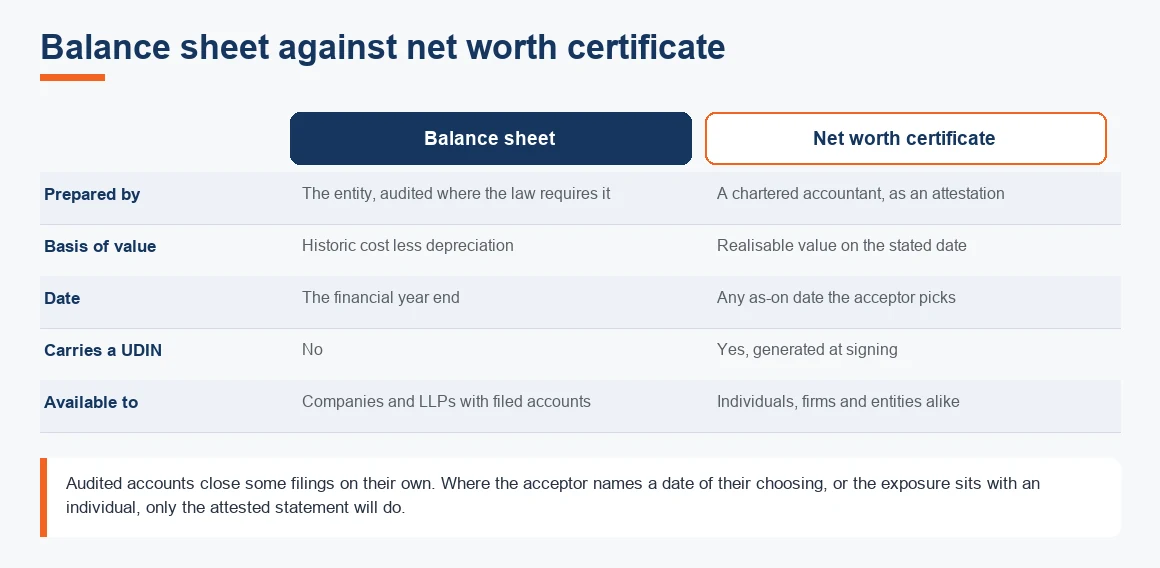
Authorship is the difference, and the rest follows from it. Management draws up accounts and signs them as its own representation of the entity. A chartered accountant examines a position and certifies it to a named reader. The balance sheet vs net worth certificate question is at bottom a question about who is answerable for the numbers.
Preparation and attestation are different professional acts. An auditor reporting on accounts expresses an opinion on statements somebody else prepared. A member certifying a position authors the conclusion rather than commenting on one, and the document carries an identifier tying it to that member and to no other.
Acceptors treat the two accordingly. Filed accounts are received as the entity's own reporting: useful, and self-interested by construction. A certificate is received as an independent professional's statement addressed to the reader holding it. That is why a lender already holding three years of audited figures still asks for the second document.
Line Items a Balance Sheet Carries That a Net Worth Statement Drops
Accounts carry balances that exist for reporting reasons rather than because anything is owned. Capitalised software, goodwill arising on an acquisition, and development costs carried forward all appear as assets under Schedule III to the Companies Act 2013. None of them can be sold separately or pledged to anybody. A statement of position either removes them or discloses them without attributing value to them.
Related-party balances behave in a similar way. A loan from a director to the company sits as a liability of the company and an asset of the director. Read at group level the two cancel each other; read at entity level they do not cancel at all. A personal position therefore has to pick one view and say which one it picked, because the same rupee is otherwise counted twice or lost entirely.
Then there is what accounts keep off the face of the statement altogether. Contingent liabilities, capital commitments and pending litigation are disclosed in the notes rather than deducted from anything. Section 2(40) of the statute governing Indian companies makes those notes part of the financial statement. A reader who stops at the two columns has read half the document, and formed a view on the wrong half.
Book Value Against Realisable Value: The Real Divide
Measurement is the divide that produces most of the argument. Books record what was paid, less the depreciation charged since. A flat bought in 2006 for a sum long since irrelevant sits in the accounts at that sum less two decades of depreciation, where it is depreciated at all. Nothing in that treatment is wrong, and nothing in it describes the present.
A certified position generally reports what the holdings would realise instead. That is a different measure and it moves in the opposite direction for land, buildings and long-held investments, which tend to appreciate while their carrying amount falls. The statement names which measure it adopted, and a reader who skips that line misreads the total by a wide margin.
Where the gap is widest the number changes character entirely. Property, an unquoted holding in a family company and jewellery can each differ from cost by a multiple. What a willing buyer would pay is an opinion supported by evidence, while cost is a fact supported by an invoice. Neither is the more honest of the two. They answer different questions, and only one of them tells a lender what its security is worth today.
Why an Audited Balance Sheet Still Gets Sent Back by Lenders
The commonest rejection has nothing to do with quality of work. Audited accounts are drawn to 31 March, and the lender wants the position as at a date it chose for itself, frequently the previous month end. No amount of audit rigour converts one of those dates into the other, and no note can be added to make it do so.
The second reason is the wrong reporting entity. A promoter offering a personal guarantee is being assessed personally, and the company's accounts describe the company. The shares in that company become one line in the promoter's schedule, sitting beside the flat, the deposits and the borrowings standing in the promoter's own name. Where earnings rather than holdings are being tested, how a filed return is read is the separate question.
The third is that filed accounts carry no attestation addressed to this reader. An audit report is addressed to the members of the company. A certificate is addressed to the bank, the mission or the authority that asked for it, and carries an identification number generated by the signing member for that one document. A verifier told to check an identifier cannot check one that was never issued in the first place.
From Audited Accounts to a Certified Figure: What Changes
Moving from accounts to a certified figure starts at the capital line. For a company that is the equity and reserves total. For a firm it is the partners' capital and current accounts. For a proprietor it is the capital account carried in the business books. Whichever it is, that number is the opening point and hardly ever the closing one.
Adjustments then run in both directions. Balances with no realisable value are taken out. Assets carried at cost are restated where the statement reports what they would fetch. Amounts due from related parties are examined rather than accepted. A receivable outstanding for several years is treated for what it has become, not for what it was recorded as.
Finally, items the books never carried are brought in. A proprietor's own flat, personal deposits, jewellery and a share in a jointly held property are outside the business books by definition. A personal position includes every one of them. What emerges is a dated list of holdings rather than a trading entity's accounts, and the two are not expected to reconcile line for line.
Which Entities Even Have a Balance Sheet to Start From
Not every applicant has accounts to start from, and the request usually assumes they do. Companies file their financial statements with the Registrar in Form AOC-4 within thirty days of the annual general meeting under section 137, so audited figures exist and are public. Limited liability partnerships file a Statement of Account and Solvency in Form 8 by 30 October each year under section 34 of the Limited Liability Partnership Act 2008.
Firms and proprietors sit in between the two. They keep books, and a partnership deed or a tax filing may produce something recognisable as accounts, but nothing is placed on a public file. An audit arises only on crossing a threshold. For an LLP that means turnover above 40 lakh or contribution above 25 lakh, a test written into rule 24(8) of the rules framed in 2009.
Salaried individuals keep no books at all, which is not a defect in them. Their position is put together straight from bank, registry and depository records. Where the question concerns a company rather than the person standing behind it, the arithmetic for an incorporated entity runs off a statutory definition and reaches a different number.
Verdict: When Your Audited Accounts Are Already Enough
There are requests that filed accounts close outright, and checking for them first saves a wasted exercise. Registrar filings, most statutory returns, income tax proceedings and many supplier registrations ask for the accounts as filed and want nothing beyond them. A tender asking for three years of audited figures to evidence turnover is asking for exactly that and no more.
The requests that accounts cannot satisfy share a recognisable shape. They name a date other than the financial year end. Or they name a person rather than an entity. Or they use the word certified with a profession printed next to it. Any one of those three makes an attested statement unavoidable, and arguing the point with the acceptor rarely succeeds.
Where it is unavoidable, the accounts are not wasted work. They are the starting material, and the shortest route runs from the audited figures, through the adjustments described above, to a position certified to the reader who asked the question. Nothing in the books has to be redone to get there.
This post supports Balance Sheet vs Net Worth Certificate, which sets out what Patron delivers and for whom.