
In this guide
The Short Answer on a CMA-Signed Net Worth Certificate
Can a CMA issue a net worth certificate? A cost accountant in practice can sign a statement of that kind, and no statute forbids it. The absence of a bar is not a right of acceptance. Most Indian banks, consulates and tender boards name a chartered accountant in the checklist itself, so a CMA signature is often returned before anyone reads the figure.
The signature holds where the recipient has written CA or CMA, which happens in a number of tender formats and departmental schedules. It holds nowhere that a rule prints the words chartered accountant on its own. That single line in the acceptor's paperwork decides the outcome far more often than either professional Act does.
If a CMA-signed statement is already in your hands, do not discard it. Ask the recipient in writing whether their format admits a cost accountant. Where it does not, the schedules, valuations and confirmations behind the figure usually survive intact, and only the attestation has to be redone.
What the Cost and Works Accountants Act Lets a CMA Certify
The Cost and Works Accountants Act 1959 defines a member in practice by the work offered. Section 2(2) covers the practice of cost and works accountancy, the costing or pricing of goods and services, and the preparation, verification or certification of cost accounting and related statements. The wording is deliberate, and it puts the cost ledger in a CMA's hands.
That mandate is substantial. Cost audit under section 148 of the Companies Act 2013 belongs to a cost accountant and not to a chartered accountant. The cost records kept under the Companies (Cost Records and Audit) Rules 2014 rest on the same authority. A CMA in practice signs the cost audit report in Form CRA-3 and certifies cost data filed in anti-dumping and subsidy proceedings. Price justification certificates for public sector buyers come from the same desk.
Where the Act stops is equally deliberate. Its certification clause reaches cost accounting statements, not financial ones. A net worth figure is drawn from a balance sheet, a title deed, a demat holding and a loan account, and none of those sits in a cost record. ICMAI has pressed for wider certification rights for years, with real success in places: GST law until 2021 accepted an annual reconciliation certified by either profession. Those gains came from naming the cost accountant in a specific statute, not from widening section 2(2) of its own Act.
Where the Chartered Accountants Act Gives CAs Exclusive Ground
Put the two definitions side by side and the split is one word. Section 2(2) of the Chartered Accountants Act 1949 covers the preparation, verification or certification of financial accounting and related statements. The cost accountants' Act says cost accounting and related statements. Financial against cost is the whole of the statutory boundary, and a net worth statement sits on the financial side of it.
Exclusivity does not come from that clause alone. It comes from the statutes that then name the profession. Section 515(3)(b) of the Income-tax Act 2025, in force since 1 April 2026, defines an accountant as a chartered accountant holding a valid certificate of practice. Prescribed income-tax certificates travel with a CA signature for that reason. Section 141 of the Companies Act 2013 restricts appointment as auditor to a chartered accountant. Section 4(2)(l)(D) of the Real Estate (Regulation and Development) Act 2016 names an engineer, an architect and a chartered accountant in practice, in that order.
Once the document is signed, the printed identifiers are what a verifier works with. The membership number is looked up on the institute's register, and the firm registration number places the practice. The signature is given either personally or for and on behalf of the firm. Practising status and what a signature commits the signer to are the two ideas that decide whether any of it carries weight.
What a Company Secretary Can and Cannot Certify
The third profession is defined by a different verb altogether. Section 2(2) of the Company Secretaries Act 1980 describes practice in terms of company law work: promotion, incorporation, amalgamation and winding up. It also covers services performed as an authorised representative in filing, registering, presenting, attesting or verifying a company's documents.
That covers a large body of certification. A company secretary in practice conducts the secretarial audit required by section 204 of the Companies Act 2013. The same member certifies the annual return of companies above the prescribed size, in Form MGT-8 under section 92(2). A long list of e-forms filed with the Registrar of Companies is pre-certified the same way.
None of that is a financial opinion. A CS certificate says that a filing has been made correctly, that a resolution was passed, that a register is in order. It does not say what an applicant is worth. Where a filing carries a compliance question and a money question at once, two certificates travel together and two people sign them. The division is functional rather than hierarchical.
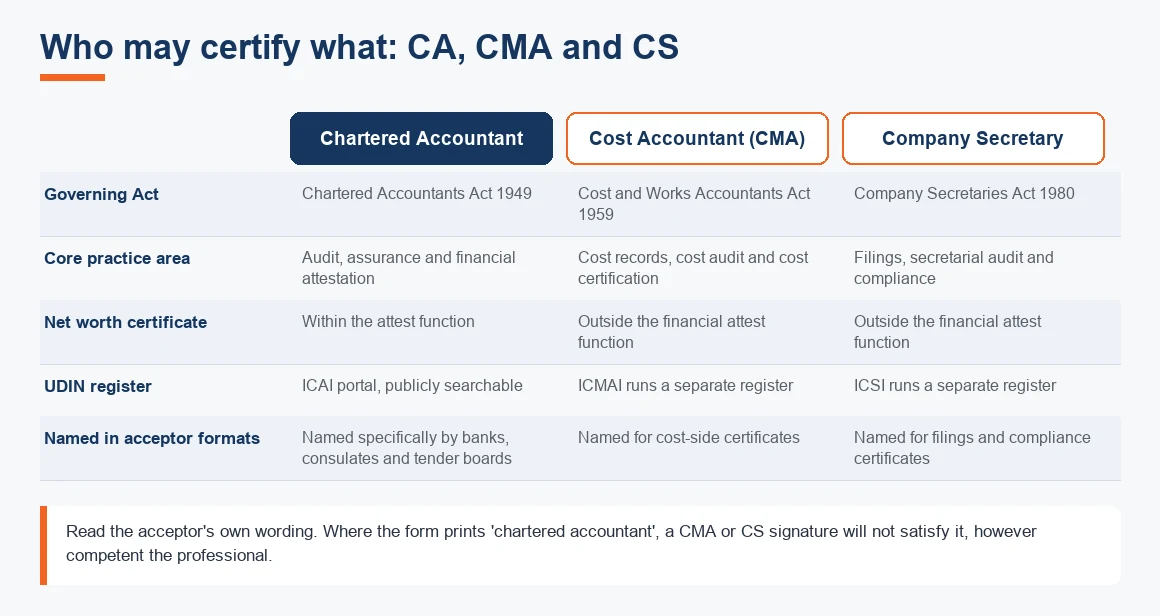
Which Acceptors Insist on a CA: Banks, Embassies and Tender Boards
Three groups settle this in practice, and each of them does it in a different register.
Banks decide by internal policy. A credit file checklist is the bank's own document, and a great many read net worth certificate from a chartered accountant without qualifying it further. That is contractual rather than statutory, and arguing the point once the file is with the credit team rarely helps. The Reserve Bank works the same way where it prescribes directly: an NBFC's net owned fund position is reported on the strength of the statutory auditor's certificate.
Consulates decide by document list. A visa checklist is published by the mission, and where it asks for professional attestation of funds it usually names a chartered accountant. Missions take no view on Indian professional statutes. They follow their own list, so a signature outside that list produces a returned document rather than a debate.
Tender boards and regulators decide by printed form, and this is the least negotiable of the three, because the profession is fixed in the format before you ever see it. RERA's withdrawal certification names a chartered accountant in practice in the Act itself. Where a format prints CA or CMA, a cost accountant signs it without difficulty, which is worth reading for before assuming either way.
UDIN Rules Differ Across ICAI, ICMAI and ICSI
All three institutes run a unique document identification number system, and all three run their own. ICAI phased its mandate in through 2019: certificates from 1 February, GST and tax audit reports from 1 April, and the remaining attest functions from 1 July. ICMAI made the number compulsory for audit, assurance, attest and review services from 1 October 2019. ICSI issued its UDIN Guidelines the same year, mandatory from 1 October 2019.
Three institutes, three registers, three portals. A chartered accountant's number is checked on the ICAI portal, a cost accountant's on the ICMAI portal and a company secretary's on the ICSI portal. None of the three queries the other two.
This is where a wrong signature is usually caught. A verifier at a bank or a mission has been told to check the number on the ICAI portal. A number generated by another institute returns nothing there and the file stops. The document may be genuine and correctly signed by a member of a statutory body. It fails anyway, because the check being run is not the check that certificate answers. Matching the printed details is the step that exposes this in seconds.
Verdict: When a CMA Certificate Is Enough and When It Is Not
One test settles the question, and it is not a reading of either Act. Look at what the acceptor has written down. Where the checklist, form or rule prints chartered accountant, a CMA signature will not get through on technical merit. Where it prints CA or CMA, or asks only for a certificate from a practising professional, a cost accountant is on solid ground.
There is a real set of documents where a CMA is not merely acceptable but correct. Cost audit reports, cost records certification, cost data for anti-dumping and subsidy proceedings, and price justification for public procurement all belong to a cost accountant. Sending those to a chartered accountant is the same mistake running the other way.
If the wrong document is already in hand, the fix is usually smaller than it looks. The schedules and confirmations behind it stay usable, and only the certification is redone. Working out which document the recipient actually asked for is the step that matters, and the directory of CA-signed certificates sorts them by the request rather than by the name. Where the question is what an asset is worth rather than what a position is, a valuer's report answers something else.
This post supports Can a CMA Issue a Net Worth Certificate? CA vs CMA vs CS, which sets out what Patron delivers and for whom.