
In this guide
Wealth Built Over Decades Rarely Matches One Year of Declared Income
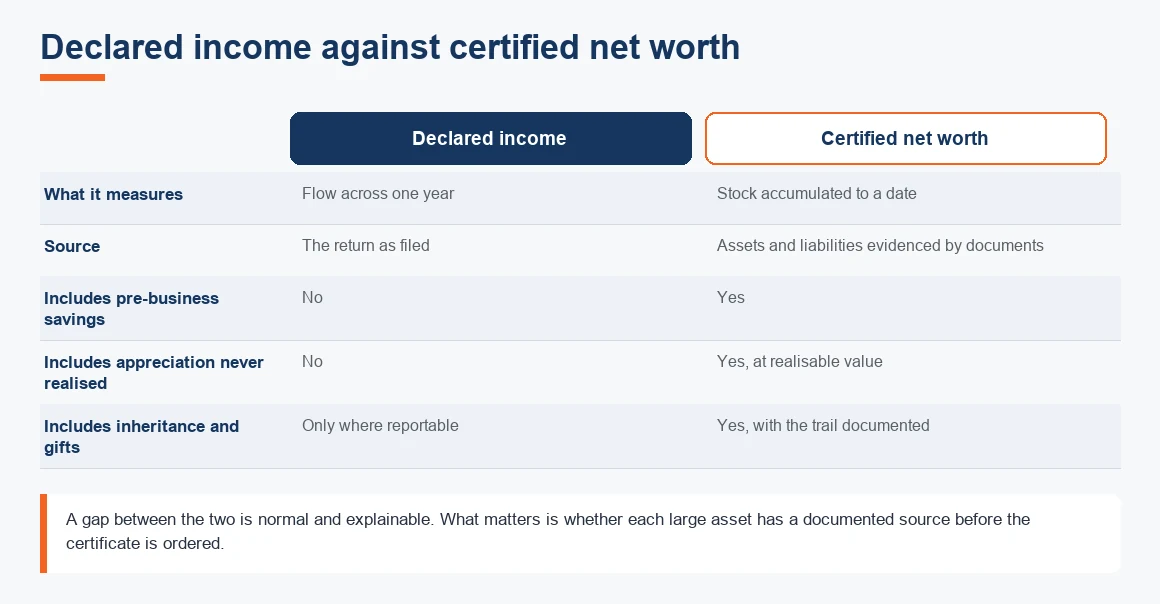
One is a measurement taken on a day and the other is a total for a year. Holdings are counted at a date; income is what came in over twelve months and reached a return. Framing it as net worth vs declared income makes the two look like rival accounts of one thing, which they were never built to be.
Acceptors compare them anyway, and for a defensible reason. A lender or a mission is usually holding two papers, one of which is a return, and the return is the one carrying a government acknowledgement. A schedule showing holdings far beyond anything those returns would fund gets read as a question rather than as an answer.
The line worth drawing is not between large and small. It runs between a difference whose source can be named and evidenced, and a difference with no source offered at all. The first is ordinary, and it is disposed of in a paragraph. The second is what the deeming provisions of the tax law reach, and no wording on a certificate makes it go away.
Legitimate Reasons the Two Numbers Diverge
Most of the distance is built before the shutters ever go up. Fifteen years of salary. A provident fund settled on leaving. The proceeds of an earlier business sold on, or a share of family property received on partition. All of that sits in the schedule and none of it appears in this year's return. A return describes the year it covers. It says nothing whatever about the twenty years before it.
Growth in value is the second source, and a return is blind to it by design. A plot bought in 1996 has multiplied without a single taxable event, because the charge falls when the asset moves. Section 67 of the Income-tax Act 2025 taxes gains in the tax year the transfer takes place, exactly as section 45 of the 1961 Act did. Until that day the growth is real, unrealised and unreported.
Exempt receipts do the same work more quietly. Agricultural income is exempt under section 11 of the 2025 Act read with Schedule II, and was exempt under section 10(1) of the 1961 Act. Interest credited to a public provident fund account behaves the same way. Each of these builds holdings year after year without ever entering a taxable total, so a schedule can outrun a decade of returns without anything irregular having happened.
Inheritance, Gifts and Spousal Assets in the Trail
Inheritance is the largest single source of a difference that looks unexplained, and it is also the easiest to document badly. India has charged no duty on estates where the death occurred on or after 16 March 1985. The Estate Duty Act 1953 ceased to apply from that date, so nothing was ever filed that would create a record. Property received under a will or on succession also sits outside the charge on gifts, which means no return shows it either.
Where there is no will, the trail is assembled rather than produced. A legal heir certificate or a succession certificate comes first, with the death certificate and the mutation entry in the revenue record behind it. Where the heirs have divided things among themselves, a family settlement deed carries that. Municipal tax receipts running in the new name for several years often do more than any of them, because they show a position acted on rather than merely asserted.
Gifts turn on who gave, not on how much. Section 92 of the Income-tax Act 2025, carrying forward section 56(2)(x) of the 1961 Act, charges money or property received without consideration above fifty thousand. A gift from a relative falls outside that charge whatever its size. A gift deed, the donor's identity and means, and a banking channel are what make the claim readable to somebody who was not there. Where a spouse funded something, section 99 of the 2025 Act clubs the income arising from it with the transferor. The item is shown for what it is rather than rearranged.
Preparing a Short Reconciliation Note for the Acceptor
Put the note on a single page and give it one shape. Open with a position at an earlier date the acceptor can already verify, usually an assets schedule filed with a past return. List what has been added since, one line per source, each line naming what it was. Close with the total the certified schedule carries. If those lines add up to the difference, the note has done its job and nobody needs to ask a second question.
Not every line needs a document behind it, but some always do. Inheritance, gifts, anything a spouse funded, the proceeds of something sold, and any borrowing taken to acquire an asset. Credits and high-value transactions are reported to the department anyway, through what it can already see and the record of tax deducted. Those belong in the note, reflected rather than explained around.
Consistency with the return is the entire purpose of writing one. Where turnover crosses one crore, an audit is required under section 63 of the 2025 Act, with the report on Form 26. That threshold rises to ten crore where cash receipts and cash payments are each within five per cent of the total. Audited figures exist in those cases and the note has to agree with them. Which paper each acceptor asks for is a separate question from whether the two agree once both are on the table.
When the Gap Invites Scrutiny Under Sections 68 and 69
These provisions are worth naming precisely, because they get cited loosely more often than not. Sections 68 and 69 of the Income-tax Act 1961 deal with unexplained credits and unexplained investments, and they govern tax years beginning before 1 April 2026. From that date the Income-tax Act 2025 holds the same ground, as section 103 on unexplained investment. Section 102 covers credits, and sections 104 to 106 cover assets, expenditure and borrowings by hundi.
What gets asked is always the same three-part question. Who provided this, could they have provided it, and did the transaction happen the way it is described. Identity, capacity and genuineness are the three things an officer tests, and a confirmation letter answers only the first. Bank trails, the other party's own return and the timing of the credit are what answer the remaining two.
Failing that test is expensive, which is a reason to build the trail carefully rather than a reason to avoid the subject. Section 115BBE of the 1961 Act charged such income at sixty per cent, with no deduction and no set-off allowed. Section 195 of the 2025 Act keeps that treatment, but the Finance Act 2026 cut the rate to thirty per cent from tax year 2026-27. Surcharge and cess are added, and the separate penalty was folded into section 439(11). None of it is triggered by having a schedule certified. A certificate records a position on a date and names the evidence behind it. It settles nothing about the tax character of anything, and it discloses nothing the schedules did not already contain.
Fix the Books Before You Order Any Certificate
Order of work decides how this goes. Clean the ledger, assemble the trail, write the note, and have the schedule certified last. Running it the other way round produces a document a reviewer can question and a set of answers put together afterwards under pressure. Cleaning the ledger first is the longer half of the job and the half worth starting early.
Some readers should stop before the certification step altogether. Where something material has no source that can be named, no certificate resolves that, and hunting for a differently worded one is the wrong search. The position is fixed either by getting the source documented or by accepting that the item cannot be presented. Both of those are decisions to take with a professional, before any document is drawn.
Where the trail does hold, the difference stops being a problem and becomes a paragraph. Holdings accumulated across decades, evidenced source by source, are an ordinary thing to certify and are certified every day. Getting the position attested is then a matter of presenting what is already documented, in the order somebody else can follow.
This post supports Proprietor Net Worth vs Declared Income, which sets out what Patron delivers and for whom.