
In this guide
Your Capital Account Balance Is the Starting Figure, Not the Final One
Start at the capital account, then expect to leave it behind. It is a book figure, and a book figure describes only what has been through the books. A plot bought in 2004 was never entered. A fixed deposit held outside the concern never appeared either. Machinery written down to a token value is still cutting metal. None of those is right in a ledger.
Understatement is the usual direction, and three habits produce it at once. Fixed assets are carried at cost less depreciation rather than at what they would fetch. Stock is carried conservatively, often at whatever the last purchase invoice said. Anything held outside the trading name is simply absent, because it never had a reason to be posted anywhere.
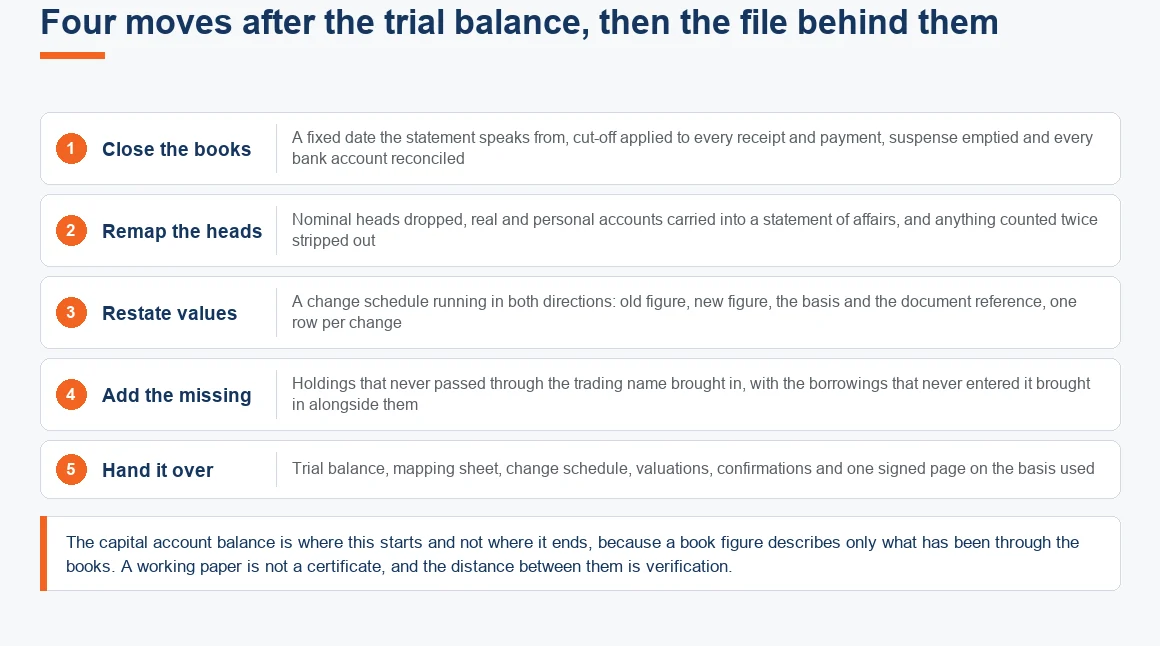
So a net worth statement for a proprietorship is built in four moves after the trial balance is drawn. Close the period cleanly, remap the heads, restate the values, then add what was never there. Why the two positions are one is settled elsewhere. This is what the work looks like once that is taken as read.
Closing the Books Before Anything Else
Nothing downstream survives a careless cut-off. Fix the date the statement will speak from, then decide for every receipt and payment whether it falls before or after that date. An invoice raised on the last day belongs in receivables even if the money lands a fortnight later. A cheque written that day and cleared the following week has already left the concern.
Suspense is the next thing to empty. Entries parked there because nobody knew where to post them have to become either something held or something owed, and the difference is the whole point. Unposted journals, unadjusted advances and stale debit balances in supplier accounts belong in the same sweep. A head that has not moved in four years is usually wrong rather than dormant.
Reconcile every bank account last, and treat that reconciliation as the first piece of proof rather than a formality. Cash and bank are the only figures an acceptor can test against a document somebody else issued. If the reconciliation will not close, the schedule is not ready, whatever the rest of it looks like.
Moving Trial Balance Lines Into Assets and Liabilities
A trial balance and a statement of affairs are not the same animal. The trial balance carries nominal heads, and nominal heads describe a period: sales, wages, rent, depreciation. Those drop out entirely. What carries forward are the real and personal accounts, which describe a position at a moment. Mapping is the act of deciding, head by head, which of the two a line actually is. Assets set against liabilities is the destination, and it is a much narrower document than a ledger.
Debtors, creditors and advances take the longest. An advance paid to a supplier is something held; an advance taken from a customer is something owed. In a small ledger both are frequently posted into the same group. Deposits lodged with landlords, utilities and government departments behave nothing like trade receivables yet are often filed among them. Statutory balances cut both ways: input tax credit not yet used is recoverable, while tax collected and not yet paid over is owed.
Then strip out whatever is counted twice. A party who both buys and supplies shows up as debtor and creditor, and only the net is real where a right of set-off exists with that same party. Cheques deposited but not yet credited sit in two places at once. Transfers between two of the concern's own bank accounts inflate both sides if only one leg was posted. Adding the columns as you go exposes an obvious duplication faster than reading the list again.
Adjusting Book Values to Realisable Values
Everything so far has been rearrangement. This step changes what the numbers mean. A ledger measures at historical cost less depreciation, because that is what a tax computation and a year-on-year comparison need. This schedule measures at what an item would realise. For a long-running concern the movement is usually upward, and occasionally very far upward.
A shop bought in 1998 and depreciated ever since sits in the books at a fraction of the market. A machine written down to one rupee is still running and still saleable. Land carries no depreciation at all and stands at whatever was paid for it decades ago. Every one of those needs a fresh figure and a reason behind it. That reason is a registered valuer's report, a circle rate or ready reckoner extract, or a dealer's written quotation for used plant.
The movement is not always upward, and a schedule that only ever revises in one direction reads as advocacy. Goods unsold through two seasons, a balance owed by a customer who has stopped trading, a deposit with a party nobody can now trace: those come down or come out. Whichever way a line moves, record the old figure, the new figure, the basis and the document reference, one row per change. That schedule is what a reviewer opens first.
Bringing In Assets That Never Entered the Books
Now add what the ledger had no reason to hold. A flat in the owner's name, a plot received from a parent, term deposits. A public provident fund balance, insurance policies with a surrender value, mutual fund units. Shares lying in a demat account, and a provident fund balance from an earlier salaried job. None of it passed through the trading name, so none of it is in the trial balance.
Physical holdings need a firmer trail than the rest. Gold and jewellery are stated on a valuer's certificate, with purchase invoices where they exist and a note on how the holding arose where they do not. Vehicles are stated on the registration certificate together with a dealer's valuation. The paper each holding needs varies by class, and gathering it before the schedule is drawn saves drawing the schedule twice.
Anything that cannot be evidenced at all is better left out than argued for. One unsupported line invites a reviewer to doubt the supported ones around it. Borrowings travel the same route in reverse: a housing loan, an outstanding card balance, a loan taken against a policy, a private borrowing from a relative. All of those are real and none of them is in the business ledger. Omitting one is the error a lender finds fastest.
Handing the Working Papers to Your CA
A clean working file is a short list of things. The trial balance at the date. The mapping sheet showing where each head went. The change schedule with a reference against every line. The valuation reports, bank confirmations and ownership documents those references point to. A single page on the basis used, dated and signed by whoever prepared it.
Expect the first questions to land in the same places every time. Cash in hand that looks large against the concern's turnover. Balances with relatives and with connected concerns. Something held with no title document behind it. A borrowing with no confirmation from the lender. Records generally exist to answer these. Rule 46(9) of the Income-tax Rules 2026 requires books to be retained for seven tax years from the end of the relevant tax year.
What a practitioner then does with the file is governed by ICAI's guidance on special purpose certificates. That guidance requires the criteria used and the evidence obtained to be identified before anything is signed. A working paper is not a certificate, and the distance between them is verification. Where the working file is attested is the step after this one, and a file assembled this way leaves less of it to send back.
This post supports From Proprietorship Books to a Net Worth Statement, which sets out what Patron delivers and for whom.