
In this guide
An ITR Reports a Year's Income; a Certificate Reports a Day's Wealth
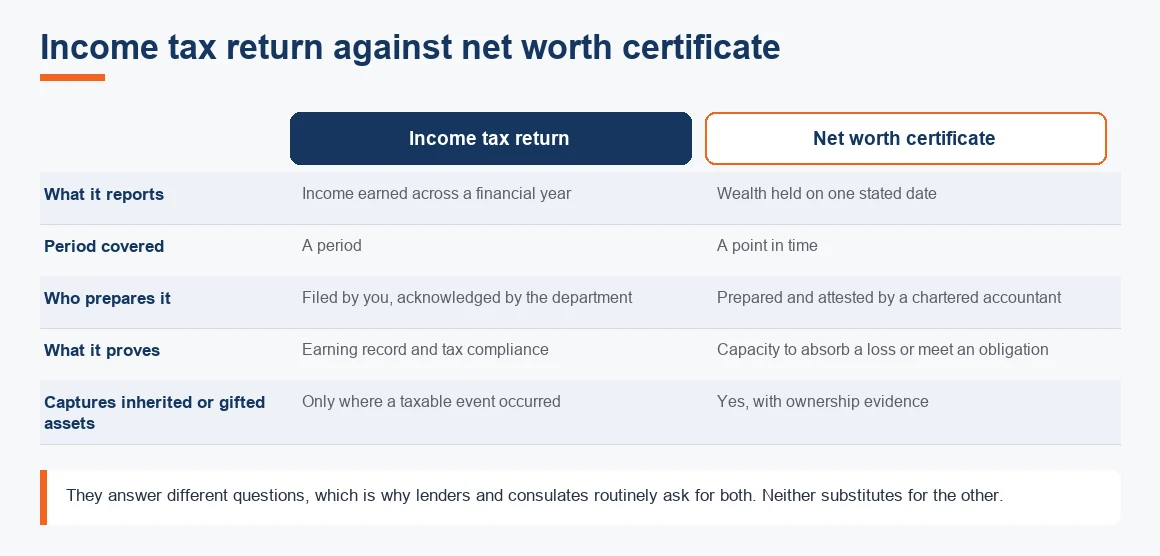
One document covers twelve months; the other covers a single day. That is the whole of the net worth certificate vs ITR question, and almost every downstream confusion grows out of forgetting it. A return reports what was earned and taxed between 1 April and 31 March. An attested statement reports what was held and owed on a date somebody chose.
Authorship differs as sharply as period does. A return is filed by the taxpayer, on the taxpayer's own computation, and the department accepts it for processing without thereby agreeing with it. An attested statement is signed by a chartered accountant who examined the underlying records and reached a conclusion about them.
Each is evidence of something the other cannot show. A return evidences a flow and the tax paid on that flow. An attested statement evidences a stock and the claims standing against it. Asking which of the two is stronger is like asking whether a speedometer beats an odometer.
Why Your Salary Is Not Your Net Worth
Salary is a rate; what a person is worth is an accumulation. Somebody earning well in a metro, paying rent, school fees and tax, and saving little, has a large first number and a small second one. The two are not versions of each other, and no multiple converts one into the other reliably.
The reverse case is far more common than it looks from a payslip. A schoolteacher who inherited farmland in 1998 may certify a figure no household salary would suggest. Assets acquired before any earning history began, or received rather than bought, sit entirely outside the income record and always have.
There is a link between the two, and it runs slowly. Earnings not consumed become savings, savings become assets, and assets accumulate over decades into a position. A person can raise the first number sharply inside a year and move the second hardly at all. That is why a lender reads several years of income beside a current position, instead of treating either as a proxy for the other.
Why Acceptors Often Demand Both Documents Together
Two different questions are being asked, and each document answers one of them. Capacity to repay is a question about future cash, and past earnings are the only observable guide to it. Capacity to absorb loss is a question about what still exists when the cash stops. A file carrying one answer and not the other is incomplete on its face.
The second reason is cross-checking, which costs the reader nothing. Somebody holding both can test one against the other without asking the applicant a single question. Interest declared in the return ought to correspond to the deposits in the schedule, and the department's record of tax deducted shows which payer released it. A property whose sale was reported in the return ought to have left the asset list. Where the two agree, confidence in both rises together.
Certain files are sent back for the missing half almost automatically. Loan applications above a lender's threshold, guarantor documentation, tender pre-qualification and several visa categories each name both documents in the checklist itself. An applicant who reads that checklist as a menu finds out otherwise at the first review, and the file restarts rather than continues.
What an ITR Proves That a Certificate Cannot
A return does several things an attested statement cannot, and the first is history. Six consecutive returns show a trajectory: whether earnings are rising, whether they collapsed in one year, whether a business recovered afterwards. A single-date statement carries no direction in it at all.
The second is the compliance record. A filed return is a declaration made to the state, linked to a permanent account number, carrying the tax deducted and paid against it. It places the applicant inside a system that a reader can query. The law makes that filing obligatory above prescribed thresholds, so its absence is itself information about the applicant.
The third is projectability. A lender setting an instalment needs a monthly figure it can defend, and it takes that figure from declared earnings rather than from holdings. This is one reason a salaried applicant with a clean filing record and no property is often lent to, while a landowner with no returns is not. Where filed accounts fit in is a related question for anyone running a business.
What a Certificate Captures That Your ITR Misses
Assets that never passed through a return are the obvious gap. Property inherited under a will, gold received at a marriage, a transfer from a parent: none of these is income. The income tax charge does not reach them at all. Receipts from defined relatives, receipts on the occasion of marriage and receipts under a will each sit outside it.
Appreciation is the second gap, and it is the larger one. Land bought in 1994 and still held has produced no taxable event, because the charge on capital gains arises on transfer rather than on growth. Thirty years of value therefore exists in the owner's position and appears nowhere across thirty years of filings.
Liabilities are the third. A return says almost nothing about what is owed, since borrowing is not income and repayment is not deductible for most individuals. An attested statement nets them in one place. That is the only place a reader sees the housing loan, the car loan and the card balance subtracted from what is held. Reading the two side by side without that subtraction overstates the applicant every time.
Reconciling a Large Gap Between Declared Income and Assets
A position much larger than declared earnings needs an explanation sitting ready in the file, not assembled at the counter. The explanation is documentary and taken item by item: which asset, acquired when, funded from what. Property registrations, securities transactions and large deposits already appear in what the department can see anyway, so the dating exercise is better done against that record than from memory. Most gaps close the moment the acquisitions are dated, because they were funded across many years rather than out of one.
Transfers inside a family are where records run thinnest. A gift needs a deed, or at the very least a written record and a banking trail. An inheritance needs the will, the succession certificate or the mutation entry. A spouse's contribution to a jointly registered property needs the payment trail from the contributing account. Each of these is entirely ordinary, and each is disbelieved when undocumented. What counts as documentation is settled by the evidence a reader accepts, not by what a family understands among itself.
The income tax law deals separately with what cannot be explained. An unexplained investment, and unexplained money or jewellery, are treated as income of the year in which they are found. Income taxed on that footing carries a flat charge in place of ordinary slab treatment, set at thirty per cent since 1 April 2026. Where a gap is genuinely large, a short written reconciliation attached to the statement is better than leaving a reader to guess at it.
Verdict: When Your ITR Alone Will Do the Job
Plenty of applications close on returns alone, and obtaining a second document adds nothing to them. Rental agreements, most card applications, salaried personal loans inside a bank's pre-approved limits and many student visa categories test earnings and nothing else. Where the checklist names only returns, only returns are needed, and a certified statement in the envelope will not improve the outcome.
The wording that signals otherwise is specific and easy to spot. A demand for net worth certified by a chartered accountant is one. A request for a statement of assets and liabilities duly attested is another. So is a printed threshold expressed as a figure. Each of the three means the return will not close the file. So does any requirement addressed to standing rather than to earnings. The income tax portal's own return pages set out which form applies, and say nothing about the second document, which is the point.
Where both are wanted, they are built from different material and neither is redone for the other. Returns are already filed and cost nothing to produce again. The statement is assembled from bank, registry and depository records as at a chosen date, and the attested statement of position is issued against that evidence.
This post supports Net Worth Certificate vs ITR, which sets out what Patron delivers and for whom.