
In this guide
A Proprietorship Has No Separate Legal Identity, So the Two Merge
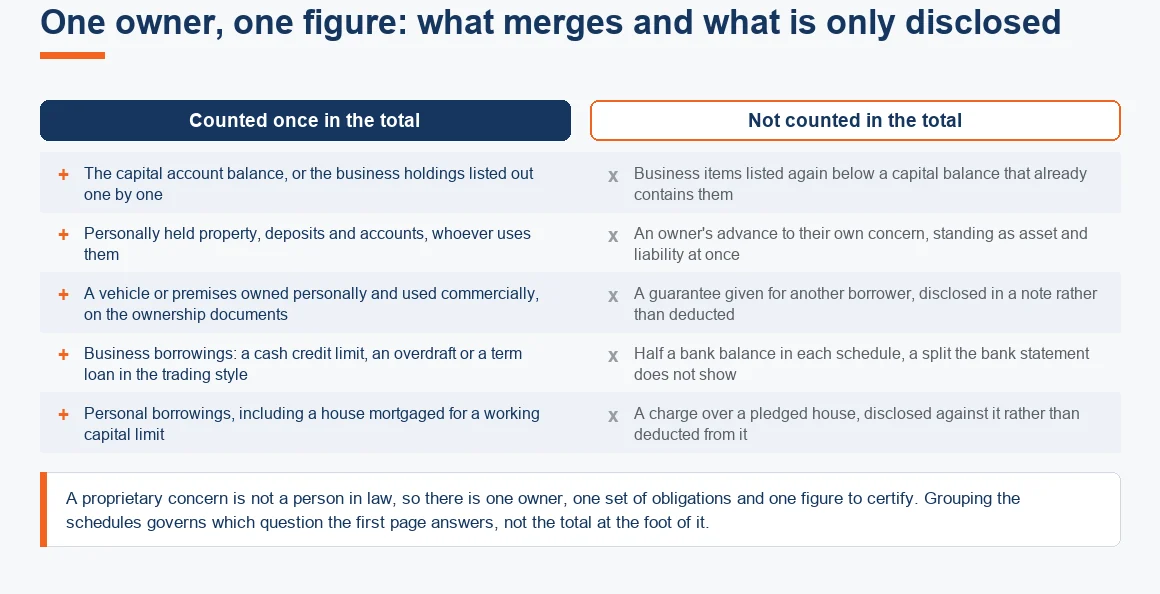
Both. Owners search this as proprietor net worth, personal or business, as though one of the two had to be chosen. A proprietary concern is not a person in law, so there is one owner, one set of obligations and one figure to certify.
The Supreme Court put that plainly in Ashok Transport Agency against Awadhesh Kumar in 1998. A proprietary concern is only the business name under which the proprietor carries on business, so a suit runs against the individual rather than against the trade name. Nothing about the trading style changes who owns and who owes.
Everything downstream follows from that holding. The statement is issued against the individual's permanent account number, because the concern has none of its own. Section 25(6) of the Central Goods and Services Tax Act 2017 makes the same point for indirect tax. Registration is granted on a permanent account number, and a proprietor's is a personal one. The face of the statement names the individual first and the trading style second.
Pulling Business Capital Into the Personal Statement
The concern enters the personal statement through the capital account. That balance is what the ledger says the owner's own funds inside the business amount to, once everything it owes has been set against everything it holds. A single line can carry the whole of it.
The alternative is to list the business holdings individually: plant, stock, receivables, the current account balance, the deposit lodged with the electricity board. Each then sits in the schedule beside the flat and the fixed deposit. Both routes arrive at the same total, because the same items are being counted either way. Which route is used depends on what the reader has asked to see, and on how much detail the file can carry without becoming unreadable.
The error to watch for is counting one thing twice. Where the business holdings are set out line by line, the capital balance comes out. Where the capital balance is carried instead, the stock and the machinery do not appear again below it. Money the owner has advanced to their own concern is the same trap in miniature, since it stands as an asset in one column and a liability in the other. Converting a ledger into schedules is where those removals are actually made, and assets set against liabilities is the shape the result takes.
Assets That Sit on Both Sides of the Line
Ownership and use answer different questions, and treating them as one question is what creates the grey zone. A car registered to the individual and driven on deliveries is owned personally and used commercially. Premises bought in the owner's name with the shop trading from the ground floor are the same case. Because one person holds both sides, neither classification moves the total. What it moves is how quickly a reviewer can follow the schedule.
A bank account runs on the same logic. The account belongs to whoever's name is on it, whatever passes through it, so the balance is stated once and in one place. Where takings have gone through a personal account for years, that balance is still a single balance on a single date. Dividing it notionally between two schedules invents a split the bank statement does not show, and a reviewer who asks for the statement will find the invention.
Evidence follows ownership rather than use. A vehicle needs its registration certificate, premises need the sale deed with a recent municipal tax receipt, and an account needs a balance confirmation on the bank's letterhead. Where something owned personally has been pledged for the concern, the sanction letter naming it belongs in the same file. That fact changes what the asset is free to answer for, which is a different matter from who owns it.
Business Loans That Follow You Personally
Liabilities cross the same line, and they never cross it in the borrower's favour. A cash credit limit, an overdraft or a term loan sanctioned to the trading style is sanctioned to the person behind it. The sanction letter usually says as much, naming the individual as proprietor of the concern. Recovery is not confined to the shop and its contents.
Security is where the two sides visibly meet. A house owned long before the concern existed is mortgaged for a working capital limit. That is most often done by depositing the title deeds with the lender, under the Transfer of Property Act 1882. The house stays in the schedule at its value and the charge over it is disclosed. Dropping the property because it is pledged understates the position; suppressing the charge overstates what is free.
Guarantees are the quiet item. Where the owner has stood surety for another borrower, the Indian Contract Act 1872 governs what that exposure is worth. Section 128 of the Act makes a surety's liability co-extensive with the principal debtor's, unless the contract provides otherwise. Nothing is due while the principal keeps paying, so the amount is disclosed in a note rather than deducted. Where a partner's exposure stops is a different question, because a firm does hold property in its own name.
Presenting Combined Figures Without Confusing the Acceptor
Presentation decides whether a merged figure reads clearly or reads as a muddle. The usual arrangement is two schedules under one certified total. Business holdings and business borrowings sit in the first, personal holdings and personal borrowings in the second, with a single net figure at the foot. The grouping adds nothing and removes nothing.
Notes carry the rest of the meaning. A short paragraph does more for a reviewer than another column of figures. It gives the date the position speaks from, the basis on which each class has been measured, and the source of any valuation. A note recording that the concern has no existence apart from its owner answers the question a careful reader will otherwise raise. Contingent items belong in the same place, since they have no column of their own.
Lenders read the two blocks for different reasons. A working capital assessment turns on the business block, because that is what the limit is drawn against, and the credit officer looks there for stock, receivables and existing charges. The personal block answers what stands behind the borrower if the concern stops paying. Setting them out separately lets each of those be answered without a reader having to unpick one total to get at either.
When Splitting the Two Actually Helps Your Case
There are files where the split is not a presentational nicety but the thing being asked for. Tender formats often print a fixed pro forma calling for the net worth of the bidder, and the bidder named in that document is the concern. A pre-qualification schedule pairing that figure with three years of turnover is asking about the business. Answering it with a merged total invites a query rather than settling one.
The reverse case is more common than proprietors expect. A concern two years old, trading modestly, standing behind an owner who has held property for two decades, looks thin on its own numbers and sound on the merged ones. Opening with the business block there answers the question badly.
Neither arrangement changes the legal position, and no ordering of schedules fences business debt away from personal holdings. What the choice governs is which question the first page answers. Settling that before anything is signed avoids reissuing afterwards, and how a signed statement is issued follows from the presentation rather than the other way about.
This post supports Proprietor Net Worth, which sets out what Patron delivers and for whom.