
In this guide
Unlimited Liability Blurs the Line, but the Two Certificates Stay Separate
Unlimited liability makes the two figures feel like one number. A creditor of a general firm can reach a partner's personal property, so it is tempting to present the business and its owners as one combined position. The documents do not work that way. Each names one subject, states one as-on date, and carries schedules belonging to that subject alone.
The source of the confusion is a single provision. Section 25 of the Act makes every partner liable jointly with the other partners, and also severally, for all acts of the firm done while a partner. Liability is shared in that sense. Ownership of assets is not shared, and a statement of position records ownership rather than exposure.
Which of the two is wanted is settled by the request, not by the preference of whoever prepares it. A letter naming the business and quoting its permanent account number wants the business's position. A letter addressed to an individual wants that individual's. Where a letter names both, two documents are prepared and neither absorbs the other.
What Sits Inside a Partner's Personal Statement
A partner's own statement starts outside the business entirely. Immovable property held in the individual's name sits on it, and so do fixed deposits and savings balances. Listed and unlisted holdings in a demat account, provident fund and small savings, vehicles and jewellery follow. Each is evidenced in the individual's own name, and that name is the test for inclusion.
Personal borrowings come off the same statement. A home loan, an outstanding card balance, a personal loan, a loan against securities and money borrowed from family all reduce the individual's position. Borrowings are the half most often omitted, usually because the applicant has thought of the exercise as a list of what is owned. A schedule of assets with no trace of the debt financing them is not a position at all.
The interest in the business appears as one line rather than as a share of its assets. It is described as the balance standing to the individual's credit in the named business at the stated date. Property of the firm under section 14 stays on the firm's own statement, and property held in an individual's name stays on the individual's. The distinction is a question of title, and title is documentary.
How a Partner's Share in the Firm Is Carried Into It
The carrying figure is the account balance and nothing larger. Add what stands to the partner's credit in the capital account to what stands in the current account. Strike that total at the same date the personal statement uses, and carry the single amount across. How those balances are built is a firm-level exercise, and a personal statement takes its result rather than repeating it.
Two ratios are routinely confused at this point. The profit-sharing ratio decides how income is divided. The capital ratio records how much each partner has funded. They need not match, and in the absence of a contract to the contrary section 13(b) has partners sharing profits equally however unequal their capital. Applying a profit share to the business's own funds therefore produces a number belonging to nobody.
Where the deed says nothing about valuing a partner's interest, the account balance still holds. No partner can realise a share of the firm's assets while the business continues. Section 29 confirms that from the other direction. A person to whom a partner transfers an interest cannot require accounts or inspect the books while the business continues. That transferee takes only the transferring partner's share of profits. On dissolution the position changes, and section 48 then governs how accounts are settled.
Double-Counting Traps When Both Certificates Go In Together
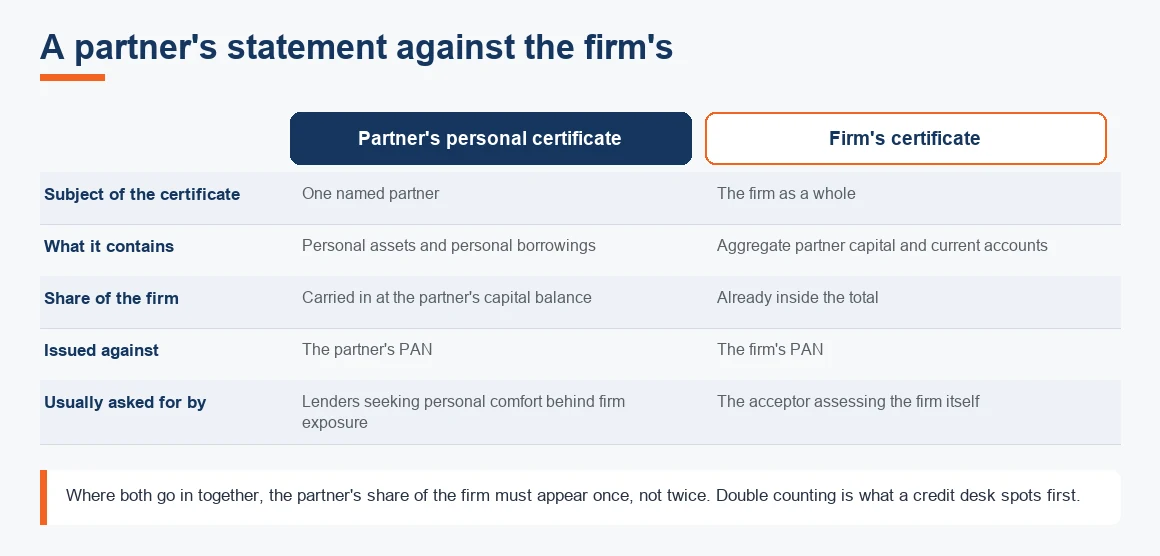
Two statements going into one file get read together, and duplication surfaces quickly. The first form of it is business property reappearing on an individual's schedule. A machine owned by the business, a vehicle in its name, stock and trade receivables all belong on the entity's statement. Repeating them on an individual's schedule inflates the combined file without adding anything real to it.
Partner loans are the subtler case. Money a partner has advanced beyond agreed capital is genuinely an asset of that partner and a liability of the business, so showing it on both statements is correct. It becomes duplication only where the same advance has already been swept into the partner's capital account in the books, and is then shown again as a receivable. Establishing whether the advance sits in the liability schedule or inside owners' funds settles the point.
A credit desk finds this by adding up. The carried interests on the partners' statements should total the business's own funds, adjusted only for any partner whose statement is not in the file. Where the sum of those carried figures exceeds what the business reports as owners' funds, something has been counted twice. The second check is a name-by-name comparison of the two asset schedules, which takes minutes and catches the obvious cases.
Why Lenders Ask a Partner to Stand Behind the Firm
If a partner is already answerable for the firm's debts, a guarantee looks redundant. It is not. Liability under the Partnership Act attaches through the firm, and the claim runs against the firm before it reaches anyone else. A guarantee creates a direct contractual claim against the individual that can be enforced on its own terms.
The Contract Act supplies the machinery for that. Section 126 of the 1872 Act defines a contract of guarantee as a contract to discharge the liability of a third person in case of default. The person giving it is the surety. Section 128 makes the surety's liability co-extensive with that of the principal debtor unless the contract provides otherwise. Standing behind another's debt is a separate undertaking, then, and not a restatement of partnership liability.
Who is asked varies with the facility. Working capital limits commonly bring personal guarantees from every partner, so every partner's position goes into the file. Smaller or fully secured facilities are often closed on the managing partner alone. Retirement complicates it, since a retiring partner stays liable to third parties for acts of the firm until public notice of the retirement is given. What a lender checks beforehand is set out separately.
Verdict: Which of the Two Your Acceptor Actually Wants
Framed as partner net worth vs firm net worth, this reads like a choice between two figures. It is really a question about a subject. Read the request for the name it uses, the permanent account number it quotes and the purpose it states. A facility to the business points one way, and a visa file, a court filing or a personal guarantee points the other.
Both are genuinely needed more often than readers expect. Any file where the business borrows and the partners guarantee needs both, and so does most diligence on a business with few assets of its own. Where both go in, the two documents have to agree on the carried balance, and any difference between them should be explainable in a sentence.
The two are issued from different places. A statement in an individual's name, whether or not that individual happens to be a partner, belongs with an individual's own position. A statement in the business's name, drawn from its books and covering its property alone, belongs with the firm-level route to certification.
This post supports Partner's Personal Net Worth vs Firm Net Worth, which sets out what Patron delivers and for whom.