
In this guide
Co-Applicant Worth Sets the Unsecured Ceiling and the Collateral Cut-Off
An eighteen-year-old holding an admission letter owns nothing a lender can assess. No filed return, no salary record, no asset that would survive a haircut. The application is therefore built on the co-applicant, and a net worth certificate for an education loan reports that person's position rather than the student's.
The certified figure decides two things at once. It sets how far a lender will go without asking for security, and it fixes the point at which security starts being asked for. Below that point the file runs on income and standing. Above it, a property or a deposit has to be pledged, inspected and valued before anything is disbursed.
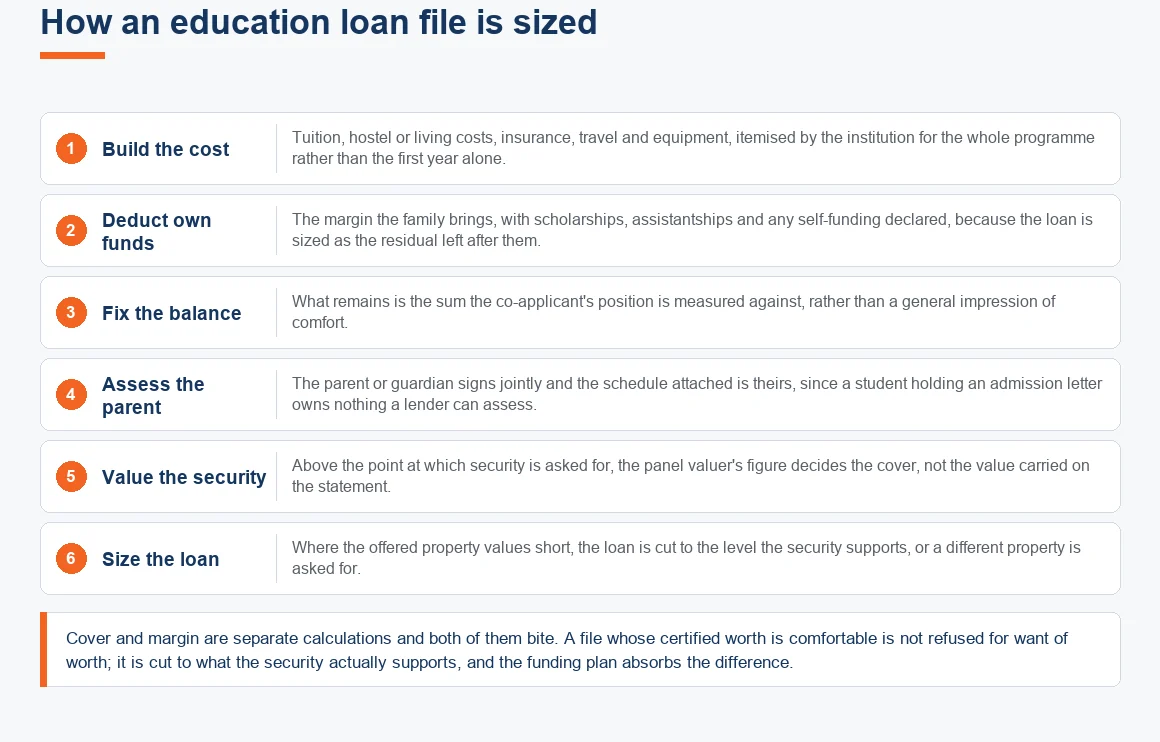
The sum being tested is known before the assessment starts. Tuition, hostel, insurance, travel and equipment produce a cost of study, the family's own contribution is deducted, and the balance is what the loan has to cover. The co-applicant's position is then measured against that balance rather than against a general impression of comfort.
Secured Against Unsecured Slabs at Indian Education Lenders
Indian education lending is banded, and the bands come from a scheme rather than from negotiation. Under the model scheme most public sector banks publish, a merit-quota loan up to seven and a half lakh rupees needs no collateral. It is covered instead by the Credit Guarantee Fund Scheme for Education Loans. Above that figure the same schemes ask for tangible security covering at least the full amount of the loan.
Margins move with the band as well. One bank's published scheme terms show no margin up to four lakh rupees, five per cent above that for study in India and fifteen per cent for study abroad. That margin is the family's own contribution to the cost of study. The certificate is what shows a lender the family can find it when each instalment falls due.
A central scheme now sits over the band structure. The central education loan scheme provides a credit guarantee of 75 per cent on loans up to seven and a half lakh rupees for students at listed institutions. It also carries interest subvention of 3 per cent during the moratorium on loans up to ten lakh rupees, where annual family income is up to eight lakh rupees. Schemes differ between lenders and are revised, so the circular that applies to a particular file is the one worth reading.
Parent as Co-Applicant: Whose Figures Count
Every education loan carries at least one co-applicant, and the model schemes require the loan to be granted jointly with the parent or guardian. The student signs as borrower. The parent signs as the person whose income and assets the lender is actually relying on, which is why the schedule attached to the file is the parent's.
Two parents can join the same file, and the effect is not simply additive. Incomes are added for servicing capacity. Assets are added only to the extent each holds a distinct share, because one flat between them remains one flat. Lenders that find the same property in both schedules at full value treat the file as overstated, and the correction is rarely limited to that one line.
Retired and non-earning co-applicants are the difficult case. A pension is income and is treated as such, but a pension that stops before the repayment does is a problem the asset base has to answer on its own. A co-applicant with substantial property and no income strengthens the security side and not the servicing side. The usual outcome is that a second co-applicant joins, rather than an argument being won with the first.
Collateral Valuation Weighed Against Certified Worth
Two documents describe the same property and they rarely agree. The certified statement carries the asset at a value supported from the evidence available to whoever prepared it. The lender's panel valuer inspects the property and produces a figure of its own, and that second figure is the one the security cover is calculated on.
The gap is usually structural rather than dishonest. A valuer works from comparable registered transactions and applies a view on marketability, while an owner works from what neighbours are asking. Agricultural land, property with an unclear title chain and a flat in a building without an occupancy certificate all fall further than owners expect them to. Tangible security offered is assessed on what it would realise, not on what it is felt to be worth.
Cover and margin are separate calculations and both of them bite. The security has to cover the sanctioned amount, and the family has to bring the margin as well. A file where the certified worth is comfortable but the offered property values short is not refused for want of worth. The loan is cut to the level the security supports, or a different property is asked for, and the funding plan has to absorb the difference.
Papers Education Lenders Add on Top
This file starts where an ordinary loan file ends. The admission letter or confirmed offer of a seat is the first document, because nothing is sanctioned against an intention to study. A cost-of-study estimate from the institution follows, itemising tuition, hostel or living costs, insurance, travel and equipment for the whole programme rather than for the first year alone.
The co-applicant's income evidence carries as much weight as the schedule does. Filed returns for the last two or three years, a salary certificate or audited accounts, and bank statements covering a full year are standard. A schedule describing substantial assets alongside returns describing a modest income invites the obvious question. It is far better answered inside the file than across a counter.
Declarations complete the set. Scholarships, assistantships and any self-funding the family intends to bring are declared, because the loan is sized as the residual left after them. The deferral through the course runs for the course period plus one year under the model scheme, so the repayment schedule a lender builds begins well after the final disbursement.
Strengthening a Weak File Before You Apply
A thin file has three honest repairs and no shortcuts. The first is a stronger co-applicant. Adding a second parent, or a close relative the scheme permits, changes both the income side and the asset side at once. It is the change lenders respond to most directly.
The second is evidence for assets the family already holds but cannot prove. Ancestral property with no mutation entry, a plot bought decades ago with the deed misplaced, gold with no purchase record. Each of them is worth nothing to a lender until it is documented. Certified copies from the registry, a mutation entry and a valuation report convert a claim into a line on a schedule.
The third repair is sequence. Getting the position certified before the application goes in, rather than after a query, keeps the file moving and keeps the as-on date current. How a credit team then reduces those figures is set out in the discounts a credit team applies. A relative asked to sign rather than to co-apply takes on the obligations described in a third person backing the loan. The wider set of documents a lending file can call for sits at certificates for a loan file.
This post supports How Net Worth Decides an Education Loan Application, which sets out what Patron delivers and for whom.