
In this guide
Lenders Expect a Guarantor's Worth to Cover the Exposure Being Backed
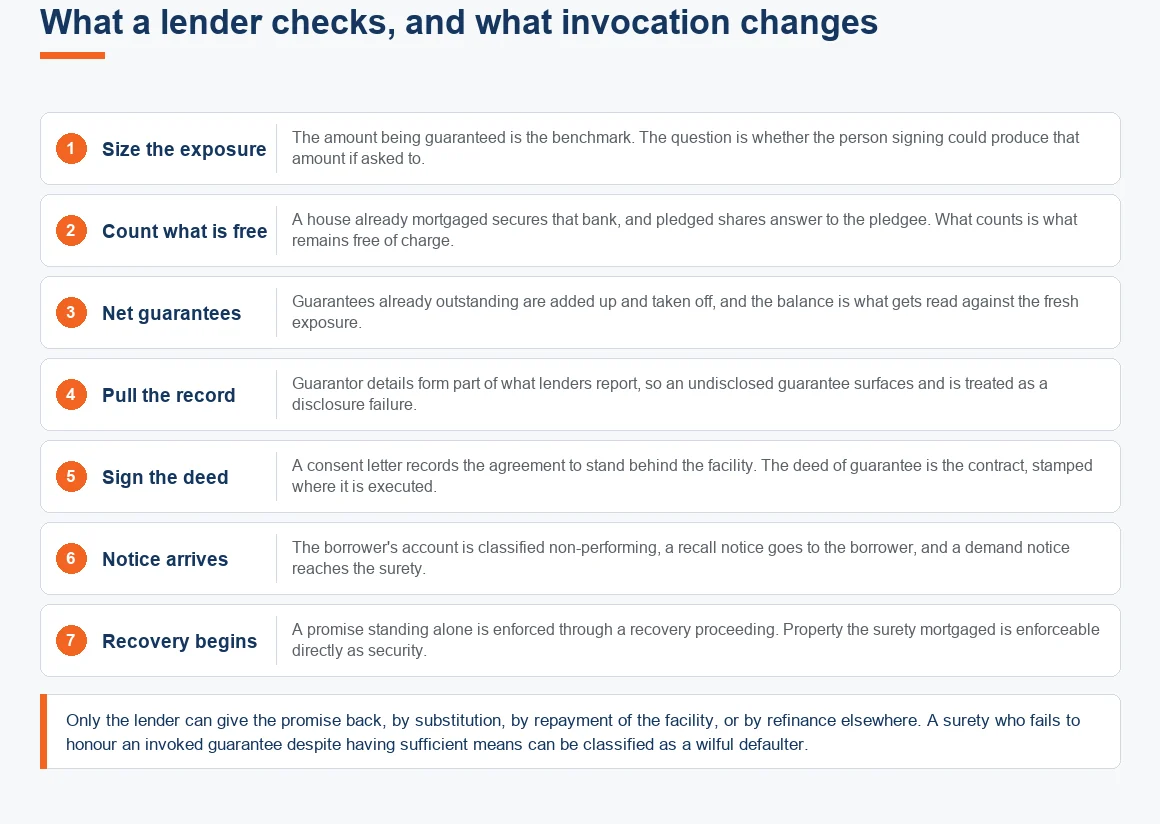
Standing as a guarantor is not a character reference. It is a promise to pay somebody else's debt, and a lender accepts the promise only if it could actually be honoured. The benchmark is therefore the exposure itself: the amount being guaranteed, and whether the person signing could produce that amount if asked to.
The measure is unencumbered worth rather than headline worth. A house already mortgaged to another bank is securing that bank. Shares pledged against a loan answer to the pledgee. What a lender counts is what remains free of charge and could realistically be realised, which is usually a good deal less than the total printed on the statement.
The borrower's own position does not substitute for it. A guarantee is asked for because the borrower's position was found insufficient, so repeating the same assets under a second name adds nothing to the file. Where one property appears in both schedules, it can support only one of them, and the credit note will record which.
Multiples and Thresholds Common Across Indian Lenders
The honest answer to how much is that no Indian statute fixes it. Neither the Contract Act nor any RBI direction prescribes a ratio between what a guarantor holds and the amount being guaranteed. What exists instead is credit policy, written by each lender, approved by its own board and not published anywhere a reader can check.
Expectations are expressed as a multiple of the exposure, and the multiple moves with the security. Where a facility is fully covered by the borrower's own assets, the guarantee is a comfort layer and a modest position may be accepted. Where nothing but the promise stands behind the money, the same lender wants substantially more. Anyone quoting one fixed multiple as an industry rule is describing a single lender's circular rather than a norm.
Secured and clean exposure are assessed differently, and this is where most confusion begins. A person supporting a facility already covered by a mortgage is being asked for a fallback. A person supporting an unsecured facility is the security. The sanction letter states what was actually required on that file, and it is the only document that does. Reading it before signing is the step most people skip.
Papers a Guarantor Submits Along With the Certificate
The guarantor net worth certificate travels with a file of its own. Identity proof, PAN, filed returns for two or three years and income evidence come first. Behind the schedule sit the title deeds, the demat and mutual fund statements, the deposit receipts and the loan account statements for whatever is owed.
Then come the papers that create the obligation. A consent letter records that the person agrees to stand behind the facility. The deed of guarantee is the contract itself, stamped under the stamp law of the state where it is executed. An understamped deed creates an evidentiary problem long before it creates a legal one. Specialised education finance companies and other non-bank lenders use the same bundle under their own names for it.
Where property is also offered, a third layer appears. The title chain, a search of the registry for existing charges, a valuation from a panel valuer, and then the document creating the charge. That last step converts the promise into security offered to the lender. The certificate itself carries the signing member's registration details and a unique document identification number, and the credit file records both alongside the schedule.
Existing Guarantees That Shrink Your Usable Worth
Guarantees already given are the item left off most often. Someone who signed for a brother's business loan four years ago, and has heard nothing since, does not think of it as a liability at all. To a lender assessing a second guarantee it is among the most relevant facts in the file.
The netting is arithmetic rather than judgement. The lender adds up the guarantees already outstanding, deducts them from unencumbered worth, and reads the balance against the fresh exposure. Commitments that sit outside the totals never enter the computation itself. That is precisely why a schedule which omits the note beneath it looks stronger than the position it describes.
Non-disclosure rarely survives the file. Submission to the credit bureaus happens on four reference dates in every month. Guarantor details form part of what goes in. A guarantee given to another lender therefore surfaces in the report a credit team pulls. A gap between the declared position and the bureau record is then treated as a disclosure failure rather than as an oversight. It colours how every other figure in the file is read.
Liability a Guarantor Signs Up For Under the Contract Act
Chapter VIII of the Indian Contract Act 1872 is short and unsentimental. Section 126 defines it. A contract of guarantee is one to perform the promise, or discharge the liability, of a third person should that person default. It names three parties: the person who gives the promise, the person in respect of whose default it is given, and the person it is given to. Section 128 then fixes the extent. A surety's liability is co-extensive with what the principal debtor owes, unless the contract says otherwise. Interest and charges travel with the principal amount.
The Act also gives the surety rights, which guarantors are rarely told about. On paying, section 140 invests the surety with every right the creditor had against the principal debtor. Section 141 entitles the surety to the benefit of each security the creditor held when the guarantee was given. If the creditor parts with such a security without consent, the surety is discharged to the extent of its value. Section 145 implies a promise by the borrower to repay the surety whatever was rightfully paid under the guarantee.
Several routes discharge a surety altogether. Section 133 does so where the creditor varies the terms of the contract with the borrower without the surety's consent, as regards later transactions. Section 134 does so where the creditor releases the principal debtor. Section 139 does so where the creditor's own act or omission impairs the surety's eventual remedy against the borrower. Section 137 makes clear that mere forbearance to sue the borrower is not one of those routes. Chapter VIII of the Contract Act sets each of them out with illustrations.
What Happens When a Lender Invokes Your Guarantee
Invocation begins with paper. The borrower's account is classified as non-performing, a recall notice goes to the borrower, and a demand notice reaches the guarantor carrying an amount and a date. The order in which a lender chooses to move through that sequence is its own. A guarantor's turn does not come last by right, and many people discover this only when the notice arrives.
What a lender can actually reach depends on what was signed. A guarantee standing alone is an unsecured promise, so enforcing it means a recovery proceeding. Applications for recovery of debts of twenty lakh rupees and above go to a Debt Recovery Tribunal, under the pecuniary limit notified in 2018. Smaller claims go before a civil court. Where the guarantor also mortgaged property, that property is enforceable directly as security. Assets never offered and never charged are reached only through a decree or a recovery certificate.
The bureau consequence arrives before the legal one does. An invoked guarantee that is not honoured is reported, and the guarantor's own borrowing capacity contracts immediately. It can go further than that. The 2025 wilful defaulter directions allow a guarantor who fails to honour an invoked guarantee, despite having sufficient means, to be classified as a wilful defaulter. That applies where the outstanding amount is twenty-five lakh rupees or more. The classification is disseminated to the credit bureaus and restricts fresh credit.
Stepping Down as a Guarantor Later
Exit is a matter of consent rather than of intention. The promise was given to the lender, and only the lender can give it back. Substitution is the usual route. Another person of comparable standing signs, that person's schedule is assessed in the normal way, and the original signatory is released on the same document that admits the replacement.
Two clean exits exist besides substitution. The facility is repaid and closed, and the promise falls away with the debt it was supporting. Or the borrower refinances elsewhere, the old facility is cleared out of the proceeds, and the obligation ends with the account. Section 131 of the Contract Act adds one more. The death of a surety operates as a revocation of a continuing guarantee for future transactions, absent a contract to the contrary.
Anyone whose exposure has changed should refresh the certified position instead of letting an old one stand. Guarantees released, facilities closed, fresh ones given: each of them changes the note beneath the computation and therefore the figure a reader is relying on. The same requirement turns up in a different setting when a parent backs a course of study, covered in a family backing a student's borrowing. Where the asset offered is held with somebody else, assets shared with a co-owner governs the share that can be carried. Facility by facility, certificates a lender's file needs lists which document is asked for.
This post supports Guarantor Net Worth Requirements, which sets out what Patron delivers and for whom.