
In this guide
Appraisers Convert Your Declared Worth Into a Tangible, Unencumbered Figure
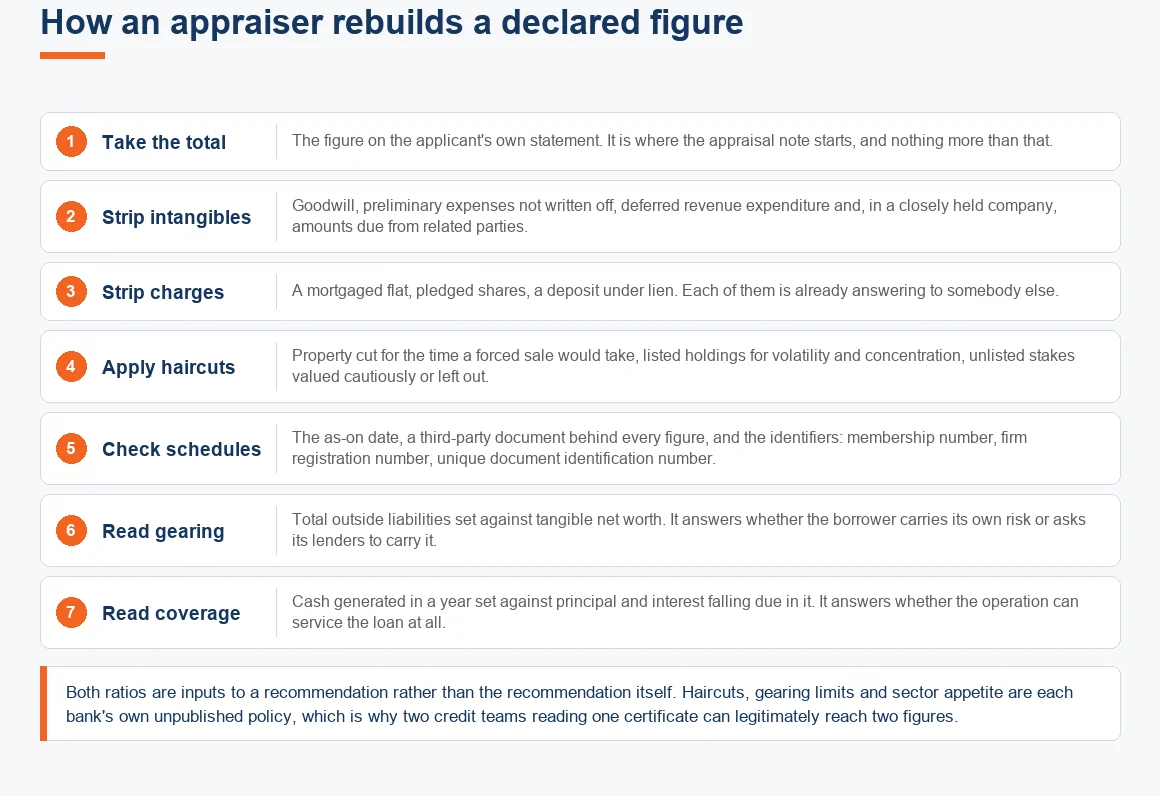
Two figures exist in every loan file. The first is the total on the applicant's statement. The second is what the credit team writes into the appraisal note once it has worked through that total. The short answer to how banks assess net worth is that they rebuild the figure rather than accept it. Only the rebuilt one reaches the sanctioning authority.
The working measure is tangible net worth. Intangibles are removed first: goodwill, preliminary expenses not written off, deferred revenue expenditure and, in a closely held company, amounts due from related parties. What survives is meant to be capital that exists independently of the borrower's own accounting choices.
Encumbered assets go next. A flat mortgaged to a housing lender, shares pledged against a loan taken on them, a deposit under lien for an existing facility: each is already answering to somebody. The distance between a declared position and a sanctioned one is mostly these two steps. Applicants who have never read an appraisal note find the size of it surprising.
Haircuts Applied to Property, Shares and Unlisted Holdings
Property carries the largest reduction because it is the slowest asset to turn into money. A panel valuer's figure replaces the owner's estimate at the outset. The valuer works from comparable registered transactions and the guideline value, and the credit team then applies its own cut for the time a forced sale would take. Title risk compounds that. An unclear chain of ownership, an unregistered agreement or pending litigation can push a property's contribution close to nothing. How much of the reduced figure can then be lent against is governed by the proportion advanced against security.
Listed shares and mutual fund units are discounted for volatility rather than for saleability. A holding valued on one date can be worth materially less on the date a lender needs it, so a reduction is applied to the closing value. Concentration matters as much as size does. A portfolio sitting almost entirely in one scrip is treated more cautiously than the same amount spread across twenty.
Unlisted and closely held interests are the hardest of the three. A stake in a private company has no quoted price, and the owner's valuation usually rests on a projection. Some credit teams take audited book value, some take a multiple of earnings, and some leave the holding out of the note altogether. A partner's capital account in a firm is handled the same way. Where the borrower's business and the asset are the same business, the holding provides no independent cushion at all.
What a Lender Actually Checks on the Certificate
Dates are checked before figures are. The as-on date is compared with the application date and with the closing date of the financial statements behind it. A statement drawn up as on 31 March and submitted in December carries nine months of unrecorded movement. The credit team then either asks for a current one or discounts what it has been given.
Schedules are where a file is won or lost. A total with no annexure is an assertion. A total supported by a property schedule with survey numbers, a demat holding statement, bank confirmations and a loan-wise liability list is evidence. Every figure should trace back to a document that a third party issued. Assets valued by the owner with nothing behind them are the first items struck out of the note.
The identifiers printed on the certificate are copied into the credit file. Membership number, firm registration number and the unique document identification number are recorded, with the date and place of signing. A certificate that reaches the credit team without them is sent back before anyone reads the arithmetic on it.
Net Worth Read Together With Credit History and Cash Flow
Two different questions are being asked at once. Repayment capacity asks whether income or operating cash flow can service the instalment month after month. Absorption capacity asks what stands behind the borrower if that income stops. Net worth answers the second question and says very little about the first, which is why a large asset base does not by itself produce a sanction.
The credit information report sits beside the schedule for a reason. It records conduct rather than capital: instalments paid late, an account settled rather than closed, a write-off, an overdue card. RBI's 2025 credit information reporting directions fix four reference dates in every month for submission. The record of past conduct that a credit team pulls is therefore seldom stale.
Income documents carry weight the schedule cannot borrow. Filed returns for the last three years, the annual tax statement, salary slips or audited accounts, and twelve months of bank statements make up the other half of the file. Where the certified position and the filed returns tell different stories, the returns generally prevail. They were filed under a statute; the certificate was prepared for this application. Reconciling the two before submission is far cheaper than explaining the gap afterwards.
How Gearing and Coverage Ratios Shape the Decision
Ratios turn a position into something comparable across borrowers. For a business, the gearing test sets total outside liabilities against tangible net worth, which is the figure the appraisal note has just rebuilt. A borrower whose outside liabilities are a small multiple of that figure is carrying its own risk. One whose liabilities are many times larger is asking its lenders to carry it. Where a particular bank draws that line is internal policy and moves with the sector.
Coverage works on cash instead of capital. Cash flow measured against instalments tests whether what a business generates in a year exceeds the principal and interest falling due in it. Term exposures are usually sized around that ratio. A ratio below one means the loan is being repaid out of something other than the operation, and the credit team will want that something named in the note.
This is the point at which a strong asset base stops helping. A borrower with substantial property and weak operating cash can service nothing without selling something, and no lender wants to be repaid by a sale it has to force. Both ratios are inputs to a recommendation rather than the recommendation itself. The sanctioning authority can move either way with the same numbers in front of it.
Why Two Banks Value the Same Applicant Differently
Credit policy is a bank's own document. Haircuts, gearing limits and sector appetite are set internally and are not published, so two credit teams reading one certificate can legitimately reach two figures. A bank that has lost money in a sector prices and sizes its exposure there more tightly for years afterwards.
Valuers explain much of the remainder. Banks work from a Board-approved valuation policy and a panel of independent valuers, as RBI requires for collateral valuation. Two panel members inspecting the same flat can still differ widely on comparables, on the floor, on the road width and on the age of the building. The applicant experiences a rejection. The file records a valuation.
A second application is not the same application. Gaps that produced queries the first time can be closed before the file goes in again. The missing schedule, the undisclosed charge, the asset shown at full value when only part of it is owned. A share in a jointly held asset and a third party standing behind it each change what the reader in front of the file actually sees. Applicants comparing what one lender wants against another usually start from the certificate a lender expects.
This post supports How Banks Assess Net Worth in Loan Applications, which sets out what Patron delivers and for whom.